In my family, rules were never written down. They were whispered like secrets too heavy for the dark.
Two incense sticks showed respect to the ancestors. Four honored the restless dead. Three—especially after midnight—was forbidden. Three was not an offering. It was an invitation.
When I was twelve, I reached for a third stick during the Qingming Festival. My grandmother’s frail hand shot out, clamping down on my wrist with frightening strength. Her breath smelled of stale tobacco and bitter tea.
“Put it back, Ah Boy,” she rasped. Her eyes darted toward the shadows behind the altar.
“Why, Popo?” I whispered, staring at the red incense stick in my trembling hand. “Aren’t three lucky?”
“Three is a doorway,” she murmured, her grip tightening until my fingers went numb. “Two incense sticks feed the ancestors. A third feeds what lingers in the gaps between them. Some doors do not close the way they open.”
“You mean ghosts?” I asked.
She looked at me, her expression chillingly hollow. “I mean things that remember you longer than you remember them.”
At the time, I assumed she was warning me about bad omens or vengeful spirits. Only later did I understand that memory itself could become a parasite, lying dormant until the slightest invitation allowed it to attach.
The Apartment Above the Shuttered Shop
My grandmother’s apartment sat directly above a long-closed herbal shop in Bukit Merah. Below, the iron shutters were rusted shut, sealing in the scent of decades-old rot.
Above, the apartment’s wooden windows had been nailed shut.
After her funeral, my mother refused to enter the building. “Sell it,” she insisted over the phone, her voice tight with panic. “Don’t go up there, Jun. That place isn’t right.”
“It’s just an old flat, Ma,” I lied. “I’ll stay a week, pack her things, and clear the altar.”
The truth was that I wanted isolation. I was tired of dodging questions about my ruined marriage and failed career.
When I unlocked the door, the heavy air hit me like a damp towel, thick with cloying camphor, dried roots, and something sour underneath. Dust hung motionless in the dim yellow light.
I set my bag down and walked into the living room.
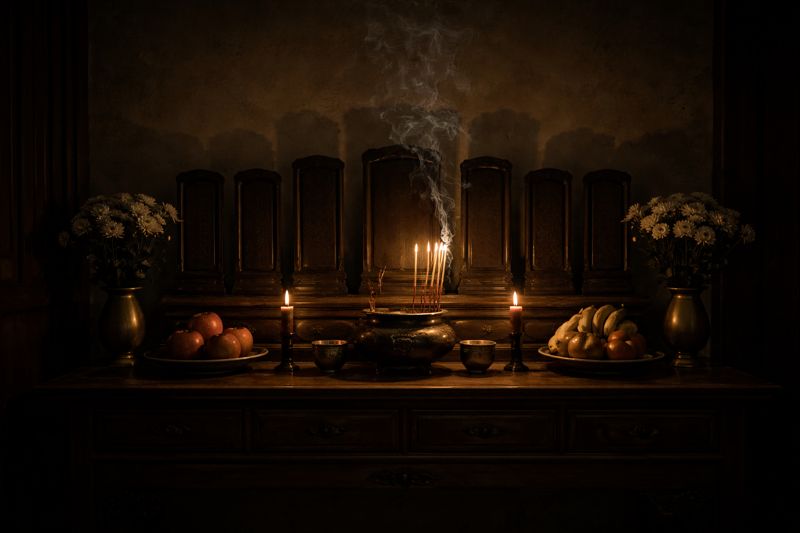
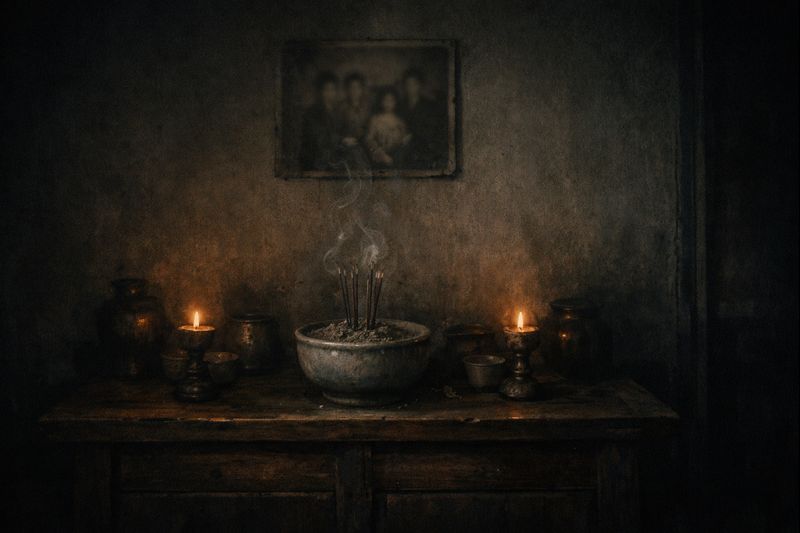
The ancestral altar waited against the center of the wall. A recent photograph of Popo rested in a small frame beside the large, yellowed central portrait, with a black ribbon draped across one corner.
Popo’s photographed smile felt unnaturally still, but the sharp eyes in the yellowed portrait beside hers seemed fixed on me.
The Earth Beneath the Ash
The altar was black from decades of soot. At its center sat a heavy porcelain burner, its ash packed into a hard grey crust like ground bone.
Behind the burner stood the large, yellowed portrait of a man in a stiff silk tunic. His posture was unnaturally rigid, his eyes so sharp they seemed to track me across the room.
“Who is he?” I had asked Popo years ago.
“Your great-grandfather,” Popo had snapped, her face darkening. “Do not stare into his eyes. He is still looking for something he lost.”
She never gave me his name.
That night, the apartment felt suffocatingly cold. My hands trembled as I opened the small drawer beneath the altar. Inside lay a bundle of red incense sticks tied with frayed yellow thread.
I knew the rule. Two for the ancestors. Four for the restless dead. Three was forbidden.
I just didn’t believe it. So I pulled out three.
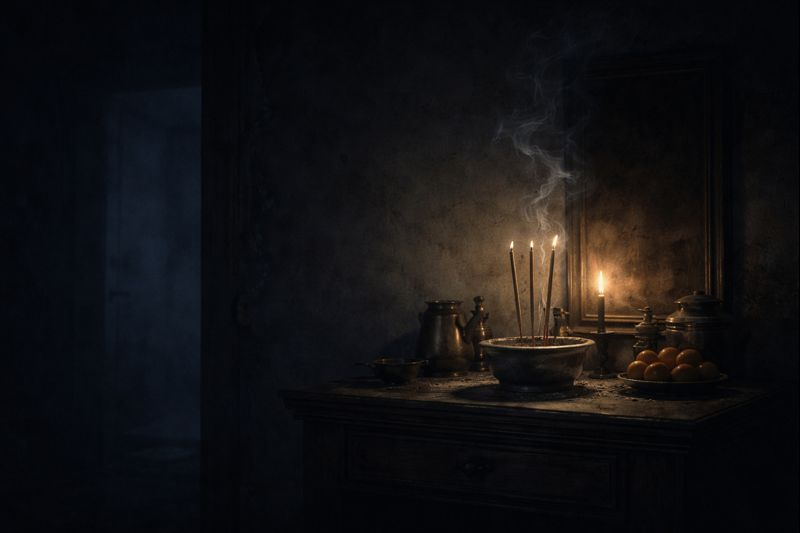
The moment I struck the match, its flame flared a deep crimson and caught all three incense tips. Thick grey smoke poured from them, sinking instead of rising.
I forced the three burning sticks into the packed ash. The smoke spilled over the rim of the burner like a slow waterfall, filling the room with the suffocating stench of wet soil, decaying leaves, and fresh grave dirt.
Clack.
From the dark corridor beyond the apartment door, heavy footsteps echoed.
What Shares the Shadow
Thump. Thump.
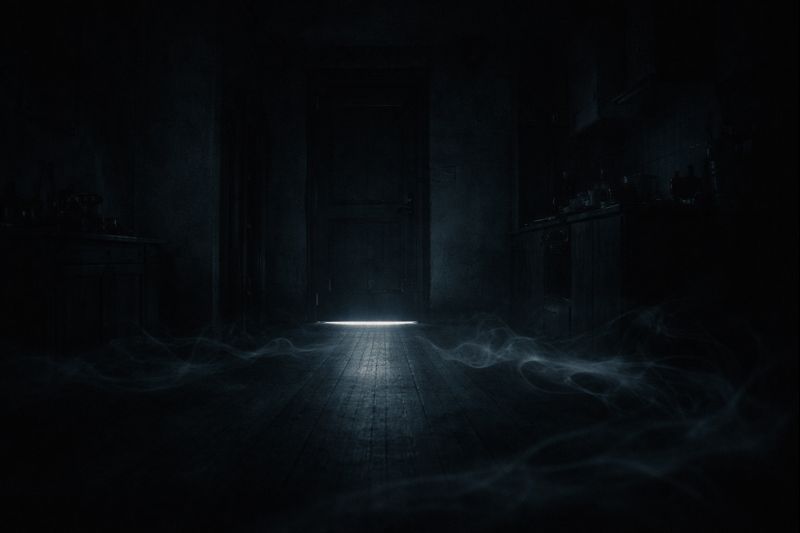
The footsteps were slow and unhurried. They moved along the narrow corridor and stopped directly outside my apartment door.
My blood ran cold. “Who’s there?” I called out, my voice cracking in the silence.
No one answered. The door handle turned slowly until the lock caught.
Then I felt the air shift behind me. The smell of grave dirt closed around me as a cold breath brushed the back of my ear.
Behind me came the soft drag of cloth shoes across the floorboards.
“You called me,” a rasping voice breathed from just behind me. It sounded like dry leaves scraping together. “You lit the third.”
I froze, paralyzed by primal terror. I couldn’t even turn my head.
Slowly, the dragging noise retreated toward the living room entrance and fell silent.
When I finally summoned the strength to look back at the altar, my lungs seized. The man in the large, yellowed portrait had changed. His head was no longer facing forward.
Within the faded portrait, his head had turned sideways, his painted eyes staring out of the frame and into the room where I stood.
The Corridor of Names
That night, sleep pulled me into a suffocating nightmare.
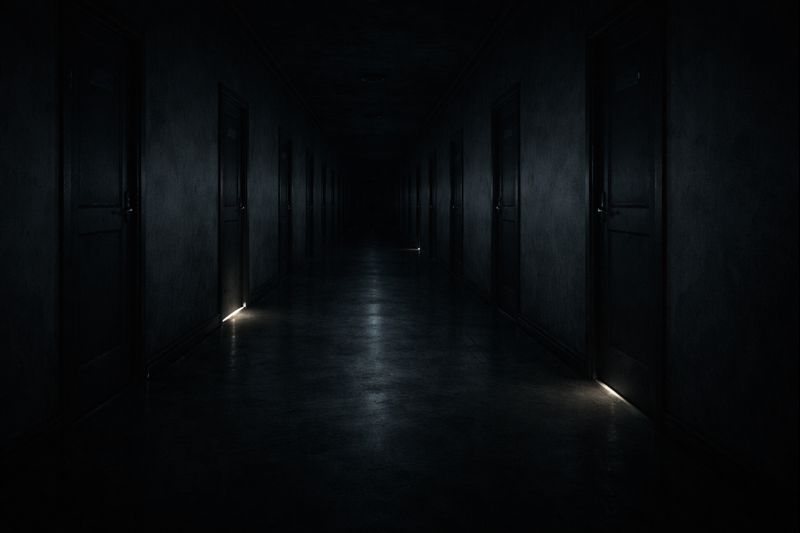
I knelt in an endless corridor, illuminated only by flickering oil lamps whose flames bent unnaturally though no wind stirred.
Rows of doors lined the hall, each bearing a name painted in black ink. Some names were bold and sharp; others were nearly faded into nothingness. Cold, putrid air bled out from beneath the doors.
Click.
The doors began to swing open simultaneously. Pale, gaunt hands reached out from the darkness beyond them, clawing at the air.
“Remember us… count us…” a thousand raspy whispers scraped against my ears.
At the end of the hall stood a towering door. Blank. No name. It creaked open—and absolute darkness rushed out to swallow me.
I gasped awake in the dark apartment, my throat raw.
I went into the living room and checked the altar. The incense had burned out completely, but the porcelain burner was overflowing with grey ash that spilled onto the wood like snow.
Panic seized me as I struggled to ground myself. I tried to recall my name.
Jun… Jun… What came after Jun?
My mind was completely blank. A terrifying void where my own identity used to be.
“Jun Wei,” I forced out, my voice trembling. The name felt like a foreign stone in my mouth.
I repeated it, forcing the name back into my mind.
Then, from the dark corner behind the altar, a dry, papery voice chuckled.
“You lit three, Jun Wei. Now the door is unlocked.”
What Slipped Away
After that, sleep was impossible. I sat trembling through the pale light of dawn until the sun rose, then fled down the stairs—and froze.
The heavy iron shutters of the herbal shop—rusted shut for as long as I could remember—were pulled wide open. Behind the counter stood a stooped old man, grinding dried roots in a stone mortar. The sharp scent of fresh ginseng and camphor filled the air.
“You burned the third stick,” he said without looking up.
“How do you know?” I asked, my voice barely a whisper.
He glanced at the grey ash clinging to my sleeve like dead skin.
“Two incense sticks are for the ancestors—the ones still remembered,” he rasped, his eyes milky with cataracts. “Three calls to those who were never properly counted. The forgotten. The ones whose names slipped out of living memory.”
Cold sweat slicked my back. “What do they want from me?”
“A home,” the old man murmured, grinding faster. “They want to be remembered. To do that, they must carve out space in your mind.”
I backed out of the shop and into the bustling street. When I turned back, the shutters were rusted tight again. Dead. Sealed.
Suddenly, my phone buzzed in my pocket. A text message from my mother.
“Are you done clearing up yet, Great-Grandfather?”
I stared at the screen, my heart hammering against my ribs as my own memory began to bleed away.
The Unwritten Ledger
That night, the air in the apartment hung heavy, reeking of fresh earth.
I stood before the altar. My mother’s text message burned in my mind. I was losing myself—my own name slipping through my fingers like ash.
“No,” I whispered into the dark room. “This is my life.”
I reached into the altar drawer and pulled out two sticks. I lit them together. Two sticks for an ancestor who had been forgotten.
The match flared. This time, pale smoke rose straight and true from both incense tips.
Kneeling, I pressed my forehead against the cold floorboards. “Whoever you were, whatever you lost,” I whispered through a trembling breath, “you cannot have me.”
Something drew my gaze beneath the altar, where an old ledger lay buried under dust. Its pages were brittle and yellowed. I opened it to the final page, where a single line remained blank. When I picked up a pen, an unnatural impulse seized my hand.
The pen moved on its own, scratching a name across the paper—one I had never heard before: Chen Wei-Ming.
Somehow, I knew it belonged to the man in the portrait.
“You are remembered,” I said, tears blurring my vision as I fought to hold on to what remained of myself. “You are named. But you are not me.”
CRACK.
A jagged fracture split the portrait down the center, cutting through the man’s painted face. The crushing weight in the air vanished.
The Echoes That Linger
Before sunrise, I packed my bags and left Bukit Merah without looking back at the herbal shop’s rusted shutters—or saying goodbye.
The apartment has been sold, but some doors, once opened, never truly close.
The horror didn’t end in that room. It just settled into the background of my life.
Sometimes, in the middle of a brightly lit office or a crowded train, the distinct stench of grave dirt and burning incense fills my lungs.
Last week, my father called me. He went silent for several seconds.
“Dad?” I asked, a chill passing through me. “Are you there?”
“Sorry, Ah Boy,” he muttered, sounding deeply confused. “For a second… I forgot who I was calling.”
Every night now, the dream returns. In it, I kneel in that endless corridor of oil lamps and named doors.
Most of the doors remain shut. The final blank door at the end of the hall is no longer one of them.
It stands wide open, waiting for me to forget who I am.
Related Stories
Some rituals do not summon strangers.
In one family, incense was lit for every ancestor except one — a deliberate silence that allowed protection to follow while a single name slowly disappeared from memory.
Ancestral Summoning: The Bloodline That Erased a Name
But not every forgotten rule belongs to a family altar.
High in the mountains, four children once rang a bell and spoke a name the elders never used — and the stone answered by borrowing their steps.