Two people finally sit down for a horror movie. One wants something that actually feels like horror. The other says, “Sure – just no jump scares.” A title appears. Too gory. Another. Too slow. Another. “I heard that one is really disturbing.” Ten minutes later, nobody has pressed play and the snacks are disappearing faster than the options.
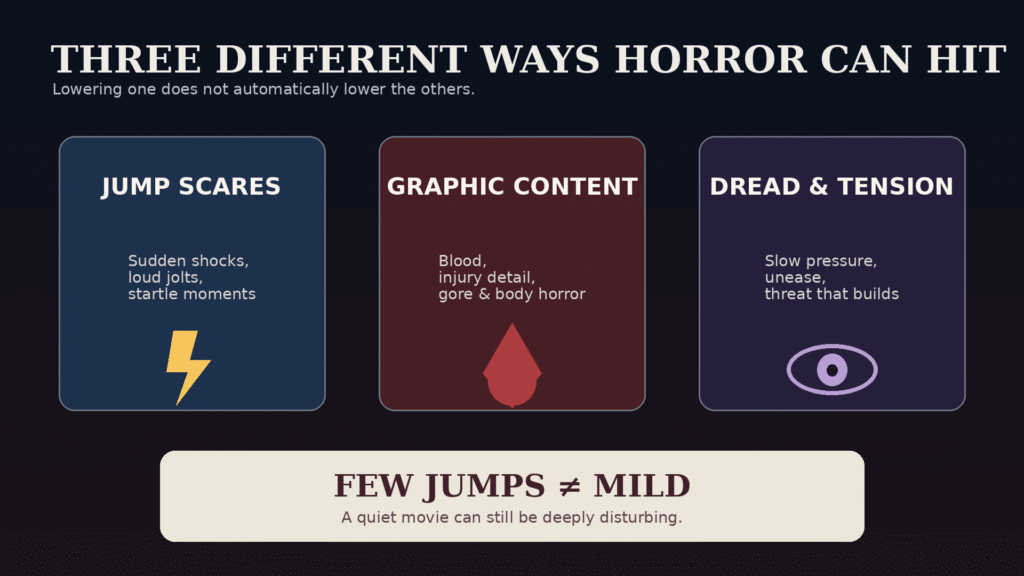
The problem is not that one of you likes horror and the other does not. Often, you simply have different scare tolerances—different kinds of fear bother each of you. One person can handle a room full of ghosts but hates sudden bangs. Someone else barely reacts to jump scares and wants nothing to do with body horror. “Not that scary” means something different to everyone.
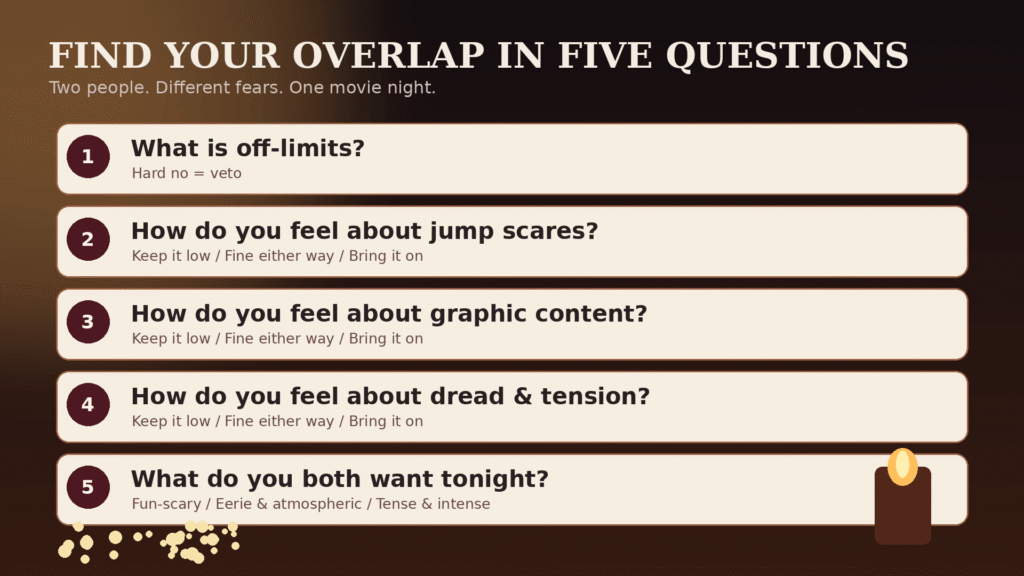
That is why the useful question is not, “How scary is this movie?” It is, “Which kinds of scary work for both of us?” Start with what either person will not watch, compare your tolerance for jumps, graphic content, and dread, then decide what kind of night you actually want. The goal is not to find the mildest movie. It is to find the overlap.
If you just want somewhere to start: for the classic mixed-tolerance problem – one person still wants something that feels like horror while the other wants the jumps and graphic content dialed down – The Others is the strongest default starting point here. It keeps the atmosphere and dread without leaning on constant jolts or gore. But it is not the answer for every pair: slow pacing, child/death-related material, or a shared appetite for bigger scares can point you somewhere else.
Find Your Overlap in Five Questions
You can do this in a couple of minutes. If “anything is fine” usually lasts until the first suggestion appears, answer separately first. For Questions 2 to 4, choose the strongest level both of you are genuinely comfortable with: Keep it low, Fine either way, or Bring it on.
1. What Is Off-Limits?
Start with anything that gets an automatic no from either person. That could be animal harm, sexual violence, harm to children, suicide, graphic body horror, or a very specific personal trigger. A hard no is a veto. It is not something to bargain away because the other person really likes the trailer.
Hard no = “We are not watching that.” Tolerance = “We would prefer less of that.”
That distinction keeps the rest of the method simple. Someone can prefer less blood without needing a completely bloodless movie. But if a certain kind of content will ruin the night, remove the film before you debate whether everything else looks perfect.
For granular checks, Does the Dog Die? can help, but it is crowdsourced. Where formal content advice exists, a classification board such as the BBFC is the better starting point.
2. How Do You Feel About Jump Scares?
Pick one: Keep it low, Fine either way, or Bring it on. If one of you enjoys sudden jolts and the other jumps when the microwave finishes, your shared answer is probably Keep it low. That does not make the movie mild. It only removes one fear mechanism from the menu.
If jumps are the main disagreement, Where’s The Jump? is useful for checking jump-scare patterns and timings. Treat it as a specialist guide, not an official certification.
3. How Do You Feel About Graphic Content?
Use the same scale: Keep it low, Fine either way, or Bring it on. Here we mean bloody violence, injury detail, gore, disturbing imagery, and body horror. “Keep it low” does not mean absolutely zero blood; if even brief material is off-limits, that belongs back in Question 1.
This is where easy-looking compromises can surprise you. A movie can be funny, playful, or light on jump scares and still get very bloody. Tone and graphic content are separate choices. Your stomach does not care how charming the dialogue was five minutes earlier.
4. How Do You Feel About Dread and Tension?
Again: Keep it low, Fine either way, or Bring it on. This is the fear that builds instead of popping out of a cupboard – prolonged threat, psychological unease, claustrophobic tension, or that slow feeling that something is wrong long before the movie tells you why.
This question fixes an easy horror misunderstanding: few jump scares does not mean easy viewing. A movie can barely jolt you and still make “something creepy, but not something I will think about at 3 a.m.” a very important distinction.
5. What Kind of Horror Night Do You Both Want?
Now put something positive back into the decision. Pick the mood you both actually want tonight: Fun-scary, Eerie & atmospheric, or Tense & intense.
The first four questions stop obvious mismatches. This one stops every compromise from becoming almost-horror. If both of you want tension, keep the tension. For a playful night, choose playful. If you want old houses, whispers, and the uneasy feeling that somebody should really stop opening doors, go atmospheric.
The rule: remove hard nos, choose the strongest fear level both of you accept, then aim for the kind of horror you both still want.
Find Your Movie Zone
Once you compare the five answers, the choice usually gets much easier. These are not six movies ranked from least scary to most scary. They are six different answers to six different disagreements. Start with The Others if your conflict is the classic mixed-tolerance one; move to another route when your shared profile changes.
| Zone | Works when… | Example | Check first |
| Best default starting point | Low jumps + low graphic burden; serious atmosphere still wanted | The Others | Child threat; death/suicide/infanticide references; slow pace |
| Tense, not gore-heavy | Strong tension wanted; startles acceptable; graphic content restrained | A Quiet Place | Frequent startles; child peril/death; childbirth distress |
| Jump-friendly supernatural | Both enjoy startles and want a classic supernatural scare ride | The Conjuring | High jump load; possession/religious material; child threat |
| Fun-scary | Both want horror with a lighter, more playful target | Happy Death Day | Jump moments; repeated murder; sexual/drug material |
| Low-jump, heavy dread | Jumps kept low; disturbing slow dread is acceptable | The Witch | Child/animal harm; disturbing imagery; slow burn |
| Less jump-driven, more graphic | Big jump shocks less important; stronger violence and psychological tension acceptable | Get Out | Gore; surgery imagery; abduction/hypnosis; major social themes |
Default Starting Point: The Others
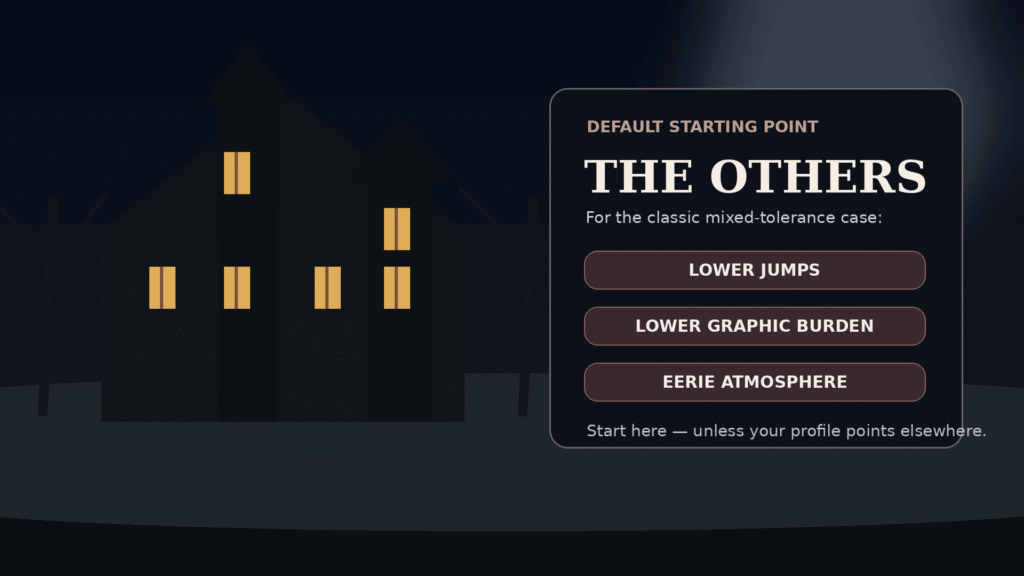
One of you wants a proper ghost story. The other has already ruled out the kind of movie that spends two hours slamming doors, blasting the soundtrack, and putting something horrible behind every shoulder. This is the situation where The Others becomes the most useful place to start.
Jumps: Keep it low | Graphic: Keep it low | Dread: Fine either way / Bring it on | Tonight: Eerie & atmospheric
Its advantage is not that it removes horror. The fear comes more from supernatural atmosphere, uncertainty, and psychological tension than from a heavy jump-scare or gore burden. That gives the horror fan something recognizably dark and unsettling while asking less of the viewer who mainly dislikes sudden shocks and graphic imagery. For that familiar “I want horror, just not those parts” disagreement, the balance is unusually useful.
Before pressing play, clear the deal-breakers. The BBFC content advice for The Others flags threat involving children and references to death, suicide, and infanticide. If sudden shocks are your main concern, Where’s The Jump? gives you a specialist check on the jump-scare side. And if either person hates a slower pace, this default quickly stops being useful.
Choose another route if both of you actually want more jumps, want something faster or funnier, or are comfortable trading the restrained graphic profile for stronger intensity. “Default” here means start here, not stop thinking.
Affiliate disclosure: As an Amazon Associate I earn from qualifying purchases. Using these affiliate links does not add any extra cost to your purchase.
Choose A Quiet Place When You Want More Tension, Not More Gore
Maybe the sensitive viewer is not asking for a gentle night at all. They just do not want gore doing the heavy lifting. If both of you are comfortable with startles and want the tension turned up, A Quiet Place becomes the stronger fit than The Others.
Jumps: Fine either way / Bring it on | Graphic: Keep it low | Dread: Bring it on | Tonight: Tense & intense
The useful trade is simple: less emphasis on graphic violence does not mean less intensity. The film leans on sustained threat, silence, sudden sound, and the pressure of staying quiet while danger is close. That works for a pair who still wants to feel properly nervous without choosing something gore-forward.
Clear the non-negotiables first: the BBFC flags sustained threat, children being menaced, injury detail, and a childbirth sequence. If child death is a hard no, check a granular warning source such as Does the Dog Die? before watching. Then check the startle side – Where’s The Jump? identifies frequent jump moments. If either part is a hard no, this route is out.
If this is your match and you want a physical copy, the current A Quiet Place 4K + Blu-ray + DVD edition is on amazon.com.
Choose The Conjuring When Jump Scares Are Part of the Fun
Sometimes the framework does not need to remove jump scares because both people actually like them. If the two of you are the kind of viewers who enjoy the sofa-cushion reflex, The Conjuring makes more sense than politely sanding all the jolts off movie night.
Jumps: Bring it on | Graphic: Keep it low / Fine either way | Dread: Bring it on | Tonight: Tense & intense
This is the classic supernatural scare-ride route: hauntings, possession, mounting threat, and a much stronger startle presence than the default winner. Gore is not the main attraction, so it can work when both people want conventional haunted-house horror but do not want graphic violence to dominate.
The other caveats matter just as much. The BBFC flags strong horror, possession/religious material, child threat, suicide references, and some bloody images. For anyone who likes to know how jolt-heavy the ride is, Where’s The Jump? places The Conjuring firmly on the higher-startle side. If that sounds exciting to both of you rather than exhausting to one of you, that is exactly why this route exists.
Choose Happy Death Day When Tonight Should Be Fun-Scary
Some nights, neither person wants two hours of spiritual despair. You still want horror, but you would also like to finish the movie without feeling as if the room itself needs therapy. That is the role Happy Death Day can fill.
Jumps: Fine either way | Graphic: Keep it low / Fine either way | Dread: Keep it low / Fine either way | Tonight: Fun-scary
Its repeated-murder setup sits inside a darkly comic, more playful horror frame. That makes it a useful override when The Others feels too serious and both of you would rather have horror energy than a heavy atmosphere. The important word is fun, though, not harmless.
The playful tone does not erase the content underneath it. Universal rates the film PG-13 for violence/terror, crude sexual content, language, some drug material, and partial nudity. If jumps are a hard no too, Where’s The Jump? is worth checking before you commit. Fun-scary still has to clear both people’s limits.
Shaun of the Dead is a useful contrast, not a seventh equal recommendation. It can hit the same fun-scary target, but the BBFC describes strong bloody horror. Same desired mood, very different graphic tolerance. Two people can agree on “fun” and still need different movies.
Choose The Witch When Jump Scares Are the Problem – Not Disturbing Horror
Here is where “I just hate jump scares” can become dangerously incomplete information. If the jumps are the only thing you want reduced, The Witch shows why that does not automatically lead to an easy movie night.
Jumps: Keep it low | Graphic: Fine either way | Dread: Bring it on | Tonight: Eerie & atmospheric / Tense & intense
This route is for a pair that accepts slow-building dread, disturbing themes, and a deliberately heavy atmosphere, but does not want a movie powered by repeated jolts. In other words: fewer jumps, yes. Mild, absolutely not.
This is the moment to resist the lazy shortcut of searching only for “low jump scares.” Where’s The Jump? lists only a small number of minor jump moments, but the BBFC describes strong threat, violence, and disturbing imagery involving children and animals. Add the slow pacing, and the picture is clear: choose The Witch because both of you want dread, not because one of you simply hates jumps.
Choose Get Out When You Want Fewer Big Jumps but Can Handle More Graphic Material
The opposite mismatch also happens. One person dislikes big sudden shocks, but neither viewer needs the violence kept especially restrained. In that case, Get Out can occupy a very different zone from The Others: less dependent on major jump scares, more comfortable with graphic violence, and driven by story, unease, and escalating threat.
Jumps: Fine either way | Graphic: Fine either way / Bring it on | Dread: Bring it on | Tonight: Tense & intense
The lesson is useful even if you choose another film: less jump-driven does not mean gentle. A viewer who says “I hate jump scares” may be perfectly happy here; a viewer who really means “I cannot handle disturbing violence or surgical imagery” may not be.
Get Out needs the same kind of careful reading. The BBFC content advice for Get Out flags strong violence and gore, including surgical imagery, along with abduction and hypnosis. Where’s The Jump? also records startle moments, which is why “less jump-driven” is the useful description – not “jump-free.” And its racial and social themes are central to the film, not just another box on a warning list.
Use the Method on Any Movie You Already Have
You do not need to use any of the six movies above. In fact, the best result may already be sitting in your watchlist, on a disc you own, in a library catalogue, or inside a subscription you have already paid for.
Start with hard nos. If a movie contains something either person will not watch, remove it. No amount of “but everyone says it is amazing” makes a veto disappear.
Then check the three fear mechanisms. If jumps are the disagreement, look at Where’s The Jump? If graphic material or a specific content concern is the issue, use formal classification advice where available and Does the Dog Die? as a more granular crowdsourced supplement. For dread and tension, a couple of reputable reviews can tell you more than a fake universal scare number ever will.
Finally, compare what survives with tonight’s target. A movie can pass every tolerance check and still be wrong because one of you wants a playful slasher and the other wants candlelit gothic misery. Compatibility is not just the absence of objections. You need at least one shared reason to press play.
And if the right movie is already available to you, use it. Borrow it. Stream it on a service you already have. Pull the disc off the shelf. The method does not become more accurate because money changed hands.
If the movie is sorted but you still want the night to feel a little more special, our Halloween movie night ideas guide covers the room, the mood, indoors versus outdoors, and when extra equipment is actually worth considering.
If Nothing Fits, Do Not Force It
Sometimes the five questions produce an awkward but useful answer: apparently tonight is not a horror night.
If one person wants full-intensity supernatural horror and the other wants zero jumps, zero disturbing material, and almost no dread, there may be no movie that gives both people a satisfying version of what they asked for. That is not the method failing. It just saved you from ninety minutes of one person being miserable while the other keeps whispering, “The scary part is nearly over.”
Change the target instead. Go funnier. Pick something horror-adjacent. Save the harder movie for another night. Or watch something completely different. “No good overlap tonight” is a valid result – and often a much better result than forcing a compromise nobody actually wanted.
If you still want something creepy without committing to another movie, a short horror book can be an easy change of pace.
The Better Question for Horror Movie Night
Horror gets easier to choose when the question stops being, “How scary is this?” and becomes, “Which kinds of scary work for both of us?”
For the classic mixed-tolerance pair – lower jumps, lower graphic burden, real atmosphere still wanted – The Others is where ESV would start. The five questions matter because they tell you when to choose differently. Maybe you both want the jumps. Or maybe you want fun. Maybe low jumps are fine but heavy dread is exactly the point.
Use the method tonight, save it for the next “you choose – no, not that one” standoff, or apply it to whatever is already on your watchlist. For more reader-first horror discovery, explore the Eerie Story Vault Horror Recommendations hub.