The first warning arrived in silence.
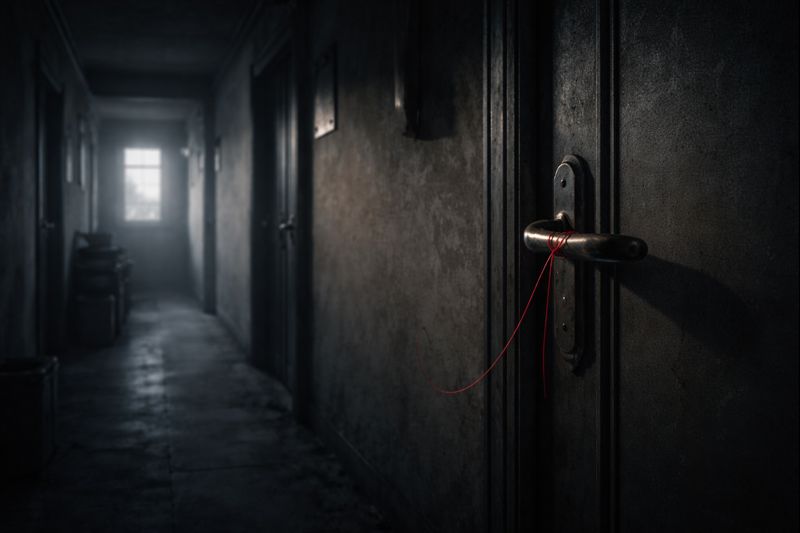
At dawn, a crimson thread hung from my apartment door handle. It was thin and frayed at both ends, wrapped three times around the handle and tied into a tight knot.
In the older districts of the city, those threads were never decorations. They marked debts that had come due—promises made to forces that never forgot.
I stood in the hall, listening to the building breathe around me. Pipes groaned. A door shut upstairs. Normal life.
My neighbor, Mrs. Gable, shuffled past, her gaze darting to the crimson thread. She froze, her frail shoulders hitching.
“Don’t touch it, Leo,” she whispered, her voice trembling. “When a red knot binds to your door, it has already chosen what it wants.”
“It’s just a prank, Mrs. Gable,” I lied, forcing a light tone. “Some kid playing games.”
“You don’t throw away a summons!” she snapped, backing towards her apartment. “You burn it, or you pay.”
I dismissed her warning, but my fingers hesitated as I reached for the thread. The thread felt unnaturally warm against my fingertips—pliant, with a faint throb beneath its fibres.
The knot cinched tighter around the handle before the thread snapped.
I tossed it into the trash chute and watched it vanish into the pitch-black drop. I thought breaking the thread had broken the summons.
As I turned the key in my lock, a low, drawn-out rasp rose from deep within the chute.
“Claimed.”
I froze, telling myself it was just the wind. But as I closed my door, the air inside the apartment turned frigid and heavy, each breath suddenly as difficult as breathing underwater.
The Crimson Ledger
By noon, the unnatural cold had left my apartment. A week later, I was working alone in the basement of the community archive.
Most days were predictable—cataloguing forgotten records and boxing away histories that had outlived their witnesses.
That morning, a book sat at the bottom of an intake crate I had emptied the previous evening.
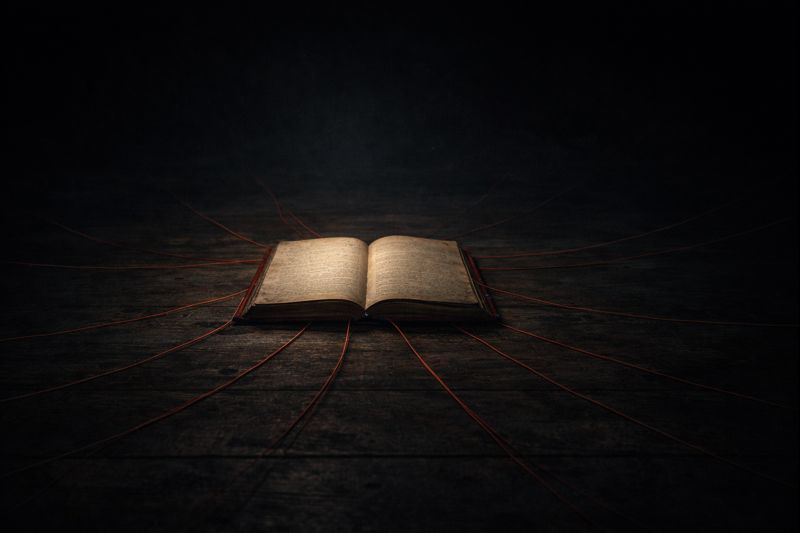
It was small but heavier than its size suggested, bound in cracked leather the colour of dried blood. Pressed into the cover was a single symbol: a looping threefold knot.
My stomach tightened.
“Who dropped this off?” I muttered to the empty room.
The fluorescent tubes above buzzed like trapped flies, flickering cold white across the concrete walls.
I opened the cover.
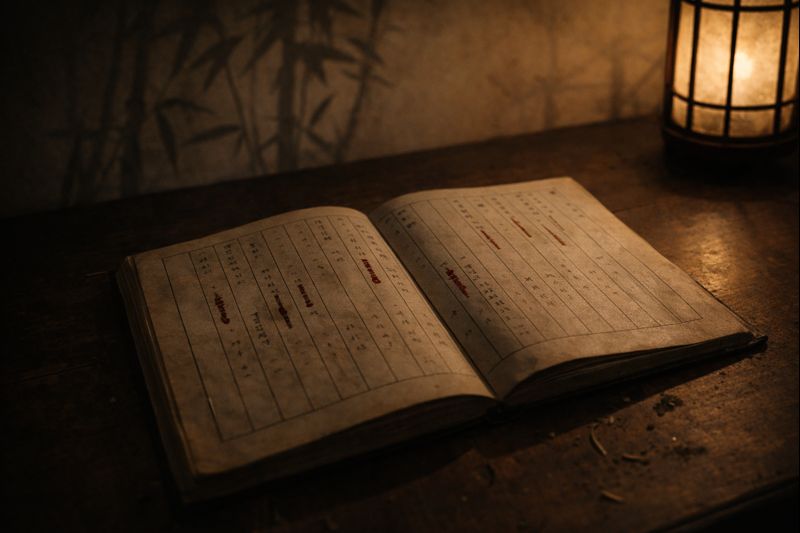
The thick pages smelled faintly of iron and decay. Inside were names written in elegant black ink. Beneath each ran a thin red line. Some stretched cleanly across the page. Others ended abruptly in dark, uneven smears.
Dates crowded the margins, each followed by a terse note: Drowned. Suffocated. Vanished.
“Is this a joke?” I said aloud, my voice echoing hollowly in the damp basement.
“No joke,” a voice rasped.
I spun towards the sound, my back striking the shelves. The aisle was empty, but dust turned slowly in the air, as though someone had just retreated into the shadows.
I forced my gaze back to the ledger. Hooking my fingers beneath the rough pages, I turned them until I reached the final leaf.
At the bottom of the final page, black ink welled through the paper, forming my name in fresh letters: LEO MARLOWE. Beneath it, a fresh, wet red line began drawing itself across the blank entry.
The fluorescent lights died, plunging the basement into darkness. A warm thread dragged slowly across the back of my neck.
The Pattern
I slapped a hand against my neck, gasping as the thread melted like grease between my fingers. The lights overhead shuddered back to life with a loud POP, blinding me.
I bolted from the basement and didn’t stop until I was outside, leaving the ledger behind on the damp desk.
Yet when I woke the next morning, the cracked red ledger lay on my chest.
Sleep fractured after that. Every night, I dreamed of unseen hands tying crimson knots tight around my throat. I woke up gasping, my throat aching as if bound by biting wire.
Desperate for answers, I dug through archived folklore during my shifts. References were scattered, but one phrase appeared repeatedly: The Red Thread Ledger.
The origins varied, but every account agreed on a single rule: Once a name appears, a life must be taken.
Then the local news reports started matching the pages.
A delivery driver named Wen died in a horrific fiery crash. I remembered his entry in the ledger—the red line inked beneath his name ended abruptly halfway across the page.
Two nights later, an elderly woman passed away unexpectedly. Suffocated in her sleep.
“They’re just coincidences,” I whispered to my reflection in the restroom.
“Is it?” a raspy voice murmured from inside the drain.
I backed away, heart hammering.
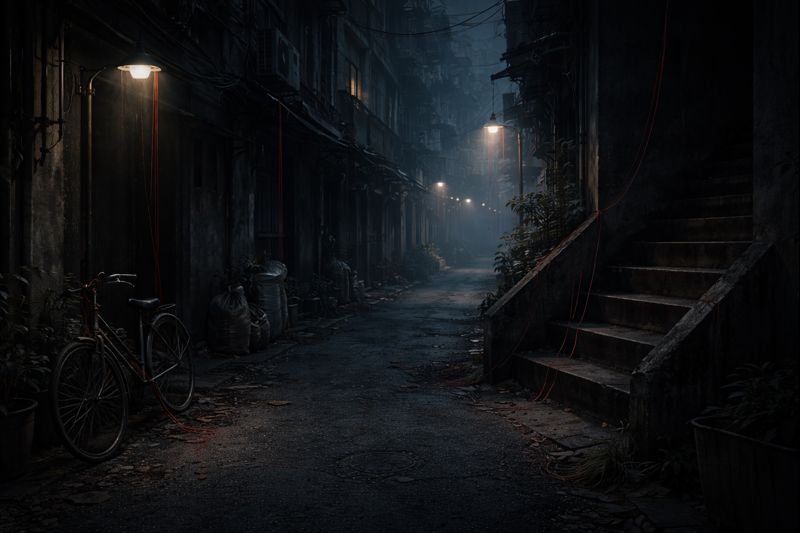
Red threads began appearing everywhere. One snagged on my bicycle spokes. Another swung like a tiny noose from a lamppost.
And every morning, a fresh red thread waited coiled at my apartment door.
I finally mustered the courage to open the ledger again to my page. Beneath my name, a thin red line was creeping forward across the page like a lit fuse.
My time was bleeding out.
The Warning
I clutched the ledger to my chest and ran to Madam Qiu, the archive’s oldest caretaker. She knew the city’s forgotten history better than anyone.
The moment her gaze fell upon the cracked red cover, her face drained of color.
“You touched it,” she whispered, her gnarled hands trembling violently.
“I didn’t mean to!” I pleaded. “It was just sitting in the crate!”
She snatched the ledger, wrapped it in thick yellow parchment, and lit a bundle of bitter sage. Heavy smoke filled the small room, but it did little to mask the smell of copper and rot emanating from the book.
“This ledger doesn’t just record history,” Qiu said, her voice barely audible over the crackling herbs. “It collects unpaid debts. And now it has come for yours.”
“What debt? I don’t owe anyone anything!” I demanded, leaning over her desk.
Qiu’s pale eyes darted to the shadowed corners of the room, as if watching something crawl along the ceiling.
“The ledger keeps the balance,” she murmured. “For years, the thread was bound, waiting. But when you snapped it at your door… you forced the debt onto yourself.”
“How do I stop it?” My voice cracked.
Qiu locked eyes with me, her expression full of grim pity.
“You don’t stop it, Leo,” she whispered, pointing a withered finger at my wrists.
I looked down. Beneath the skin of my wrists, faint red veins were pulsing—writhing like living worms, slowly knotting themselves together.
“It doesn’t want your life, Leo.” Her gaze remained fixed on my wrists. “It wants a vessel. You snapped the thread… and now you belong to it.”
The Attempt to Escape
That night, I locked the ledger inside the steel archive vault and swore I was done. Armed with a pair of shears, I walked the streets and cut every red thread I could find.
For a brief, naive moment, the air felt lighter. I thought I had won.
The illusion shattered the next evening. While I was sitting in my living room, a sudden, blinding agony seared my right arm.
I gasped, dropping to my knees. A thin crimson line was burrowing underneath my skin, wrapping around my wrist like a living wire. It pulsed violently—burning like liquid fire one moment, ice-cold the next—cinching into a neat threefold knot beneath my flesh.
“No, no, no!” I screamed, tearing at my skin, but there was nothing to grab.
Driven by blind panic, I sprinted back to the archive and forced open the vault.
The ledger was sitting on top of the safe. Open.
The dark letters of my name glowed against the parchment: LEO MARLOWE.
Beneath my name, the wet red line dragged itself across the page before stopping exactly halfway.
As I stared, horrified, a swarm of static filled my ears. I didn’t just hear it—I remembered it. Heavy boots marching on concrete. Cold steel. Voices chanting a nameless oath in unison.
“This isn’t a death sentence,” I choked out, clutching my burning wrist as the room spun.
The ledger hadn’t chosen me as another victim. It had chosen me as its vessel. And my service had just begun.
The Truth of Fate
I burst into Madam Qiu’s living quarters before dawn, wild-eyed and bleeding from where I had tried to scratch the knot out of my flesh.
She took one look at my wrist and sighed, a sound heavy with centuries of grief.
“When the thread burrows,” she said softly, “it means you’ve taken the bait.”
“How do I destroy it?!” I demanded, slamming my hands onto her table. “There has to be a way to cut it out!”
“You cannot destroy a debt, Leo,” Qiu replied, her pale eyes fixed on mine. “You can only pay it, or pass it on.”
She explained that the ledger didn’t create the misfortune—it merely gathered the forgotten horrors of the past. When left untended, the burden exploded, claiming entire bloodlines.
“The original keepers stayed with it,” Qiu murmured. “They watched over the pages, feeding the ledger so it wouldn’t feed on the city.”
“And what did that cost them?” I asked, my heart hammering against my ribs.
“Their humanity,” she said quietly.
A floorboard creaked behind me. I spun around. Standing in the darkened doorway was a tall, shadowy figure—its body wrapped tightly in miles of writhing red thread, its face a featureless void.
“It’s time to take your post, Leo,” Qiu whispered, her voice suddenly hollow and emotionless.
When I looked back at her, a red thread was trailing from her open mouth.
The Final Binding
Madam Qiu’s silhouette faded into the suffocating darkness, leaving only the oppressive stench of iron behind.
I bolted back to the archive, but the doors slammed shut behind me with a heavy, deafening thud. The locks clicked into place on their own. I was trapped.
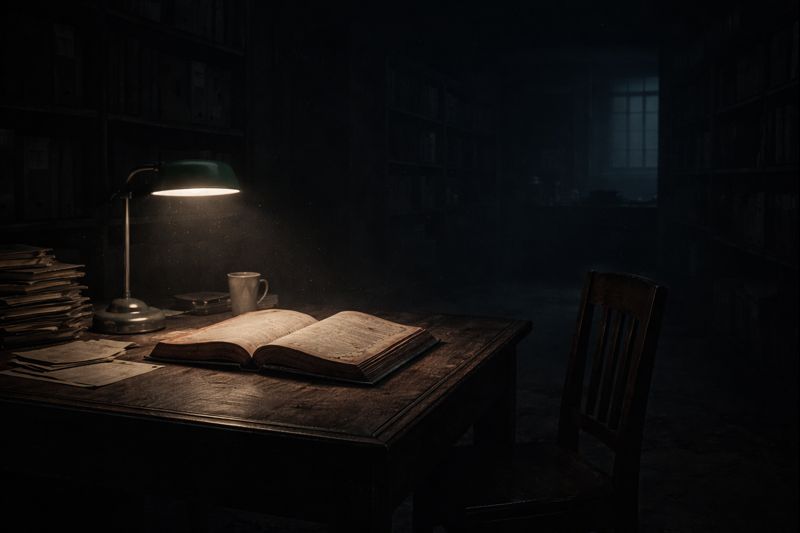
The ledger lay waiting on the center table, glowing faintly and radiating a sickening heat.
“Take up the mantle,” a chorus rasped from the shadow-drenched corners of the room. “Or give us every drop of your blood.”
Agony flared in my arm. The red thread beneath my skin split, branching out like a spiderweb of crimson fire. It dragged my hand towards the table, forcing my fingers around an ancient bone-handled pen.
“I won’t do it!” I screamed, fighting the unseen force dragging my arm down.
“You already agreed when you snapped the thread,” the shadows answered.
My hand slammed onto the paper. The pen twisted in my grip, driving its tip into my palm. Blood welled around the puncture and filled the ink reservoir.
Driven by an irresistible, terrifying urge, my hand moved across the parchment, tracing the red lines beneath every name.
Beneath a young girl’s name: Bound. Beneath a young father’s name: Bound.
I wept as my own hand sealed their fates, and the horrifying truth settled over me. I was no longer just a victim but the ledger’s new scribe—forced to mark the city’s doomed souls to save my own life.
The Watcher
Now, night after night, I sit alone in the suffocating silence of the basement archive.
The transformation is nearly complete. The red threads have spread up my arms, over my shoulders, and wrapped tightly around my neck. I no longer feel cold, nor hunger, nor fear. I only feel the endless, heavy pulse of the ledger.
Every evening, new names bleed onto the pages. Some belong to strangers. Others belong to people I recognize from the streets, completely unaware of the invisible web tightening around them.
I do not write with ink anymore. The red threads have burrowed into my wrists, drinking straight from my veins.
Sometimes, as dawn approaches, I hear footsteps outside the archive door. A curious passerby stops, noticing a thin crimson thread I’ve carefully looped three times around the outside handle.
My breath catches in my throat. I lean close to the wood, watching through the tiny glass pane.
“Is this a joke?” a young woman’s voice mutters from the hall.
I see her fingers hesitate over the red thread. Some fading part of me wants to scream at her to run, to burn it, to save herself—but no sound escapes my throat except a low, wet rasp.
Her fingers pinch the thread. She pulls it free.
Relief smothers the last of my guilt. I smile in the dark as the ledger beside me opens to a blank page, the ink rising to write her name.
The thread does not bargain. It does not hurry. It only waits for its next vessel—and now, so do I.
Related Stories
Some names are written into books that refuse to close. Others are remembered by the places where the living once slept.
At a remote training camp, one metal bunk quietly marked the final night of every recruit who rested there — as if the place itself had already decided who would never leave the barracks alive.
The Military Bunk That Recorded Every Recruit’s Final Night
But not every count is written in ink. Some are spoken aloud in the dark.
At another training ground, recruits sometimes heard a roll call long after lights out — and one name was always answered by a voice that no longer belonged to the living.