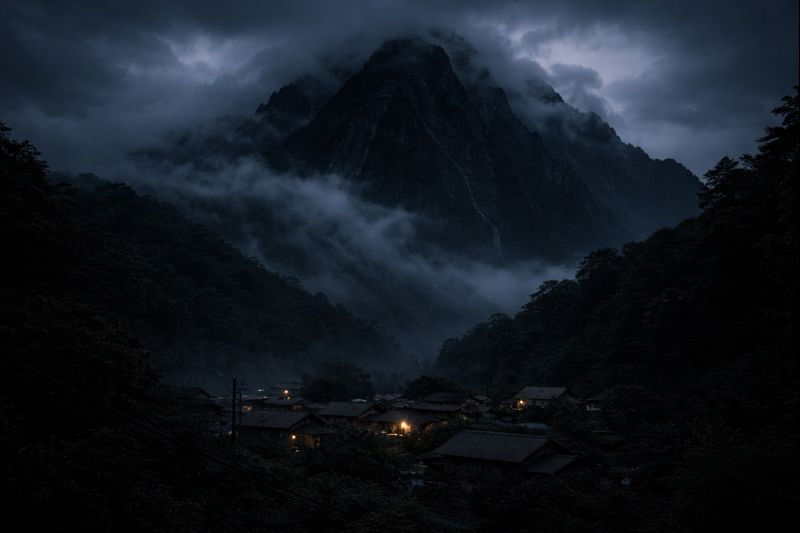
Mount Khelar watched our village the way a butcher watches a pen—still, patient, and completely certain of who would bleed first.
Its jagged ridges scarred the sky, as if something massive inside had tried to claw its way out long before our ancestors arrived.
The elders called it a taboo older than written names: Never summon anything within the stone.
They taught it to us before we learned our letters, drilling it into our heads with terrifying quiet. Whether you used cold iron, burning incense, or only a desperate whisper, something would answer when you called into the peaks. And it always remembered the one who spoke first.
At night, the wind did not simply blow downhill; it dragged itself across the valley. It rattled the wooden latches and tapped the glass like long, dry fingernails.
“Only the rock cooling after sunset,” the elders insisted, their voices tight as they bolted the shutters. They never called it a voice. And while they denied it, they never once looked toward the windows.
For generations, the old terror held.
But fear decays into routine, and routine eventually hardens into superstition. The mountain remained silent for years.
We grew comfortable. We grew arrogant.
I was twelve when we finally forgot why the rule existed.
The Shrinking Streams
That summer, the world went wrong.
Rain fell incessantly, heavy and gray, yet the streams did not swell—they shrank, as though something beneath the mountain were drinking them dry.
The goats refused the high pastures. At the tree line, they would recoil, screaming like pigs as they stared into the dense pines at a boundary we could not see.
People joked about the mountain being “restless,” but their laughs were thin, brittle things that died quickly in the humid air.
The elders stopped smiling altogether.
In the dead of night, they crept out to repair the ancient boundary markers along the tree line—scratched, moss-covered stones no one was meant to touch unless the boundary had begun to fail.
They worked in absolute silence, wrestling the heavy stones back into place until their knuckles bled. Whenever anyone asked, they called it trail maintenance.
We knew better. Children always notice what adults are too terrified to acknowledge.
We saw the fresh tallow smeared on the stones. We saw the way the elders’ hands shook. But most of all, we noticed the dirt under the markers.
The rain had not exposed it. Something beneath the stones was slowly forcing them out of the earth.
The Night We Crossed the Boundary
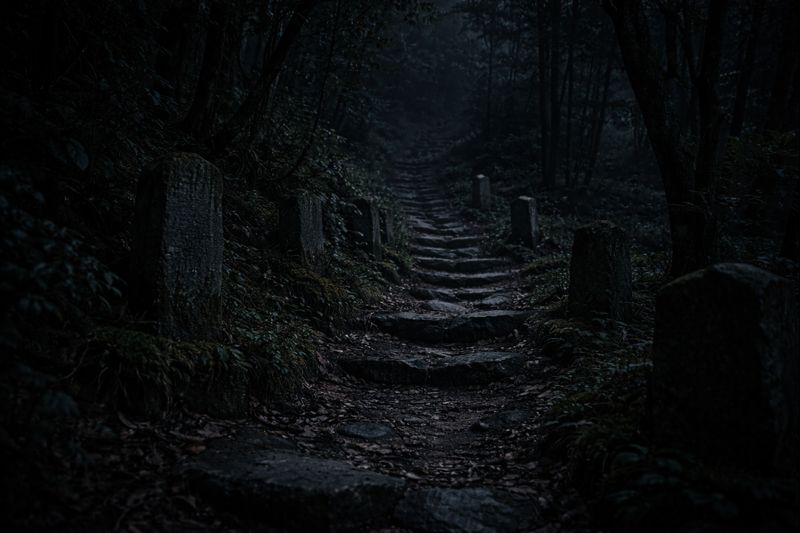
One evening, when the moon hung thin and sharp like a bone hook, four of us met near the trailhead.
Four, because standing alone near that dark tree line felt like an invitation to be hunted.
We told ourselves the warnings were just campfire stories meant to keep kids from wandering off. Nothing had happened in decades. We were brave, foolish, and starved for something real.
We brought the forbidden ingredients anyway: a small brass bell, a wooden bowl of coarse salt, and our voices.
As we passed the boundary stones jutting from the earth, the forest changed instantly.
The oppressive summer heat gave way to a wet, lingering chill. The canopy above swallowed the moonlight whole.
Insects went dead silent. Not a bird stirred in the branches.
Even the crunch of our boots sounded wrong—muffled, as if the forest were smothering every sound. We laughed, but the sound died the second it left our throats, crushed by the heavy air.
We began the old rhyme. Softly at first, then louder, letting its sing-song cadence mask the tremor in our voices.
It named the things the mountain would demand if it ever woke:
A voice to hear, a stone to break,
a circle drawn, for the thing to take.
We kept walking into the dark, ignoring the instinct screaming at us to turn back.
The Mouth in the Stone
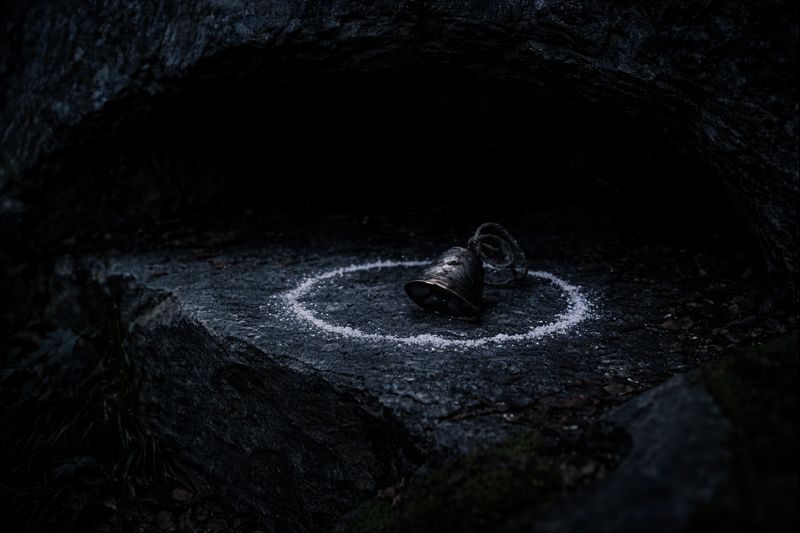
Halfway up the mountain, we reached a flat shelf of black rock. At its center, a smooth cavern curved inward like a jaw hinged wide.
My shoe scraped across the gravel, the sound slicing too sharply through the silence.
I saw the flicker of terror in the others’ faces, but no one spoke. Pride wouldn’t let us stop now.
We followed the rhyme, one demand at a time.
We poured the salt. It did not scatter in the wind; it fell like lead, forming a stark, unbroken circle on the black stone.
I lifted a loose shard from the cavern floor and struck it against the shelf. It broke on the third blow, the crack vanishing into the mountain as though the stone had swallowed it.
Then came the bell.
I struck it four times—once for each of us. The sound didn’t echo into the trees. It sank straight into the black rock beneath our feet, heavy and dead.
Finally, we spoke the mountain’s true name—the forbidden, jagged syllable the elders refused to let touch their lips.
For a heartbeat, nothing happened. Relief flooded my chest. I opened my mouth to laugh.
Then the stone pulsed.
The Fifth Ring
It wasn’t an earthquake. It was a heavy thrum, like a massive heart beating through the mountain.
The bell in my hand trembled, ringing a fifth time entirely on its own.
Then the voice rose from the dark mouth of rock. It was a calm rasp, whispering directly into the back of our skulls.
It asked for passage through the valley—only our agreement that we would not stand in its way.
My throat locked. I waited for someone to run, to cry out, to say no.
No one did. One by one, rigid with terror, we nodded.
Above us, the clouds split. A pale, dead-white trail opened across the slope, glowing faintly in the dark.
Our chests heaving, we stared at it, mistaking our terror for awe.
By the time we returned home, the mountain’s welcome felt real, and the adults’ warnings seemed like lies.
In truth, we had just unlocked the door.
What Followed Us Down
By morning, the mountain felt closer. Not in distance, but in the heavy, suffocating weight of its presence.
Paths shifted overnight.
The trail back to the village leaned uphill no matter which way we walked.
The goats finally returned to the higher pastures, but they grazed while backing up the slopes, their wide eyes fixed on us below.
That night, the brass bell rang again.
Not in my bedroom. Far up on the dark peak, chiming at steady, agonizing intervals.
By morning, Lucas was gone.
His bed was cold, and his boots were missing. A pale trail of salt crossed his bedroom floorboards and ended beneath the open window.
Before noon, the remaining three of us found one another in the village square. We huddled beneath the eaves, whispering about Lucas’s empty bed and the trail of salt beneath his window.
We had barely begun deciding what to tell the adults when the eldest woman passed nearby. Her gaze dropped to the white crust along our hems, and she stopped without a word.
At dusk, the elders gathered us beneath the hanging lanterns.
The eldest woman’s voice did not rise. It rasped, dry as dead leaves.
“The rite,” she whispered, her eyes wide with a dread she could no longer hide, “never called a guardian. It invited movement. The mountain doesn’t descend on its own. It travels by borrowing feet.”
She looked at our boots, her breath catching in her throat.
“You gave it four sets of steps. Lucas was the first to pay with his.”
Unmaking the Rite
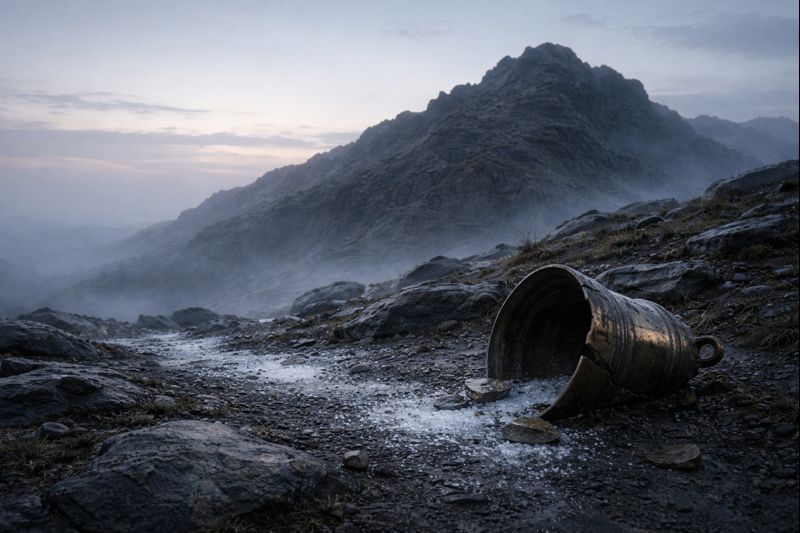
At dawn, the three of us climbed the mountain again.
We brought fresh spring water, a clean cloth, and trembling apologies. But apologies are pathetic things when faced with an ancient hunger.
The eldest woman had given us one chance: break the circle, silence the bell, speak the name backward—and whatever followed, never look back.
Ahead of us, the black stone shelf waited.
Across its surface, the salt circle had hardened into a white crust, while the pale, dead-white trail cut deeper into the slope, pointing straight toward our homes.
Before any of us could speak, the voice stirred.
From the dark mouth rose a wet, rattling breath that rasped against our ribs. No permission was sought this time. Whatever lurked within simply waited for the next set of steps.
We understood then.
The pale path wasn’t a gift. It was a throat, opening wide to swallow the village.
“Break the rite!” I screamed, panic finally shattering our silence.
We drenched the salt with spring water and scrubbed it with the cloth until a dark gap opened in the white circle.
I brought a heavy stone down on the brass bell until its rim split and the clapper tore free. Together, we shrieked the mountain’s true name backward, our desperate voices cracking against the stone.
We turned and bolted down the mountain without looking back.
Behind us, the wind tore down the slope with the sound of a thousand screaming lungs. Trees snapped. Pebbles rained down.
Then, all at once, the mountain fell silent.
Why I Never Answer the Mountain
Life returned to the valley, but it was an altered, hollow kind of living.
The village elders say the path is closed—for now.
But some nights, when the air turns impossibly thin, I can feel space itself stretching, as if the stone is still waiting for an invitation it knows was only delayed.
Lucas was never found.
His house sits abandoned at the edge of the village, the front door left swinging on its rusted hinges.
On heavy, overcast nights, you can hear the faint, hollow tread of boots pacing across his floorboards in a circle that never ends.
The pale trail on the slope didn’t fade either. The grass refuses to grow over it.
It sits there like a long, white scar, pointing straight at our roofs.
Of the three of us who came back down, only I remained in the village. The others fled as soon as they were old enough, though neither ever spoke of what happened on the mountain.
Years have passed.
Though no longer a child, I still never cross the stone boundary markers. Whenever the tree line draws near, my eyes remain fixed on the dirt.
The truth is clear now.
Mountains do not sleep. They listen. They hoard every word dropped into their quiet, waiting for a foolish voice to grant them passage.
And when the cold wind slides downhill at midnight, scraping its long, dry fingers against my glass, I pull the blankets over my head and stare into the dark.
I don’t answer.
Because names carry footsteps. And something in Mount Khelar is still counting mine.
Related Story
Some rules are not written because they were never meant to be tested.
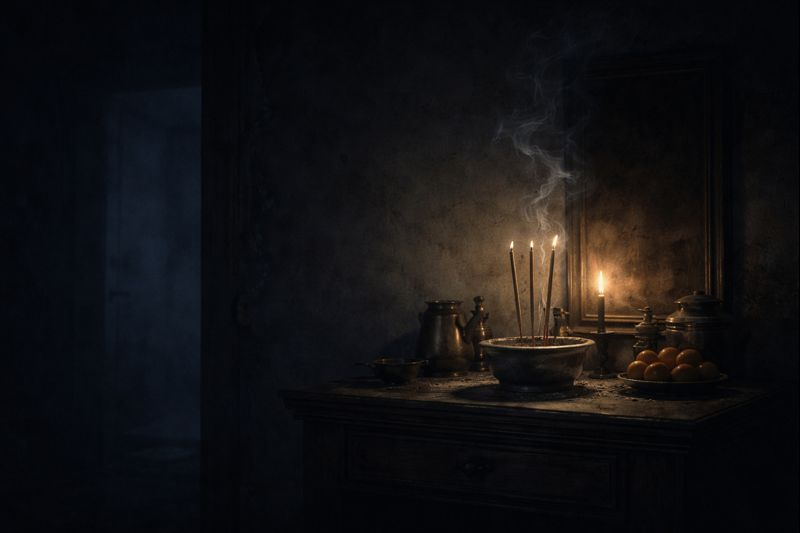
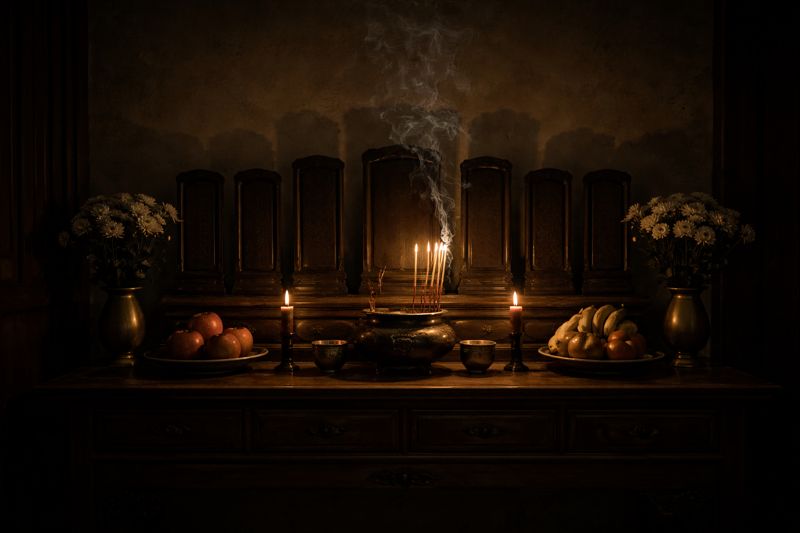
In one quiet apartment above a shuttered shop, a third incense stick was lit where only two should stand — and the smoke began to sink toward names that had long slipped from memory.