You already know you like psychological thrillers. The harder question is what kind of unease you want next.
Maybe being trapped with the wrong person bothers you more than anything paranormal ever could. Maybe you want a mystery where memory itself can’t be trusted. Or perhaps tonight calls for an old house, a deserted motel or something moving through the hallway that definitely wasn’t there before.
Not all dark thrillers unsettle you in the same way.
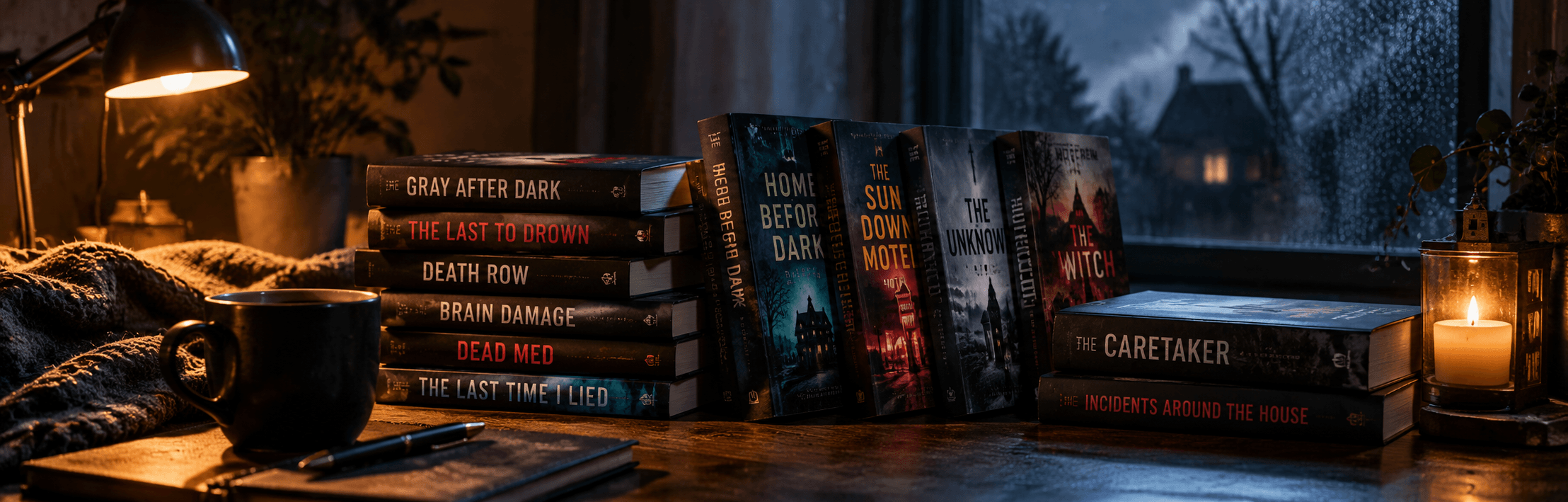
These 12 books move between captivity, survival, damaged memory, buried secrets, haunted places and explicit supernatural threats. Some stay comfortably inside thriller territory. Others let horror through the door.
So forget trying to find the single “darkest” book.
Start with the kind of bad night you actually want.
Affiliate disclosure: As an Amazon Associate I earn from qualifying purchases. Using these affiliate links does not add any extra cost to your purchase.
Quick Guide: What Are You in the Mood For?
| If you’re in the mood for… | Try this | Know this first |
|---|---|---|
| Human danger that feels disturbingly possible | Gray After Dark — Noelle W. Ihli | Captivity and wilderness survival drive the fear. |
| A remote trip where suspicion spreads through the group | The Last to Drown — Noelle W. Ihli | A past massacre, missing supplies and eighty-four miles of whitewater separate the group from help. |
| A dark idea you can finish quickly | Death Row — Freida McFadden | An execution-countdown thriller in novella form. |
| A murder mystery built around damaged memory | Brain Damage — Freida McFadden | Psychological and medical suspense rather than horror. |
| Medical-school pressure turning dangerous | Dead Med — Freida McFadden | Academic stress, deaths and escalating danger. It revises the earlier Suicide Med. |
| Old trauma and girls who vanished years ago | The Last Time I Lied — Riley Sager | A camp mystery with a slower, more patient build. |
| A haunted house with a mystery underneath it | Home Before Dark — Riley Sager | Family secrets matter as much as what may be inside the house. |
| Ghosts, old murders and the night shift from hell | The Sun Down Motel — Simone St. James | A murder mystery where the supernatural gets plenty of room. |
| Séances, disappearances and a reality that won’t sit still | The Unknown — Riley Sager | High-concept and twist-heavy, especially in its later stretch. |
| Freida McFadden inside an estate tied to witch-trial history | The Witch — Freida McFadden | More haunted psychological thriller than extreme horror. |
| An isolated supernatural threat with rules of its own | The Caretaker — Marcus Kliewer | Strong eerie setup, with an ending that leaves room for interpretation. |
| An entity already inside the family home | Incidents Around the House — Josh Malerman | The clearest outright supernatural horror on this list. |
When Other People Are the Nightmare
Sometimes nothing paranormal needs to happen.
Another person is enough.
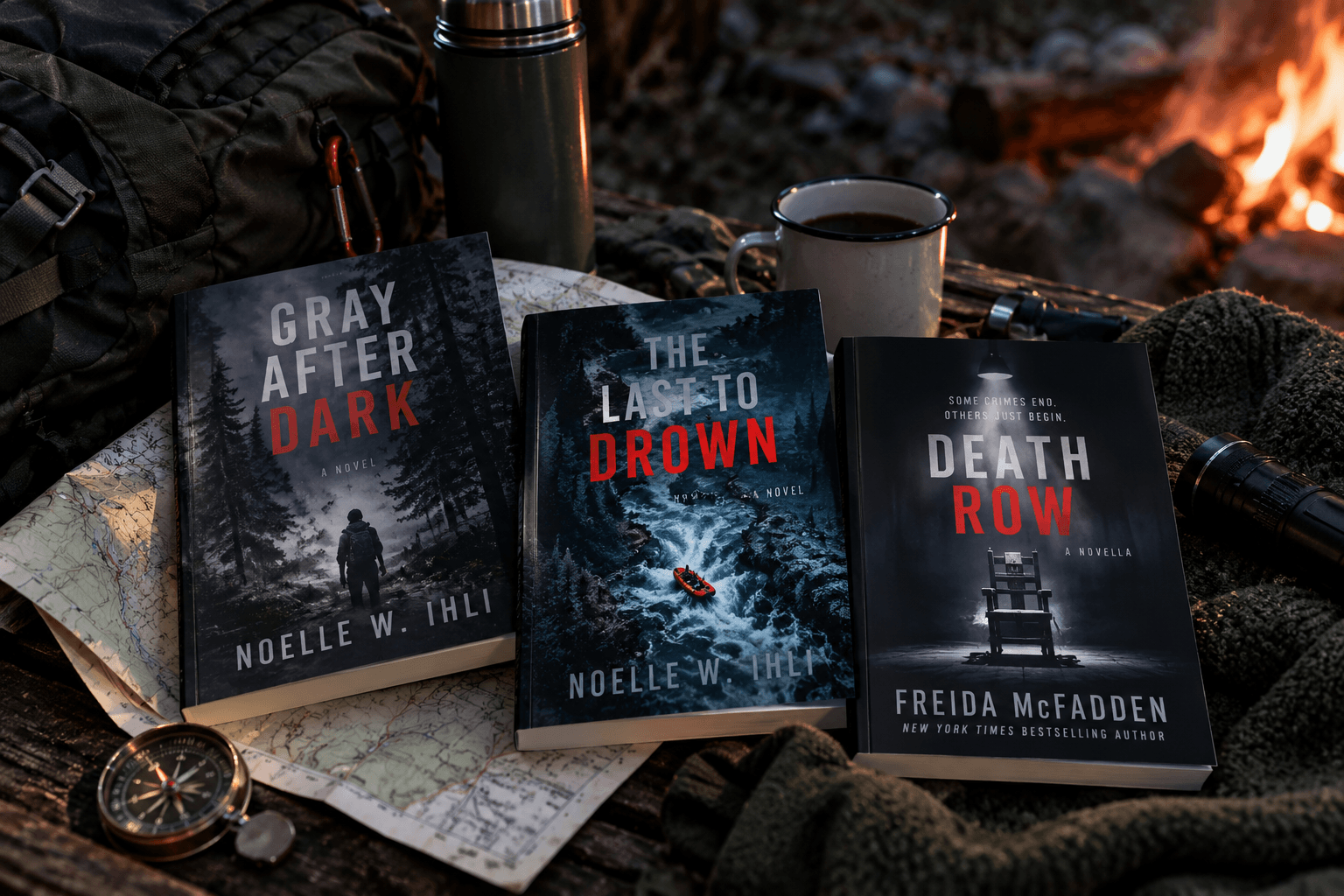
Gray After Dark — Noelle W. Ihli
Miley is training alone in the Idaho wilderness when she is abducted and taken somewhere help isn’t likely to find her.
From there, Gray After Dark becomes a survival problem. Captivity strips away control, isolation makes every decision more dangerous, and resistance carries consequences.
That realism gives the book its teeth. There is no curse to break or ghost to blame. The nightmare works because people are capable of creating it themselves.
Some of the character backstory moves more slowly than the central ordeal, but once the survival pressure takes over, this is a strong pick for readers who want their next thriller to feel harsher without becoming supernatural.
If the isolation is what grabs you most, The Last to Drown turns that fear into a group problem.
The Last to Drown — Noelle W. Ihli
Five days. Twenty strangers. Eighty-four miles of whitewater.
And this stretch of river already has a history.
Seven years earlier, a guide murdered a group of rafters there. Now Kaia is travelling the same route when supplies begin disappearing, screams break the night and suspicion starts moving through the group.
That gives The Last to Drown a very different shape from Gray After Dark. The threat isn’t built around captivity. It comes from distance, a hostile environment and the uncomfortable fact that nobody can simply step away from the people around them.
The river does part of the trapping for them.
If uncertainty about the people beside you sounds worse than facing one obvious threat, this is the more interesting survival read.
Death Row — Freida McFadden
Talia Kemper is waiting to be executed for murdering her husband.
She insists the man she supposedly killed is still alive.
That single contradiction gives Death Row most of what it needs. Instead of letting the mystery stretch across hundreds of pages, McFadden traps it inside an execution countdown with very little room left for mistakes.
At roughly 80 pages, this isn’t trying to give you the same immersion as the full-length novels around it.
That’s also the attraction.
For a night when you want a nasty little psychological problem without committing to another 400-page book, Death Row gets in, twists the knife and leaves.
Want the shortest commitment on this list? Death Row is the pick when you want an execution-countdown mystery you can finish in one sitting rather than another full-length thriller. See Death Row on Amazon →
Fractured Memories and Breaking Points
The threat isn’t always standing across the room.
Sometimes the harder problem is working out what happened when memory, exhaustion or pressure has already damaged the picture.
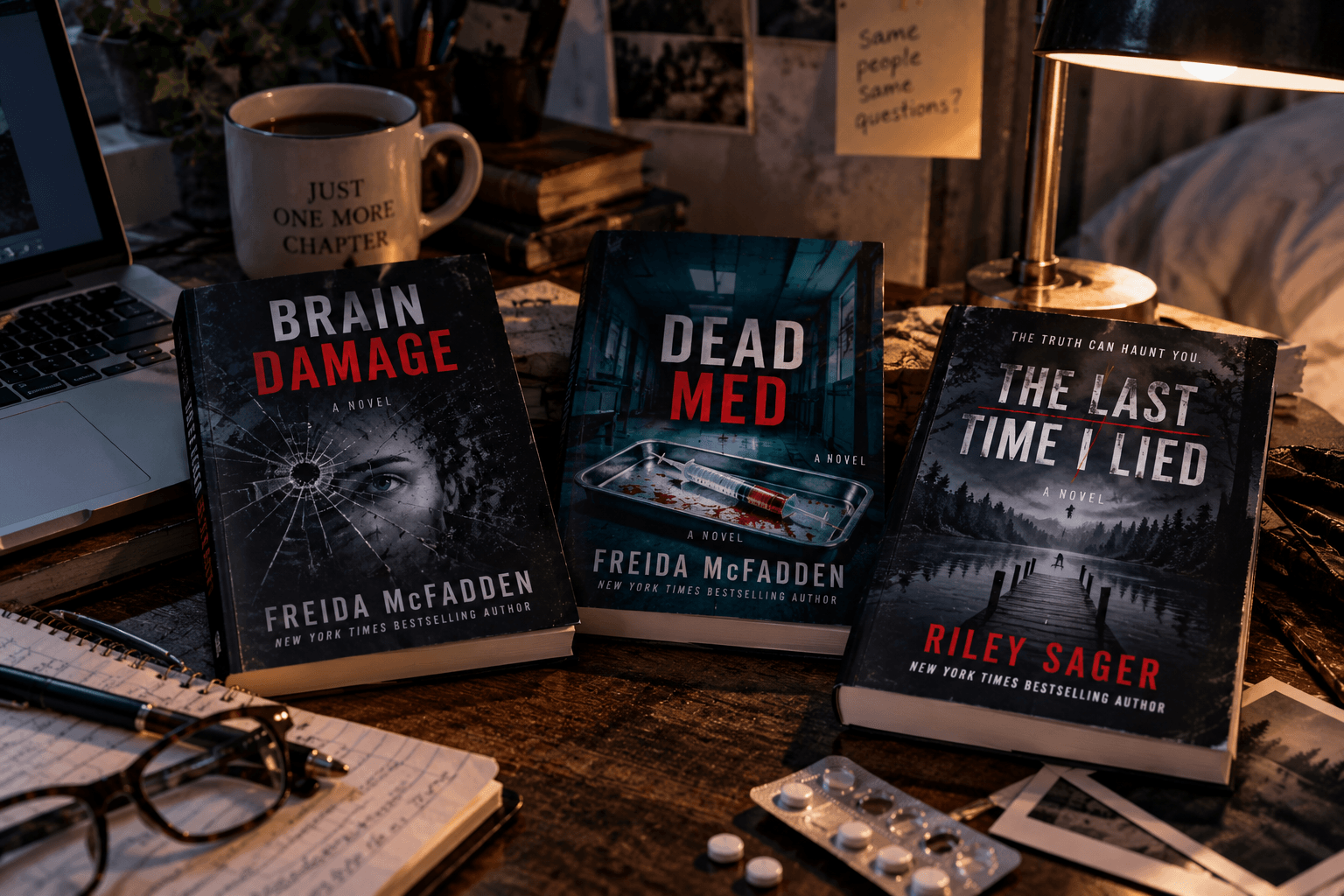
Brain Damage — Freida McFadden
Dr. Charly McKenna survives an attempted murder but loses pieces of the event that nearly killed her.
Brain Damage builds its suspense around that gap. Recovery doesn’t simply mean getting better; it means slowly reconstructing a night someone else may be very invested in keeping blurry.
Medical recovery, domestic suspicion and damaged memory give this a darker psychological hook without turning it into horror.
If you like thrillers where the truth has to be rebuilt rather than merely uncovered, this is a strong fit.
Longtime McFadden readers should note that the story predates the 2026 edition. The newer publication date does not mean this is an entirely new novel.
Dead Med — Freida McFadden
Medical school already runs on competition, exhaustion and the quiet terror of falling behind.
Then students start dying.
The setting is already built to grind people down. Long hours, academic pressure and ambition create a brittle environment before the deaths begin making everyone wonder whether the strain around them has become something much worse.
One important note: if you’ve read Suicide Med, check before buying. McFadden has described revising and renaming the older book as Dead Med, so this is not a completely unrelated novel.
Medical school is already the pressure cooker here. Dead Med piles deaths and suspicion onto the competition and exhaustion, making it the more claustrophobic academic read. Just remember that it revises the earlier Suicide Med. See Dead Med on Amazon →
The Last Time I Lied — Riley Sager
Three girls disappeared from Camp Nightingale.
Emma was the one left behind.
Years later, she returns to the same camp carrying memories that never settled into anything resembling an answer.
The setting gives The Last Time I Lied atmosphere, but the real tension comes from digging back into an old disappearance while questioning how much of the past has been remembered correctly.
This is one of the more patient books in the group. It spends more time reopening old secrets and letting suspicion accumulate than sprinting from threat to threat.
That makes it less immediate than Gray After Dark or Brain Damage, but potentially much more appealing if an unresolved past bothers you more than physical danger.
Prefer a slower mystery built around old trauma? The Last Time I Lied trades immediate danger for a camp disappearance, uncertain memory and secrets that have had years to settle in. See The Last Time I Lied on Amazon →
Places That Don’t Feel Empty
A house can hide a story.
A motel can remember a murder.
And sometimes the setting begins to feel less like scenery and more like another character in the room.
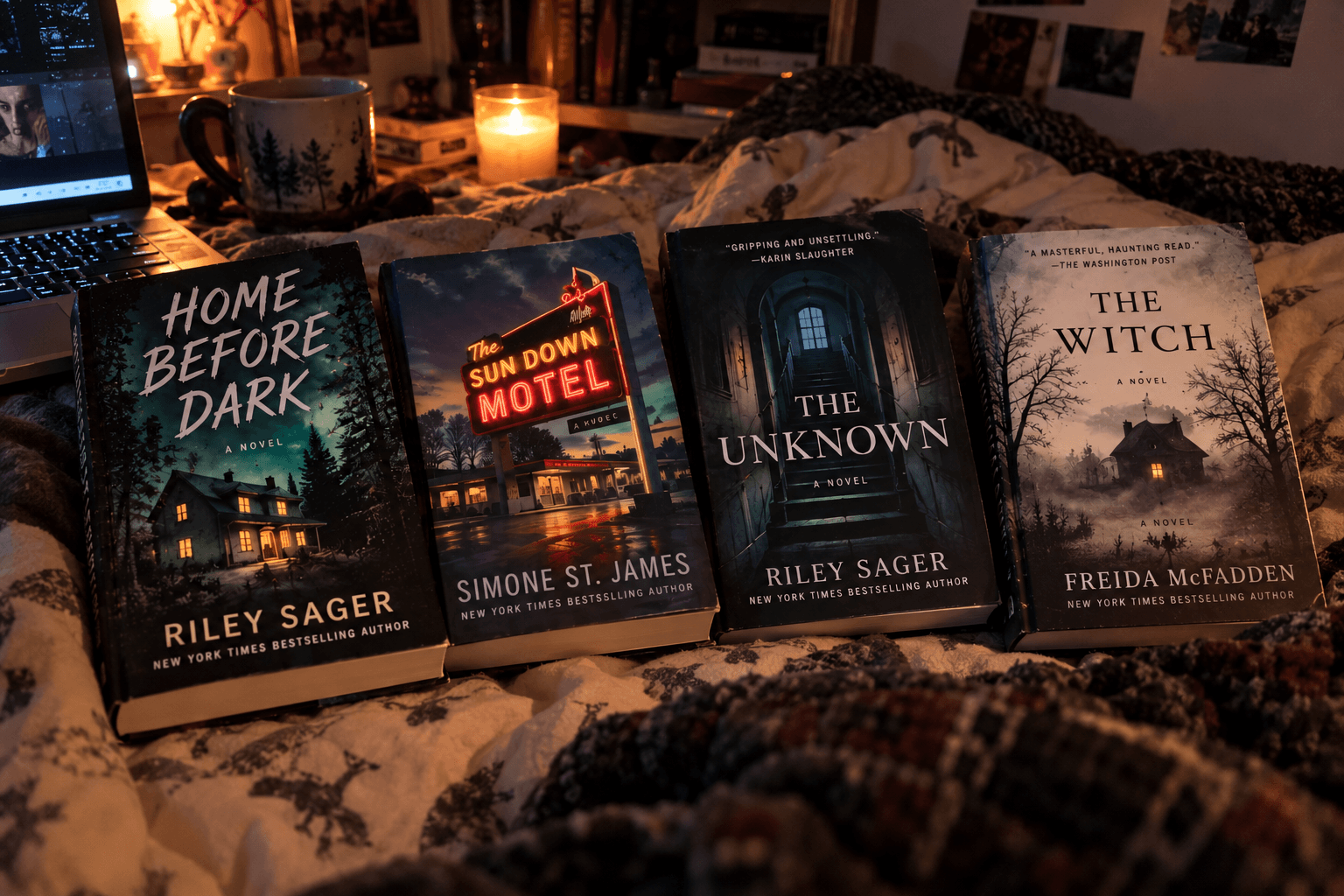
Home Before Dark — Riley Sager
Maggie Holt inherits the house her family fled when she was a child.
It is also the house her father turned into a bestselling account of a haunting.
Maggie has spent years doubting what he wrote. Returning gives her a chance to discover how much of the story was invented, exaggerated or worse than she remembers.
That tension between family history and possible haunting is what makes Home Before Dark work so well here.
There is still a mystery to investigate. Stories conflict. Old decisions need explanations. The supernatural question doesn’t replace the thriller; it complicates it.
The pace is more atmospheric than frantic, so readers looking for constant threat may find it deliberate.
If family secrets interest you just as much as whatever may be upstairs, this is one of the strongest matches on the list.
If the haunted location itself is what hooks you, the Sun Down Motel has vacancies.
Unfortunately.
The Sun Down Motel — Simone St. James
There is something wonderfully unpleasant about a motel after midnight.
Empty rooms. A glowing vacancy sign. Long stretches of silence where every unexpected sound seems louder than it should.
The Sun Down Motel folds that atmosphere around old murders, a disappearance and two investigations separated by decades.
The mystery gives you something solid to follow while the motel keeps supplying reasons not to relax.
And the ghosts aren’t merely decorative atmosphere. The supernatural has enough presence here that readers wanting every strange event to retain a rational explanation may find the book goes further than expected.
If a murder mystery wrapped around a genuinely haunted location sounds appealing, that’s exactly what this book is offering.
The Unknown — Riley Sager
An isolated island is being used for a film production built around paranormal history.
Séances and disappearances soon make the line between performance and reality considerably less useful.
That’s the pleasure of The Unknown at its best. Everyone is already surrounded by cameras, stories and staged fear before anything genuinely strange begins, so every new development arrives with a question attached.
Bloody Disgusting’s review makes the main trade-off clear: the later stretch stacks considerably more twists and explanation onto that setup.
If you enjoy thrillers that keep pulling earlier assumptions apart, that density may work for you. If you prefer revelations to simplify the mystery rather than multiply it, the back half may feel busier than the premise needed.
The Witch — Freida McFadden
Julia Barlow has lost her job, lost her apartment and retreats to her family’s centuries-old Massachusetts estate because she has nowhere better to go.
The house is tied to witch trials, and once Julia arrives, strange occurrences begin making the family’s past feel considerably less buried than she would prefer.
Julia is already vulnerable before the house starts pressing on her, which makes every new uncertainty harder to dismiss.
McFadden’s psychological-thriller instincts are still very much present. Secrets and family history matter as much as the possible haunting.
Readers expecting extreme witch horror may find the chills restrained. Readers wanting familiar thriller machinery inside an old estate with something wrong in its walls may have a much better time.
When the Supernatural Is the Threat
The last two books aren’t mainly asking whether something paranormal might exist.
The otherworldly threat is already part of the problem.
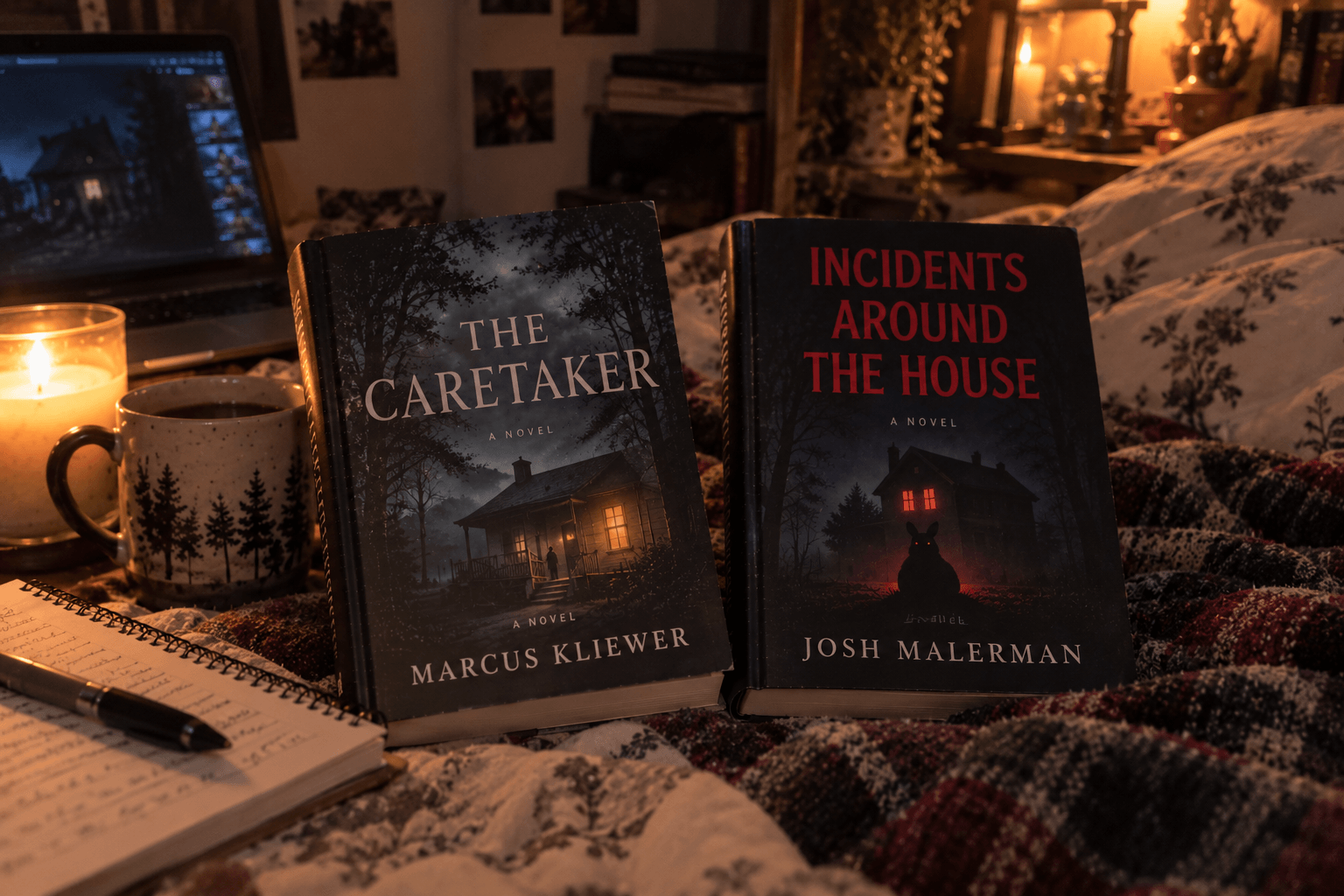
The Caretaker — Marcus Kliewer
Macy Mullins takes a caretaking job at an isolated property because she needs the money.
The previous owner had been performing a set of strange rites there to keep otherworldly Visitors from crossing onto the property.
Macy soon discovers that the rules aren’t eccentric housekeeping.
They’re defensive measures.
The reservation comes from what happens after that setup.
The ending is deliberately open-ended. Horror Homeroom argues that the final pages make that ambiguity satisfying rather than frustrating. If you need the story’s supernatural rules to resolve cleanly, that openness is still worth knowing before you choose it.
If the ritual rules, Visitors and isolated-property dread are what interest you most, the setup still has plenty to offer.
Incidents Around the House — Josh Malerman
Eight-year-old Bela knows something she calls Other Mommy.
At first, that sounds like the sort of phrase only a child could make alarming.
Then Other Mommy begins intruding further into Bela’s home, family and life.
Because the story stays close to a child’s perspective, familiar rooms and adult conversations become slightly warped. Bela understands enough to know something is wrong without always possessing the language or context an adult narrator would give you.
That voice is central to the book. So are the longer monologues and unconventional rhythms that come with it.
If the style works for you, it makes the family’s home feel increasingly unsafe in a very particular way.
If One Dark Read Leads to Another
Some of these books make natural follow-ups because they explore related fears from different angles.
Human danger + survival uncertainty: Gray After Dark and The Last to Drown both isolate their characters, but the pressure comes from different places. One gives you a clearly defined human threat; the other makes the people travelling beside you part of the uncertainty.
Haunted mystery + a stronger supernatural presence: Home Before Dark and The Sun Down Motel both give you an investigation tied to a haunted place. The difference is how openly the supernatural enters the story.
Supernatural rules + entity horror: The Caretaker and Incidents Around the House both remove the need to ask whether something impossible exists. One builds its unease around rituals and rules; the other places the entity directly inside a family’s home.
Did Death Row’s short commitment catch your attention?
Our Best Short Horror Books guide compares compact horror reads by the kind of fear you want, rather than treating page count as the whole decision.
What Kind of Dark Read Are You After?
There isn’t one correct way for a thriller to become darker.
The better question is which kind of unease you’re willing to take home with you.