
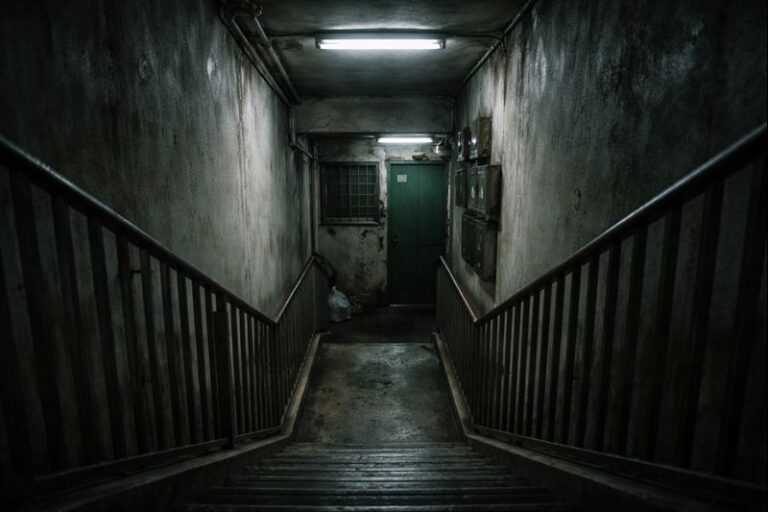
The haunted apartment stairwell in Block 17 never appeared in rental listings, yet everyone who lived there learned its habits. Built in the late 1970s as public housing, the block had been repainted and relit more than once. The stairwell stayed narrow. Its fluorescent bulbs flickered. Its walls sweated through the dry months.
Long-term residents said the stairwell remembered what the building tried to forget.
I moved in during the rainy season. Block 17 stood behind an old wet market, pressed between newer towers that stole the sun. The lift stalled often. The rent was low. I signed.
My unit was on the fifth floor.
Most evenings I took the stairs. They felt quicker than the lift—as if the climb shortened when I was tired.
Within my first week, I noticed the floor numbers did not align.
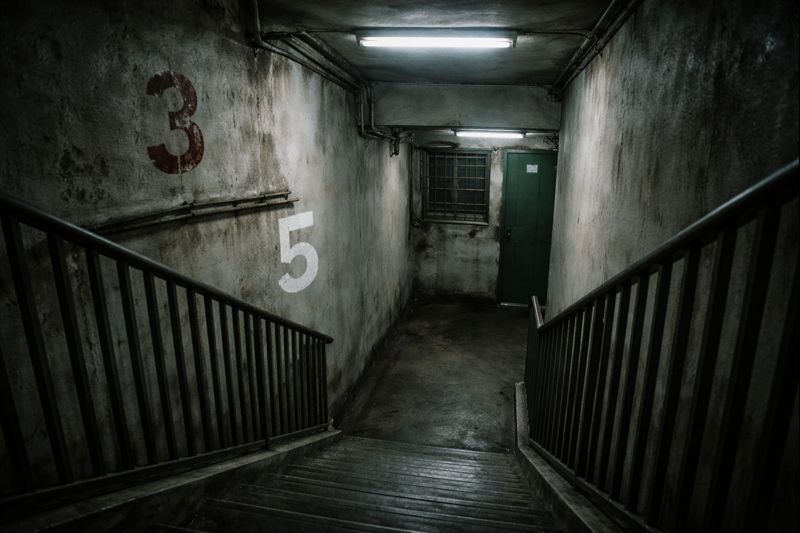
The “3” leaned crookedly, paint chipped. I climbed the next flight without thinking and reached my floor. The marking read “5,” as it should have.
Still, the climb felt wrong.
I counted the steps again. Fewer than before.
At my door, I hesitated before unlocking it, half-expecting the number beside it to change while I watched.
It didn’t.
But the stairwell felt as if it had.
The Haunted Apartment Stairwell and the Missing Fourth Floor
I tried not to think about it the next day. Still, I counted.
From the third-floor landing to my floor, there should have been another turn. Another landing marked “4.”
There was none.
I stood staring at the wall until a neighbor brushed past me, muttering an apology. Heat crept up my neck. I told myself I was being foolish.
That evening, I asked the security guard downstairs.
“There was a fourth floor,” he said after a moment.
He did not look at me. He rubbed his thumb against the armrest of his chair, slow and steady.
“What happened to it?”
“Renovation,” he said. Then, quieter, “Maybe.”
When I turned toward the stairs, I noticed something else.
He never once looked up at them.
Stories the Residents Stopped Telling
Over the following weeks, small details gathered.
The mailboxes skipped from 3A to 5B. Older numbers showed faintly beneath scratched paint. A faded utility map marked a row of rooms in grey, then ended mid-corridor.
One night, returning late, I met an elderly woman near the landing.
“If you hear footsteps above you,” she said, gripping her grocery bag, “don’t look up.”
Her slippers brushed the concrete as she walked away.
During a power outage, I sat near the stairwell entrance with Mr. Tan from the second floor. Without light, the steps vanished into shadow.
“This building was crowded once,” he said quietly. “Too many families.”
When I asked about the fourth floor, he frowned.
“There was no fourth floor,” he said.
He had told me the opposite days earlier.
I did not remind him.
When the Seventh Month Came
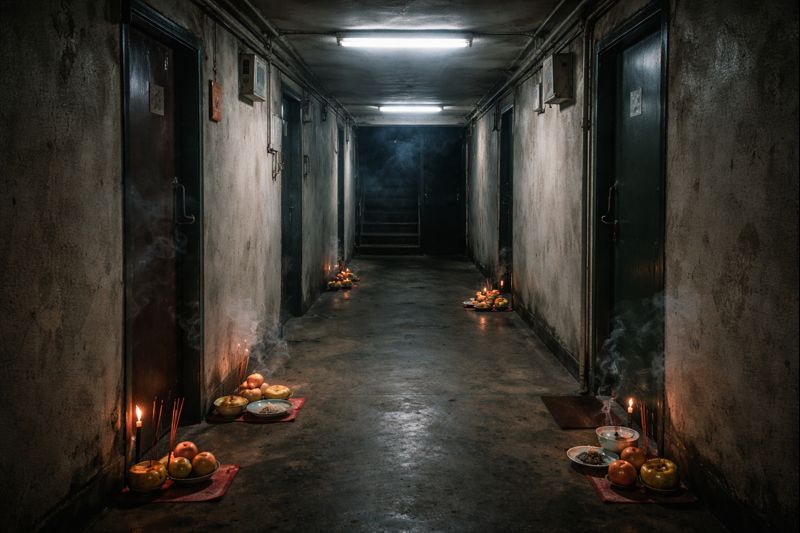
During the seventh lunar month, incense smoke drifted along the corridors. Bowls of rice and cups of tea lined doorways. I left a small plate outside my unit, though I told myself I did not believe.
That night, I took the stairs.
At the third-floor landing, I heard breathing above me.
Slow. Careful.
I did not look up.
I climbed.
The next landing read “6.”
I stepped closer. The paint was fresh.
The fifth floor—my floor—should have been here.
My hands shook as I counted the steps again. Fewer than before.
Between the third and sixth floors, faint outlines marked where doors had once been. Scratches scarred the walls at shoulder height. The air smelled like paper sealed too long in darkness.
I backed down one flight.
Footsteps followed.
Always one level above. Never closer. Never farther.
When I stopped, they stopped.
I pressed my palm against the wall and felt it damp beneath my skin.
What the Records Couldn’t Hold
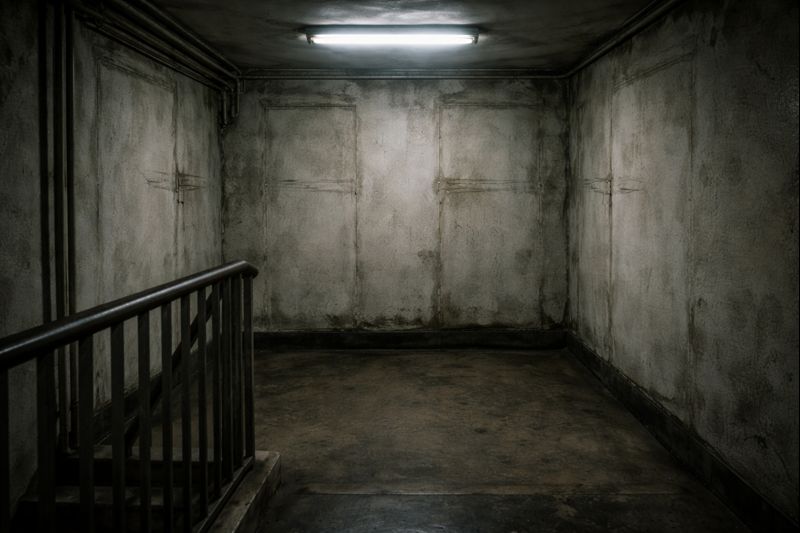
I did not return to my unit that night.
Outside, the footsteps ceased. I slept at a friend’s place and woke with the sense of being counted.
The next morning, I went to the town library.
Archived notices were brief. Unit Reassigned. Floor Closed for Works. Resident Relocated.
No disasters. No investigations.
Just quiet revisions.
Older blueprints showed faint corridors that thinned between copies. Entire sections blurred, then disappeared in later drafts.
When I searched my own unit number, I found it listed once under “Relocated.”
No date.
No destination.
I closed the file.
I did not go back to pack.
When the Building Finished Counting
I returned to Block 17 before dusk.
From the street, it looked complete—rows of windows, laundry hanging from metal poles.
Inside, the stairwell waited.
The numbers along the landings looked recently repainted.
Where “5” should have been, a thin line crossed it out.
I climbed anyway.
At the third-floor landing, I heard breathing above me.
I did not look up.
The next landing read “6.”
Behind me, footsteps descended.
They matched my pace.
When I reached where my door should have been, there was no handle.
Only smooth concrete, still damp.
For a moment, I considered knocking.
I did not.
I left.
Why the Haunted Apartment Stairwell Still Changes
I never went back for my things.
The lease ended without notice. My deposit was returned in cash I do not remember collecting.
From the street, Block 17 still looks whole. Windows unbroken. Laundry swaying in the evening air.
Inside, the haunted apartment stairwell remains.
The elderly woman no longer lives on any floor. Mr. Tan says he has never met her.
Sometimes, when I pass the building at dusk, I feel the urge to count the windows.
I don’t.
The stairwell does not collapse.
It makes room.
One floor at a time.