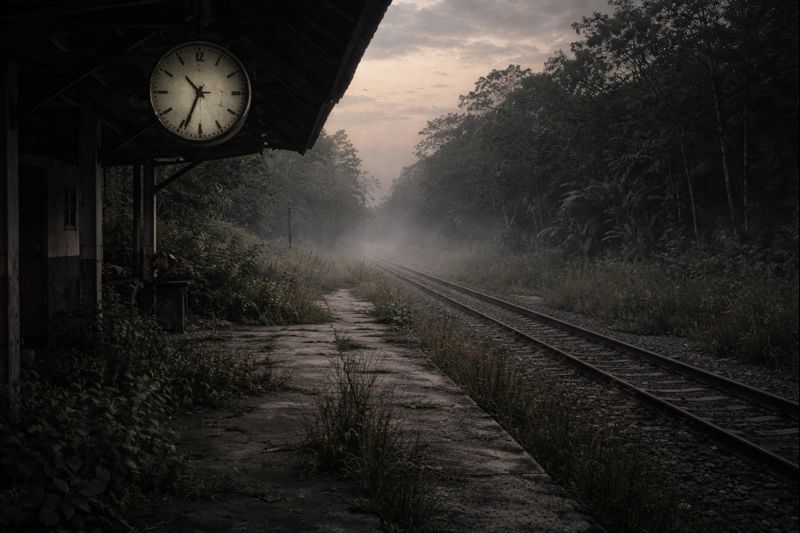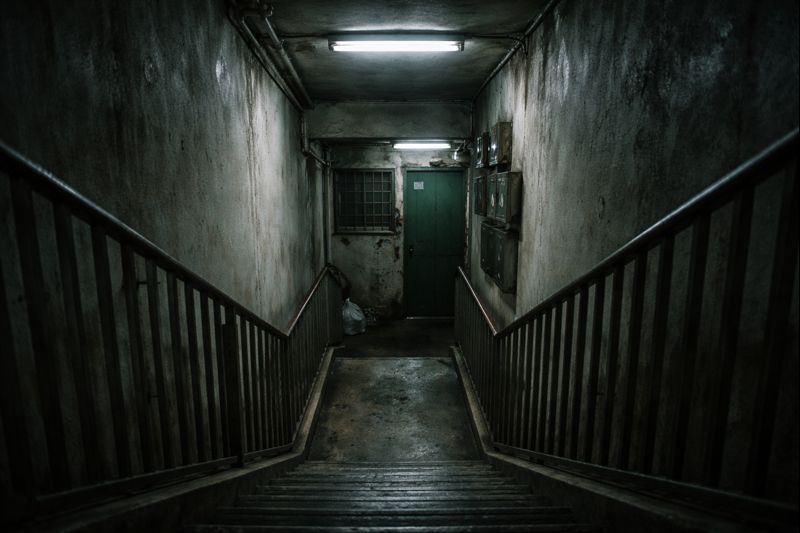
The apartment stairwell in Block 17 of RoseMairs was never mentioned in rental listings, yet every tenant learned its habits.
Built in the late 1970s as public housing, the block had been repainted and relit, but the stairwell still felt narrow and airless. Its fluorescent bulbs hummed with a damp, insect-like vibration. Its concrete walls sweated through dry months.
Long-term residents said the stairwell remembered what RoseMairs tried to forget.
I moved into Unit 502 during the monsoon season. The building stood wedged behind a sprawling wet market, shadowed by towers that stole the sun.
The lift stalled constantly; the rent was cheap. I signed without looking twice.
Most evenings, I took the stairs. On my third night, I noticed the stencilled numbers were wrong.
The “3” was crooked, its paint peeling like dry skin. I climbed the next flight and stepped onto my landing. The painted digit read “5.” There was no fourth floor.
Worse, the climb had felt shorter than it had the night before.
The next night, I counted my steps. Twenty-two steps to the second floor. Sixteen to the third. Nine to the fifth.
The stairs weren’t merely skipping floors. They were compressing the distance between them.
I stood outside my apartment, key hovering above the lock.
The hallway air smelled faintly of damp earth and old salt, like something pulled from the seabed.
Behind me, beyond the turn in the stairwell, slow, heavy footsteps began climbing from the space where the fourth floor should have been.
They weren’t climbing. They were catching up.
The Haunted Apartment Stairwell’s Missing Fourth Floor
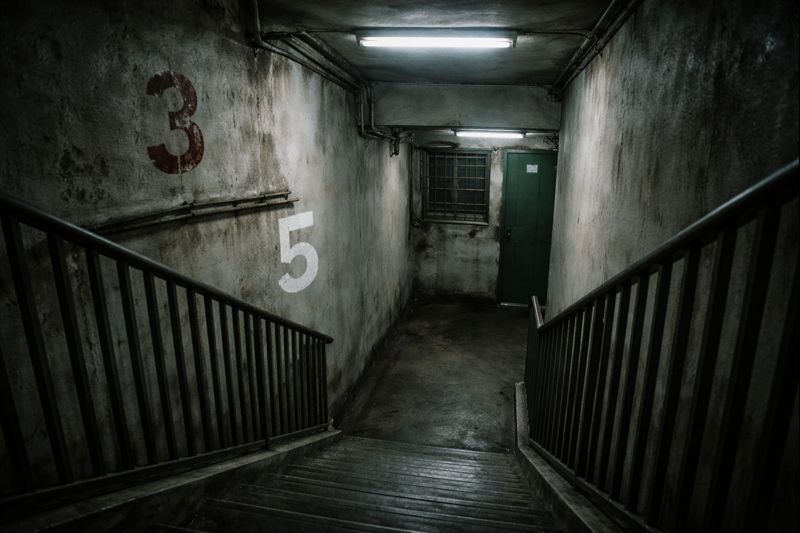
The following evening, I stopped on the third-floor landing.
There should have been another turn and a landing marked “4.” Instead, the stairs climbed in one unbroken flight toward the fifth, with seamless concrete where the fourth-floor door should have been.
I pressed my palm against it. The painted concrete was ice-cold and bled water beneath my hand.
A neighbour coming up from below brushed past me, head lowered, muttering an apology without meeting my eyes.
He never glanced at the missing doorway. It was as though his mind had simply slid around the absence.
My chest tightened. I fled up to the fifth floor.
I found the night security guard downstairs, seated beneath a buzzing yellow bulb.
“Was there ever a fourth floor?” I asked.
His fingers stilled on the wooden armrest. He didn’t look up.
“Used to be,” he muttered, his voice low and papery.
“What happened to it?”
“Renovation,” he said. Then, so quietly I almost missed it: “They sealed it in. With the sound inside.”
A cold draft swept through the lobby, carrying the same heavy smell of rotting earth and old salt.
The guard pulled up his collar and stared rigidly at the concrete floor.
He refused to look at me. He refused to look at the stairwell behind me—even when the faint, wet slap of bare feet descended the stairs and stopped at the lobby threshold.
Stories the Residents Stopped Telling
Over the next week, the building’s lies began to unravel.
The lobby mailboxes skipped abruptly from 303 to 501. On the wall beside them, the faint grey numbers 401, 402 and 403 bled through the peeling green paint like old bruises.
One night, returning late, I met an elderly woman near the third landing.
“If you hear footsteps above you,” she whispered, her knuckles whitening around her grocery bag, “don’t look up. Looking means admitting you can hear them. Once they know that, they start coming for you.”
Her slippers scraped rapidly across the concrete as she hurried into the dark.
Two nights later, a thunderstorm knocked out the power. I sat near the lobby entrance with Mr Tan from the second floor.
With the lights dead, the stairwell beside us became a shaft of solid darkness.
“This building was crowded once,” he muttered, staring into the blackness. “Too many families. The fourth floor was the worst. At night, you could hear them screaming through the walls.”
“What happened on the fourth floor, Mr Tan?”
His face twitched. “There is no fourth floor. Never was.”
Only moments earlier, he had spoken of the screaming. Now his eyes were wide and glassy, his terror so raw that it had choked him into silence.
He hadn’t forgotten. Something was forcing him to un-remember.
The next evening, the rain returned, heavy and cold. I started my climb.
Twenty-two steps to the second floor. Sixteen to the third.
Then—three steps. Just three.
I was at my door on the fifth floor. The distance between floors was disappearing.
Then, from the space directly behind me—a space that shouldn’t exist—a damp, freezing breath touched the back of my neck.
When the Seventh Month Came
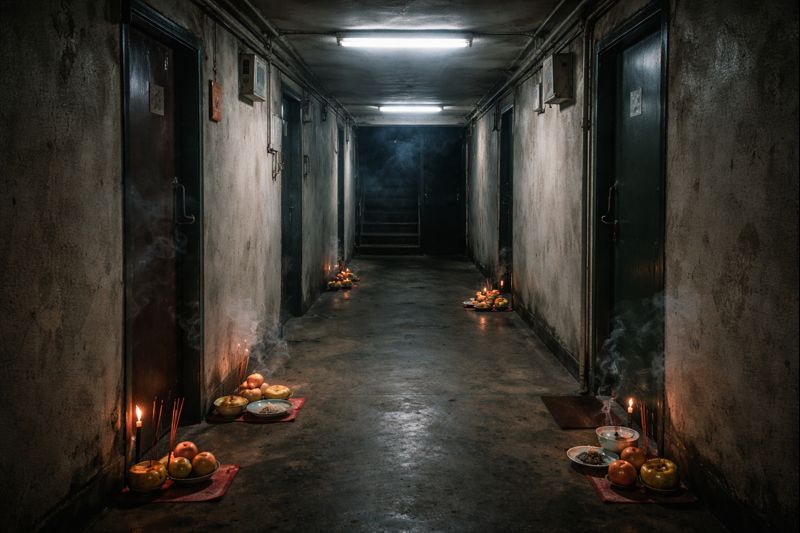
By the time the Seventh Month began, burning hell notes and sweet incense filled the estate, but neither could mask the stench of wet rot seeping from RoseMairs’ walls.
Like the other tenants, I left a cup of tea beside the offerings in the lobby. Then I took the stairs, chin lowered and eyes fixed on my worn shoes. I counted each step until I reached the third-floor landing.
One, two, three.
The number painted on the wall read “6.”
I gasped. The fifth floor was gone—erased. The space between the third and sixth floors had collapsed into a single flight of three shallow steps.
Along the wall, rectangular patches of fresh grey cement marked where doors had once been. At shoulder height, deep fingernail gouges scarred the plaster, as though someone had clawed at it while the openings were being sealed.
Behind me, bare feet struck the step above with a wet slap-slap.
Freezing cold seized the stairwell. My breath bloomed into white mist.
I backed down one step.
Slap. It took one step down toward me.
I stopped. It stopped. Whatever stood one step above me breathed with a wet, rattling wheeze that reeked of stagnant river water.
A grey, bloated hand drifted into the edge of my vision, hovering inches above my left shoulder. Its long, blackened nails flexed toward my throat.
Don’t look up. Don’t look up.
“You left tea for us,” a rasping voice bubbled beside my ear. “But we want your door.”
I didn’t turn.
Throwing myself backwards down the stairs, I lost my footing and tumbled—then struck concrete that reeked of fresh paint.
This was not the third floor. Directly ahead stood a door stencilled with the number 404.
What the Records Refused to Remember
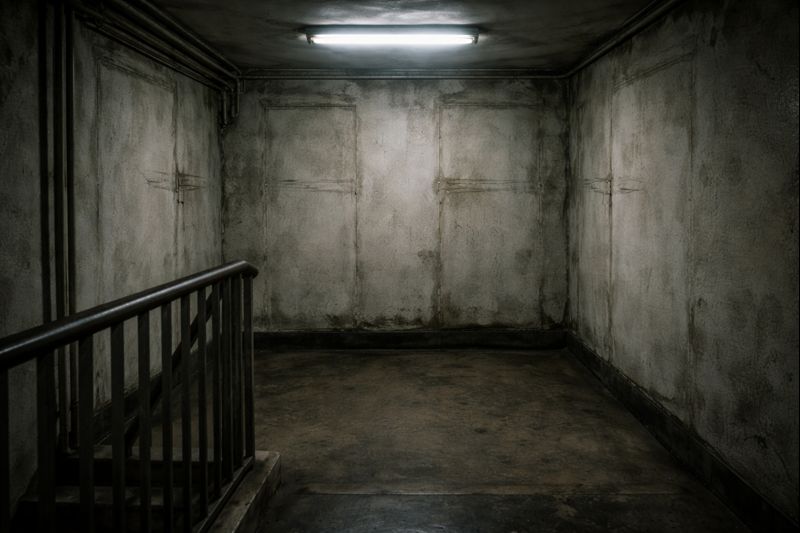
I don’t remember how I escaped the fourth floor. One moment I was facing Door 404; the next, I was stumbling through the lobby into the rain, with the wet slap of bare feet stopping just behind me.
I spent the night on my friend’s floor, but sleep was impossible. Each time I closed my eyes, I imagined an invisible ledger snapping shut and my name being neatly struck through.
The next morning, I went to the housing authority’s records office as soon as it opened.
The microfilm records were sickeningly sparse: Unit Reassigned. Works Completed. Resident Relocated. No fires, no violence, no recorded tragedies. Just the slow, bureaucratic erasure of lives.
Blueprints from 1978 showed a complete fourth floor, with apartments lining both sides of the corridor. By 1985, the entire level had become a greyed-out void. By 1992, the stairwells were drawn narrower and the ceilings lower, as though the building were slowly digesting its own structure.
Marked as Relocated
Then, in the current tenancy register, I found my own file.
Unit 502 was marked Relocated. The status date was yesterday.
The identification photograph attached to my tenancy agreement no longer showed my face. It showed an empty room whose doorway had been sealed flush with fresh grey concrete.
The truth settled over me with nauseating clarity. The fourth floor hadn’t been renovated. It had been digested. The stairwell wasn’t skipping floors—it was consuming them, pulling whole corridors into the quiet spaces between numbers.
Landing before Door 404 had not been an escape. It had been intake. I had already been processed.
My phone buzzed. A notification from my banking app filled the screen: Rental Deposit Refunded.
I looked down at my hands. Fresh grey concrete dust was packed beneath my fingernails, deep into the quick.
I had escaped Block 17, but it had already erased me from the only home I had. It wasn’t waiting for me to return. It was making room for me inside.
When the Building Finished Counting
I returned to Block 17 at dusk. The records had erased Unit 502, but I needed to see whether the building had done the same.
From the street, the building looked unchanged—laundry poles jutting out like skeletal ribs, televisions flickering behind grimy glass.
But as I crossed the lobby threshold, the air turned dense and heavy, smelling of old tide and damp lime.
I took the stairs.
The landings were wrong. The old painted numbers had vanished. In their place, fresh red digits gleamed wetly: 1, 2, 3, 6.
My floor was gone.
The landing marked “6” occupied the exact place where the fifth floor should have been. Where the wooden door to Unit 502 had stood the previous day, there was only a smooth wall of cold grey concrete.
I pressed my palm against it.
The concrete was still damp and yielded slightly beneath my hand, like thick skin. From deep within the wall came the muffled buzz of my alarm clock ringing for work.
My home was inside the wall. Everything I owned—my clothes, possessions and every trace of the life I had built—had been swallowed whole.
The Wrong Side of the Count
Behind me, heavy, wet footsteps echoed up through the stairwell.
I turned and looked over the railing.
A figure hung in the open shaft between the third and sixth floors, its silhouette blurred as though seen through thick steam. It occupied the exact height where the fourth-floor landing should have been, with nothing beneath its feet.
“You stayed too long,” a voice whispered, sounding like wet gravel shifting beneath a wave. “Now you’re on the wrong side of the count.”
Panicking, I spun toward the stairs, but the flight that should have led back to the lobby now rose away from me.
Flight after flight stretched endlessly upward into pitch darkness. The stairwell hadn’t just erased my apartment. It had sealed the exit.
Why the Haunted Apartment Stairwell Keeps Changing
I ran up the only flight left, but every turn brought me back to the same lightless stretch of stairwell.
The air thickened with the stench of stagnant seawater and wet mortar. Behind me, the slap-slap of bare feet was no longer following. It matched me step for step at my side.
Cold, waterlogged fingers wrapped around my wrist.
“Don’t fight it,” the wet voice rasped into my ear. “The building is just making space.”
My foot slipped, and I plunged through the darkness without striking a single step.
The walls folded inward, damp and yielding beneath my hands. They smothered my cries, crushed the breath from my lungs and pressed against my skin until I could no longer tell where my body ended and the stairwell began.
I didn’t die. I was filed away.
Now I stand in the dark space between the third and sixth floors. Every evening, I hear new tenants climbing below me.
I try to stay silent, but my feet are always wet. They keep slipping against the concrete.
The Last Page
If he was filed away inside those walls, you may be wondering how his story reached you.
I am the friend whose floor he slept on.
He vanished three months ago. The management at Block 17 insisted that Unit 502 had been vacant for months. When his tenancy record disappeared from the housing authority’s system, the police had little left to investigate. It was as though he had never lived there at all.
Yet this morning, his notebook appeared inside my locked desk drawer. Its pages were freezing to the touch, swollen from seawater and reeking of salt and fresh lime mortar.
Everything you have read was written in his frantic handwriting—even the final pages describing what happened after the stairwell swallowed him. I’ve spent the last hour trying to understand how he could possibly have written them.
When I reached the final line—They keep slipping against the concrete—the air in my room turned ice-cold.
Then, directly above my head, a wet footstep sounded from the ceiling.
Related Story
Some buildings change slowly, one floor at a time. Others hide something behind a reflection.
In a newly renovated apartment, the mirrors were polished, the walls repainted, and the past carefully covered. But late at night, the reflection sometimes showed something that did not belong to the person standing in front of it.