I had not seen Chen Wei An in three years, but I recognized his voice the moment he called.
Chen was the person people turned to when something could not be properly explained. He kept records of things families preferred not to name aloud—strange deaths, broken rituals, promises made to the dead.
Adrian had trusted him. That alone was enough to make me listen.
“Adrian Leong is dead,” Chen said.
For a moment, neither of us spoke.
I stood in my kitchen in Melbourne, half-dressed for work, watching the rain crawl down the window.
“How?”
“You should come back,” Chen said instead. His voice sounded tired, as though he had not slept in days.
I tightened my grip on the phone.
“All right.”
I booked the flight before I could think better of it.
By the time I arrived for the funeral, Adrian’s family home was already crowded with murmured prayers and rows of damp shoes.
White mourning cloth hung above the doorway, stirring whenever someone entered.
Chen stood near the entrance.
He looked thinner than I remembered. Dark shadows rested beneath his eyes.
When he saw me, some of the tension left his face.
“You came.”
“I had to,” I said. “He was my best friend.”
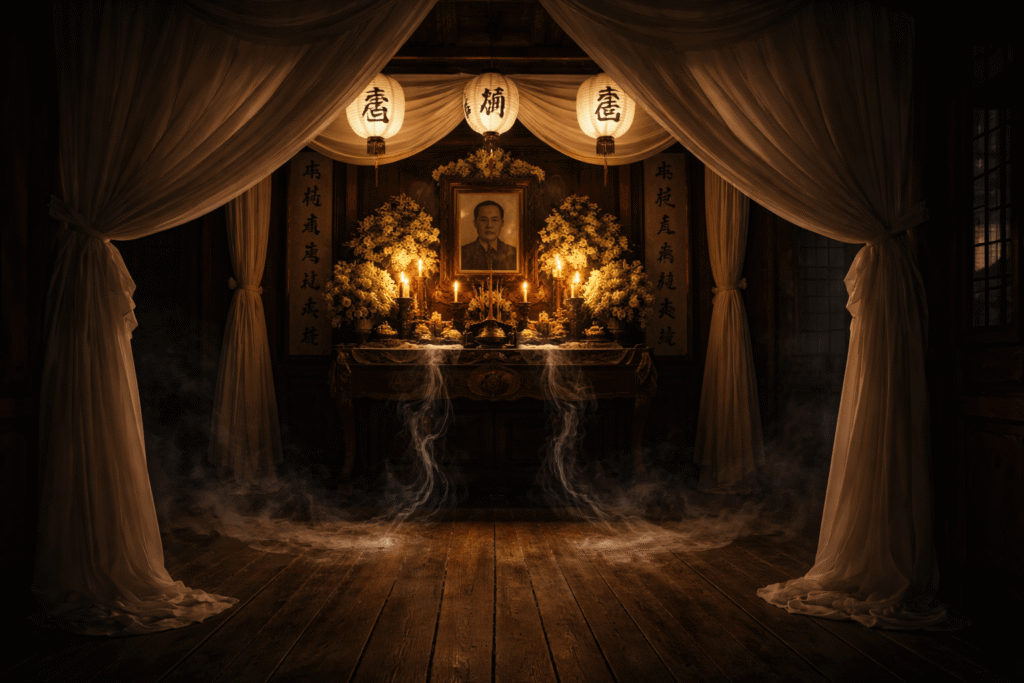
Chen glanced toward the room where Adrian’s portrait had been placed.
“I know,” he said quietly. “That is why I called you.”
The Burial
The cemetery clung to a low hill, where rainwater pooled between the graves and turned the paths to black mud. With every step, the earth yielded beneath our shoes, as though something below had shifted to make room.
Around the open grave, men in pale shirts tested the ground before every step. Mud swallowed the edges of their shoes and released them with soft, wet sounds.
Behind them, Adrian’s relatives stood beneath open umbrellas, holding them low although nothing had fallen from the sky.
One side of the burial ground remained empty.
Without looking down, the mourners curved around it, leaving a wide patch of soil untouched between themselves and the graves.
It took me a while to notice. The earth there was darker than the surrounding mud.
The ropes creaked, drawing my attention back to the grave.
Adrian’s coffin descended slowly into the earth. Paper offerings burned nearby, their ashes rising through the damp air.
When the burial was over, the mourners left in small groups. Chen followed Adrian’s family, leaving me alone beside the grave.
I remained beside the grave after everyone had gone.
I had travelled too far to leave Adrian so quickly. For a little while longer, I stood there remembering the small things—the late-night calls, the arguments that never lasted, the promises we had made when we were younger.
That was when I noticed something red lying near the dark patch of ground.
I moved closer and saw a red packet resting on the mud.
The Red Packet
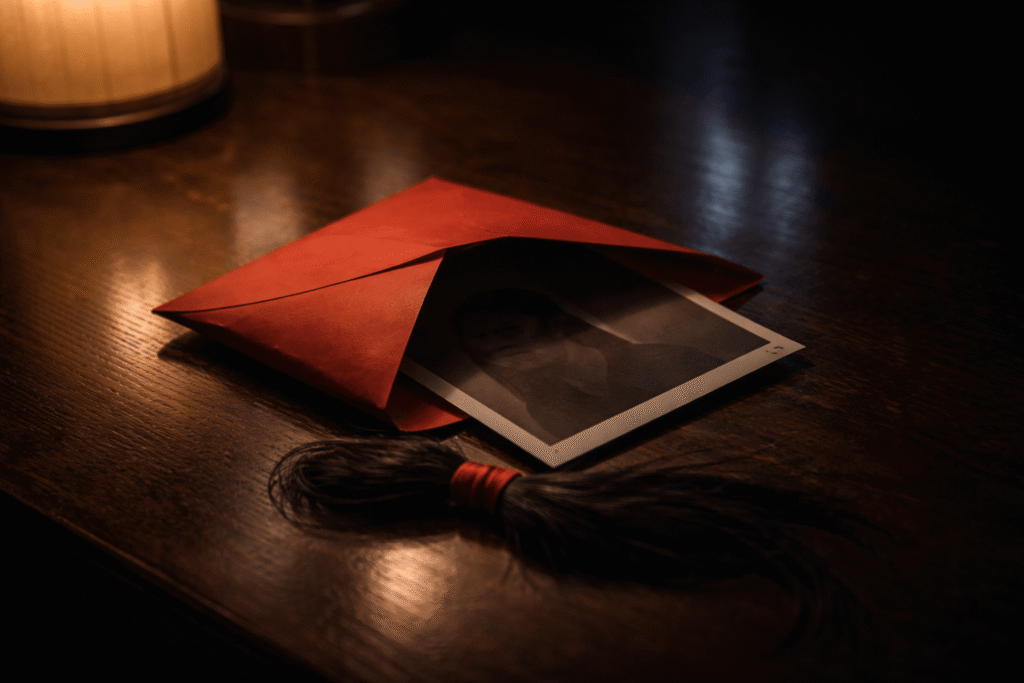
It lay half-buried beside a crooked grave marker, its red paper too bright against the wet soil.
“A red packet? Whose is it?” A glance around showed no one nearby.
“May as well see who dropped it.”
The packet came free from the mud with a wet tug. One corner had darkened with damp, and something inside pressed against my palm with unexpected weight.
“No name. Nothing to say who it belonged to.”
The blank red paper only deepened my curiosity. I opened it, and a photograph slipped into my palm.
It showed a young woman wearing an old-fashioned bridal dress, its fabric tinted red by hand against the black-and-white image. She had a fine-boned face and dark eyes fixed upon the camera.
Something in her expression made me feel as though I had been meant to find her.
Behind the photograph was a folded strip of paper bearing the woman’s Eight Characters.
As I unfolded it, a lock of black hair slipped across my fingers.
Without warning, icy breath grazed my neck.
“Found you,” a woman whispered beside my ear.
I spun around, but no one was there. I hurriedly bundled everything back into the packet and folded it shut.
When I looked up, Chen stood several paces away, one hand raised as though he had been about to call my name.
His gaze dropped to the packet.
“You opened it.”
“Yes. Why?”
“You should have left it closed.” His voice caught on the final word.
The Invitation
That night, Chen brought me back to Adrian’s house.
I placed the red packet on the table between us.
“Tell me what this is. Why shouldn’t I have opened it? It’s only a red packet.”
“Not here,” Chen said. “I’ll explain when we’re alone.”
Before we could leave the room, Adrian’s second aunt entered. Her eyes moved from our faces to the packet on the table.
“What happened?”
I told her where I had found it and what was inside.
Her hand closed around the back of a chair.
“冥婚,” she whispered. “A ghost marriage.”
“A red packet left near a grave is not always an offering. Sometimes, it is an invitation. If an unmarried man picks it up and opens it—”
“What?”
“The dead may take that as acceptance.”
“That’s superstition.”
“Some things are safer to believe than ignore,” Chen said.
His gaze remained fixed on the packet.
“Until we understand who left it there, you need to be careful.”
I dismissed the warning, though I still carried the packet back to my hotel. The following morning, I placed it beside the lamp and left for the airport.
By the time I reached Melbourne, night had fallen. While unpacking, I opened my bedside drawer to put away my passport—and froze.
The red packet lay inside.
“No. Why is it here?”
I remembered it lying beside the lamp on the hotel table before I shut the door.
The Bride Who Followed
For the first few days, there was nothing I could prove—only drifting incense and damp marks spreading across the bedroom wall.
Then I found a strand of black hair curled inside the bathroom sink—far too long to be mine.
The following morning, another strand lay across my pillow.
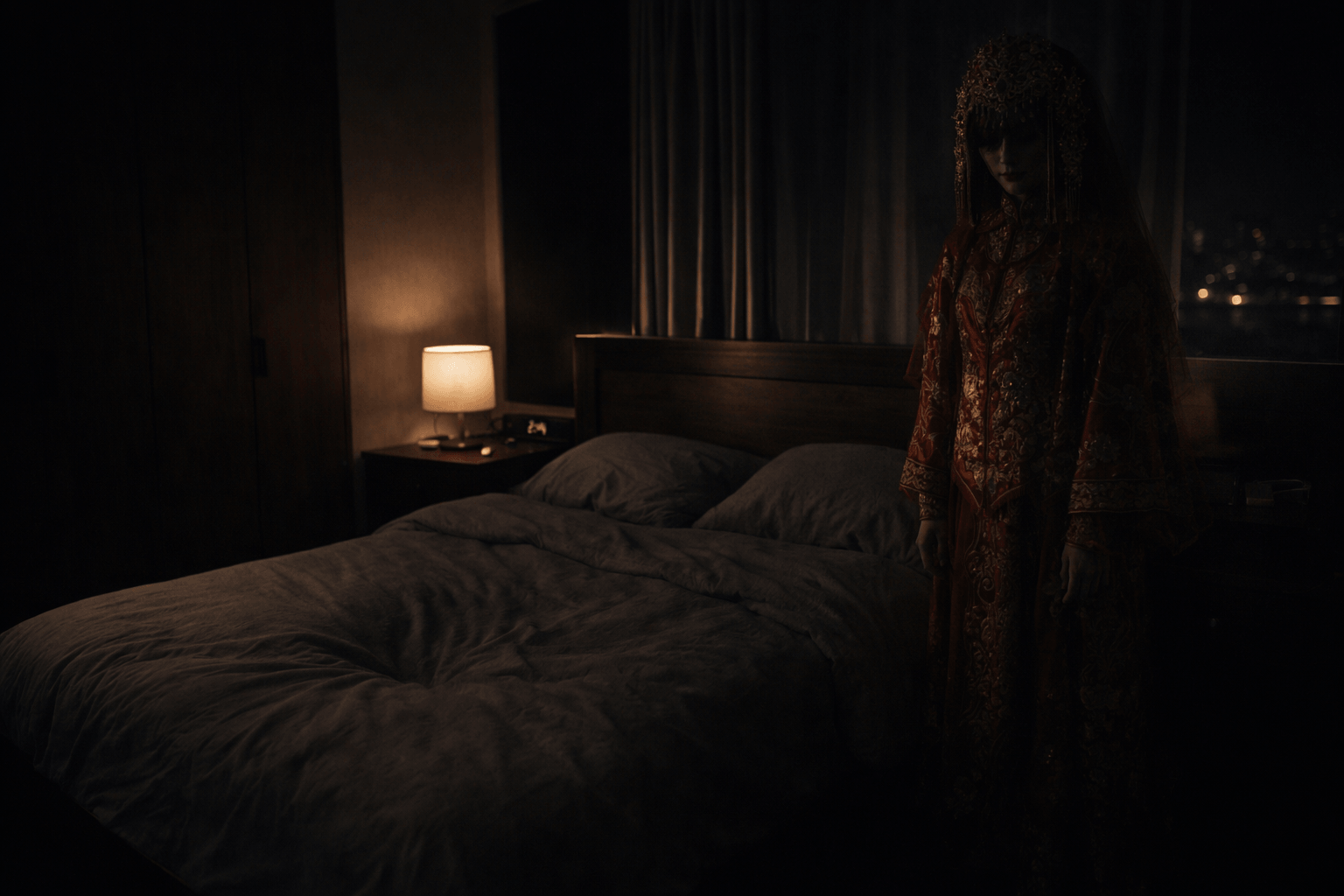
That night, I woke to find the empty side of the mattress sinking beneath the blanket.
I touched the hollow. It was cold, and the mattress slowly lifted beneath my hand.
“You’re tired,” I told myself.
A few evenings later, the keys I had left on the kitchen table lay neatly beside the bathroom sink. A strand of long black hair curled around the key ring.
“I must have moved them.”
One night, while reheating dinner, I caught her reflection in the microwave door—head bowed, red sleeves almost brushing my shoulders.
The woman from the photograph.
I turned so quickly that my hand struck the counter.
The kitchen was empty.
Two nights later, soft footsteps crossed the bedroom and stopped behind me.
I sat frozen on the edge of the bed, staring at the wall.
“It’s nothing,” I whispered.
The air stirred against my neck as the mattress sank beside me, the blanket shaping itself around an invisible body.
I stumbled to my feet.
“Get away from me.”
The next morning, I buried the packet in a rubbish bin three streets away.
That night, it lay on my bedside table—dry and bright as new.
With shaking hands, I opened the packet. Her photograph was clearer now, and fresh brush ink stained the back:
You opened my fate.
Behind me, the empty side of the bed creaked beneath an unseen weight.
The Refusal
I finally went to a Taoist priest in Box Hill because I had run out of explanations that sounded sane.
His temple sat above a row of shops, quiet and heavy with incense. He listened without interrupting.
“Picking it up was an invitation,” he said. “Opening it was consent.”
“I didn’t agree to anything.”
“The dead do not always care about intention.”
That night, he came to my apartment.
Talismans covered the windows. He chanted, ringing a bell while his peachwood sword cut through the incense smoke.
Everything went still, and for one brief moment, I believed the ritual had worked—until the cold returned.
The priest’s bell fell silent.
She stood beside the balcony door, dressed in faded red. Her face was the same as in the photograph, only no longer flat or distant.
She neither floated nor glowed; she only stood there, waiting with the stillness of someone who had waited far too long.
“You opened my fate,” she said.
“I want this over. Gone. Finished.”
Something broke behind her eyes—not rage, but the silent hurt of a bride rejected at the altar.
“I waited to be chosen,” she said. “I was buried before anyone came for me. Left between doorways with no home to enter.”
“You accepted what was offered. Now you wish me gone.”
“If you will not take me,” she whispered, “I will take what I was promised.”
Her fingers pressed against my chest, directly over my heart.
The Curse
The windows shook in their frames.
Before the priest could raise his sword, the bride swept him across the room. His body struck the wall, and the bell slipped from his hand.
She turned to me, and the moment two cold fingers touched my chest, darkness swallowed everything.
I woke up on the floor at dawn. The priest was gone, but a burning pain beneath my collarbone drove all thought of him away.
In the mirror, the skin there had turned grey and brittle, aged far beyond the rest of me.
The following day, I cut my finger while preparing breakfast. It was barely more than a scratch.
A week later, it remained open, its edges blackening. Then the decay began to spread.
The skin around my wrists thinned and wrinkled. My knees buckled without warning. Within weeks, my clothes hung from a body reduced to bone and loose skin.
Yet every doctor gave me the same answer.
“Your results are normal.”
I stared at the physician across from me.
“Does this look normal?”
He lowered his eyes and reached for his prescription pad.
After the third doctor, I stopped asking.
The curse kept me alive while my body slowly failed, changing just enough each day to remind me that she had not finished.
Then my sister called—her newborn son was blind in one eye. Two weeks later, my cousin’s daughter lost hearing in one ear, and the next child born into our family was born without a hand.
Only then did I understand what the bride had meant.
She was not taking what had been promised from me alone—she was taking it from my bloodline. I booked the first flight home.
The Terms
My family no longer spoke of superstition with embarrassment. Fear had made them practical.
Through Chen, we found an old monk at a hill temple where the bells had turned green with age.
He listened without interruption, then asked for the photograph. For a long time, he studied the woman’s face.
“She does not hunger for chaos,” he said. “She wants a place.”
His ritual was nothing like the Taoist priest’s. There were no swords and no struggle—only chanting, a low drum, and a basin of water placed before her photograph.
The monk spoke to her as one would speak to the wronged and forgotten, and the water in the basin trembled beneath his voice until it slowly stilled.
“She will spare the rest of your bloodline, but she has named her terms.”
My father gripped the edge of the bench. “What terms?”
“A shrine must be built in the family home.”
“Her photograph will stand at its centre.”
“Offerings must never be neglected. Her name must be spoken during festivals and death anniversaries.”
He paused before the final condition.
“No descendant may hide her or speak of her with shame.”
My mother looked at me.
“And my son?”
The monk held my gaze.
“He will remain bound to her suffering, though not as her husband. The curse already placed upon him will stay.”
“For how long?”
“As long as he lives.”
“It will not kill him quickly,” the monk added. “That is the mercy she offers.”
“Mercy?” A broken laugh escaped me. “You call this mercy?”
The Shrine
The shrine was built in my parents’ house before the month ended.
Red cloth covered the dark wood, with her photograph placed at its centre. Each morning, fresh tea was set before her; at dusk, incense was lit, and on the first and fifteenth days of every lunar month, fruit was offered.
No one forgot, because no one dared to.
Chen visited once. He stood before her photograph for a long time, then bowed without saying a word.
By then, the decay had slowed, but it had not stopped.
The skin between my ribs sank inward. Some mornings, my hands would not close properly. I stopped looking into mirrors that showed too much of me.
The weight remained inside my chest—not pain, but a quiet presence reminding me that my body was no longer mine alone.
The doctors still had no name for it, but my family no longer needed one.
The Bride Who Stayed
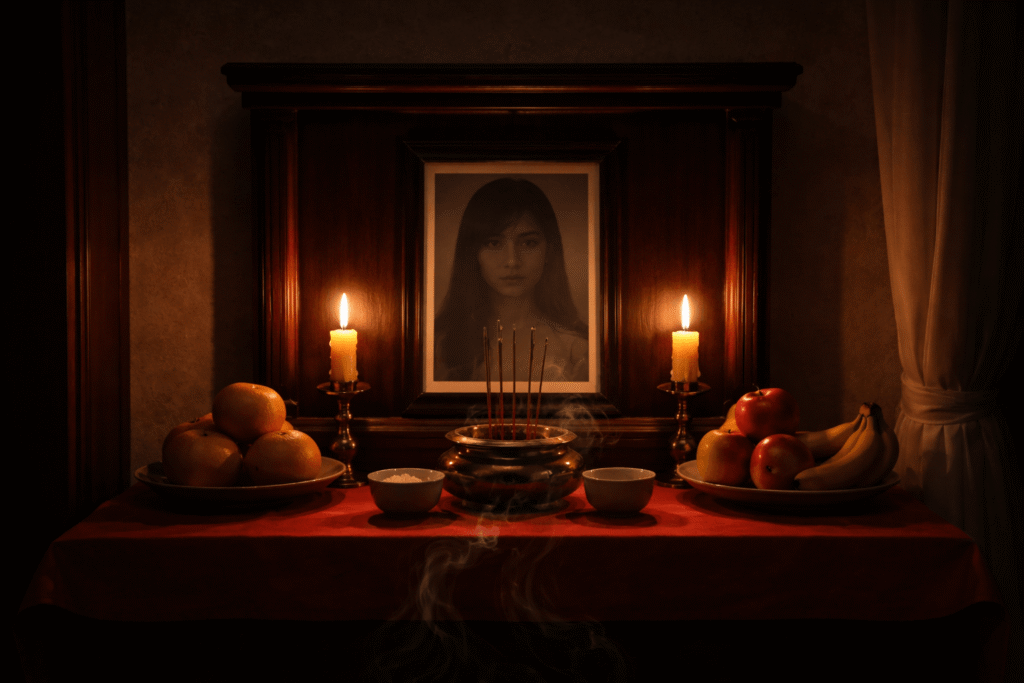
Years passed, and the offerings continued. My pain became routine. Whenever I passed the shrine at night, the house seemed to hold one more presence than it should.
My sister often brought the children when she came to tend it. They learned not to touch the offerings—and which questions were better left unasked.
Last month, while replacing the fruit, my niece frowned at the photograph.
“She looks different.”
My niece leaned closer, studying the woman’s face with an attention too serious for a child.
“She smiles more when you’re here.”
I rolled my wheelchair beside her, my legs no longer strong enough to carry me far.
“It’s probably the light.”
But when I looked at the photograph, I saw it too. The woman’s lips, once pressed into a patient line, now curved into the faintest smile.
The familiar weight stirred inside my chest, gentle as a hand resting over my heart.
Related Stories
But Adrian Leong was already marked long before I met her.
What followed him to the grave was not only the curse I carried — but something older, something buried beneath his family’s land that had been waiting generations to return.
The Curse That Waited Three Generations Beneath the Fields
What followed Adrian to the grave did not end with the living—it continued in ways no one could record properly.
A man who believed he could correct death began losing pieces of himself instead.