Mabel Tan did not believe in haunted rooms, but she had already begun to dislike Room 713 before the end of her first night assigned to Wei Jun.
Her assignment came on a loose slip of paper rather than through the hospital system. The senior staff handed her Wei Jun’s chart, avoided her gaze, and assured her that he had been stable for weeks.
Coma patient. Male. Early thirties. Road-traffic accident. Stable condition. No agitation expected. Routine observation.
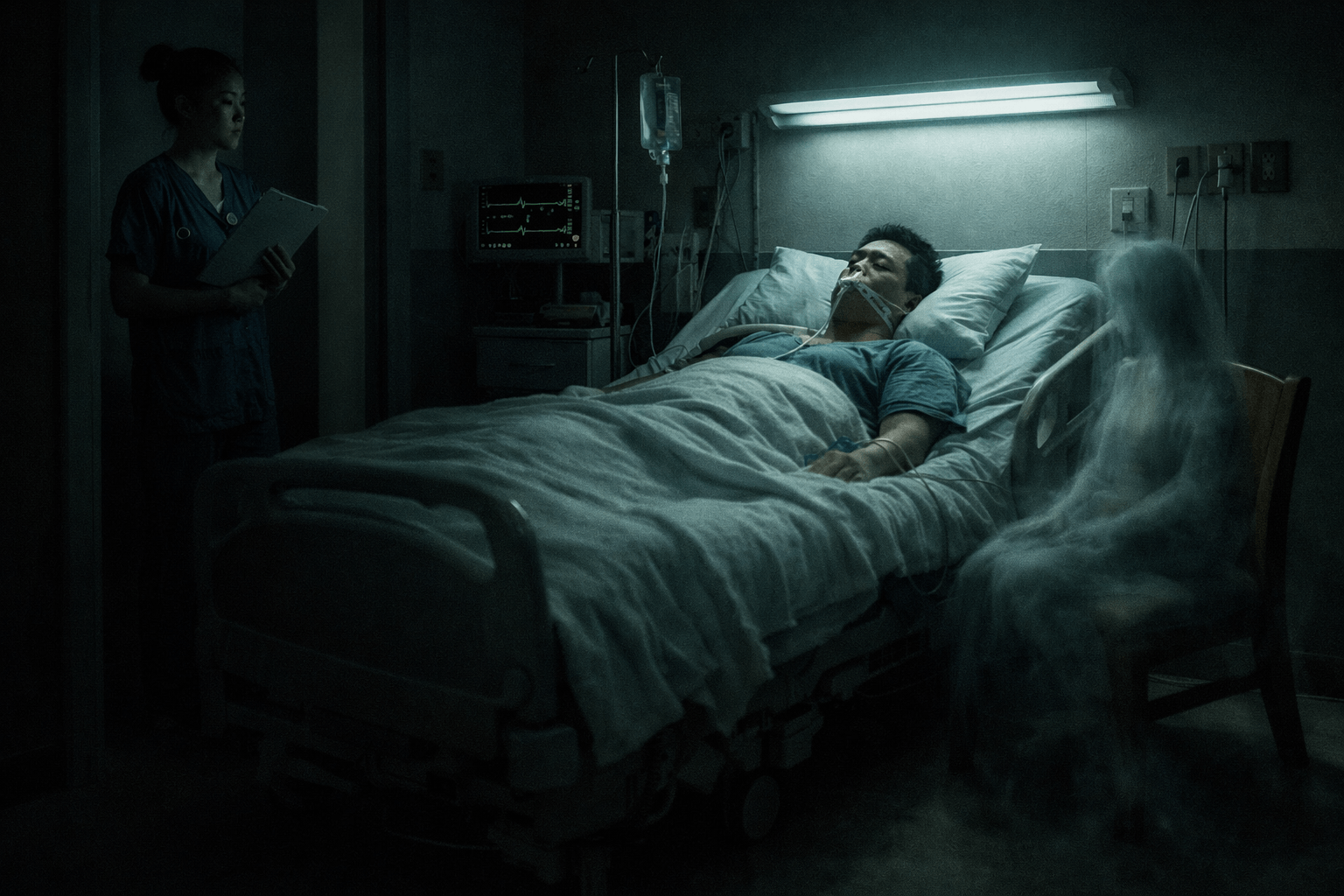
Everything was routine, except for the empty chair beside his bed.
It had already been pulled close when she entered, angled towards him as though someone had been sitting there moments earlier.
Wei Jun lay motionless beneath the dim ceiling light, his face pale against the pillow.
Mabel turned back to Wei Jun, but her attention kept drifting towards the chair.
It creaked again.
This time, the sound came from the seat.
Mabel told herself it was the air conditioning. Even so, the unease kept her standing as she wrote the first observation note.
The Call Bell No Patient Pressed
The first hours passed as hospital nights always did.
An old man in Room 705 needed help reaching the bathroom. A woman in Room 709 cried in her sleep.
Mabel moved through the dim corridor, grateful for anything that kept her away from Room 713.
At 2:13 a.m., the call light above Room 713 began to blink.
Mabel stopped in the corridor. Wei Jun was in a coma. He could not have pressed the button.
Still, she had to check.
As Mabel pushed open the door, the call light stopped blinking.
She remained at the entrance, listening. Wei Jun lay exactly as she had left him, motionless beneath the blanket. His hands were nowhere near the call button.
Then the chair beside his bed shifted.
Its legs scraped softly across the floor, followed by a long creak from the seat—as though someone had leaned back after waiting for her to arrive.
Mabel forced herself closer to the bed.
Cold pressed through her uniform. A stale, shut-in smell filled the room, like air released from somewhere sealed for years.
As Mabel leaned closer to check Wei Jun’s breathing, a woman whispered beside her ear. The words were not meant for her.
“You left me there to die.”
Mabel spun around to find the chair empty.
The cold released her, and the machines returned to their steady hum. Mabel stumbled from the room without finishing her examination.
Outside, the ward continued as though nothing had happened.
Something Entered Behind Her
Mabel approached the charge nurse before her next night shift and asked to be moved from Room 713.
Instead of answering immediately, the woman gave her a thin smile. “Your assignment has already been fixed.”
“Fixed? What do you mean?”
“I changed it twice,” she said, glancing at the sheet. “Both times, your name returned to Room 713.”
Mabel did not ask again.
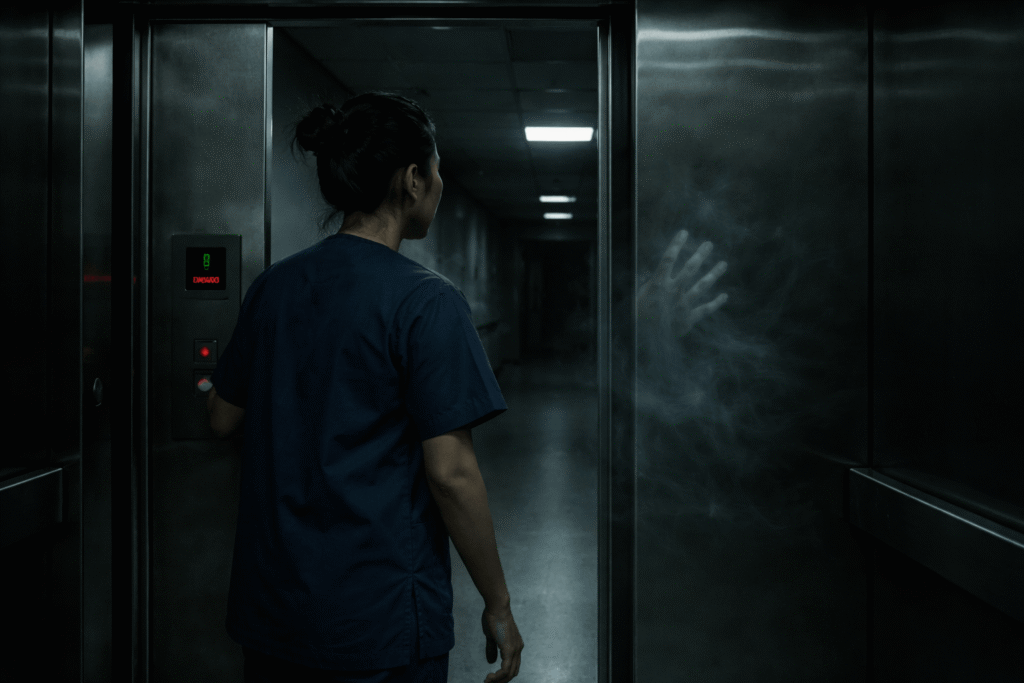
Later that night, at 1:50 a.m., Mabel took the service lift to B2 to collect the blood forms. The overload alarm shrieked before the doors could close.
OVERLOAD.
Mabel stared at the glowing warning, then glanced at the clipboard and phone in her hands. She stepped back into the corridor, and the alarm fell silent.
For several seconds, she watched the empty lift. Feeling foolish, she stepped inside again.
This time, the floor dipped beneath her feet, as though another passenger had entered behind her.
The alarm erupted.
OVERLOAD.
A few seconds later, the alarm cut out and the doors slowly closed.
The lift began to descend without its usual jolt. It glided smoothly downward, carrying her deeper beneath the hospital.
Mabel watched the floor display, but it remained blank.
The Patient Who Came from the Morgue
After what felt like far too long, the lift stopped without a chime.
The blank display flickered to life. A single letter appeared—M—just before the doors opened onto the morgue corridor.
Mabel remained inside, confused. She had pressed B2, not the morgue.
Before Mabel could reach for the controls, a figure beyond the doors caught her eye.
A barefoot man in a hospital gown stood with his back to her. Some of the fear gripping her began to ease. He must have wandered down from one of the wards.
“Sir, you can’t be out here.”
The man slowly turned to face her. He was thin and middle-aged, with dull, colourless skin.
“I took the wrong lift,” he said.
Mabel stepped closer. “Which ward are you from?”
His dry lips formed a faint smile. “You should ask where I came from.”
As he raised his hand, a stiff white tag swung from his wrist. Mabel recognised it at once—the kind attached to bodies in the morgue.
When she saw that the date was three days earlier, the last of her relief vanished.
When Mabel looked at him again, dark purple stains were spreading across his face and neck. His skin sagged around one clouded eye, revealing the unmistakable marks of a body that had been dead for hours.
He slowly pointed over her shoulder. “You can’t keep them waiting.”
Mabel followed his finger towards the lift—and saw that she was no longer alone.
Pale figures stood packed shoulder to shoulder behind her. Some wore hospital gowns, while others wore faded uniforms from another era. Their heads remained bowed.
They had been inside with her the entire time.
Mabel woke on the floor with staff gathered around her and the sharp sting of ammonia beneath her nose.
The Dead No One Else Could See
Occupational Health blamed Mabel’s collapse on exhaustion and low blood sugar.
The CCTV footage showed Mabel stepping out of the lift alone, speaking to an empty corridor, and collapsing moments later.
“That’s all the camera caught,” the clerk said.
“There were people in that lift.”
The clerk lowered her voice. “You’re just too tired.”
Later, Hafiz, an elderly cleaner from the night shift, found Mabel smoking beside the loading bay. She had quit two years earlier, but her hands would not stop shaking without the cigarette between them.
He listened quietly as she told him what had happened.
“This hospital wasn’t always a hospital,” Hafiz said when she finished.
Mabel looked towards the dark building behind them.
During the war, he explained, detention sheds had stood on the hill. Prisoners were brought there to be registered, questioned, and held. Many never left.
“The sheds were torn down,” Hafiz said. “Then they built the hospital over them.”
“So you think it’s haunted?”
“I think some places remember what they were used for.”
After that night, Mabel began noticing things other people never seemed to see.
A visitor at the vending machine became a gaunt man in torn khakis, his wrists dark with bruises. Reflections remained in windows after the people had already walked away.
At 2:13 each morning, the hospital changed most of all.
The corridors remained quiet, but no longer empty. Mabel felt unseen bodies crowding every chair, doorway, and stretch of wall, their decades of waiting thickening the air.
They waited in silence, as though expecting someone to call their names.
They Knew She Could See Them
Soon, they noticed her.
A little girl in an old-fashioned cotton dress stood at the end of the pediatric hall, hands folded, watching Mabel. An elderly man with a drainage tube in his side waited outside a locked theatre and nodded as she passed. Figures appeared in lift reflections before they appeared inside the lifts themselves.
Then they began moving closer, one at a time, like patients waiting to be called.
One stood beside her at a hand-washing sink, visible only in the steel mirror. Another crossed the ICU threshold, though the sensor doors never opened.
By the fourth night, Mabel realised something worse.
The dead were becoming easier to see.
The living began to look out of place. Staff faces blurred when they spoke, and their voices seemed to come from far away. Meanwhile, the silent figures in the corridors grew sharper by the hour, their eyes bright with need.
Mabel did not know what they wanted, only that they believed she could give it to them. Their need followed her through the wards, pressing harder into her thoughts each night until she could no longer ignore it.
The Hospital No Medium Would Enter
She began searching for someone who could help them.
First came a temple medium, followed by a bomoh recommended by one of the kitchen staff. Then came a man who called himself a spiritual engineer and demanded payment before hearing what had happened.
None of them stayed.
One fled after watching the lift display change floors by itself. Another stood outside the hospital with his eyes closed for several seconds before shaking his head.
“No. This place is already arranged.”
Madam Ong was the last to come—and the first to explain what they were facing.
“A haunting is one house, one death, one wound,” she said. “This is administration.”
She was small and stern, with the faint smell of sandalwood and mothballs clinging to her clothes. She requested the hospital’s oldest floor plans, a basin of clean water, rice, joss paper, salt, red thread, and the names of every wing built over the original grounds.
Before entering the hospital, Madam Ong warned Mabel that the ritual would not release everyone.
“Some are trapped. Some are attached. Others no longer trust release. They have been here too long.”
At 2:13 a.m., they began.
Madam Ong walked along the hospital corridor with a brass bell in one hand and red thread in the other, softly calling for the forgotten to step forward.
Mabel poured salt across each junction while joss ash slowly blackened the water in the basin.
Then the ward doors opened by themselves.
The patients slept as the machines continued their steady rhythm, unaware that the corridor was filled with the dead.
They came forward as they believed their turn had finally arrived.
The One the Ritual Could Not Release
What happened next felt almost procedural.
Madam Ong stood in the lift lobby, ringing the brass bell as she called for the forgotten dead to follow the path she had opened.
One by one, the figures crossed the salt lines and stepped into a brightness no electric bulb could produce.
For a moment, Mabel saw them clearly: starving men in work clothes, nurses from another era, patients in outdated gowns, a boy wearing only one shoe, the barefoot man from the morgue, and the little girl from pediatrics.
Their faces were not peaceful. They merely looked less burdened, as though a weight had finally shifted from their shoulders.
They vanished within the brightness like breath fading from glass. When the last figure disappeared, the light faded and warmth returned to the empty corridor.
Mabel turned towards Room 713, already knowing what she would find.
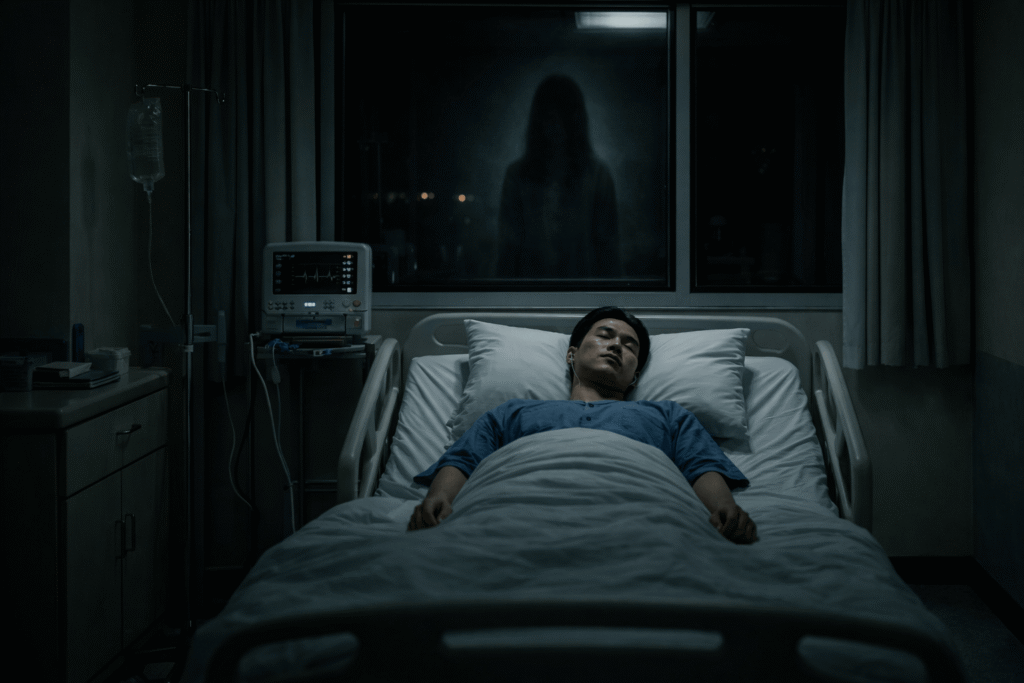
The chair was still occupied.
The woman from the accident sat where she always had, damp hair falling across one cheek as she watched Wei Jun.
Madam Ong stopped beside Mabel.
“I warned you,” she said. “Some choose to stay.”
“The woman?”
Madam Ong’s expression hardened. “She is waiting for him.”
Wei Jun’s monitor continued its slow, steady beeping.
The Haunting That Stayed
After the ritual, Mabel asked for a transfer. By the time it was approved, the hospital had begun to feel different.
The service lift stopped only where it was told, and staff once again sat near Room 713 without glancing nervously at its door.
But the room was never truly empty.
When Mabel happened to pass by Room 713, she saw the woman still seated beside Wei Jun. He remained unconscious, and she was still waiting.
In the years that followed, new nurses began whispering that the hospital was much better than before.
The hospital was never truly empty; its dead had simply learned to hide.
Related Stories
Wei Jun should not have stopped that night.
Some roads do not lead forward. They remember who passed through—and who didn’t leave things where they should have.
The Night Route Rules Truck Drivers Refuse to Explain
Long before Mabel stood beside her brother’s hospital bed, she had already heard the dead wait in silence.
When Ryan jokes about a rider lost on a rain-soaked hill road, Mabel is forced to face a different haunting—one that follows him home and keeps crawling.