Lin Sheng noticed something wrong with the boy before he even spoke. The child simply stood in the doorway for too long.
“Gong Gong,” his grandson said at last, stepping inside. “Can I ask you something?”
Lin Sheng looked up from his talismans, his eyes landing on the woven amulet he had made for the boy’s chest.
“What is it?”
The boy hesitated, his fingers unconsciously drifting up toward his collar. “A few days ago, at school… we played something. A game.”
Lin Sheng said nothing. Children played all kinds of games. Paper games. Whispered dares. Small rituals disguised as harmless fun.
“There was a piece of paper,” he continued. “It had words written on it. And there was a bowl of water in the middle. We all put one finger on the rim.”
Lin Sheng’s hand froze above his talismans.
“How many of you?” he asked, his voice dropping an octave.
“Four,” the boy said. Then he frowned, looking confused. “No… wait. Five. I think there were five of us. But whenever I try to remember the fifth one, I can’t see the face.”
A chilling unease passed across Lin Sheng’s face. He looked down; the edges of the woven amulet were already staining an unnatural black.
“And then?” Lin Sheng asked quietly. “What did the bowl do?”
“It kept circling,” the boy continued, his voice dropping. “We tried to take our fingers off, but it felt like our skin was stuck to the rim. It didn’t stop until the bell rang.”
“The fifth one,” Lin Sheng said, his voice terrifyingly calm despite the storm rising in his chest. “The one whose face you cannot see. Was that person wearing red?”
“No,” the boy replied, looking confused.
The Game That Opened the Door
Lin Sheng looked at his grandson’s frightened face, a quiet realization calming his initial panic. It wasn’t what he had feared. It was just a common wandering spirit that had latched onto the vulnerable curiosity of children.
“You will be fine,” Lin Sheng said, his voice softening as he patted the boy’s shoulder. “The amulet did its job. It keeps the malice from rooting inside you.”
“But what about the other three?” the boy asked, his voice trembling. “When they came back to school, their behavior changed. They got angry over everything, sometimes for no reason.”
“Because they didn’t have protection,” Lin Sheng explained. “When a ritual bowl keeps circling, it means the door was left open. A wandering spirit doesn’t always kill. Sometimes, it just feeds on their minds and twists their thoughts into rage.”
The boy looked up at Lin Sheng, his eyes pleading. “Can you help them, Gong Gong?”
Lin Sheng looked down at his grandson’s worried face and offered a reassuring nod.
“They will be fine,” Lin Sheng said. “Those wandering spirits cannot remain for long. The sunlight will help them.”
The boy let out a breath of relief, his hand relaxing against the amulet.
Lin Sheng looked past him.
He had seen this before.
Years ago, in a village where the dead had been invited in through what everyone had mistaken for a game.
Lin Sheng had been twenty-eight then—young enough to believe that anything summoned could be sent back.
The village taught him otherwise.
The Flawless
Back then, they called him the Flawless.
The name began as praise, though not everyone used it kindly. Lin Sheng demanded absolute precision in every ritual, preparation, and word spoken before the altar.
By twenty-eight, he had built a reputation that made frightened families bow before he crossed their threshold.
He knew the steps flawlessly and never needed to question what lay beyond them.
A plea cut through the midnight rain. Lin Sheng answered the call and left with him before the sun rose.
Beyond a narrow path of old pines lay the mountain village.
Its headman met him with relief clouded by shame. “At first, we thought one family had angered the dead,” the old man said.
“Then a second child began speaking to empty corners, and a third stopped answering to her own name. Now the adults hear an extra set of footsteps whenever the children walk together.”
What the Children Disturbed
The headman’s unease meant little to Lin Sheng. Failure was still a stranger to him.
“Start from the beginning,” he said.
Twelve nights earlier, five children had climbed the back slope at dusk, returning after curfew muddy to the knees.
By morning, their bizarre behaviors started: one spoke to empty corners, another ignored her name, a boy laughed when others cried, and a fourth woke with dirt under her nails, claiming she had been weeding a grave.
“And the adults?” Lin Sheng asked.
“One mother saw a red shape pass through her courtyard without touching the ground.”
Lin Sheng assumed it was just a common spirit harassing the living. Before sundown, he followed two villagers to the slope where the children played.
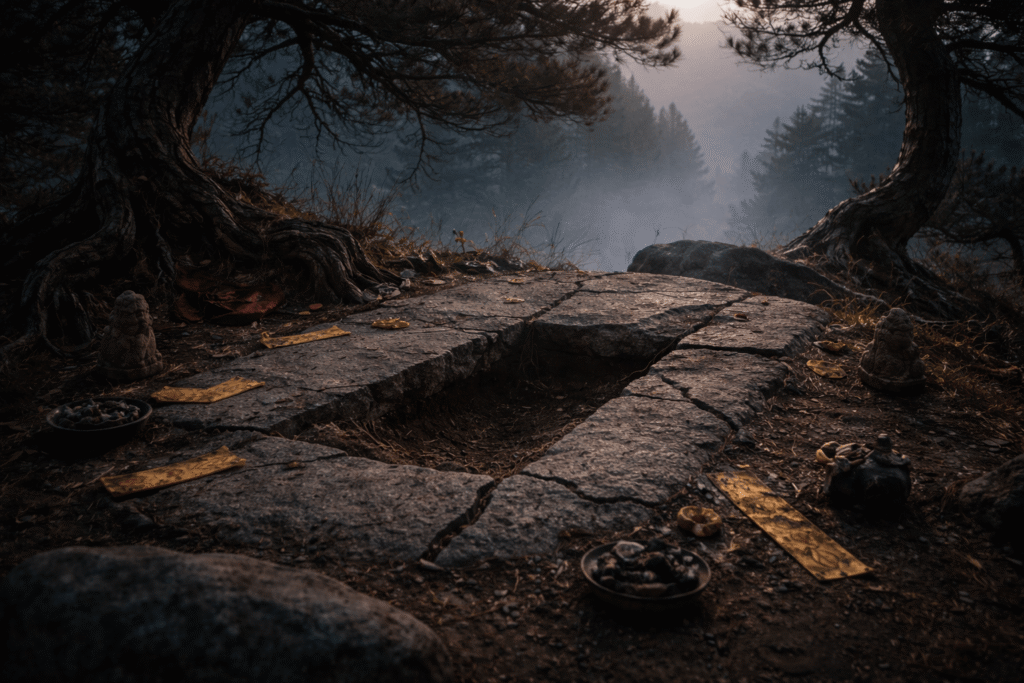
Beneath a knot of twisted roots lay a grave, far from the others. Its headstone bore a deep crack, the name deliberately chiseled away. Dead leaves and weeds choked the mound.
“What did the children do here?” Lin Sheng asked.
“They gave different answers,” the younger villager said. “One said they kicked the stone. Another said they dug beside it. The others claimed they only walked around it in a line.”
Lin Sheng crouched.
Beside the mound, five sets of small footprints formed an unbroken circle. He pressed a yellow talisman against the cracked stone. Blackness bled from beneath his fingers and devoured the paper.
“Has anyone opened this grave before?” Lin Sheng asked.
“No.”
Lin Sheng did not yet understand that the curse worked like a slow poison. Twelve days earlier, the children had merely spoken to empty corners and stopped answering to their names.
Now, their bodies were beginning to decay.
The Pattern Beneath the Curse
That night, Lin Sheng slept in the ancestral hall and dreamed of children standing in single file, each with both hands resting on the shoulders of the child ahead. When he turned to count them, they had no faces.
Only the last child wore red.
By daylight, the village tried to look ordinary. But Lin Sheng had handled enough cases to recognize when a place was pretending for its own sake.
He visited the five children one by one, searching for a common thread.
The first, a boy named Ren, was being consumed by his own bile. His skin had turned a sickening yellow, and his swollen liver pressed visibly beneath his ribs.
The second child, Shu Lan, lay drenched in feverish sweat. Her heart hammered so violently that each beat jolted her chest beneath the blankets.
The third child’s spleen was failing. The rot spreading through his belly had driven him into delirium, leaving him clawing at himself until his parents tied his hands to the bedposts.
The fourth child gasped for air in a room that smelled of rust. Every breath collapsed into a thin wheeze, and she coughed up grey ash instead of phlegm.
The fifth, a toddler, sat frozen in terror. Blood trickled from his ears as he listened to a sound no one else could hear. His small body had swollen tight with trapped fluid as his kidneys began to fail.
Lin Sheng stepped into the village street, the pattern settling heavily in his mind.
This was no possession, but something far worse.
The Ritual Beneath the Grave
Unable to trace the curse through the villagers’ accounts, Lin Sheng sent word to Mei Jie, an acquaintance in the county town. She was a widow who copied temple records for pay—and funerary records for anyone who asked politely enough.
She arrived carrying old ledgers wrapped in oilcloth.
“I heard there was an erased grave,” she said. “And inconsistent records.”
Mei Jie unwrapped the oilcloth bundle and spread the old ledgers before him. Records from forty-three years earlier referred to a “five-fold vessel” prepared for ascension. She set the relevant pages between them.
“These are not random children.”
Lin Sheng studied the faded ink again, more slowly.
Wood. Fire. Earth. Metal. Water.
Five elemental birth alignments—and five corresponding organs now failing throughout the village. His mouth went dry as the meaning revealed itself.
The children had not disturbed an ordinary grave. They had stepped into the remains of a ritual.
The One Dressed in Red
Mei Jie had traced the hidden records to a ruined temple. The rite described within them was obscene in its patience.
A practitioner seeking to become a ghost deity—a guixian, an immortal spirit existing beyond the boundaries of proper death—could not ascend through strength alone.
Five children born under specific elemental destinies had to be bound to the ritual body, their life forces sustaining its transformation. Through their suffering, the practitioner would be rebuilt into something divine and terrible.
“There’s more,” Mei Jie said.
She carefully pried apart two pages sealed along the binding seam. Hidden between them was a sketch of a child-sized figure dressed in old ceremonial red. Two concentric circles darkened each eye.
Double pupils.
Constructed sight.
“The grave was never meant for burial,” Lin Sheng whispered.
“No,” Mei Jie said, her voice falling to a hush. “It was part of the ritual.”
A Rite Against Ascension
Until now, he had believed he was dealing with a single wandering spirit—an easy matter to settle.
But a ghost deity stood behind the curse. Even incomplete, the ritual proved that the entity was far from ordinary.
“If this succeeds,” he told Mei Jie and the village headman, “the entire village will be at risk. We cannot know what a ghost deity will do once it ascends. I must prepare a rite to break the transformation.”
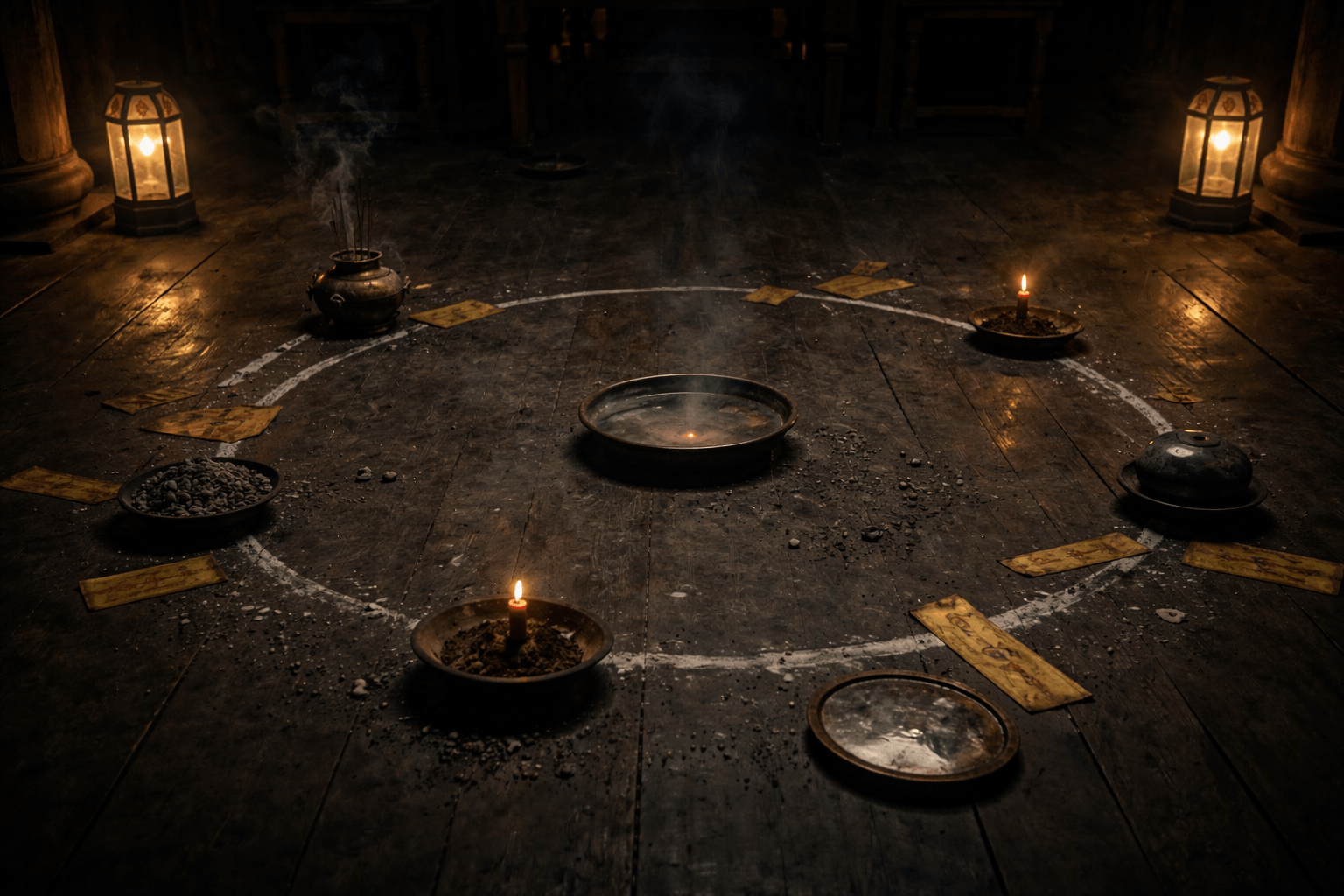
He quickly gathered what he needed: a block of raw pine, a rusted iron spike, a lump of wet river clay, a jar of charcoal ash, and a heavy brass bowl—one counter for each elemental line.
Across the floor of the ancestral hall, he drew a boundary in chalk and anchored the five objects at marked points around it.
By sunset, the children had been brought inside.
None could walk without help. The headman and several trembling fathers carried them in one by one, laying them gently upon blankets within the chalk boundary.
Their conditions had worsened by the hour. Ren’s skin had deepened to a sickly yellow-green as fever consumed him. Shu Lan’s chest bucked with each violent heartbeat, while the others whimpered through shallow breaths and blood-flecked lips.
Lin Sheng looked down at the five frail bodies arranged inside the circle.
The air in the hall was turning deathly cold.
The Rite Beneath the Illusion
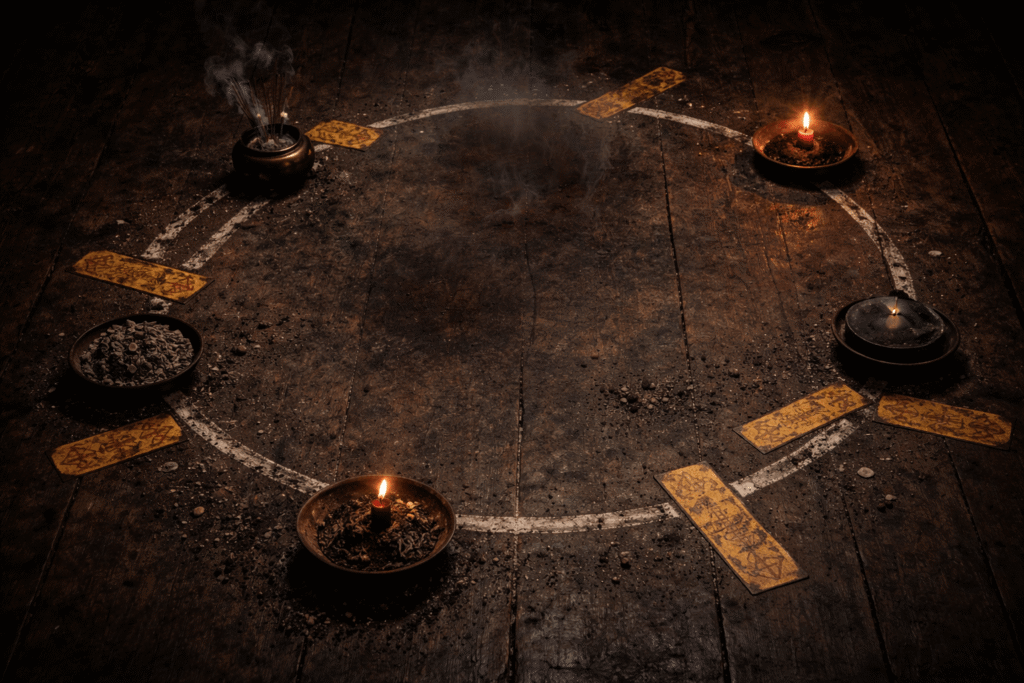
Lin Sheng lit the first talisman. The paper caught with a sharp snap, casting long shadows across the ancestral hall as he began the counter-rite.
Something shifted at the edge of his awareness.
The chalk lines appeared whole. Each elemental counter rested precisely where he had placed it. Yet a faint resistance scraped at the back of his mind, as though the room were trying too hard to appear correct.
For the first time in his life, doubt entered him.
He examined the circle once more and found no mistake. The lines remained clean. The objects remained perfectly aligned. Even the five children lay motionless within the boundary.
Lin Sheng forced the unease aside and recited the opening chant.
The spirit watched from within the freezing air.
Its illusion had already settled over the village, slipping into every mind beneath it. To Lin Sheng, the ritual circle remained flawless. Beneath that borrowed vision, the chalk marks twisted across the floor in a geometry he had never drawn.
He continued chanting, believing he was binding the entity.
Instead, the corrupted lines opened like channels. Elemental energy poured from the dying children, passed through the five counters, and fed directly into the unfinished ghost deity.
With every word Lin Sheng spoke, the ascension quickened.
When the Illusion Broke
Lin Sheng had been too confident.
Years of success had taught him to trust his own sight. Suspecting nothing, he continued the rite, sending line after line of the ancient chant into the freezing air, certain that invisible bonds were tightening around the spirit.
At dawn, the illusion broke.
Pale morning light pierced the windows, and the ancestral hall changed before his eyes. The flawless boundary vanished. In its place, corrupt sigils twisted across the floor in shapes his hand had never intended to draw.
Lin Sheng rushed to the blankets.
He was too late.
All five children had died sometime before dawn. Ren’s skin had darkened to a sickly yellow-green. Shu Lan’s chest lay motionless, while the others rested cold and breathless beneath their blankets.
The ritual had emptied them.
Lin Sheng’s rite had succeeded—but it was no longer his rite.
At the centre of the hall, where the stolen elemental energy had gathered, the air warped and thickened. Shadows drew together, slowly taking the shape of a small figure.
It was the girl in red from his dream.
Her head remained lowered until the last trace of darkness settled around her body. When she finally looked up, two concentric circles filled each eye—the double pupils of constructed sight.
She laughed softly.
The sound passed through Lin Sheng like winter entering an open grave.
“Finally,” she whispered. “This body is complete.”
The Mercy of a Monster
The ghost deity turned her double-pupilled gaze upon Lin Sheng, who remained frozen among the ruined chalk lines.
“Since you helped me complete the rite,” she said, her voice layered with a chorus of whispers, “I will grant you mercy. I will take no more lives from this village.”
A smile touched her lips as she stepped backward into the shadows.
The air warped around her. In the next instant, she was gone, leaving behind only the smell of dust and burnt copper.
Silence closed over the hall.
Lin Sheng sat among the corrupted sigils, staring at the five motionless bodies. He had trusted his knowledge without question, and through his own hands, something monstrous had ascended.
The village headman and the children’s parents rushed inside.
Their cries tore through the morning.
One mother collapsed beside the blankets. Another gathered her child into her arms and called his name again and again. Lin Sheng could not bring himself to look at them.
He remained only long enough to collect the few talismans the rite had not consumed. Without offering an explanation, he slipped from the ancestral hall and left the village by the old pine path.
He never looked back.
What Followed Him Home
Years passed after that terrible dawn.
Lin Sheng was an old man now, his hair silver and his back bent slightly beneath the weight of time and memory. In the dim light of his room, he watched his young grandson standing before him.
With trembling fingers, Lin Sheng adjusted the woven amulet around the boy’s neck.
“Do not take this off,” he warned. His voice was low and solemn. “Never. It is the only thing that can protect you from what hides in the dark.”
He held the charm between his fingers and looked into his grandson’s eyes.
“Watch it closely. If the casing begins to change colour—or turns completely black—you must come to me at once. Do you understand?”
The boy nodded quickly, sensing the gravity in his grandfather’s voice, then ran off to bed.
Left alone in the quiet house, Lin Sheng walked slowly to the open window.
He stood there for a long time, staring into the darkness beyond the glass. A cold current brushed against his skin.
Far across the courtyard, something red moved between the shadows.
A small figure in ceremonial cloth stood watching him.
Lin Sheng blinked.
It was gone.
Related Stories
They thought they were only four when the game began.
But something joined them—and it didn’t leave when they stopped.
Four Players. More Than Four Returned That Night
A desperate choice brings relief at first—money returns, life stabilizes, and nothing seems wrong.
But the thing that grants it does not stop… and when it cannot move forward, it begins to feed inward.