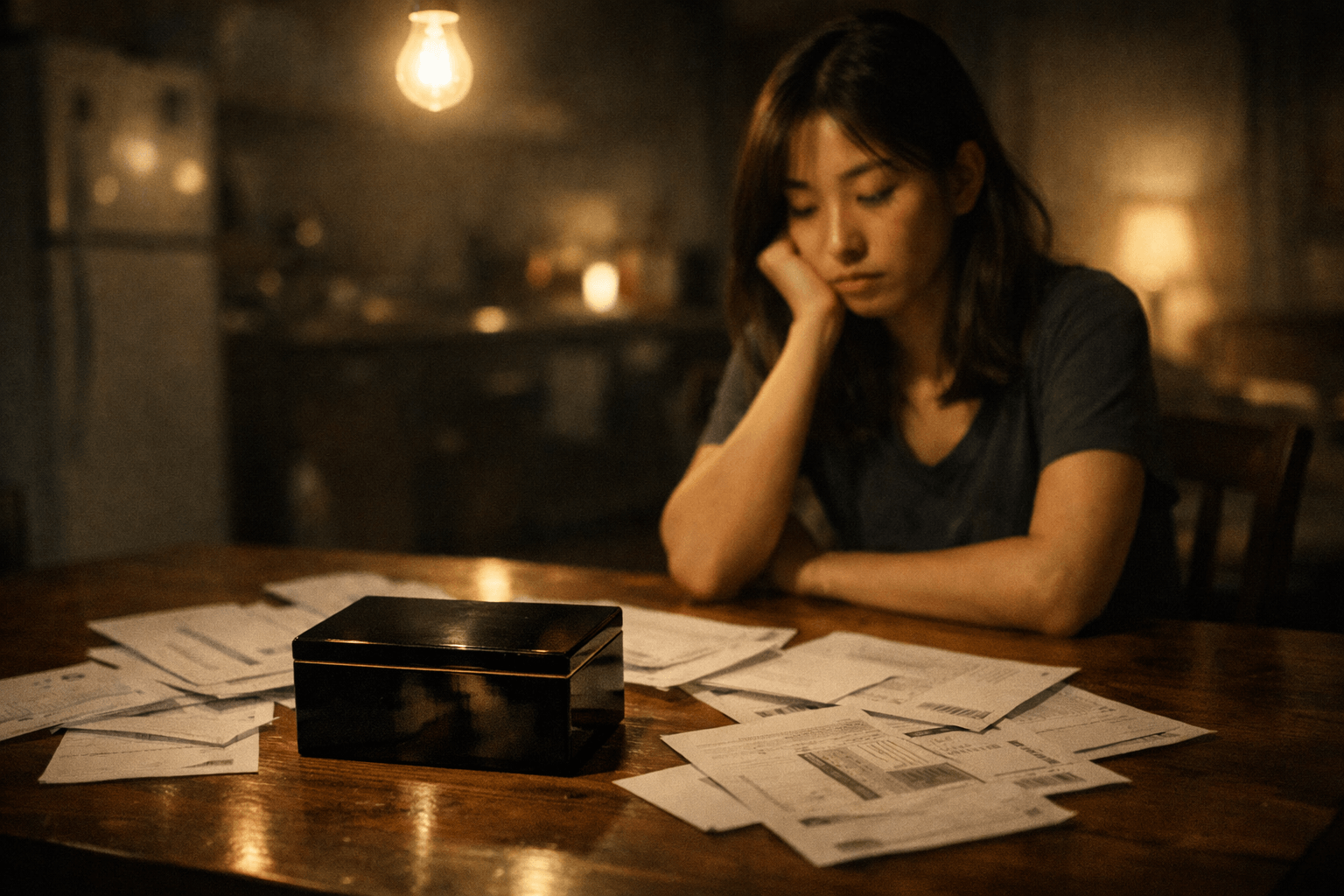
The first letter lay open beside the rice bowl, its red print beginning to curl in the damp heat that entered the apartment each evening. Beside it sat three more envelopes.
The table no longer looked like a place where a family ate. It looked like a place where failure had been sorted into neat stacks and left beneath a single weak light to be counted.
Mei Xuan sat without moving. Her mother coughed softly from the bedroom. Across the room, her younger brother bent over his schoolwork, though his pencil had not moved for several minutes.
Her mother emerged carrying a cup of plain hot water.
“The landlord called again,” she said. There was no anger in her voice, only exhaustion. “I told him one more week.”
Her brother lowered his head further.
Mei Xuan looked from the bills to the thin gold ring still on her mother’s finger.
“I’ll find something,” her mother said. She had said the same words many times before.
After her mother returned to her room and her brother switched off the study lamp to save electricity, Mei Xuan stayed at the table.
She read each amount again, though she already knew them by heart. By the time she rose, choices she would once have dismissed no longer seemed impossible.
Two days later, the suggestion came at a coffee shop near the bus interchange.
The Woman in the Mountains
Liyun had once borrowed money from Mei Xuan and repaid it late, with three separate apologies. Now she turned her paper cup between her hands and glanced toward the door.
“I heard there’s a woman in the mountains,” she said.
“Not a temple priestess or one of those fortune tellers in the market. An old woman people visit when their prayers stop working.”
Mei Xuan almost laughed, but Liyun’s expression stopped her.
“I know how it sounds. My cousin went to her when her husband’s debts were about to cost them their home. Afterward, things changed.”
“How?”
“Money came in. Work returned. Not immediately, but it came.”
Liyun lowered her voice.
“You only have to be willing to carry something.”
That night, Mei Xuan searched for the woman in the mountains.
Most of what she found was contradictory: old forum posts, copied articles and stories about gu sorcery (蛊术) in the Miao Highlands. Some mentioned insects and poison. Others spoke of hunger, bloodlines and debts passed from one person to another.
One warning appeared again and again:
Whatever you carry home must be fed.
Mei Xuan kept reading until the window began to lighten. She told herself she was only gathering information but she saved the directions.
Beyond the Ridge
By dawn, the decision had been made. Mei Xuan had checked the train routes and counted the cash in her wallet twice.
The journey took most of the day.
A train carried her out of the city, followed by a bus that climbed along wet mountain roads. By late afternoon, her phone had lost its signal, and the houses appeared only at long intervals.
She walked the final stretch alone.
The path narrowed as weeds and bamboo pressed closer, leaving the trees strangely silent.
Beyond the ridge, the path ended at a small house beneath a crooked persimmon tree.
An old woman sat outside with her hands resting in her lap. She did not rise when Mei Xuan approached.
“You’ve come a long way,” she said.
Mei Xuan hesitated. “I heard people come here when nothing else works. I wasn’t sure it was real.”
The old woman looked at her clenched hands.
“Desperation travels farther than intention.”
Mei Xuan slowly released her fingers.
The Golden Silkworm Hex
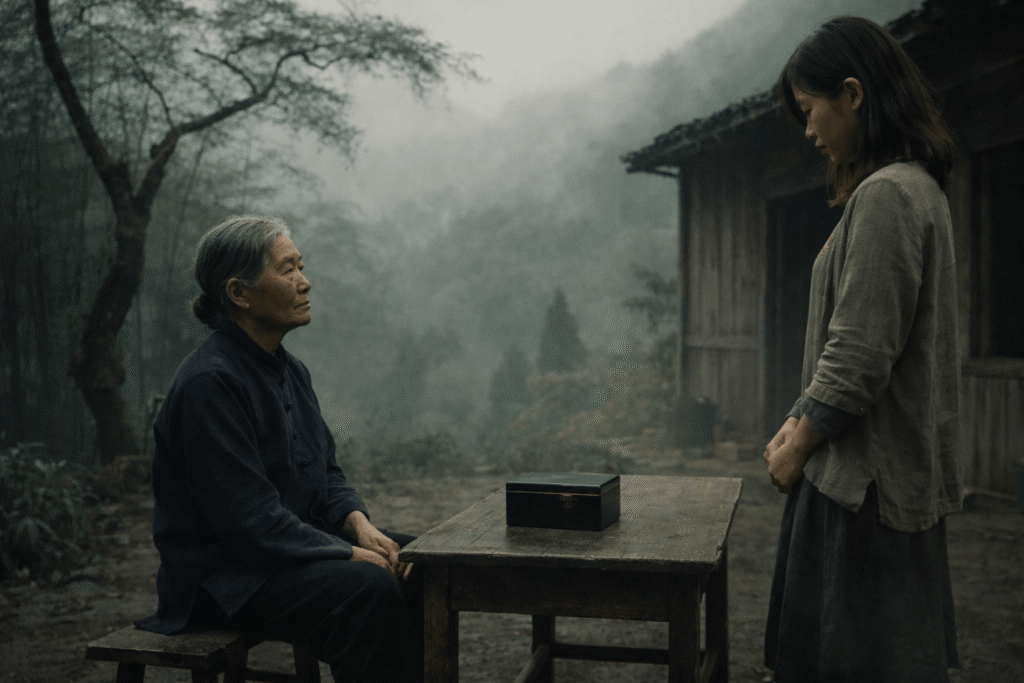
Inside, beneath the smell of dried roots, lingered a faint animal odour.
The old woman placed a small black lacquered container on the table. A dull gold line circled its lid.
“People come here for the same reason,” she said. “They want what life has refused them.”
“This is the Golden Silkworm Hex—金蚕蛊.”
“What does it do?”
“It gathers wealth. Opportunities appear. Closed doors begin to open.”
The old woman rested one finger on the lid.
“But it must be fed.”
“Fed with what?”
The old woman glanced at Mei Xuan’s throat.
“Whatever is easiest to take.”
She lifted the lid a finger’s width.
Mei Xuan saw only darkness and something shifting beneath it.
Skrr… skrr…
A sweet metallic smell rose through the gap, and the back of Mei Xuan’s tongue went cold.
“What happens when it grows hungry?”
“It begins with what you give it.”
“And if that isn’t enough?”
The old woman lowered the lid.
“Then it chooses.”
Mei Xuan thought of the thin gold ring on her mother’s finger.
She reached for the box.
Her hand trembled once before closing around it.
What the Box Brought
The bookkeeping firm called three days after Mei Xuan returned home. They offered her regular hours and spoke as though the months of silence had been an oversight.
The landlord agreed to divide the arrears into smaller payments. A week later, her brother received a bursary that covered his school fees. Her mother began discussing groceries and household repairs again.
Mei Xuan told herself that luck had simply arrived late.
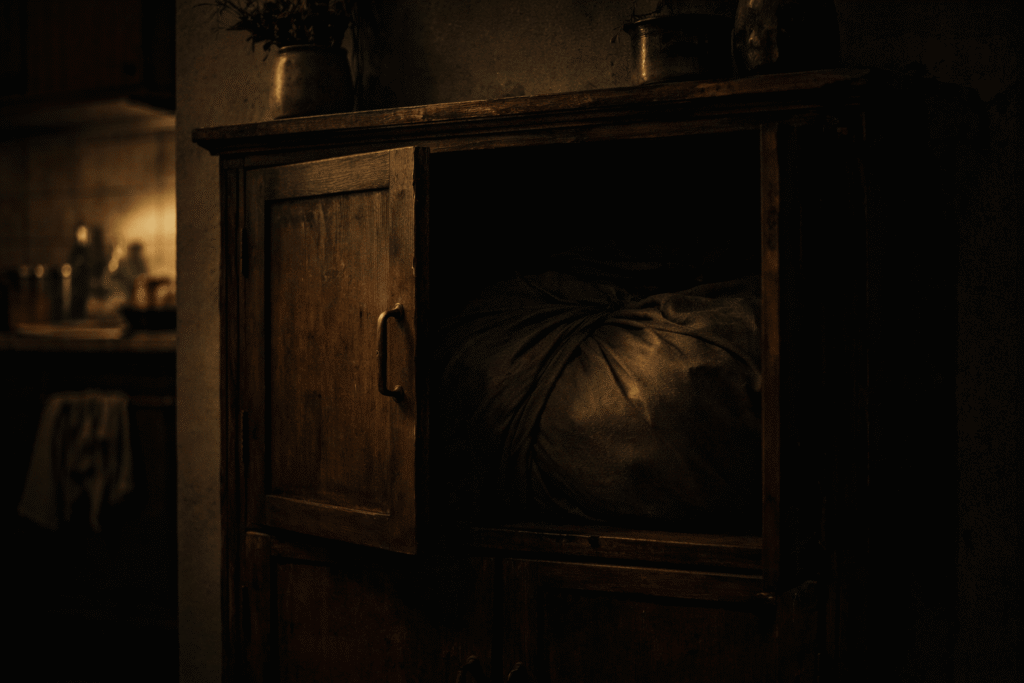
At night, faint scraping came from the cupboard where she kept the lacquered box.
Skrr… skrr…
Whenever good news arrived, the sound grew louder.
Mei Xuan began waking in front of the cupboard with no memory of leaving her bed. Each time, one of her hands rested against its door.
One afternoon, she found the cloth around the box loosened.
She was certain she had tied it tightly.
As she reached toward it, the lid gave a small shiver.
Krk.
Mei Xuan slammed the cupboard shut but the scraping continued behind the door.
Before the Full Moon
Months passed.
Mei Xuan paid the bills on time, replaced her mother’s cracked slippers and stopped counting every coin at the grocery shop. The box remained wrapped inside the cupboard.
Twice, she took it out intending to return it. Both times, she tied the cloth again.
Near the end of the seventh month, she came home to find a folded note beneath the box.
No one in the house admitted to placing it there.
What you carry cannot remain with you. Pass it on before the next full moon, or it will begin to feed inward.
Mei Xuan read the message three times.
That evening, Mei Xuan wrapped the box and carried it downstairs, determined to leave it with someone she would never have to face again.
At the entrance of the apartment block, she waited.
A faint scrape came from inside the bundle.
Skrr.
People passed at first, then fewer, until the path outside lay empty beneath the streetlights.
By midnight, no one else came.
Mei Xuan tightened her grip on the box and carried it back upstairs.
Feeding Inward
The following evening, Mei Xuan opened the cupboard and froze.
The shelf was bare. Only the folded cloth remained.
A dry scrape came from behind her.
Skrr…
She turned slowly.
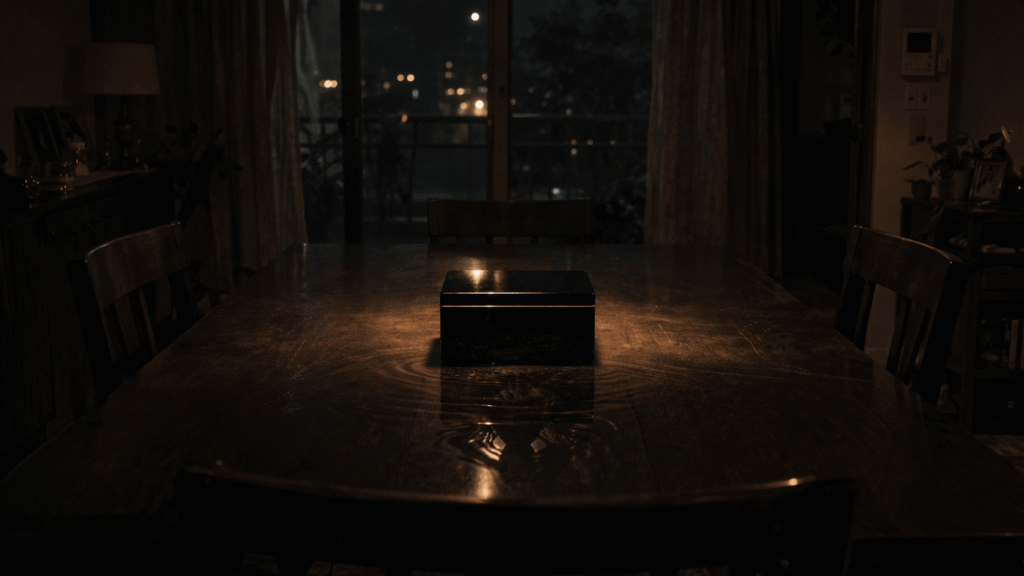
The lacquered box sat open in the centre of the dining table, exactly where the unpaid bills had once been stacked.
There was nothing inside.
The next morning, Mei Xuan woke up with a tightness in her throat. By evening, each swallow stirred something beneath her breastbone.
Two mornings later, a metallic taste filled her mouth. She bent over the sink and coughed until a thin ribbon of blood curled through the water.
Her mother urged her to visit a clinic.
“It’s only stress,” Mei Xuan said.
That night, a wet contraction tightened deep in her throat.
Glllkk…
Something dragged itself lower inside her chest.
Soon, she was too weak to go to work, and sleep came only in short, broken stretches. By the sixth day, her cheeks had hollowed and the skin beneath her collarbones appeared drawn inward.
When she touched her throat, something beneath the skin pushed against her fingertips.
The Old Woman’s Answer
On the seventh morning, with no other choice left, Mei Xuan decided to return to the Highlands, carrying the box beneath her coat.
Her legs weakened on the way to the station, forcing her to stop several times and steady herself against the walls.
By the time she reached the final slope, her breathing had grown shallow and uneven.
The old woman was sitting outside in the same place as before.
When Mei Xuan saw her, she dropped to her knees and pushed the box across the swept yard.
“Take it back,” she said. “Please.”
The old woman looked down at it.
“I warned you that relief was not the same as help.”
“I’ll pay anything.”
“You already have.”
Inside the house, Mei Xuan lay curled on the wooden floor. The lacquered box rested between them.
“It fed on your needs first,” the old woman said. “Then it fed on your fear of losing what it gave you.”
Mei Xuan pressed one hand to her throat.
“Why is it inside me?”
“You kept it too long.”
The old woman placed her hand on the lid.
“When it cannot be passed forward, it turns inward.”
A slow, wet movement stirred deep inside Mei Xuan’s chest, folding her around the pain.
Across from her, a strange smile slowly spread across the old woman’s face.
The Life It Bought
Mei Xuan pushed herself up, but dizziness swept through her and the room lurched sideways.
“Why me?” she managed, her voice barely more than a breath.
The old woman looked at her.
“Because you came.”
“If it had not been you, it would have been someone else.”
Mei Xuan looked at the lacquered box between them.
“You see, I was dying,” the old woman said. “The doctors called it cancer. They told me I only had months.”
She rested a hand against her chest.
“But I did not want to die. So I turned to what had been passed down through my family.”
“Each person who carried the box gave me a little more time.”
She looked at Mei Xuan.
“That was years ago.”
Mei Xuan’s fingers curled against the floor. “So you used me to keep yourself alive.”
The old woman did not deny it.
“You came asking for help. I gave you what you wanted—and took what I needed.”
“You knew it would kill me.”
“Yes.”
The old woman glanced at the lacquered box.
“The hex cannot create fortune from nothing. Whatever it gives must be repaid.”
Mei Xuan struggled to draw breath. “With my life?”
“Not at first. It began with your fear and your need for what it offered.” The old woman looked at her chest. “But when you kept it past the full moon, the debt turned inward.”
She curled onto her side, fighting for breath.
“Take it out,” she managed.
“It is no longer only in the box,” the old woman said. “Once the debt turned inward, it rooted itself inside you.”
Mei Xuan clutched her chest.
“There is nothing left to remove. It will not stop until the debt is paid.”
Mei Xuan’s breathing weakened to a faint, uneven rasp.
The Life That Continued
“I didn’t invent this,” the old woman said. “It was passed down. Not in the form it was meant to take, but enough of it survived.”
“My grandmother used to speak of a gifted girl who refused to accept death.”
The old woman’s voice lowered.
“She discovered a ritual that could carry a person beyond it—not merely delay the end.”
“And unlike me, she had the skill to complete it.”
“But I could never complete the ritual,” the old woman said. “I lacked both her skill and her courage.”
Her hand rested on the lacquered box.
“So I used what remained of it to keep death waiting.”
Mei Xuan’s breathing grew fainter until her chest finally became still.
Only then did the old woman lean forward and place two fingers against Mei Xuan’s throat.
A thin golden shape slipped between Mei Xuan’s lips and curled around the old woman’s waiting fingers. Its body glistened as it writhed, swollen with what it had taken.
The old woman closed her eyes.
The creature tightened around her finger, and warmth slowly returned to her face. Her breathing deepened. The tremor left her hands.
She lowered the Golden Silkworm into the box and closed the lid.
Later, the old woman returned to her chair outside and placed the box beside her feet.
Her eyes settled on the empty path beyond the ridge.
“Who will be next?” she murmured.
Far below the mountain, Mei Xuan’s family sat around the dining table. The envelopes were gone, replaced by bowls of rice and vegetables.
Her mother had prepared too much food.
A cup of plain hot water stood beside Mei Xuan’s empty place. As her mother reached to remove it, the surface gave a small inward ripple.
Related Story
A ritual was performed exactly as instructed—every step followed, every count correct.
But something had already joined before it began… and it was never included in the count.