The Teeth Beneath the Threshold That Still Remember

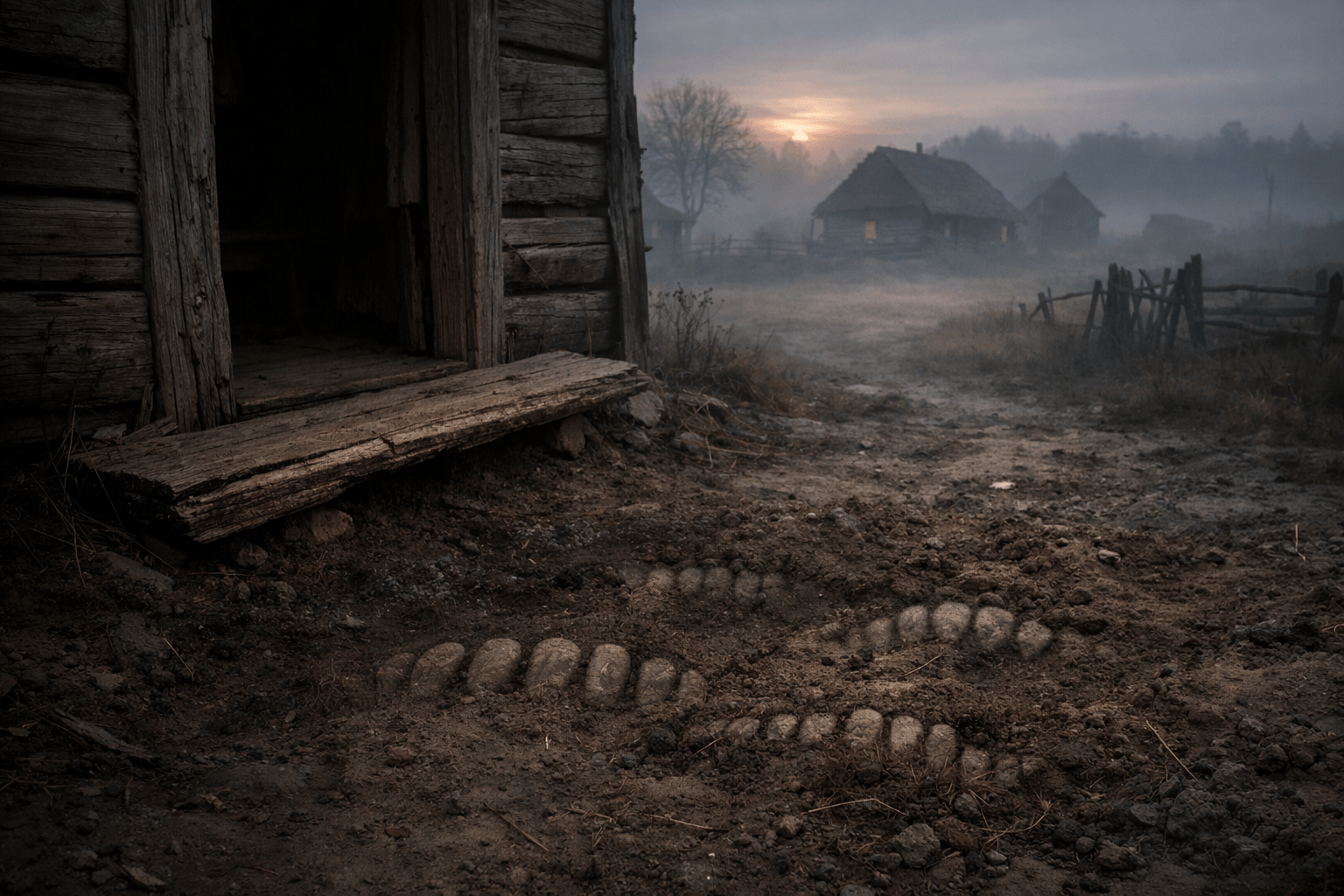
A misty village doorway with something buried beneath the threshold in this teeth buried beneath threshold horror story

In the old village of Sungai Rabit, people still said that wood remembered smoke, soil remembered blood, and teeth remembered what they had eaten.

The criminal had no proper name by the time they brought him out.

Once, he had been a son of someone, a husband for a little while, a man who laughed too loudly at market stalls and bargained over dried fish. But after the bodies were found, after the missing children were counted, after women began bolting their doors before dusk and men walked in groups with parang blades wrapped in cloth, no one in Sungai Rabit used his name anymore. A name gave shape. A name allowed return.

They called him only “that man”.

The stories around him never agreed on sequence, only appetite. A woodcutter found bones in a ditch with marks too deep and narrow for dogs. A girl came home alive but missing half an ear and all her speech. A widow vanished, and what remained in her house looked less like murder than testing—pieces taken in careful order, as if something had been tried, then rejected. Something had sampled her. Certain parts were missing first. It did not take everything. Only what it seemed to notice.

The village headman said the man had become worse than human.

The oldest widow in Sungai Rabit said that was the wrong way to put it.

“He is human,” she told them. “That is why this is dangerous.”

The Ritual of Hunger

A ritual scene in a village where teeth are taken in this teeth buried beneath threshold horror story

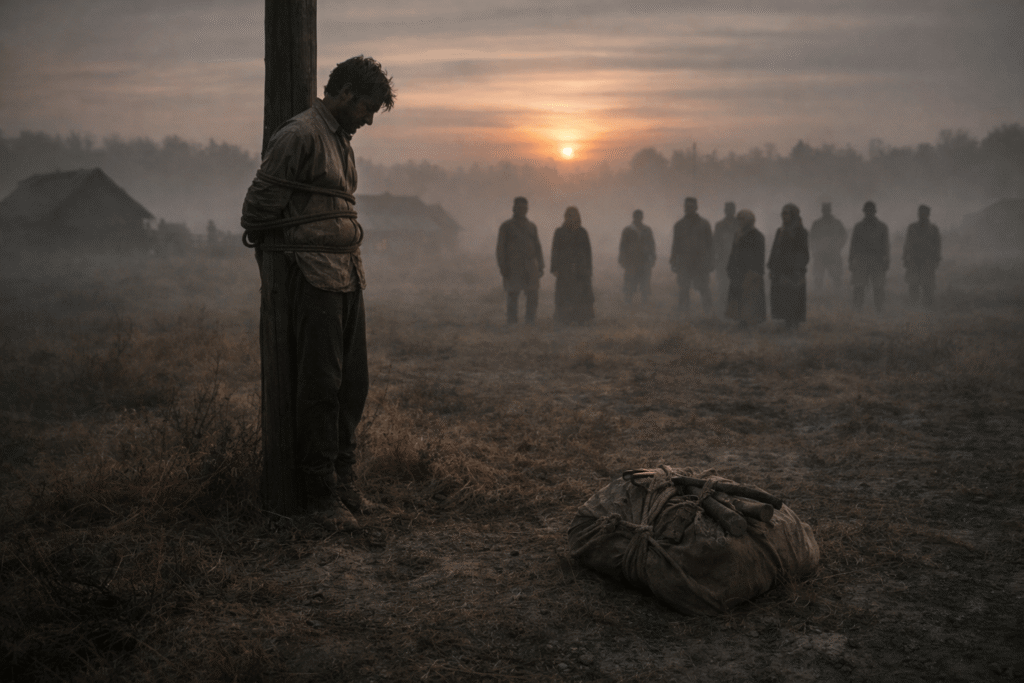
They tied him upright to the post beside the old prayer tree. It was done before sunrise, while the mist still hung low over the flooded fields. He had been beaten badly enough that one eye stayed half-shut, but his mouth kept moving in a wet, amused smile. When he saw how many people had gathered, he laughed through the blood gathered in his gums.

The elders stood together in silence. Behind them waited the black-cloth bundle that held the iron tools.

Execution would come later. That had already been decided. But the elders had argued through the night that death alone was not enough. Death released. Death scattered. Death allowed stories to continue where bodies could not.

It was the oldest widow who finally spoke the thing no one wanted to say.

“If teeth remember what they have eaten,” she said, “then let them eat for us.”

No one answered at first. The morning insects had not yet begun. Even the usual river sound seemed farther away than it should have been.

The headman looked sick. “You mean to use him.”

“I mean to use what made him dangerous,” she said. “If poison kills, some still make medicine from it.”

Another elder whispered, “Threshold burial?”

The widow nodded once.

What the Village Once Buried Beneath Its Doors

There was an old belief in Sungai Rabit, older than the mosque, older than the road, older than any record. When something wicked crossed repeatedly into human life, it could be stopped at the places where crossing happened: doorways, gates, the village bridge, the raised thresholds of the oldest houses. Beneath those boundaries people once buried charms, nails, rooster claws, strips of blessed paper, the milk teeth of children who had not yet learned malice. Boundaries needed mouths, the old stories said. A mouth beneath the threshold could bite away what did not belong.

The village had not used that practice in two generations.

Not like this.

When they opened the black cloth, the criminal leaned forward against the ropes as if curious. Then he spat blood at the headman’s sandals and smiled wider.

“Will it help?” someone in the crowd asked.

The oldest widow did not look away from the man. “Only if the teeth still know evil when they taste it.”

The Taking of the Teeth

They took them while he was alive.

Years later, no one in neighbouring villages could agree how many men held him down or who did the pulling. In some retellings the criminal screamed until his voice broke. In others, he never screamed at all.

The truth was worse.

He screamed only at the first two.

After that, he began to laugh.

It came out thick and bubbling, blood soaking his chin and chest as each tooth was twisted loose and dropped into the brass bowl at the widow’s feet. The sound turned several men away. One vomited beside the prayer tree. The women did not move.

When they reached the back teeth, the criminal’s head trembled violently against the post. His gums tore. Blood streamed over his neck. Still that ruined mouth kept forming something close to joy.

What Lies Beneath the Ground

By the time the last tooth came free, his mouth had collapsed inward like a broken trap.

The widow bent over the bowl. Some teeth were cracked, some dark at the root, some worn oddly flat as though he had bitten more than food in his life. She expected revulsion.

Instead she felt heat.

The criminal looked up at her with an emptied mouth, and somehow his expression still mocked them all.

He made a wet sound. No one understood it at first. Then he worked blood and saliva through the ruin of his jaw until words emerged, slurred and monstrous.

“If the teeth still remember,” he said, “they’ll always be hungry.”

They executed him before noon.

By evening the teeth had been wrapped in yellow cloth, knotted with black thread, and divided into seven small bundles. At each major threshold of Sungai Rabit—bridge, shrine gate, granary, prayer hall, the headman’s steps, the northern footpath, and the old river landing—they buried a bundle beneath packed earth while the widow muttered words too old for anyone else to follow.

For six days the village believed the ritual had worked.

Dogs stopped whining at empty corners. The coughing sickness among the goats faded. A baby who had cried every night since the first killings finally slept through till dawn. Men who had kept machetes under their mats allowed themselves to close both eyes again.

The Seventh Night When the Ground Began to Eat

On the seventh night, the criminal’s soul should have made its final turn.

That was what the old people said. The seventh night after death was when the restless dead came closest to the places they had loved, feared, or fed upon. Families left lights burning. Some set out rice. Some kept silent so the dead would not mistake invitation for welcome.

In Sungai Rabit, no one slept. The headman ordered every house shuttered before dark. Lamps stayed low. The air did not move.

Near midnight the dogs began to whine.

Not bark. Not growl. Whine, low and desperate, as if something had already entered their mouths.

Then came the sound.

Chewing.

Not from one place. Not outside any particular door.

From beneath the village.

A wet, steady working of jaws under wood, under bamboo, under packed earth. It passed from threshold to threshold as if something moved below them all, tasting the underside of each house. Children began to cry. Women pressed hands over mouths. Men stood rigid with blades they did not dare raise.

The chewing lasted until just before dawn.

The Silence After

When the neighbouring rubber tappers came through the next morning, Sungai Rabit was silent.

They found the first body on the steps of the prayer hall. Then another at the bridge. Then many more in houses where doors remained barred from the inside.

The dead were not scattered like after an animal attack. They lay where people lived: beside lamps, under tables, near altars, with mats overturned and bowls unbroken. Most were covered in bite marks. Some had pieces missing—tongues, fingertips, cheeks, soft flesh from under the arm, strips from the thigh. One child had both ears bitten away. The headman’s wife was found with her mouth pried open so wide the jaw had torn.

No footprints led in.

No drag marks led out.

And when the authorities finally came and asked what the villagers of neighbouring towns thought had happened, no one told the oldest part.

Every bundle was gone.

Not disturbed.

Gone.

No one recorded where the bundles went after that. Only that they did not remain where they were buried.

The Storage Facility

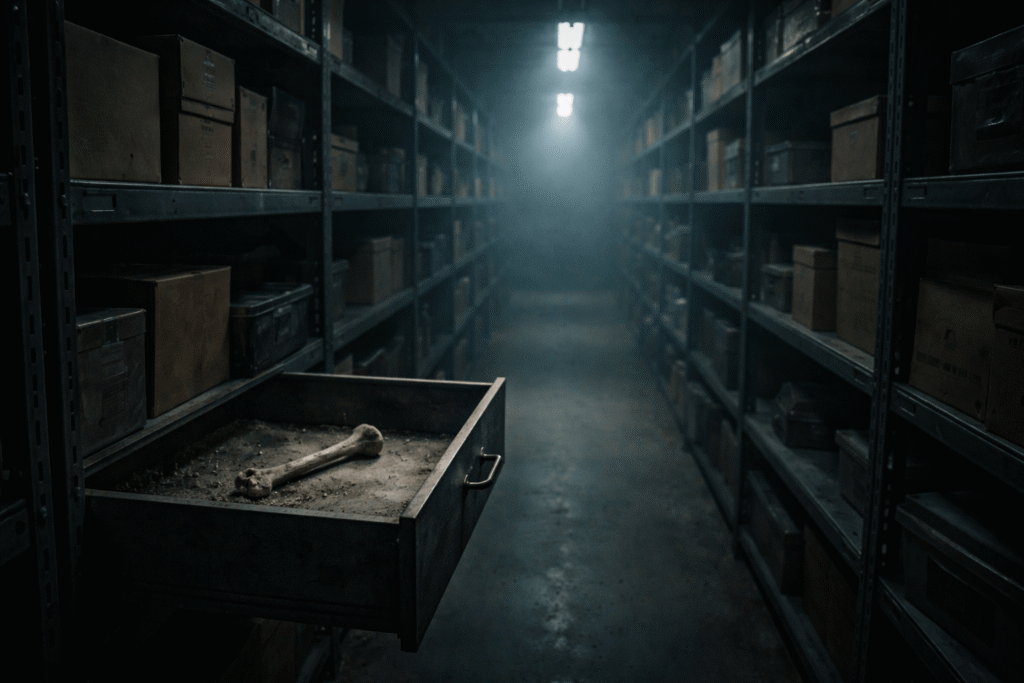
A quiet storage facility with strange objects in this teeth buried beneath threshold horror story

Mala’s supervisor did not believe in stories that relied on fear.

He believed in paperwork, keys, humidity control, and the importance of not asking too many questions about unclaimed religious items.

His name was Raghav, though most people at the storage facility called him Mr. Raghu out of habit and slight dislike. He had the tired neatness of a man who mistrusted disorder but worked among it daily. Files aligned. Labels straight. Nails clipped short. He disliked incense smoke because it clung to shelving. He disliked visitors because they touched what they should not. He disliked Mala because she was too quiet in a way that seemed almost judgmental.

Mala had transferred there after leaving St. Dymphna Hospital. She did her work without fuss, just as she always had. She checked corners before closing drawers. She never touched items without reason. If a shelf gave her the wrong kind of silence, she left it alone. She had always survived by knowing what not to touch.

Raghav thought this was superstition dressed as professionalism.

He told her once, “This is storage, not a shrine.”

Mala had looked at him and said, “Some things behave the same, no matter where they are kept.”

He laughed at that. Not because it was funny. Because it irritated him.

The facility received items from temples, estates, police inventories, abandoned houses, court seizures, and occasionally hospitals. Most were simple enough: cracked statues, Mold-stiff prayer cloths, family tablets no descendant wanted, sealed jars no one wished to open. Some had clear records. Some came with only a location and a date. Those went into Restricted if they felt expensive, dangerous, or troublesome.

The Unclaimed Box

The small wooden case arrived on a Tuesday afternoon without transfer paperwork.

No return address. No receiving note. No department stamp. Only a handwritten number on twine wrapped around the lid: 7.

Not labelled. Not explained. But divided the same way something once had been.

Raghav called the front office. They had nothing. He checked with transport. Nothing. Mala, standing nearby with a trolley of wrapped brass lamps, glanced once at the box and looked away too quickly.

“Where did this come from?” she asked.

“If there’s no record, it comes from human incompetence,” Raghav said.

He cut the twine.

Inside was another wrapping: oil-dark cloth tied in old knots. The smell that rose from it was faint but immediate—iron, old saliva, something like wet rust left in a closed room.

Mala said, “Do not open it here.”

Raghav looked at her. “And where would you suggest? Outside under the moon?”

She did not answer.

That made him open it.

Inside lay human teeth.

Not many. Twelve, perhaps. Some molars, some smaller, one broken at the root. They were old but not powdered by age. Several were dark in strange patches, as if stained from within. Two looked filed along the edges. They sat in the cloth like small pale seeds someone had spat out and gathered again.

One of the junior staff recoiled. Another muttered a prayer.

Raghav said, “Human remains, unregistered, likely ceremonial. Restricted shelf, biological note, end of problem.”

But he did not rewrap them immediately.

He picked one up between thumb and forefinger. The root was longer than he expected. The enamel felt warm.

The First Signs

That evening, after the others had gone, he opened the cloth again.

He told himself it was professional curiosity. Someone should inspect unusual items properly. Someone should determine whether the teeth had been modified, used in ritual work, or tied to a case that would later become troublesome. The facility had enough trouble caused by other people refusing to examine what they stored.

Objects like this were rarely meant to harm. They were meant to guard something. Left in storage, they lost their purpose. Better to keep them somewhere controlled.

Three was enough to test. No need to take more.

He took three teeth home in a folded handkerchief.

He did not consider it stealing.

His apartment was clean, one-bedroom, square-edged, anonymous. He lived alone, cooked little, and kept a single basil plant on the kitchen sill more out of discipline than affection. He placed the teeth on a saucer near the entrance and washed his hands twice.

What Began That Night

Nothing happened the first night.

Nothing obvious, at least.

He woke before dawn with jaw pain so severe he thought he had been grinding his teeth in sleep. His mouth tasted metallic. When he spat into the sink, the saliva ran faintly pink. He checked his gums. Inflamed, perhaps. Stress. Too much coffee. Age.

At work, food felt strange. The rice he bought at lunch seemed soft to the point of insult. The fish curry dissolved unpleasantly on his tongue. He found himself chewing longer than necessary, searching for something the food did not seem able to provide.

Mala watched him across the break table.

“Your mouth is bleeding,” she said.

He wiped at his lip. His fingertip came away red.

That night he dreamed of thresholds.

Not doors, exactly. Mouths shaped like doors. The floorboards of his apartment lifted one by one, and beneath them, something shifted in the dark, just beyond what he could clearly see. He woke with the taste of dirt in his throat.

Hunger Changes Shape

On the third day, one of his molars fell out while he was speaking to a client on the phone.

There was no pain. No warning. It slipped free as though it had simply lost interest in remaining, dropping onto the paperwork on his desk with a hard, precise tick before rolling slowly into the crease between two forms.

For a full second, Raghav stared at it without comprehension, his thoughts failing to arrange themselves around what he was seeing. Then embarrassment arrived, sudden and childish, as if his body had betrayed him in public.

He picked it up carefully.

Something in his mouth shifted.

Not movement—
 adjustment.

He closed his jaw slowly.

By the time his teeth met again, something else had already settled into the space it left behind.

Raghav kept his fallen tooth.

He did not throw it away.

At the sink, he rinsed it under running water, watching diluted strands of blood unwind and spiral into the drain, thinning until they disappeared. When it was clean, he placed it beside the others on the saucer near the entrance and stood there longer than he intended, looking at them without quite understanding why he could not look away.

There was still no pain.

That unsettled him more than anything.

The Mouth No Longer Fits Speech

At work, he spoke less. Not out of caution, but because forming words had begun to feel inefficient, as though his mouth no longer aligned properly with the purpose of speech. His tongue moved differently now, pressing against edges that did not sit where they should, mapping a structure that seemed subtly unfamiliar each time he tested it.

Mala noticed.

“You should see a dentist,” she said quietly.

Raghav smiled.

It was wrong—not in any obvious or exaggerated way, but in something quieter, more structural. The alignment had shifted. The expression no longer matched the shape that carried it.

“I will,” he said.

He did not.

By the fifth day, eating had become an act of quiet frustration.

Rice dissolved too quickly against his tongue. Meat separated into fibres before he could properly work through them. Even fried food, once satisfying in its resistance, collapsed too easily, offering nothing for his jaw to hold onto.

He began to chew harder.

Then harder still.

It was no longer only the teeth he had taken.

The rest had begun to change—quietly, without pain, without resistance.

By the time he became aware of it, his mouth no longer belonged to a single origin.

What the Body Begins to Accept

One evening, alone in his kitchen, he opened the refrigerator and stood there for a long moment before taking out a piece of raw chicken intended for cooking. He did not prepare it. He did not hesitate. 

Cooking it felt unnecessary.

The thought arrived without reason—only certainty.

He bit into it.

The texture held—finally offering something his jaw could recognize.

For the first time in days, his jaw stopped trembling. The resistance was immediate, dense, something that pushed back instead of yielding. He stood there, unmoving, as a slow, unfamiliar sense of relief spread through him.

He did not question it.

The sounds began that same night.

At first, he thought they came from the pipes—a soft, wet grinding somewhere behind the walls, accompanied by a faint shifting pressure beneath the floor tiles, as though something moved just beyond the reach of certainty.

But after a while, he noticed something else.

When he moved, the sound moved with him.

When he stood still, it stopped.

He turned toward the entrance.

The saucer sat where he had left it. Three teeth, clean and still.

He listened.

The sound did not come from the walls.

It came from them.

A soft, steady working—as though they were still trying to chew.

Replacement Begins

At the facility, items began to go missing.

It was not the objects themselves that changed. It was what moved through them—
 something that no longer required a single form to continue.

At first, it was easy to ignore. The kind of small irregularities that happened in places built to hold what no one wanted to track too closely—misplaced tags, delayed entries, drawers not fully closed. Nothing that could not be explained by routine carelessness.

But this was different.

Not the usual things. Not charms, not mislabelled records, not the kind of objects that slipped between categories and disappeared into paperwork.

Not objects or anything that could be easily replaced.

What Could Not Be Replaced

The first was a jar of preserved animal bone fragments from an old temple clearing. It had been catalogued properly, sealed, and placed on a mid-level shelf in Restricted. When the drawer was opened during a routine check, the jar was still there—but lighter than it should have been.

Inside, the fragments were gone. Nothing had been broken. Nothing forced.

It was as if the contents had not been taken—but used. Reduced until nothing remained that required a boundary.

Only a fine, pale dust remained at the bottom, as if something had reduced them over time, leaving nothing solid behind.

Nothing had been removed by hand.

Whatever had taken them had not needed to open anything.

No one reported it.

No one wanted to.

A sealed envelope went next.

Hair offerings, bound in red thread, taken from a rural shrine clearing and logged under cultural preservation. The seal had not been broken. The edges remained intact.

But when it was opened for verification, the contents were no longer inside.

The thread lay collapsed against the paper, slack and empty, as though what it once held had simply withdrawn from it.

A faint dampness remained along the inner fold, as though something had been held in a mouth before being removed.

By the third instance, the pattern could no longer be dismissed.

A wrapped bundle labelled ancestral remains — incomplete set was found partially opened during a scheduled inventory sweep. The cloth had not been cut. The knots had not been disturbed.

But the contents were missing.

The cloth carried a faint, unfamiliar scent—organic, warm, and not entirely clean.

Not misplaced or transferred.

Just missing.

Nothing Was Disturbed

No forced entry.

No record of removal.

Raghav checked the logs himself.

He did not rush. He did not call anyone over. He sat at his desk, back straight, movements precise, and went through each entry one by one, cross-referencing dates, signatures, access points.

Everything appeared in order.

It was the kind of order that required nothing to be opened—only reduced.

He paused, tongue pressing briefly against the inside of his teeth, adjusting to a sensation he could not quite name.

That was what unsettled him, though he could not explain why.

Not the absence of explanation—but the wrong kind of order. The containers remained.The seals remained. And yet the contents were gone.

Beginning of The First Bite

On the seventh night, Mala stayed late.

She had not planned to. Her shift had ended on time, her tasks completed with the same quiet efficiency she carried through everything. But as she moved toward the exit, something in the storage air made her pause.

It felt wrong.

Not in a way she could name—not a sound, not a movement—but a kind of stillness that did not belong to an empty building. The air had settled too completely, as if the facility had stopped holding its breath and begun listening instead.

She remained where she was, one hand resting lightly against the edge of a shelving unit, her eyes adjusting to the dimmer after-hours lighting.

Somewhere deeper inside the facility, a drawer slid.

Not fully.

Just enough to shift.

Mala turned her head.

The sound did not repeat.

Something Inside the Drawer

She waited.

Nothing followed.

After a moment, she exhaled slowly and stepped back into the aisle.

Near the far end, one of the junior staff—Kumar—was still inside, crouched beside a lower drawer, sorting through a set of mislabelled storage items. He glanced up briefly when he saw her.

“Still here?” he asked.

Mala nodded once. “You too.”

“Just finishing this,” he said, tapping the edge of the drawer lightly. “Someone mixed up the Restricted tags again.”

His tone was casual, but there was a faint tightness in it, something held just beneath the surface.

Mala watched him for a moment longer than necessary.

“Did you open anything?” she asked.

Kumar frowned slightly. “Just checking labels.”

A pause.

“Why?”

Mala did not answer immediately.

Before she could respond, Kumar shifted his position, reaching deeper into the drawer. His sleeve brushed against something inside—something that did not move like the rest. 

It shifted—not away from his hand, but toward it.

He paused.

“Wait,” he muttered.

Mala stepped forward slightly.

“What is it?”

Kumar leaned closer, squinting into the dim space. “Something’s—”

He stopped.

His hand jerked back sharply.

What Left the Mark

A small, involuntary sound escaped him—not quite a shout, not quite a breath.

“What happened?” Mala asked, already moving toward him.

Kumar straightened too quickly, knocking his elbow against the edge of the shelf.

“Nothing,” he said. Too fast.

Mala reached him.

“Show me.”

He hesitated.

Then, reluctantly, he held out his hand.

At first glance, it looked minor.

A shallow mark along the side of his index finger. Not deep enough to bleed heavily, but enough for a thin line of red to form and gather at the surface.

But the shape—

Mala leaned closer.

It was not a scrape.

Not a cut.

Two small, curved impressions pressed into the skin, slightly offset from each other.

It was not deep enough to take.
 Not yet. It felt less like a wound—
 and more like something had paused to understand what it had touched.

Like something had tested the flesh. As if something within the drawer had found its edge and pressed upward.

Not tearing.

Not biting fully.

Just—

pressing.

What It Asked For

Kumar let out a small laugh, too forced to be convincing.

“Probably something sharp inside,” he said. “Old metal or—something.”

Mala did not respond.

For a moment, her gaze held—longer than it should have.

Then it settled.

The skin around it had already begun to pale slightly, as if the blood beneath it had withdrawn.

“Wash it,” she said quietly.

“I will,” he replied quickly. “It’s nothing.”

But he did not move immediately.

For a moment, he stood there, staring at his own hand.

Then, almost absent-mindedly—

he brought the finger closer to his mouth.

Not to lick the blood.

Just—

closer.

As if something in him had paused mid-decision.

Mala’s voice cut through, sharper this time.

“Don’t.”

Kumar blinked.

Then lowered his hand.

“Yeah,” he said, forcing another small laugh. “Yeah. I’ll go wash it.”

He turned and walked toward the sink area, his steps slightly uneven, as if his body had not fully decided how to move yet.

His steps slowed once—just slightly—

as if something in him had begun to adjust to a rhythm that was not his own.

Mala remained where she was.

Behind her, somewhere deeper in the facility—another drawer shifted—just enough to suggest something inside had adjusted its position.

Soft.

Measured.

Almost careful.

Mala did not turn this time.

She already understood something had begun.

Something Goes Missing

She passed the restricted shelves.

Her steps slowed without her deciding to slow them.

Something in the air had changed again—not as sharply as before, not enough to alarm anyone who wasn’t paying attention, but enough that the silence felt layered now, as though something beneath it had begun to move.

Mala paused.

Then turned back.

The drawer she had seen earlier—the one Kumar had been working from—was no longer fully closed.

It sat slightly ajar.

Not wide enough to suggest carelessness.

Just enough to suggest interruption.

Mala approached it carefully, her gaze shifting first to the surrounding shelves, then to the floor, as if expecting to find something out of place.

Nothing was disturbed.

Everything remained aligned.

What Was No Longer There

That, more than anything, unsettled her.

She reached out and pulled the drawer open.

Slowly.

Inside, the compartments were still arranged as before—wrapped bundles, labelled pieces, sealed items placed in careful rows.

But the space did not feel the same.

There was a gap.

Not obvious.

Not immediately visible.

But present.

Mala’s eyes moved across the contents, adjusting, recalibrating, searching for what her mind had already begun to recognize before it could name it.

Then she saw it.

The cloth.

The same oil-dark wrapping that had once held the teeth.

It lay folded in on itself now, collapsed slightly at the center, as though something had been removed from within it not by hand, but from the inside outward.

Mala did not touch it.

For a brief second, the urge crossed her—sharp, immediate—
 to confirm it with her own hands.

She did not move.

It was empty.

Not taken.

There was nothing left that could be returned to its place.

Not Random

Her gaze shifted—quickly now, instinctively—to the other compartments in the drawer.

Everything else remained.

Untouched.

Undisturbed.

It wasn’t random.

A cold understanding began to settle into place.

This was not loss.

Not misplacement.

Not error.

Something had begun to choose.

And for the first time—
 she was not sure she stood outside it.

Mala straightened slowly.

Her eyes moved down the aisle.

“Kumar?” she called.

No answer.

The facility remained still.

Where He Should Have Been

Too still.

Mala stepped away from the drawer and moved toward the sink area at the far end, her pace measured but no longer hesitant.

“Kumar?”

Still nothing.

The light above the washing area flickered once—not fully dimming, just enough to shift the shadows across the tiled wall.

The tap was running. Not fully.

As if something had interrupted it before it could finish.

A thin, steady stream of water, left unattended.

Mala stopped just short of the doorway.

The sound of water should have filled the space.

But it didn’t.

It felt… contained.

As though something else had absorbed the rest.

She reached out and turned the tap off.

The silence that followed was immediate.

Complete.

Mala’s gaze lowered.

The floor beneath the sink was dry.

No footprints.

No sign of movement.

No sign that anyone had stood there at all. His name remained in the log. Nothing else did. Not even the absence felt recent.

Behind her—a drawer slid open.

Soft.

Deliberate.

Mala closed her eyes briefly.

Not in fear.

In recognition.

Then she turned.

Mala Notices

Behind her, a voice spoke.

“You noticed.”

Mala did not turn immediately.

For a brief moment, she remained where she was, her eyes still on the open drawer ahead, as if confirming something one last time before allowing the rest of the world to return.

Then she turned.

Raghav stood at the far end of the aisle.

The overhead light above him burned steadily. It did not flicker. Nothing in the space shifted or reacted to his presence.

And yet—

something did not align.

It was not a single detail she could isolate. Not posture alone, not expression, not movement. It was the way everything about him seemed to settle too completely into the space, as though he no longer adjusted to it—but belonged to it.

His posture was relaxed.

Too relaxed.

His breathing, if it was there at all, did not reach her.

His presence felt… finished.

What Did Not Align

A subtle transformation involving teeth in this teeth buried beneath threshold horror story

Mala’s gaze moved—not to his face first.

To his hands.

They hung loosely at his sides.

Clean.

Still.

No tremor.

No hesitation.

Nothing in them suggested uncertainty, or even awareness of consequence.

Only control.

Then her eyes lifted.

To his mouth.

For a moment, her mind refused to resolve what it was seeing.

Not because there were too many—

But because they did not agree with each other.

The teeth sat unevenly, some longer, some narrower, some angled slightly inward, as though they were still adjusting their positions against one another.

When his jaw shifted, they did not meet cleanly.

They settled.

You Took Them

Mala held her gaze there a second longer than she should have.

Something in her resisted looking away.

Then:

“You took them,” she said.

Raghav tilted his head, just slightly.

“I kept what was unclaimed.”

“That’s not what they are,” Mala said.

A pause.

Something faint moved along his jaw, a slow testing motion, as if the structure itself required constant awareness.

“No,” he said softly. “It isn’t.”

He stepped closer.

Not quickly.

Not threatening.

Measured.

Each step placed with quiet precision, as though distance itself had become something he now understood differently.

“I thought they were objects,” he said. “Like everything here.”

His tongue moved slowly across his teeth, pressing lightly along their edges, as if confirming their placement.

“They are not.”

They Remember

Mala did not step back.

“Then what are they?”

Raghav’s gaze held hers.

For a moment, there was nothing in it that could be named. No confusion. No fear. No trace of the man she had worked beside.

And then—

something settled behind it.

Not madness.

Not hunger.

Recognition.

“They… remember,” he said.

“But they needed something that could decide.”

His gaze did not shift.

“Something that could choose where it continues.”

Silence followed.

Not empty.

Waiting.

Mala felt her voice lower without intending it to.

“They wiped out a village.”

Raghav nodded once.

“Yes.”

“It had not been choosing then,” he added quietly.
 “It had been feeding.”

“And you brought them here.”

“No,” Raghav said.

He did not hesitate.

A small pause followed, not for thought—but for correction.

“They didn’t stay what they were.”

Something in Mala’s chest tightened, sharp and immediate.

“What do you mean?”

Raghav lifted one hand slightly—not toward the shelves, not toward any single object—but toward the space itself, as though indicating something that could not be pointed to directly.

“This place,” he said, “is where things stop staying separate…”

He let the words settle.

“…but not destroyed.”

Mala said nothing.

Because for the first time—

there was nothing left to dismiss.

The System Remembers

“They don’t stay separate.” he continued. “Not really.”

He smiled again.

That same wrong alignment returned, the movement of his mouth no longer matching the structure beneath it, as though each part of it had learned its position separately and was still deciding how to fit.

For a moment, he said nothing more.

The silence stretched—not empty, but occupied, as if something within it was waiting to see what would follow.

Then:

“They change,” he said quietly.

“Not into something else,” he added.

“Into something that no longer stays contained.”

“It doesn’t destroy things. It uses them until they no longer need to exist separately.”

The air shifted.

Not in temperature.

In certainty.

What Mala Had Already Seen

Mala felt it before she understood it, a tightening at the edge of recognition, as though something she had already noticed was now arranging itself into place.

Her thoughts moved quickly, not searching, but aligning.

The tablet.

The ash.

The matchstick.

The room that corrected itself.

Each one separate.

Each one contained.

Each one… behaving.

Different objects.
 Different rules.

But all placed here—
 long enough to—

Mala’s breath caught, just slightly.

“…connected,” she said.

They Do Not Stay Separate

The word came out softer than she intended, as if speaking it too clearly might fix it into something she could no longer deny.

Raghav’s smile widened.

Not with amusement.

With agreement.

He stepped closer.

Slowly.

“I thought the teeth were teaching me,” he said.

His voice carried no strain, no hesitation—only a quiet adjustment, as if he were correcting an earlier assumption.

A small movement passed through his jaw.

“They weren’t.”

For the first time, she wished she had been wrong about something.

Mala did not move. 

“What then?”

Raghav tilted his head slightly, considering the question—not as something difficult, but as something newly understood.

“They remember,” he said.

A pause.

Then, softer:

“Through what they consume.”

It No Longer Waits

The sound came again.

Not from the walls.

Not from the floor.

From him.

A slow, internal movement, barely visible—his jaw shifting, testing, as though something inside it had begun preparing itself without urgency.

Mala’s gaze moved—past him now.

Not by decision.

Down the aisle.

The drawers.

They were no longer closed.

Not fully.

Each one slightly open.

Not forced.

Not disturbed.

Adjusted.

From within them—

a faint sound.

Not the wet grinding she had heard before.

Something softer.

Measured.

Breathing.

Raghav followed her gaze.

“It’s easier now,” he said quietly.

Mala did not look back at him.

“What is?”

For a moment, he did not answer.

Then:

“It doesn’t wait.”

A pause.

“It decides.”

It Has Begun to Choose

Mala felt her throat tighten.

Behind her, another drawer shifted.

Soft.

Controlled.

Raghav’s voice came again, steady, almost reflective.

“Before, it reacted.”

The word settled.

“Now—”

He did not complete the sentence.

He did not need to.

He looked at her.

“You notice things others don’t.”

The words were the same.

The tone was the same.

But something in them had changed.

Not learned.

Not chosen.

Repeated.

Selection

Mala understood.

Not all at once.

Not as a sudden realization.

But as something that had been forming quietly, piece by piece, now settling into place with a weight she could no longer ignore.

The criminal.

The village.

The teeth.

Each of them had felt separate before—isolated events, contained stories, things that could be examined, categorized, and set aside.

But they were not separate.

They had never been.

This was not an accident.

She had not touched it.
 She had not interfered.

And that was why it had not dismissed her.

It had left her… available.

Not a mistake.

Not even a failure of ritual.

The ritual had worked.

Just not in the way it was meant to.

The Pattern Was Already There

Mala felt the shape of it now, not as an idea, but as a pattern—something that did not need to be explained because it had already been repeating itself long before she recognized it.

It had been happening.

She thought of the empty cloth. The missing bone fragments. The jar that had weighed less without breaking.

Something is always taken. Something is always buried.

And eventually—

something remains.

The Thought Was Not Hers

The thought did not feel like her own.

It felt… continued.

And she did not know when she had begun to accept it.

Raghav stepped closer.

Not fast.

Not hidden.

Deliberate.

Each step carried a quiet certainty, as though distance had already been resolved and what remained was simply the movement required to complete it.

Behind him, a drawer slid open.

Then another.

The sound did not startle her.

It confirmed something.

Soft movements filled the aisle now, one after another, not loud, not violent—but persistent.

Measured.

Too many.

Mala did not run.

The instinct surfaced—sharp, immediate—then passed, as if it no longer applied.

For a brief moment, the idea surfaced—sharp, instinctive—but it did not hold.

Running implied distance.

Distance implied separation.

And she understood now—

there was none.

This place did not hold things apart.

It brought them into alignment.

She felt it in the air, in the stillness, in the way every object, every space, every sound seemed to exist within the same quiet structure.

There was no escape.

Only sequence.

Only continuation.

And now—

selection.

What It Chooses

Raghav stopped an arm’s length away.

He did not reach for her.

He did not need to.

He studied her instead.

Her face.

Her hands.

Her throat.

Not with urgency.

With attention.

As though each detail had already been considered, and what remained was only confirmation.

Then he spoke, almost gently.

“You were already marked.”

Mala felt her breath catch—not sharply, not in panic, but in a quiet, involuntary recognition, as if something inside her had been waiting for those words long before she heard them.

“When?” she asked.

Raghav’s smile did not change.

“When you chose not to touch what should not be moved.”

A pause followed.

Not for emphasis.

For completion.

“That’s how it knows you.”

The lights above them hummed softly.

The storage facility remained as it had always been.

Orderly.

Still.

Unchanged.

Nothing had been overturned.

Nothing broken.

Nothing out of place.

Only the drawers remained open.

Only the faint, measured breathing continued—soft, overlapping, not from any one direction, but from within the space itself.

Mala stood where she was.

For a moment, she became aware of her own breathing.

Then—

of something beneath it.

Raghav did not move.

He no longer adjusted to the space.

He did not react to it.

He did not belong to it.

He had settled into it.

No longer correcting.

No longer observing.

Only choosing.

“It doesn’t eat what is evil,” he said softly.

His voice did not rise.

“It takes what begins to recognize it.”

When It Begins to Answer

The words settled.

Something shifted.

Not in front of her.

Not around her.

Within.

For a moment, something in her resisted.
 Not fear. Not denial.
 Just a quiet refusal to understand.

It did not hold.

A faint pressure along her jaw.

Not pain. Not yet.

Just the quiet awareness that something had begun to consider her shape as something it might keep.

So slight she might have missed it—if she had not already learned what to notice.

Mala did not move.

For a moment, her body failed her—not in panic, but in recognition.

She did not reach for her mouth. She did not step back.

Behind her—

a drawer slid open.

Soft.

Measured.

As though responding.

The breathing did not stop.

It adjusted.

And somewhere within it—

something had begun to recognize her.


Related Stories

Before the storage facility, there was another place with rules she never questioned.

Inside Operating Room Four, Mala breaks one—and something unfinished begins repeating, waiting for her to complete it.

The Rules No One Breaks in Operating Room Four

The village thought the hunger ended when the buried teeth disappeared from Sungai Rabit.

It did not end there. This story follows what happened after those missing fragments resurfaced elsewhere—spreading through a storage facility, consuming the people it touched, and revealing the true origin behind the village horror.
They Were Still Alive — But Something Was Missing

Scroll to Top