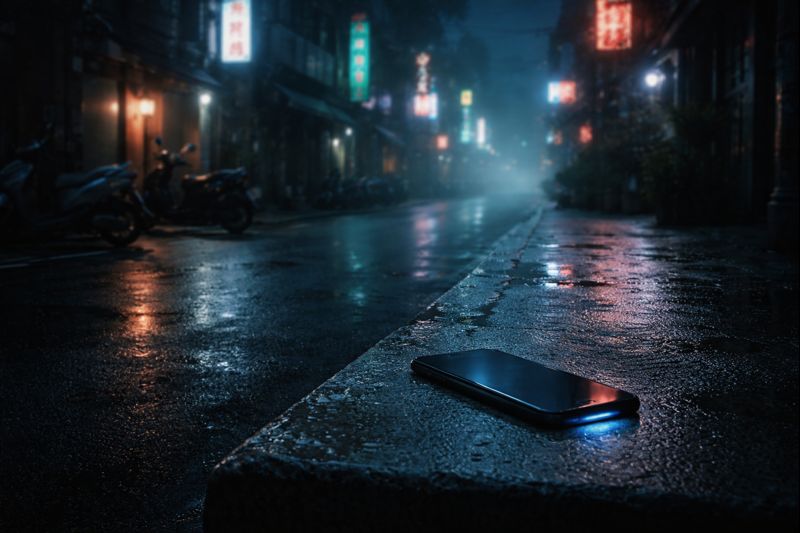
Urban legends used to travel in whispers through campfire smoke. Now, they arrive as a system notification at 12:47 a.m.
Aaron learned that the hard way.
When his phone buzzed on the nightstand, Aaron squeezed his eyes tighter. Work started in six hours, and his mind was already frayed from days of insomnia. The last thing he needed was the phone’s blue glare piercing the dark.
Bzzzzzz. The second vibration was longer and heavier, less like a mechanical alert and more like a demand.
Swearing under his breath, Aaron reached through the chill beside his bed. He tapped the notification.
City Transit Alert: Your train is arriving now.
He frowned, his thumb hovering over the glass. He’d downloaded the transit app weeks earlier for a weekend trip and hadn’t opened it since. Besides, the city’s trains stopped running at midnight.
A new line appeared beneath the alert, typing itself out character by character:
Do not miss this one.
“Great. A glitch,” Aaron muttered, his voice thin in the suffocating quiet of his studio apartment.
BZZZZZZ.
The phone bucked in his palm.
Last Reminder. Platform 4.
The floorboards beneath his bed began to vibrate. Not a tremble, but a steady, pounding rhythm—the deep rumble of steel wheels grinding along tracks directly beneath his third-floor apartment.
The Tracks Below
“What the hell…?”
Aaron bolted out of bed, his heart hammering against his ribs. The apartment walls groaned as the vibration intensified, rattling the framed prints near the entryway.
His phone chimed again.
Boarding confirmed. Look down.
Aaron forced himself toward the window. The quiet street below was smothered in fog, thick and uneven as curdled milk. Through the fog, the asphalt buckled and split, peeling back like dead skin to reveal rusted rails embedded in the earth.
A headlight cut through the fog—a sickly yellow beam that burned cold against his window.
Ding-dong.
The familiar transit chime didn’t come from his phone this time. It rose from the floorboards beneath his bare feet.
Then a raspy, distorted voice crackled from his phone’s speaker:
“Mind the gap, Aaron. We don’t like to keep the other passengers waiting.”
Aaron dropped the phone. It clattered against the floorboards, face-down.
From the corridor outside his apartment came the mechanical whir and heavy clunk of train doors sliding open.
The Abandoned Line
Aaron’s chest heaved as he stared at his apartment door. It stood wide open now, though he hadn’t touched it. Beyond it, the corridor was empty. He picked up his phone. The screen flickered back to life, displaying a transit map with a single blinking dot three blocks away.
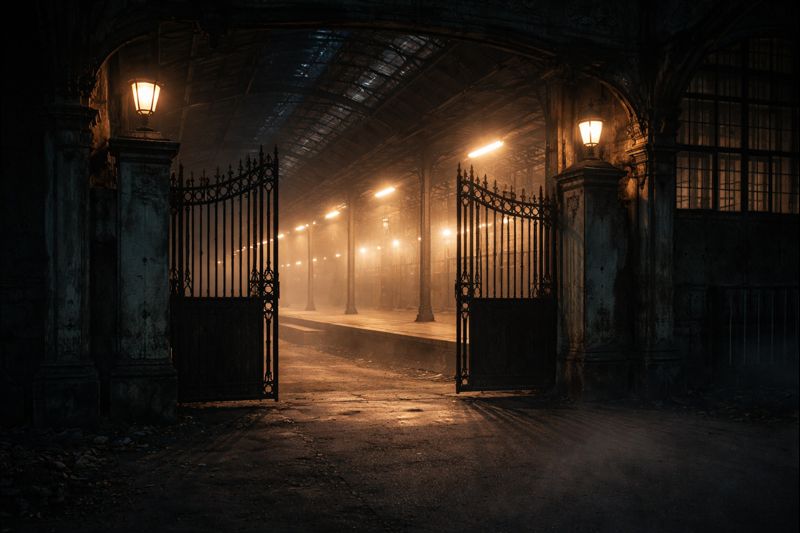
The old station.
It didn’t make sense. The station had been condemned five years earlier after a series of unexplained disappearances along the tracks. It had been fenced off, sealed, and left to rot.
By the time Aaron stepped out of the building, the blinking dot seemed to tug at something behind his ribs. The city was eerily lifeless. No traffic. No wind. Only the low, unnatural hum thrumming through the soles of his sneakers.
Three blocks later, he reached the station’s perimeter. The rusted chain-link gates, chained shut for years, now hung wide open. The severed padlock lay on the pavement, a thin thread of smoke curling from its glowing shackle.
“Is anyone there?” Aaron called out.
His voice was swallowed instantly by the fog.
His throat tightened as he slipped through the gate and descended the concrete steps. With every step, the air grew colder, thick with the smell of scorched copper and stagnant tunnel water.
His phone screen flashed.
Arriving at Platform 4. Stand behind the yellow line.
Aaron lifted the phone, its glow catching the bare edge of the platform. “There is no yellow line,” he whispered.
Click.
Overhead, a single fluorescent bulb flickered to life, buzzing like a dying insect. In its sickly green glow, the platform edge emerged—and along it ran a bright yellow stripe, freshly painted and still wet.
The Waiting Train
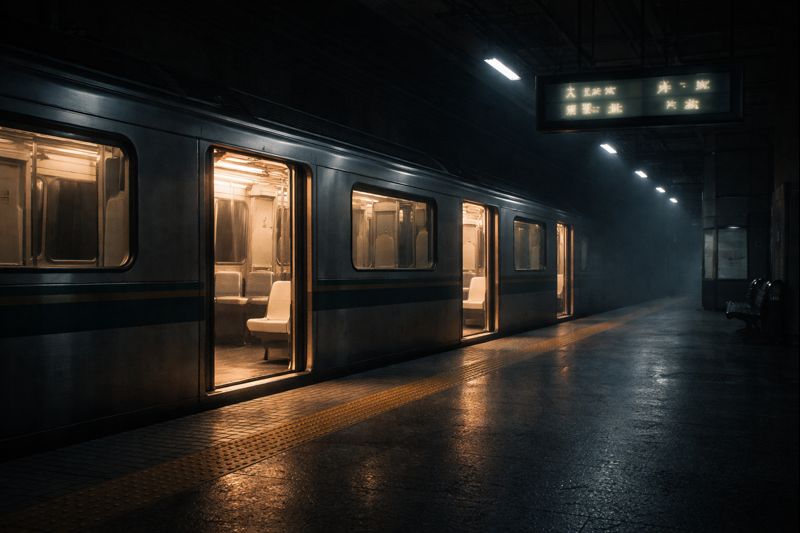
Beyond the wet yellow line, a train waited at Platform 4.
The train looked ancient. Its metal sides were scratched and discolored, coated in a patina that looked less like rust than dried blood.
Inside, the train car pulsed with a dull light, but the windows were nearly opaque with condensation, revealing only dark, shifting shapes beyond the glass.
The train doors stood wide open, spilling damp, freezing air across the platform.
Aaron froze behind the wet yellow line. “This is crazy. I’m going home.”
He turned toward the stairs, but the way back was gone—sealed behind a wall of swirling black mist.
“Going back isn’t an option, Aaron.” The voice came not from a loudspeaker, but from the open train doors. Smooth and layered, it sounded like three voices speaking in perfect unison. “Your ticket has already been validated.”
Aaron stepped back, his heel skidding across the still-wet yellow line.
A pale, unnaturally long arm uncoiled from the shadowed train car, its fingers closing around the steel doorframe.
“Step aboard,” the layered voice purred. The fog inside the car parted just enough to reveal rows of passengers sitting perfectly upright, their faces completely featureless. “We’re running behind schedule.”
The doors began to slide shut.
Final Stop
The pale arm withdrew into the train. The doors stopped halfway, leaving a narrow gap. Aaron edged closer to the train, his heart battering his ribs like a trapped bird.
The digital display above the train flickered to life with a harsh static hum. Instead of destinations and arrival times, lines of text began appearing.
Names.
They scrolled past line by line, glowing a pale, spectral green. Some flashed too quickly to decipher, but others lingered long enough for Aaron to read. They were full names—formal and old-fashioned, the kind carved into weathered marble headstones.
MILLER, ELEANOR.
VANCAMP, ARTHUR.
The board spasmed with static, its glowing characters scrambling before they froze on a new line.
A-A-R-O-N.
Aaron’s breath caught. The display sparked, and the remaining letters snapped into place with sickening precision:
AARON V. MENDOZA — FINAL STOP.
The train doors shuddered another inch apart with a strained mechanical groan, as though inviting him in.
His phone jolted in his hand as a single message bloomed across the glass:
Board now. Your seat is waiting.
Inside the car, one of the featureless passengers slowly turned its head toward the open doors. It had no eyes, yet Aaron felt its attention settle on him with crushing weight, pinning him in place.
The Refusal
The crushing pressure pinning Aaron in place softened into a heavy, unnatural calm. Inside that car, there would be no more grueling shifts, no more mounting debt, no more lonely, sleepless nights. Just endless, silent motion.
It didn’t feel terrifying anymore. It felt like an escape.
He stepped over the wet yellow line and lifted one foot toward the threshold.
“That’s it,” the layered voice whispered from the darkness of the carriage. “Step across. Rest.”
The voice was too sweet. Too hollow.
The floor inside the car shifted beneath the dull light. It wasn’t metal, but damp soil slowly churning in place. The sight shattered the trance. Aaron jerked his foot back and stumbled onto the concrete.
“No,” Aaron said, his voice trembling before it hardened. “I’m not getting on.”
The train’s rhythmic hum died. Cold slammed into Aaron, turning his next breath white as frost crawled across the wet yellow line.
For three long seconds, the train sat utterly silent. Then every featureless head inside the car snapped toward him at once.
“WRONG ANSWER,” the layered voice shrieked through his phone’s speaker.
“You can refuse us tonight,” the layered voice whispered. “But the line always comes back for its passengers.” The train doors slammed shut hard enough to crack their fogged windows.
Before Aaron could scream, his phone died in his hand. The fluorescent bulb, display board, and train car lights snapped off together, plunging him into absolute darkness.
Deleted Passengers
At dawn, Aaron woke on the floor of his studio apartment, his dead phone clenched in one hand. He had no memory of leaving Platform 4. Cruel, mundane light streamed through the windows.
Aaron sat at his desk, his untouched coffee growing cold. His fingers flew across the keyboard as he searched archived message boards and obscure local transit forums for “Platform 4,” “12:47 a.m.,” and “final stop.”
At first, he found nothing but dead links. Then, six pages into the results, he found an archived thread from three years earlier. The post had been timestamped 12:48 a.m.—one minute after the notification time.
User_9041: Got the notification tonight. It has my name on the board. I can’t stop walking toward the station. If I don’t post tomorrow, you’ll know why.
There were no replies. The user’s profile image was a solid black square, and the account status read DELETED.
Aaron’s blood ran cold. He opened a cached copy of the user’s post history. Dozens of threads and daily updates filled the archive. After that night, there was nothing.
His monitor flickered. The browser vanished, replaced by a black screen displaying a single line of pale-green text:
SEARCHING FOR MISSING PASSENGERS IS NOT PERMITTED.
A cursor began blinking beneath the warning. Aaron typed:
WHO IS THIS? WHAT DID YOU DO TO THEM?
The computer speakers crackled with static. Then the familiar layered voice whispered from them:
“We gave them the escape they wanted. We’ll give you yours.”
The Endless Reminder
Aaron deleted the transit app, factory-reset his phone, then unplugged his computer and shoved it into the closet.
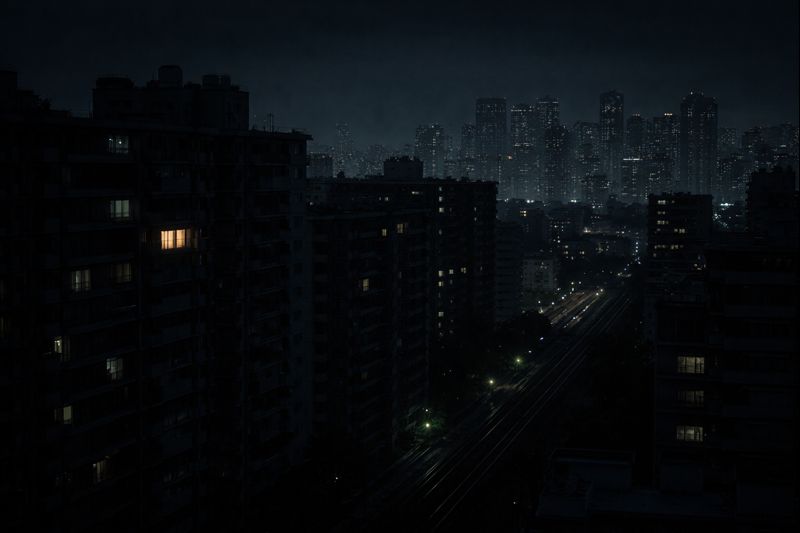
For weeks, silence followed. The city carried on, ignorant of the tracks rusting beneath its streets. He almost convinced himself it had been a stress-induced hallucination.
Tonight, the silence finally broke.
At 12:46 a.m., Aaron lay awake, staring at the ceiling. His apartment was dead quiet.
12:47 a.m.
On his nightstand, his phone—completely wiped, disconnected from Wi-Fi, and powered down—lit up.
No ringtone. No vibration. Just a blinding, pale-blue glare that painted the apartment walls in icy light.
Aaron froze, keeping his eyes fixed on the ceiling. But from the darkness beside his bed, a soft, electronic ding-dong echoed from the floorboards.
The sheets shifted beside him with a soft rustle.
Aaron slowly turned his head. A figure sat on the edge of his bed, facing the window. Its head rotated toward him without moving its shoulders, revealing a face completely featureless and smooth as porcelain.
Glowing red letters spread from his phone’s screen:
Missed your train? Don’t worry. We brought the platform to you.
Related Stories
Some places don’t announce where they’re really taking you.
Sometimes the door opens to a corridor that isn’t listed on the building directory.
The Elevator That Knows When You Press Twice
Elsewhere, the instructions arrive earlier.
A phone lights up before dawn with suggestions that quietly decide where the city should go next.