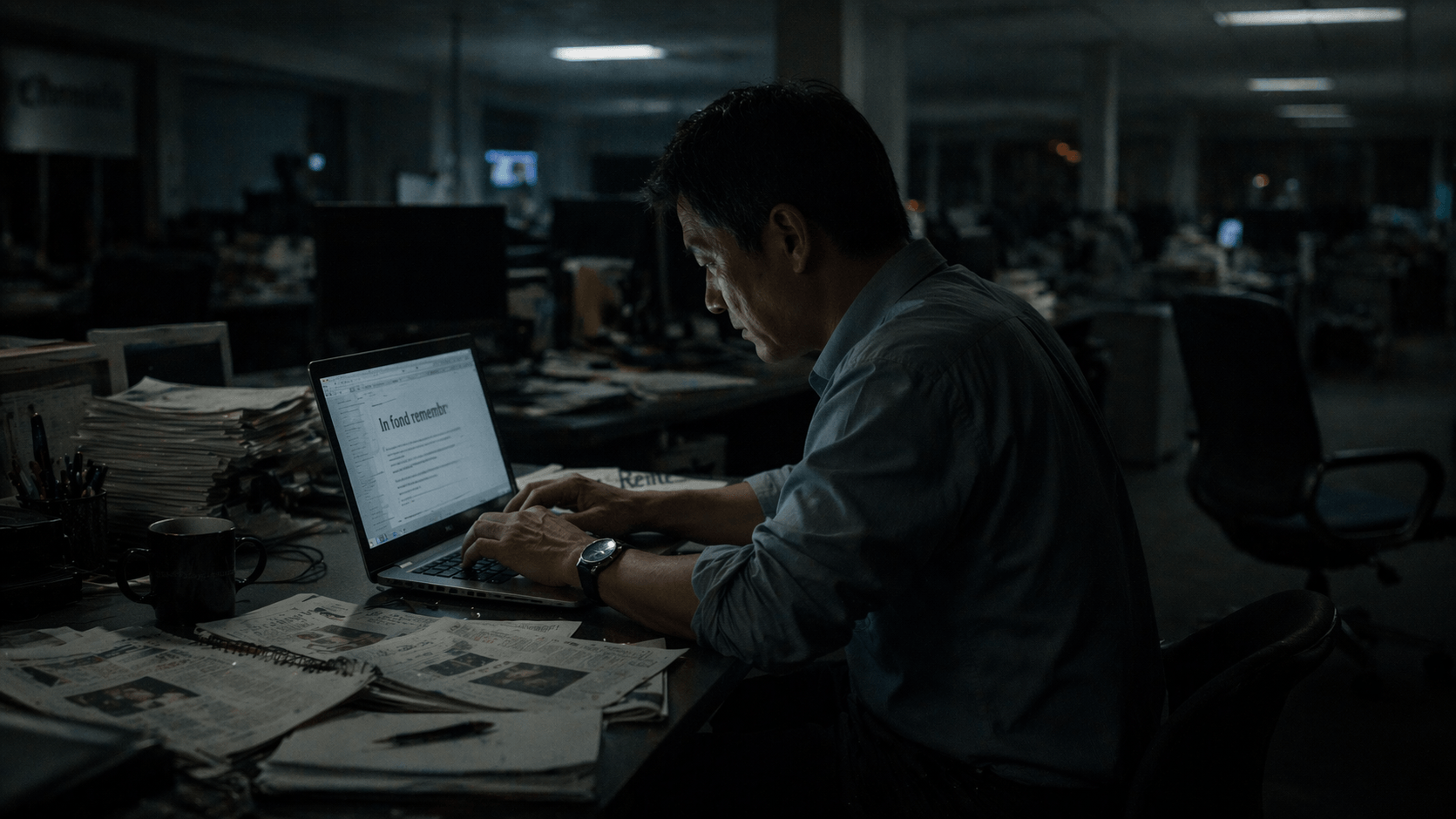
Lester Tan had been at the newspaper for only nineteen days when the obituaries editor slid a thin file across his desk.
“Write this cleanly and quickly,” May said. “Don’t make the family call to complain.”
Lester nodded confidently.
Young, well-dressed and punctilious about punctuation, Lester disliked anything left unfinished. To him, incompleteness was usually the result of incompetence.
He opened the file for Adrian Leong’s funeral and began adjusting the spacing, correcting a date and trimming a sentimental line from a relative’s tribute.
Several other lines felt awkward to him, so he rewrote them according to his own sense of what sounded better.
Once the obituary read the way he believed it should, Lester leaned back with a faint sense of satisfaction.
“As long as it reads well,” he murmured, “that’s enough.”
He took pride in his ability to compress a messy life into a graceful final paragraph.
“Don’t write too much,” May said without looking up. “Families want dignity, not literature.”
Lester smiled. “A little literature helps.”
“It only helps you.”
“It gives it structure,” he said. “Otherwise, it just… ends.”
May fixed him with a tired, unsmiling look.
“The dead don’t care.”
Her words meant little to Lester. He turned back to Adrian Leong’s file and admired his finished work.
Where the Record Begins
By lunchtime, he had refined the obituary several more times, smoothing away every awkward line. Lester felt the small thrill of improvement and the private vanity of believing he could make grief more bearable by handling it properly.
Then May called his name again.
“There’s a staff shortage downstairs,” she said. “The police liaison needs someone to document homicide scenes for two weeks. You’ve been seconded. Temporary only.”
Lester blinked. “But I write obituaries.”
“Now you’ll be helping to record where they begin.” May smiled.
Lester hesitated, then agreed.
The senior crime photographer met him in the lobby beside a van that smelt faintly of bleach and wet rubber.
His name was Harun. Fatigue showed plainly on his face: dark circles sat beneath his eyes, and the whites were threaded with red, as though he had not slept enough.
“This is my first homicide scene,” Lester said as they drove. “Is there anything I should know?”
Harun fixed him with a stern look that discouraged further questions.
“Stand where you’re told. Write down what you see. Don’t touch anything.”
Lester rolled his eyes. “I know the basics.”
Harun gave him a flat, unimpressed look. “No. You only know the paperwork. The crime scene is different.”
Lester said nothing more. When the van stopped, he followed Harun out.
At the crime scene, police tape fluttered in the night breeze with a dry, flapping sound.
Beyond it, the alley was divided by hard light and shadow. Every puddle reflected the red and blue lights, though one reflection flickered out of rhythm with the others.
The officers moved through the alley in near silence, speaking only in low voices. No one laughed. No one raised their voice.
The Smallest Thing Taken
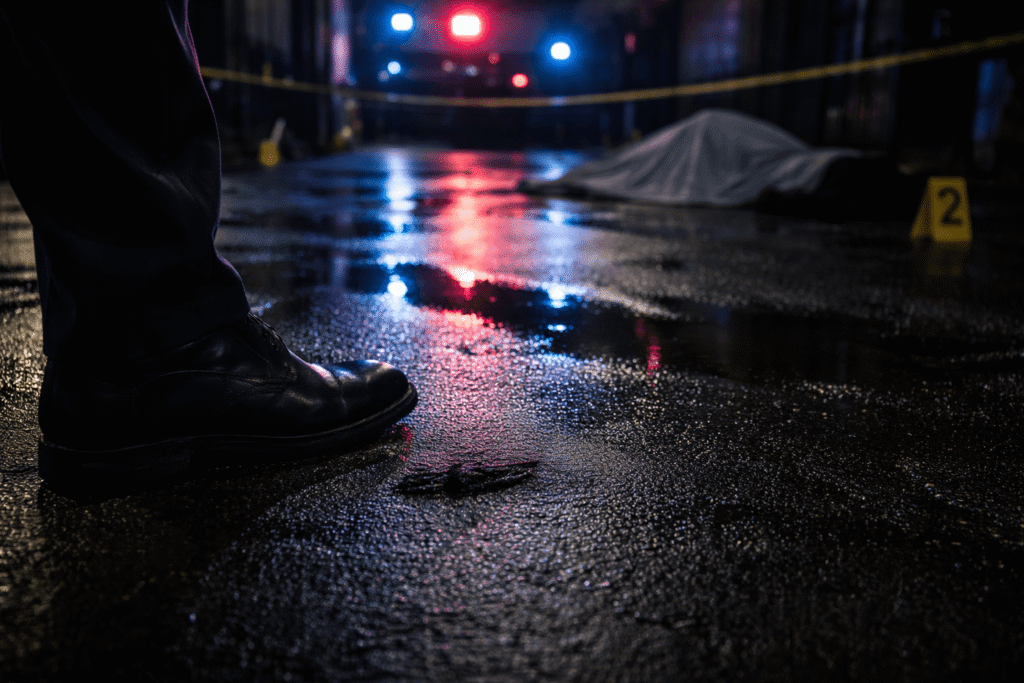
Beyond them, the victim lay partly turned towards the wall, one arm bent beneath her and her dark, shining hair spread across the concrete.
Lester began taking down notes, the words arranging themselves easily in his mind.
Female. Early twenties—
“So young,” he said softly. “What a pity.”
Harun turned sharply. “Hey. Don’t say that here.”
Lester raised both hands slightly, embarrassed but not sorry. He stepped sideways to get a better angle for his notes, and his shoe came down on something soft.
He frowned and lifted his foot, revealing a dark smear clinging to the edge of his sole—wet, fibrous and nothing like mud.
Without giving it another thought, Lester wiped it against the curb and returned to his notes.
The disorder of the scene began to grate on him.
His eyes settled on the knife first. It hid the blood beneath it, so he shifted it slightly, just enough to bring the stain into view. Then he nudged the chair leg inwards.
A child’s broken watch lay on the floor. Lester picked it up and placed it closer to the victim’s hand.
“Much better,” he murmured.
Harun caught his wrist.
“Hey. What are you doing?”
“Making sense of the frame.”
Harun’s voice dropped. “Nothing here belongs to you—not the scene, not the story, not the dead. You’re destroying evidence.”
Lester pulled his hand away, offended. “They’ve already collected what they need. I’m not harming anyone.”
Harun stared at him until Lester finally turned to leave.
Neither man noticed the victim’s eyelids slowly part behind them, her lifeless eyes fixing on Lester and following him as he walked away.
That night, while working on the report, Lester dismissed Harun as overly sensitive. He had only made the scene look right.
The First Correction
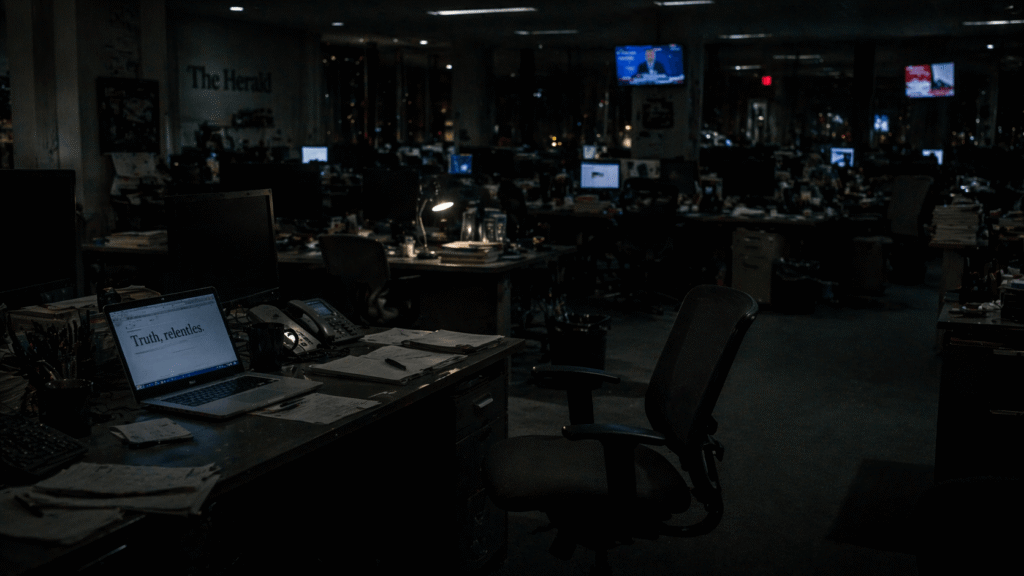
A week into the reassignment, the office stopped feeling empty after midnight.
Long after everyone else had gone, a second keyboard would begin tapping somewhere beyond Lester’s desk.
The rhythm would falter—tak… tak—then resume, as though whatever was typing had forgotten what came next.
Lester told himself it was only the strain of working too many late nights.
One night, the chair behind him shifted with a faint scrape, as though someone had leaned forward to read his screen.
Lester kept his eyes forward.
When he finally turned, the chair was empty—but no longer where it had been.
Another night, while finalizing a report, Lester wrote:
The victim was found intact near the stairwell landing.
He saved the report and stepped away for a break. When he returned ten minutes later, the word intact was gone.
In its place was incomplete.
Lester froze. He changed it back and saved the report, but the moment he looked again, incomplete had returned.
“Funny,” he whispered, though there was no humor in his voice. “Very funny.”
May was passing his desk with her bag over one shoulder when she paused.
“You’re still here?”
“Did you change this?”
She leaned closer, read the line and frowned. “Why would I?”
“It keeps changing.”
“Then you must have typed the wrong word.”
“I didn’t.”
May straightened. “Go home, Lester. You’re too tired.”
After May left, Lester kept staring at the screen. The letters slowly blurred, but incomplete remained clear enough to unsettle him.
For the first time, irritation gave way to something colder.
What if the report was not being changed—but corrected?
What the Body Keeps
The next morning, Lester woke with a numbness in his left foot.
There was no pain, not even the familiar prickling of a limb gone numb. It felt as though his left foot no longer belonged to him. He pressed his thumb into the skin above his ankle. The pressure reached him faintly.
The cuts came next.
A sheet of paper caught the side of his finger, leaving a thin line of blood. Days later, the wound was still there—pale, open and stubbornly unchanged. It neither festered nor healed.
Before long, his shirts began to sag at the shoulders, the fabric hanging loose where it had once fitted.
At lunch, one of his colleagues asked if he was dieting.
“Too much stress,” Lester said.
May looked up from her noodles. “You look terrible.”
“Thank you.”
“No, I’m serious.”
He tried to laugh, but the sound came out weak. “I’m fine.”
The lie was exposed by his own body. His fingers fumbled with his buttons, and later, when he lifted a kettle, his arm stalled halfway and began to tremble. Several seconds passed before it jerked upwards, completing the movement all at once.
That night, Lester dreamed of the victim from the alley. Her eyes were open, and she stared at him with unmistakable anger.
He woke with the taste of blood in his mouth. Thin cuts had appeared along the inside of his cheek.
By morning, he had convinced himself they were nothing worth worrying about. Despite his exhaustion, Lester returned to the office, trusting the familiar order of work to steady him.
What Clung to Him
By afternoon, the familiar order of work had done nothing to steady Lester.
He had just returned to his desk after lunch when warmth spilled from his nose. He reached up, expecting a nosebleed, but blood was already gathering beneath his eyes and slipping down his cheeks.
Harun happened to be passing through the office. He helped Lester stop the bleeding, then studied him with a troubled expression.
“This isn’t a hospital matter.”
He took a parking receipt from his pocket, scribbled an address across the back and handed it to Lester.
“Go here. The monk should be able to help.”
After work, Lester followed the address with equal parts doubt and unease.
The old monk who received him showed no surprise. That unsettled Lester more than any dramatic reaction could have.
Without asking a question, the monk pointed towards a mat.
“Shoes off.”
Lester obeyed.
The room smelled of ash, tea and old wood, the scent settled deep into the walls after years of prayer. Outside, wind moved through the leaves in the courtyard.
The monk crouched beside Lester’s right shoe. With a thin brass tool, he scraped along a groove in the sole until something dark came loose.
He studied it in his palm.
“What is that?” Lester asked.
The monk looked up at him.
“Human remains.”
Lester gave a short, sharp laugh. “That’s impossible.”
What Has Been Taken
The monk’s voice remained calm.
“The dead must remain whole. Even the smallest part still belongs to them—hair, skin, ash, blood. You stepped on something that should have remained with her.”
The air seemed to thin around Lester. “Then I’ll return it.”
The monk kept his eyes on him. “It is too late.”
“Why?”
“Because it was not given to you. You took it without permission.”
Lester swallowed. “So I’m being haunted?”
The monk closed his hand around the fragment. “Yes.”
“What does she want?”
He paused before answering.
“What is missing from her, she will take from you—and then she will take more.”
Lester’s mouth had gone dry. “How much more?”
“Your life.”
“But it was only a small piece.”
“Did you do anything else at the scene?”
Lester hesitated. “I adjusted a few things. And I said it was a pity she died so young.”
The monk’s expression hardened.
“She was murdered, and you treated her death as something you could rearrange. You spoke of her with pity, disturbed what belonged to her and carried part of her away. Whether you intended to or not, you offended her.”
Lester stared at the fragment hidden inside the monk’s fist.
“She will take what you owe her,” the monk said.
“Please.” Lester’s voice broke. “Please help me.”
What Cannot Be Undone
The monk agreed to try.
He burned folded paper charms and stirred the ashes into water. Then he circled Lester three times, reciting sutras so softly that the words seemed breathed rather than spoken.
For a moment, the room felt lighter.
Then the candle nearest Lester bent. The flame did not go out. It narrowed into a trembling thread, leaning towards him as a faint hiss rose from the wick.
The monk fell silent.
“Is that all?” Lester asked. “Why did you stop?”
“She will not accept the return.”
“There must be something else.” Panic sharpened his voice. “There has to be.”
The monk turned towards the altar, not in dismissal, but resignation.
“If a spirit clings to someone, it can be guided away. If a doorway has been opened, it can be closed. But this…”
He touched two fingers to the floor.
“It cannot be undone. She has already chosen what she will take.”
Lester rose too quickly and swayed. “So I’m going to die?”
The monk looked at him with terrible honesty.
“Yes.”
Lester turned and made his way towards the door.
“Do not begin anything you cannot carry to its end,” the monk called after him.
Lester stopped, but did not turn around.
“What’s the point?” he said quietly. “I’m going to die anyway.”
The monk watched him in silence.
“That is what she wants you to believe.”
The Weight of Missing Things
Three days later, Lester stopped going to work.
By then, his cheeks had grown so hollow that he barely recognised the face in the bathroom mirror.
His collarbones pressed sharply against his skin. He ate, but the food gave him no strength. He slept, only to wake more exhausted than before.
No matter how much water he drank, his mouth remained dry.
May called, but Lester no longer had the strength to reach for the phone.
Harun sent a single message:
If I come over, open the door.
Lester read it, then let the screen go dark in his hand.
A message to his mother remained unfinished:
I’m not feeling—
The final night came without a storm or warning.
Lester lay on his bed, staring at the ceiling.
“Help,” he tried to call.
Only “He—” escaped.
His chest rose for another breath, then stopped halfway.
He thought of the young woman in the alley and the soft thing crushed beneath his heel.
Eyes burning, Lester dragged himself towards the phone, one elbow at a time. Each movement faltered before the next could begin.
He opened a message and typed:
I am going—
His thumb hovered over the screen but never touched it again.
The Last Notice
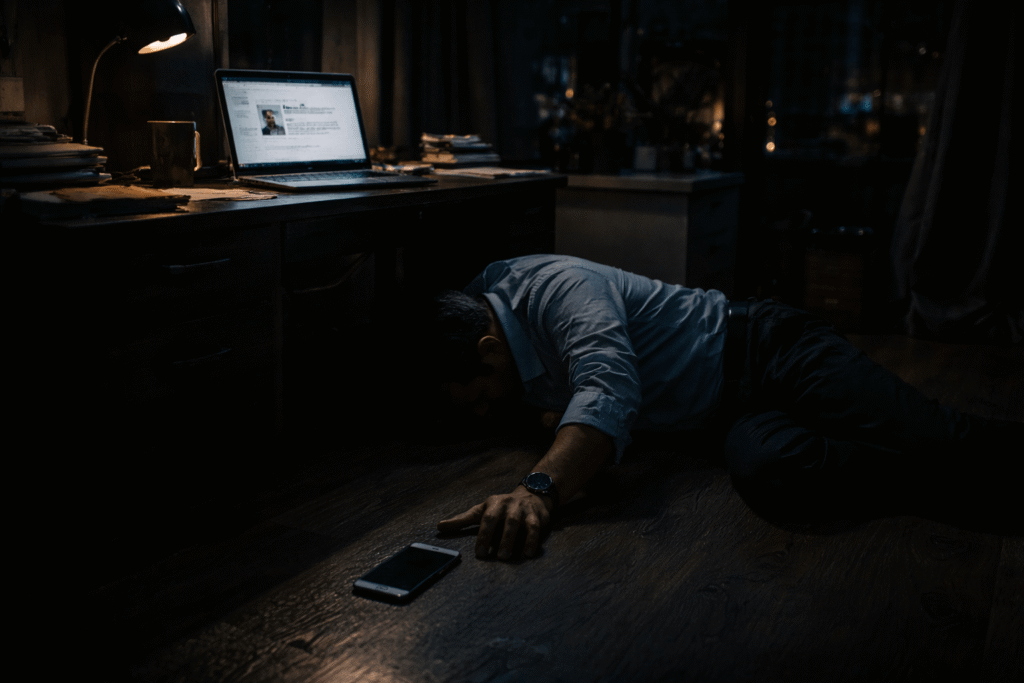
By morning, Lester was found on the floor beside his bed, one arm stretched towards the fallen phone. His body had folded around itself, as though he had stopped halfway through trying to rise.
There was no fear on his face, only confusion.
May had come with Harun after her calls went unanswered. The landlord let them in with a spare key, and the ambulance crew followed.
A paramedic knelt beside Lester, pressed two fingers to his neck and shone a light into his eyes.
“Time of death?” someone asked.
The paramedic studied him for a moment. “Unknown. Cause unclear.”
Two days later, the newspaper printed Lester Tan’s death notice.
It was elegantly composed, restrained and clean—everything he would have admired. The notice described him as diligent, thoughtful and respected by his colleagues. It said he had died peacefully at home.
No one reading it over breakfast would have known that his final word, breath and message had all stopped halfway.
For the first time, Lester’s life had been given a complete ending.
Related Stories
Adrian Leong’s death was not the beginning of the imbalance—it was only one of the things left in its wake.
At his funeral, someone took something from the dead. And something accepted it.
Ghost Marriage Curse I Brought Home from a Funeral
Some lives are stolen by the dead. Others are surrendered with a single brushstroke.
He thought he was merely finishing an effigy—until the eyes began taking everything that made him human.