Affiliate disclosure: As an Amazon Associate I earn from qualifying purchases. Eerie Story Vault may earn a commission if you buy through qualifying links in this guide, at no extra cost to you.
If you want one physical Lovecraft collection, Chartwell Books’ The Complete Fiction of H. P. Lovecraft is our recommendation for most readers. It offers a very broad one-volume collection of Lovecraft’s central fiction canon and avoids the need to assemble several separate editions before you know which parts of Lovecraft you value most.
There is one important reason not to buy it: the book is huge. At about 1,112 pages and roughly 3.8 pounds, it is much less portable than a normal paperback. If you care more about explicitly corrected scholarly texts, notes, and a lighter physical format than one-volume coverage, Penguin Classics is the better route.
That trade-off is the key to this guide. No single Lovecraft edition is strongest on coverage, portability, textual scholarship, annotations, and presentation at the same time. The right choice depends on what you want from the book.
How we compared these editions
This is a deeply researched editorial buying guide, not a claim that Eerie Story Vault physically tested every edition. We compared exact publisher and ISBN identities, story coverage, completeness claims, textual/editorial basis, format, dimensions and weight, annotations, portability, current publisher availability, and recurring usability concerns. Publisher pages and bibliographic records support factual specifications; owner and community feedback is used only for subjective points such as perceived type size, handling, and comfort.
Quick answer: which Lovecraft collection should you buy?
- Want one broad physical collection with strong one-book value? Choose Chartwell’s The Complete Fiction of H. P. Lovecraft.
- Want corrected S. T. Joshi texts, notes, and a lighter paperback format? Start with Penguin Classics’ The Call of Cthulhu and Other Weird Stories.
- Want deep annotations, illustrations, and historical context? Choose Leslie S. Klinger’s The New Annotated H. P. Lovecraft.
- Want a handsome boxed set for a gift or shelf display? Choose the Sirius/Arcturus six-volume H. P. Lovecraft Collection.
Best H.P. Lovecraft collections at a glance
| Edition | Best for | Coverage | Main advantage | Main drawback |
|---|---|---|---|---|
| Chartwell Complete Fiction | Most buyers; one-book value | Very broad one-volume fiction collection | Very broad coverage in one purchase | Very large and heavy |
| Penguin Call of Cthulhu + companion volumes | Scholarly, portable reading | Curated across multiple volumes | S. T. Joshi corrected texts; notes; smaller paperback format | Not complete in one book; costs more to build out |
| Klinger New Annotated Lovecraft | Annotations and study | 22 major stories in first volume | Extensive notes, illustrations, historical context | Very large; not complete; specialist format |
| Arcturus 6-book boxed set | Gifts and shelf presentation | Selected celebrated works across six volumes | Attractive separate volumes and slipcase | Not the whole corpus; some owners find the type/margins tight |
Amazon prices, seller details, fulfillment information, ratings, review counts, and temporary stock data are intentionally omitted because those marketplace conditions can change.
Why Chartwell is the best H.P. Lovecraft collection for most buyers
Best for: New readers who want one broad physical Lovecraft collection.
Main strength: Very broad one-volume coverage with a stable, publisher-defined edition.
Watch out for: Its 1,112 pages and roughly 3.8-pound weight make it much less portable than Penguin.
Chartwell’s The Complete Fiction of H. P. Lovecraft is our recommendation when a new reader wants one broad physical collection rather than a multi-volume route. It is a publisher-defined hardcover with a stable ISBN, not an anonymous print-on-demand “complete works” file wrapped in a new cover.
Quarto, Chartwell’s parent publisher, lists the hardcover at 1,112 pages and describes it as collecting one novel, four novellas, and 53 short stories. That gives a first-time buyer a large share of the central Lovecraft fiction canon without requiring them to plan a multi-volume reading route before they have read the author.
The strongest argument for Chartwell is not that it is the prettiest or most scholarly edition. It is that the trade-off is unusually favorable: very broad coverage, one purchase, a long-established publisher identity, and strong value relative to buying several separate collections.
For someone who wants one big Lovecraft volume on the shelf, that combination is difficult to match.
The main trade-off with Chartwell
The book is physically demanding. At roughly 3.8 pounds, it is much less portable than Penguin’s paperbacks. Some owners also describe a large omnibus of this size as cumbersome to hold for long reading sessions, which is worth considering if you usually read away from a desk or table.
Feedback on the print itself is mixed. Some owners report that the type feels small or dense, and some readers report typographical issues. Those concerns are not universal, so they should be treated as reader experience rather than a specification-level defect; they matter most if typography and textual polish rank above one-volume coverage for you.
There is also an editorial distinction worth taking seriously: Penguin explicitly identifies S. T. Joshi’s corrected texts in its Lovecraft editions. Chartwell’s official product information does not make an equally clear corrected-text claim. That does not make Chartwell a poor reading copy, but it gives text-conscious readers a concrete reason to prefer Penguin.
Choose Penguin if corrected texts and portability matter more than completeness
Best for: Readers who prioritize corrected texts, notes, and a lighter reading format.
Main strength: Penguin explicitly credits S. T. Joshi’s corrected texts and editorial notes.
Watch out for: The first volume is not complete; broader coverage requires the companion volumes.
Penguin Classics takes almost the opposite approach to Chartwell. Instead of putting a very large body of Lovecraft fiction into one omnibus, Penguin spreads the material across manageable paperbacks with introductions and notes by leading Lovecraft scholar S. T. Joshi.
Our preferred Penguin starting point is The Call of Cthulhu and Other Weird Stories. Penguin lists 18 stories in the volume, including “Dagon,” “The Outsider,” “Herbert West—Reanimator,” “The Rats in the Walls,” “The Call of Cthulhu,” “The Colour Out of Space,” “The Whisperer in Darkness,” and “The Shadow Over Innsmouth.”
Just as important, Penguin explicitly describes these as corrected texts edited by S. T. Joshi. The explanatory notes are separate from the story text rather than turning each page into a heavily annotated reference spread, so the edition still works as a straightforward reading copy.
The trade-off: broader coverage takes multiple volumes
The obvious drawback is coverage. The first Penguin volume does not contain all of the major works. If you want to continue with the same editorial approach, the route expands into The Thing on the Doorstep and Other Weird Stories and The Dreams in the Witch House and Other Weird Stories.
That makes Penguin a more expensive way to build a broad Lovecraft library, but it also gives you smaller, lighter books and a clearer scholarly editorial basis. If Chartwell’s roughly 3.8-pound format sounds inconvenient for how you read, Penguin is the better fit.
Check The Call of Cthulhu and Other Weird Stories on Amazon
If you want to continue with Penguin’s approach, the companion volumes are The Thing on the Doorstep and Other Weird Stories and The Dreams in the Witch House and Other Weird Stories.
The New Annotated H. P. Lovecraft is best for readers who want context
Best for: Readers who actively want annotations, historical context, and illustrations.
Main strength: More than 1,000 annotations plus extensive visual and historical material.
Watch out for: It is oversized, roughly five pounds, and the first volume is not complete.
Leslie S. Klinger’s The New Annotated H. P. Lovecraft is not simply a “better Chartwell.” It is a different kind of book built around context and reference use.
Liveright/W. W. Norton describes the 928-page hardcover as collecting 22 major stories with more than 1,000 annotations and nearly 300 illustrations. That makes it especially useful if you want to explore Lovecraft’s references, places, influences, publication history, and the historical world around the fiction.
That scholarship comes with a physical cost. The book is oversized and roughly five pounds, so it is far less portable than Penguin’s paperbacks. Some owners describe it as better suited to desk or table reading. It is also not a complete one-volume Lovecraft collection.
For an enthusiast, researcher, or reader who enjoys stopping to investigate context, those are acceptable trade-offs. For someone completely new to Lovecraft who mainly wants to read the stories without interruption, they are reasons to choose Chartwell or Penguin first instead.
Check The New Annotated H. P. Lovecraft on Amazon
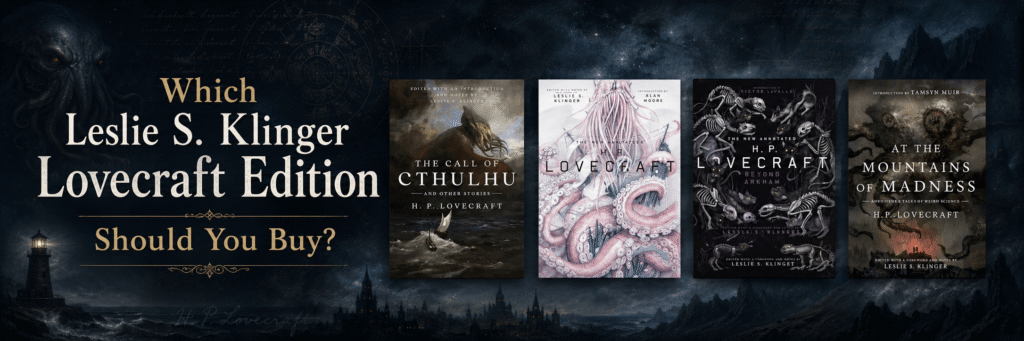
Want a closer comparison of Klinger’s annotated editions? See our full guide to the Leslie Klinger Lovecraft editions and which one you should buy.
The Arcturus six-book set is the better gift and display choice
Best for: Gift buyers, shelf-display buyers, and readers who prefer separate volumes.
Main strength: Six clothbound hardcovers in a slipcase with a presentation-first design.
Watch out for: The publisher presents it as celebrated works, not the whole Lovecraft corpus; some owners find the type/margins tight.
If you are buying Lovecraft as a gift, the Sirius/Arcturus H. P. Lovecraft Collection offers a presentation-focused alternative to a single 1,112-page omnibus.
Simon & Schuster’s official listing describes six clothbound hardcovers in a slipcase, with embossed cover designs and coordinated presentation details. Because the fiction is split across separate books, the reader does not have to handle one giant omnibus at a time.
The important warning is completeness. Simon & Schuster describes the box as a collection of Lovecraft’s “most celebrated works.” That is not the same claim as the entire Lovecraft corpus, so the set should not be marketed as a complete six-volume Lovecraft library.
Reader feedback is mixed on the compact format. Some owners report relatively small type or tight margins, while others like the size and presentation. In other words, the reason to choose Arcturus is the boxed-set experience—not textual scholarship or maximum coverage.
Amazon availability note: Amazon availability for this set can vary, so check the current seller and fulfillment details carefully before buying.
What about Library of America’s H. P. Lovecraft: Tales?
Library of America’s H. P. Lovecraft: Tales remains a strong editorial option even though it is not one of the four main recommendations in this guide.
It is a curated hardcover of major Lovecraft works in Library of America’s archival-style format. Library of America specifies features such as acid-free paper and a sewn binding, giving it a different physical proposition from Chartwell’s large omnibus.
The problem is availability rather than quality. Library of America’s own listing currently reports the title out of stock and says no reprint has been scheduled. That makes new-copy supply too unreliable for it to serve as ESV’s primary Amazon recommendation at the moment.
If you find a genuine new copy at a sensible price, it remains worth considering. But do not pay collector-style scarcity pricing just because it once looked like the ideal beginner edition.
Lovecraft collection buying traps to avoid
“Complete fiction” does not mean literally everything Lovecraft wrote
Lovecraft’s body of work extends beyond the core solo fiction. Collaborations, revisions and ghostwriting, poetry, essays, and letters are separate categories. The H. P. Lovecraft Archive’s bibliographic work treats revisions and collaborations separately, which is a useful reminder that “complete” depends on what a publisher is claiming to collect.
That is why you should read “complete fiction” as an edition-specific claim, not as proof that one book contains every text Lovecraft ever wrote or worked on. Chartwell is a very broad one-volume fiction collection, but Eerie Story Vault would not describe it as literally everything Lovecraft wrote.
Avoid random public-domain “Complete Works” omnibuses
Lovecraft’s publication history has produced many unrelated editions, especially in the public-domain market. Two covers can both say “Complete Works” while differing in typography, editing, contents, and print quality.
Before buying, verify the publisher, ISBN, and exact edition. Those three identifiers tell you far more than a dramatic cover or the word “complete.”
Bigger does not automatically mean better
Chartwell’s size is the source of both its value and its biggest weakness. Putting so much fiction into one hardcover keeps the purchase simple, but its verified page count and roughly 3.8-pound weight make it much less portable than smaller collections.
If you already know you dislike large omnibuses, do not buy Chartwell merely because its page count looks impressive.
“Incomplete” does not automatically mean worse
Penguin’s first Lovecraft volume contains substantially less fiction than Chartwell. That is not a defect: Penguin is deliberately trading one-volume coverage for corrected texts, editorial notes, and a smaller paperback format.
A reader who values the day-to-day reading experience may get more value from a curated Penguin volume than from a “complete” book they dislike holding.
Annotated does not automatically mean best for beginners
Klinger’s annotations are excellent if you want them. If you do not, you are paying for a very large reference object and a reading format that encourages frequent detours.
For a first encounter with Lovecraft, choose Klinger because you actively want scholarship—not simply because “annotated” sounds more authoritative.
The Arcturus box is not literally complete
Six hardcovers in a slipcase can look more comprehensive than one omnibus, but presentation and completeness are different questions. Buy Arcturus for the gift/display experience and the convenience of separate volumes, not because six volumes automatically means the entire corpus.
Which H.P. Lovecraft collection should you buy?
For most buyers, especially someone completely new to Lovecraft who wants one physical collection, Chartwell is our recommendation. It gives you a very broad one-volume fiction collection without requiring a multi-book purchase plan.
Choose Penguin instead if you value corrected scholarly texts, notes, and a lighter physical format more than one-volume completeness. Start with The Call of Cthulhu and Other Weird Stories, then add the companion volumes only if you want to continue in the same edition family.
Choose Klinger if annotations, historical context, and illustrations are part of the reason you are buying the book. It is a reference-heavy enthusiast edition, not the default first purchase.
Choose Arcturus if the object itself matters: you want an attractive gift/display set or prefer reading from separate volumes rather than one giant omnibus.
One-sentence decision rule: Chartwell for coverage and value; Penguin for text and portability; Klinger for annotations; Arcturus for gifting and presentation.
Prefer Lovecraft in manga form?
Gou Tanabe has adapted several Lovecraft stories into detailed horror manga. Our Gou Tanabe Lovecraft manga guide covers the English editions, where to start, and which versions to buy.
Prefer Lovecraft at the tabletop? Our Cthulhu: Death May Die buying guide explains which core box to start with, how the Seasons fit together, and which expansions new buyers do not need yet.
FAQ
What is the best H.P. Lovecraft collection for a beginner?
For a beginner who wants one physical book, Chartwell’s The Complete Fiction of H. P. Lovecraft is our all-around recommendation because of its broad coverage and one-volume convenience. If you dislike heavy omnibuses or care strongly about explicitly corrected scholarly texts, start with Penguin Classics instead.
Is Chartwell’s Complete Fiction really complete?
It is a very broad collection of Lovecraft fiction, but “complete fiction” should not be interpreted as every text Lovecraft ever wrote or worked on. Collaborations, revisions/ghostwriting, essays, poetry, and letters complicate any absolute completeness claim.
Is Penguin better than Chartwell?
Penguin is the better fit for a reader who prioritizes S. T. Joshi corrected texts, notes, portability, and a smaller physical format. Chartwell is the better fit if you want very broad one-book coverage at strong value.
Should I buy an annotated Lovecraft edition first?
Only if annotations are part of what you want. Klinger’s The New Annotated H. P. Lovecraft offers unusually deep context and study material, but its size, weight, and annotation-heavy format make it less convenient as a straightforward first reading copy.
Is the Arcturus six-book set complete?
Do not treat it as the whole Lovecraft corpus. The publisher positions it as a six-volume collection of celebrated works. Its main advantage is presentation and separate-volume reading, not absolute completeness.
Sources and Research Notes
Factual edition details in this guide are drawn primarily from Quarto/Chartwell, Penguin Random House, Liveright/W. W. Norton, Simon & Schuster/Sirius, Library of America, and the H. P. Lovecraft Archive. Major retailer or library metadata is used only to cross-check physical details where appropriate. Owner and community feedback is used for subjective experience—such as perceived type size, handling, and usability—not as a substitute for publisher specifications. Amazon marketplace conditions were checked during final marketplace verification, but live price, seller, fulfillment, availability, ratings, review counts, and stock data are not reproduced in the article because they can change.
Final recommendation
If you want one physical Lovecraft collection, Chartwell’s The Complete Fiction of H. P. Lovecraft is our recommendation for most readers. It offers a strong one-book combination of broad coverage, convenience, and value.
Choose it with the right expectation: this is a large omnibus, not a portable paperback or a documented scholarly critical edition. If that trade-off sounds wrong for you, Penguin is not a consolation prize—it is the better route for a different kind of reader.
That is the real choice. Do not choose an edition simply because its cover uses the strongest “complete” language. Choose the edition whose trade-offs match how you actually plan to read and own Lovecraft.