Affiliate Disclosure: As an Amazon Associate I earn from qualifying purchases. Using these affiliate links does not add any extra cost to your purchase.
Cthulhu: Death May Die can be surprisingly difficult to shop for. The numbered Seasons do not all perform the same job: some are complete starting boxes, some require another core, and some future or crowdfunding products look important even though a normal new buyer does not need them. Fear of the Unknown can be especially confusing because some retail wording calls it an expansion even though it is a complete standalone core box.
This Cthulhu: Death May Die buying guide is a purchasing map, not a ranking of every product in the line. It explains what you can start with, which expansion actually fits the core you own, when another core adds enough value to justify duplicated infrastructure, and which collector products you can safely ignore. For most buyers shopping the normal US retail ecosystem right now, the strongest starting point is Fear of the Unknown—but the original core remains a credible alternative for specific buyers.
Quick Answer: What Should You Buy First?
If you own nothing, start with Fear of the Unknown. It is a complete core box, does not require Season 1, and gives you enough content to learn the system before deciding whether you need anything else. The rest of the line becomes easier to understand once you separate starting cores from add-on content.
| Recommendation | Product / Route | Best For | Main Caveat |
|---|---|---|---|
| Best starting point for most buyers right now | Fear of the Unknown | New buyer who wants a complete starting core | Current buying recommendation, not a claim that it is permanently the best game. |
| Best alternative starting core | Original Season 1 | Buyer who wants Cthulhu/Hastur, the original baseline, or plans to use Season 2 | Choose when reputable normal-retail stock exists. |
| Best next large purchase for Season 1 owners | Season 2 | Season 1 owner wanting substantially more Episodes and investigators | Requires the original base. |
| Best large expansion for Fear owners | Season 4 | Fear owner wanting another full expansion | Buy only when reputable normal-retail availability is reasonable. |
| Best smaller optional add-on | Yog-Sothoth | Owner who specifically wants more Elder One variety | Optional; a core already includes two Elder Ones. |
| Future core to watch | Forbidden Reaches | Buyer specifically interested in Campaign Mode | Future/production-stage product; do not wait by default. |
| What most newcomers should skip | Collector content or a second core on day one | First-time buyer protecting budget | None of it is required for a complete first experience. |
How We Evaluated the Death May Die Line
We built this guide by checking official rulebooks, CMON FAQs, Asmodee/publisher documentation, current official project information, product prerequisites, included content and normal-retail availability. We used those sources for objective facts such as standalone status, expansion requirements and compatibility. Community discussions helped identify recurring buyer questions, points of confusion and mixed preferences, but were not used as the sole authority for rules or prerequisites. The goal is to map the safest purchase route for each ownership state rather than rank every box.
Freshness signal
[PRODUCT COMPATIBILITY AND RETAIL STATUS LAST VERIFIED: 30 AUGUST 2026]
How the Death May Die Product Line Actually Works
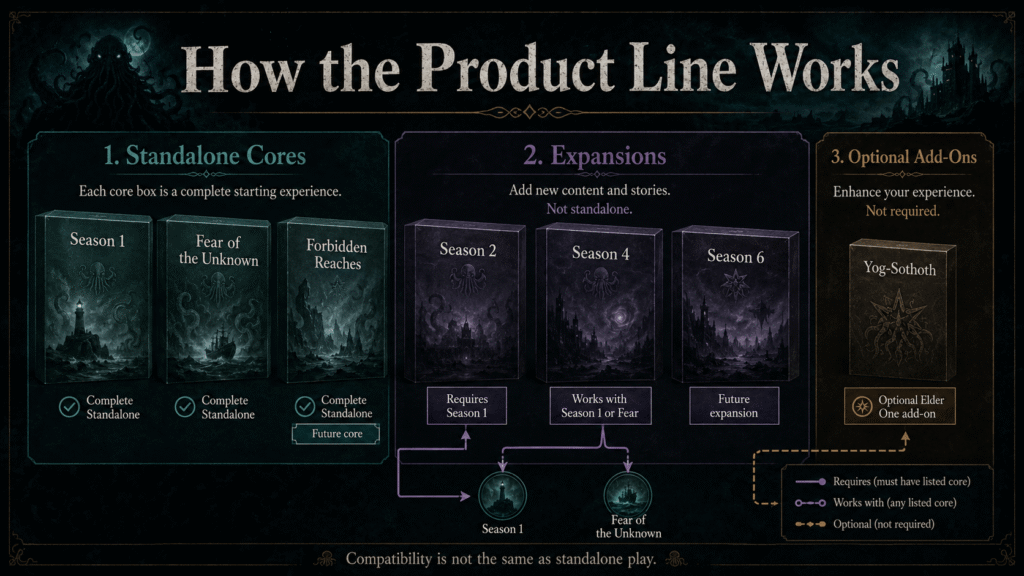
The simplest way to understand the current numbered lineup is to separate complete starting boxes from expansions. The odd/even pattern is a useful shorthand for the products that exist now, but it is not an official promise about how every future Season will be named.
That distinction matters because a Death May Die purchase is not like choosing between six editions of the same standalone game. A core supplies the full framework needed to start. A numbered expansion can add Episodes, investigators, monsters or an Elder One, but it may still depend on specific material from an earlier core. Smaller Elder One boxes sit in a different category again: they remix the boss layer of Episodes you already own rather than replacing the need for a core. Keeping those roles separate prevents most expensive mistakes before they happen.
Standalone core boxes
The original Cthulhu: Death May Die is the Season 1 core. Fear of the Unknown is the Season 3 core, even though some merchandising language also uses the word “expansion.” CMON explicitly confirms that Fear is standalone and does not require Season 1. Forbidden Reaches is the Season 5 core and is also being developed as a standalone starting box, but it remains outside the normal retail recommendation ladder at this research cutoff.
CMON confirms that Fear of the Unknown is a standalone core box
Numbered expansion boxes
Season 2, Season 4 and Season 6 are expansions rather than equivalent starting boxes. The important warning is that “compatible with the wider system” does not mean “independently playable with every core.” The clearest example is Season 2: it requires the original base game for its Episode content. Season 4 is structurally different because its published requirement accepts either the original core or Fear of the Unknown. Season 6 is still future content and should not drive a normal buy-today decision.
Collector boxes, promos and crowdfunding extras should be mentally removed from this basic map. They may matter to an enthusiast who already knows the system, but they do not change what a newcomer needs to begin. If a product page makes the line look like a wall of indispensable boxes, return to the functional question: is this a core, a playable expansion for the core I own, or optional variety? That one filter is more useful than trying to memorize every product name.
Why Fear of the Unknown Is the Best Starting Point Right Now
It is a complete core, not a mandatory add-on
Fear of the Unknown wins the current first-buy recommendation because it solves the newcomer problem cleanly. You can open this box and start the Death May Die system without owning the original. The retail box includes six Episodes, ten investigators and two Elder Ones, giving it the same kind of complete core-scale structure a new buyer actually needs. It also adds the Unknown Monster and Relic systems, but those extras should not be mistaken for mandatory complexity. The official rulebook treats the Unknown Rules as optional and specifically advises inexperienced players not to use them at first. That is useful for a newcomer: you can learn the regular system first, then add the modular Unknown layer once you want more uncertainty and variety.
It leaves room to grow without demanding a second purchase
Fear also works as a strong long-term hub. Its Unknown Monster material includes support for older monster pools, so later additions can expand what you already own instead of making the core feel isolated. That matters more than simply being newer: the value is that one purchase is complete now and still has room to integrate additional material later.
For a first purchase, that balance is more important than chasing the maximum possible amount of content. Six Episodes and two Elder Ones already create many core combinations before the Unknown modules are layered in. A buyer can therefore treat Fear as a complete stopping point rather than the first item in a mandatory bundle. If the game becomes a favorite, the optional systems and wider compatibility provide places to grow. If it does not, the original purchase was not dependent on a second box to become useful.
Current retail practicality is the final part of the recommendation, not the entire argument. At the 30 August 2026 research cutoff, Fear was the most practical major retail core for a normal US buyer, while the original core had less dependable normal-retail availability and Forbidden Reaches was still a future/production-stage product. If those conditions change, the buying recommendation should be reviewed—but Fear remains a strong starting option even without the stock advantage.
If the original core returns to stable normal retail, the decision becomes closer rather than reversing automatically. The current winner is based on the whole purchase path: completeness, the ability to begin with the standard rules, expansion options and practical access considered together.
When the Original Core Is the Better Choice
The original Cthulhu: Death May Die is not obsolete, and this guide does not treat it as an inferior version of Fear. It remains a complete starting game with six Episodes, ten investigators and the Elder Ones Cthulhu and Hastur. If those specific Elder Ones are part of why you want the game, the original has an obvious appeal that Fear cannot replace.
The original also becomes the more logical route if you already know Season 2 is high on your purchase list. Season 2 was built as an expansion to the original base, and its Episode content relies on original-core material. Starting with Season 1 therefore gives you the cleanest path into that expansion without creating a prerequisite problem later.
The caveat is purchasing practicality. Do not treat scarcity as proof that the original is more valuable, and do not pay a collector-style premium just because it is the first box in the series. If a reputable normal-retail copy is available at a sensible offer, it is an excellent alternative starting core. If not, Fear is the easier current recommendation.
This is also why the choice should not be framed as “old versus new.” The more useful comparison is route versus route. Season 1 gives you the original content library and the cleanest path into Season 2. Fear gives you a self-contained current core with its own content library and optional Unknown systems. Both can be sensible first purchases; the recommendation changes with availability and what you plan to add later.
If your interest in Death May Die comes from Lovecraft himself, see our broader guide to the best H.P. Lovecraft collections and editions.
What Should You Buy Based on What You Already Own?
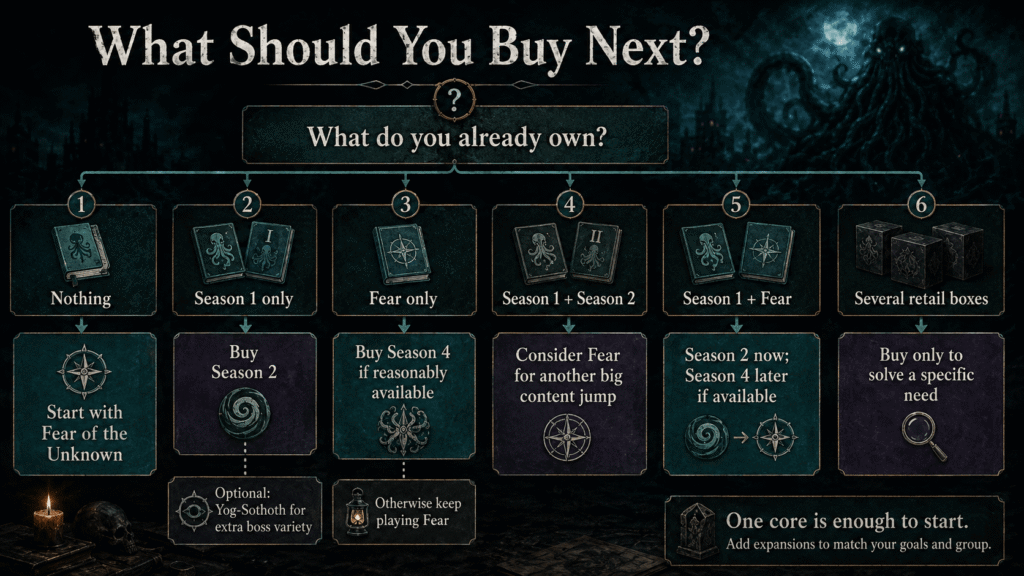
The best Death May Die purchase changes once you already own a core. Use your current collection as the first filter before looking at rankings or rare boxes.
| What You Own | Best Next Move | Key Caution |
|---|---|---|
| Nothing | Start with Fear of the Unknown. | Do not stack expansions, collector boxes or a second core onto the first purchase. |
| Season 1 only | Season 2 for a major expansion; one Elder One only if you specifically want a smaller boss remix. | Do not buy another core merely because it exists. |
| Fear only | Season 4 when reputable normal-retail stock exists; otherwise keep playing Fear or optionally add one Elder One. | Season 2 is not a clean six-Episode Fear-only route. |
| Season 1 + Season 2 | Fear if you genuinely want a large new library of Episodes, investigators, Elder Ones and optional systems. | A second core duplicates common infrastructure. |
| Season 1 + Fear | Season 2 is the cleanest current large expansion; Season 4 later if normal stock exists. | Do not chase Season 4 at inflated scarcity pricing. |
| Several retail boxes | Play what you own; add content only to solve a specific variety need. | More content is not automatically more value. |
| Completionist | Separate normal-retail completion from exclusive/crowdfunding completion. | Rarity and completion pressure can make the last purchases disproportionately inefficient. |
You own nothing
Buy one core and stop there long enough to learn what kind of variety you actually want. Fear is the current default because it is standalone, complete and flexible. You do not need an Elder One box, a numbered expansion or collector material to make the first purchase functional.
You own Season 1
Season 2 is the most efficient large expansion route because you already own the prerequisite core it was designed around. If you only want a smaller change rather than six more Episodes, one Elder One can be the more restrained purchase. The key question is whether you want more scenarios and investigators or simply a new boss layer.
You own Fear
Season 4 is the cleaner large expansion route because it can be used with Fear as the core. However, availability matters. If reputable normal-retail stock is poor, there is no need to replace a good expansion choice with a bad purchasing decision. Keep playing Fear, or add one optional Elder One only if boss variety is the specific gap you want to fill.
You own Season 1 + Season 2
Fear becomes a meaningful large upgrade because it adds another full core library: new Episodes, investigators and Elder Ones, plus the optional Unknown systems. The trade-off is duplicated infrastructure. Buy Fear for the content and modularity, not because a second core is necessary.
You own both major retail cores
Season 2 is the cleanest current large expansion if you do not already own it because the original prerequisite is satisfied. Season 4 becomes another logical option when normal retail availability is healthy. Once you have both cores, however, the case for additional purchases should become stricter: each new box should solve a specific variety goal rather than merely fill a catalogue gap.
You already own several retail boxes
At this stage, the best next move may genuinely be no purchase. The system is designed around recombining Episodes, Elder Ones and investigators, so a collection can gain value from replay before it gains value from another box. Only add an Elder One if boss variety feels stale, another Season if you want a substantial scenario library, or another core if its unique content and mechanics justify duplicated basic components. “More Death May Die” is not by itself a purchase problem that needs solving.
You are a completionist
Treat normal-retail completion and exclusive completion as two different hobbies. The first can be approached through standard cores, Seasons and normal Elder One boxes. The second can involve Kickstarter/Gamefound exclusives, legacy boxes and promos with very different availability and pricing. None of that exclusive material is required to understand or enjoy the normal system.
Looking for a different horror tabletop experience? See our Final Girl buying guide for what a first-time buyer actually needs to purchase.
Season 2 vs Season 4: Which Expansion Fits Your Core?
This is the point where broad “everything mixes together” advice becomes dangerous. Death May Die is modular, but expansion prerequisites still matter. Compatibility is not the same thing as independent usability.
Season 2: best for an original-core owner
Season 2 adds six Episodes, ten investigators, new monsters and new locations. More importantly, Asmodee states that it requires the base game Cthulhu: Death May Die. The Episode design also relies on original-core material, so a Fear-only owner should not buy Season 2 expecting it to function as a complete six-Episode expansion route by itself.
Asmodee Season 2 product information
If you own Season 1, that prerequisite is already solved. In that collection state, Season 2 is the most direct large content increase because it expands the core you have rather than asking you to buy another complete core first.
Check Season 2 on Amazon.com
Season 4: cleaner for a Fear-only owner
Season 4 adds six Episodes, six investigators and the Elder One Nyarlathotep. Published product information describes it as a non-standalone expansion that can use either Cthulhu: Death May Die or Fear of the Unknown as its required core. That makes it structurally much cleaner for someone whose only core is Fear.
Season 4 prerequisite and product details
The problem is not compatibility; it is purchasing conditions. Season 4 should be recommended when reputable normal-retail availability is reasonable. If the only options are inflated or dubious marketplace offers, the better answer is to wait. A good expansion does not become a good purchase at any price.
This also explains why Season 2 and Season 4 should not be ranked as though every owner faces the same choice. For a Season 1 owner, Season 2 is efficient because it extends infrastructure already on the shelf. For a Fear-only owner, Season 4 avoids the need to acquire the original core simply to unlock the expansion’s main Episode route. Purchase fit is determined by prerequisites first, then by the content you want—not by a universal “best expansion” label.
Do You Need an Elder One Expansion?
Usually, not yet. A new core already includes two Elder Ones, and Death May Die is built around combining Episodes with different Elder Ones. That gives one core meaningful replay combinations before you spend anything on an extra boss box. Yog-Sothoth is the strongest current smaller-add-on example because official product information says it can be combined with any Episode from the core box or expansions. In practical terms, it changes the boss layer across content you already own instead of adding another full core or large set of Episodes.
Asmodee Yog-Sothoth product information
That does not make Yog-Sothoth an automatic bundle with Fear or Season 1. Buy an Elder One when you have played enough to know that more boss variety is what you want. If you are still learning your first core, the cheaper and more useful decision is often to buy nothing.
An Elder One box is most valuable when you already like the Episodes you own and want them to behave differently under a new central threat. It is a narrower purchase than a full Season, which is exactly why it can be sensible later: you are paying for a specific type of variety instead of buying another large stack of content. That is a better reason than trying to make the collection look complete.
Check Yog-Sothoth on Amazon
Should You Wait for Forbidden Reaches?
Forbidden Reaches matters because it is an all-new standalone core and introduces Campaign Mode, which links three Episodes into a continuing structure. CMON’s design material explains that the campaign is intended to preserve the system’s modularity by allowing different Episodes and Elder Ones to be used across configurations.
CMON’s Forbidden Reaches design overview
But future importance is not the same thing as a current retail recommendation. At the 30 August 2026 cutoff, Forbidden Reaches was still in the production/crowdfunding pipeline rather than established normal US retail. Most buyers therefore do not need to delay a complete purchase of Fear now. Waiting makes sense only if Campaign Mode or the newest core is specifically what you want and you are comfortable postponing the purchase without relying on a speculative retail date.
Season 6 belongs in the same future-product bucket for this guide. It is an expansion rather than a starting core, and it should be revisited when final retail documentation and normal availability make it relevant to ordinary buyers.
What New Buyers Should Skip
A useful buying guide should tell you what not to buy. None of the items below is automatically bad; they are simply poor first-purchase priorities for most newcomers.
| Skip / Delay | Why |
|---|---|
| A second core on day one | One complete core is enough to learn the system. A second core duplicates common infrastructure before you know what kind of extra variety you value. |
| Season 2 when Fear is your only core | Season 2 requires original-base material for its Episode route. Do not buy it as if it were a self-contained Fear expansion. |
| Season 4 at scarcity-inflated pricing | It is a good structural fit for Fear, but waiting for normal retail is better than overpaying. |
| Forbidden Reaches or Season 6 as a present “must buy” | They are future/production-stage products at the cutoff, not required parts of a normal retail starter route. |
| Unspeakable / Unknowable boxes, Animal Allies, R’lyeh Rising and promos | Collector and crowdfunding material can add variety, but newcomers do not need it to get a complete core experience. |
| Every Elder One | One extra boss should solve a real desire for more boss variety; collecting them all is not a prerequisite. |
| Extra dice/accessories before playing | Learn the base box before deciding whether convenience accessories solve a problem for you. |
| Dubious “rare” marketplace listings | Verify exact product identity, manufacturer and seller conditions rather than treating rarity language as value. |
Why New Buyers Should Avoid Overbuying
The common pattern behind this skip list is simple: avoid buying ahead of your own experience. Death May Die already gives a new owner a complete core system, so optional products should answer a need you can name. If you have not yet learned whether you want more Episodes, more Elder Ones, a campaign structure or collector pieces, buying all four categories at once only makes the first purchase more expensive and the collection harder to understand.
Crowdfunding rarity deserves special caution. Exclusive content can be interesting to collectors, but scarcity is a market condition, not evidence that a box is essential or even the best value for play. A newcomer is usually better served by normal-retail content with clear prerequisites and stable product identity. If exclusive completion later becomes part of the hobby for you, make that decision separately from the question of what is needed to play.
Compatibility and Requirements at a Glance
Use this table as a purchase filter, not as a claim that every component mixes in every possible way. The most important distinction is whether a product is a complete starting box and whether its main Episode content can be used with the core you actually own.
When two products are described as compatible, ask one more question before checkout: compatible in what sense? An investigator, monster or Elder One may integrate across the wider system even when a particular Episode expansion still needs tiles or infrastructure from a specific core. The Season 2/Fear relationship is the reason this guide keeps prerequisite language visible instead of collapsing every product into a simple yes/no compatibility label.
| Product | Standalone? | Core Fit | Key Requirement / Buyer Note |
|---|---|---|---|
| Season 1 | Yes | Starting core; foundation for Season 2 | Complete original core. |
| Season 2 | No | Full intended Episode route with Season 1; only partial wider-system integration with Fear | Requires original base; Fear alone does not satisfy the Episode prerequisite. |
| Fear / Season 3 | Yes | Standalone core; compatible with the wider system | Season 1 not required. |
| Season 4 | No | Designed to expand either Season 1 or Fear | Requires one of those cores; not standalone. |
| Forbidden Reaches / Season 5 | Yes — future core | Standalone future core with broad modular intent | Not yet a normal retail recommendation at the cutoff. |
| Season 6 | No — future expansion | Future expansion; final public compatibility details should be rechecked at retail | No current CTA or buy-now recommendation. |
| Yog-Sothoth | No | Can be used with Episodes from core boxes or expansions | Optional Elder One; not required. |
Frequently Asked Questions
Is Fear of the Unknown standalone, or do I need Season 1?
Yes, Fear of the Unknown is standalone, and Season 1 is not required. Some retail wording can make Fear look like an expansion, but CMON confirms that it can be your first Death May Die purchase. Season 1 becomes relevant only if you specifically want its Episodes, investigators and Elder Ones, or if you want the cleanest route into Season 2. Do not buy the original merely because you assume every later Season depends on it.
Does Season 2 work with Fear of the Unknown?
Not as a simple self-contained six-Episode Fear expansion. Fear is compatible with the wider Death May Die system, but Season 2’s own product requirement calls for the original base game, and its Episode content relies on original-core material. A Fear-only owner should therefore treat Season 2 as prerequisite-dependent rather than as the obvious next large box.
Is Season 4 standalone?
No. Season 4 is an expansion. Its published requirement accepts either the original Cthulhu: Death May Die core or Fear of the Unknown, which is why it is the cleaner large expansion route for a Fear-only owner. That recommendation still depends on finding it through reputable normal retail rather than paying an unreasonable scarcity premium.
Should I buy Season 1 or Fear first?
For most new US buyers right now, Fear is the stronger starting purchase because it is standalone, complete, has optional extra systems that can be ignored at first, and offers the most practical current retail route. Choose Season 1 instead when you specifically want Cthulhu and Hastur, prefer the original baseline, or intend to build into Season 2 and can find a reputable normal-retail copy.
Should I wait for Forbidden Reaches?
Not by default. Forbidden Reaches is a meaningful future core because of Campaign Mode, but it was not normal US retail at the research cutoff. Waiting is reasonable if Campaign Mode or the newest core is the feature you specifically want. Otherwise, there is no need to postpone a complete Fear purchase simply because another core is coming later.
Do I need Kickstarter or Gamefound boxes?
No. Crowdfunding and collector material can expand a collection, but it is not required for a complete newcomer experience. Start with a normal retail core. If you later become a completionist, treat exclusive collecting as a separate decision with different availability, pricing and value trade-offs. A normal player can build a substantial Death May Die collection through retail products without treating every campaign-exclusive box as a missing piece.
Final Buying Decision
If you are completely new to Cthulhu: Death May Die, start with Fear of the Unknown. One core is enough. Learn the system first, leave the optional Unknown rules aside if you want a simpler first session, and add content only after you know what kind of variety you are missing.
If you own the original core and want a substantial expansion, Season 2 is the cleanest next purchase because you already have the base material it requires. If you own Fear and want a large expansion, Season 4 is the better structural fit when normal reputable stock is available; otherwise, waiting is better than forcing the purchase. For a smaller change, one Elder One such as Yog-Sothoth can add boss variety without another large box.
Collectors can go much deeper, but that is a different goal from building a sensible playable collection. Keep normal retail and exclusive completion separate. The safest rule is the same throughout this guide: buy the next box only when it solves a specific content or compatibility need—not because the product line makes an empty space on the shelf feel unfinished.