Maybe your first Resident Evil memory did not involve a controller at all.
Maybe it was one of the movies: someone standing in front of a door that absolutely should not be opened, while you sat safely on the other side of the screen thinking, There is no chance I would go in there.
Games ruin that comfortable distance.
Now the flashlight is in your hand. The hallway is yours to cross. Something moved around the corner, you have six bullets left, and unfortunately nobody else is going to press forward on the stick for you.
That is part of the fun of finally trying Resident Evil yourself.
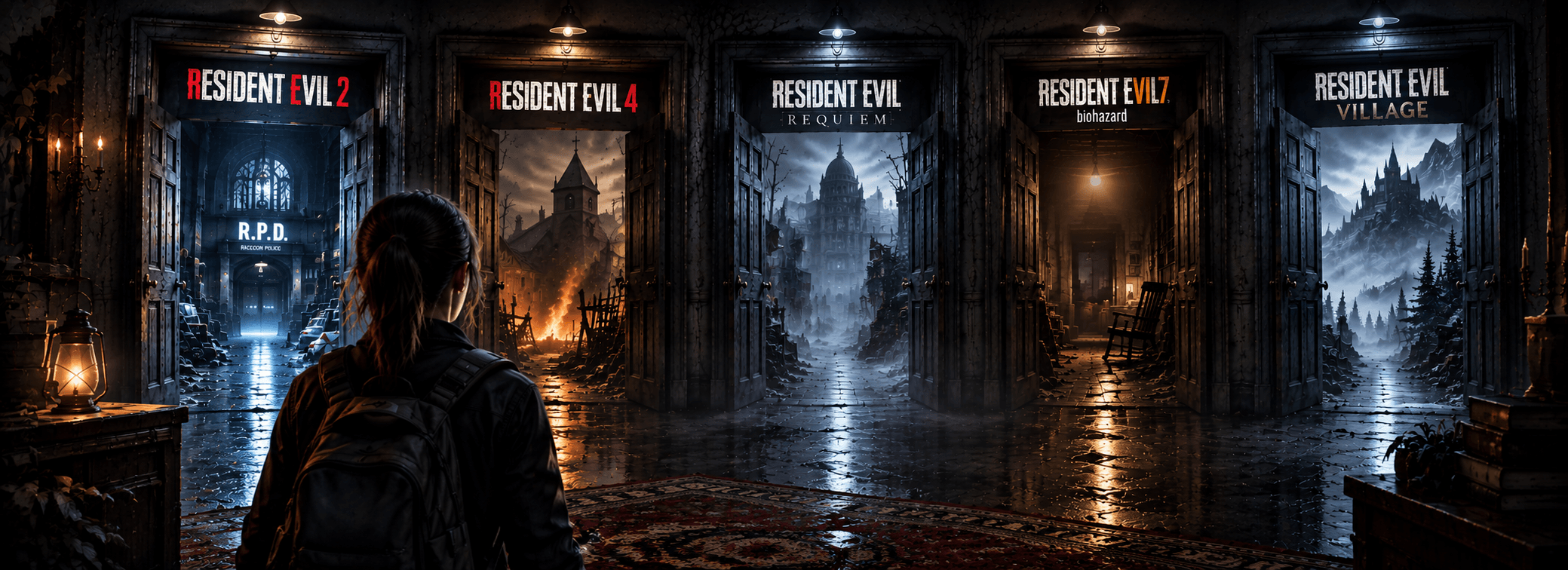
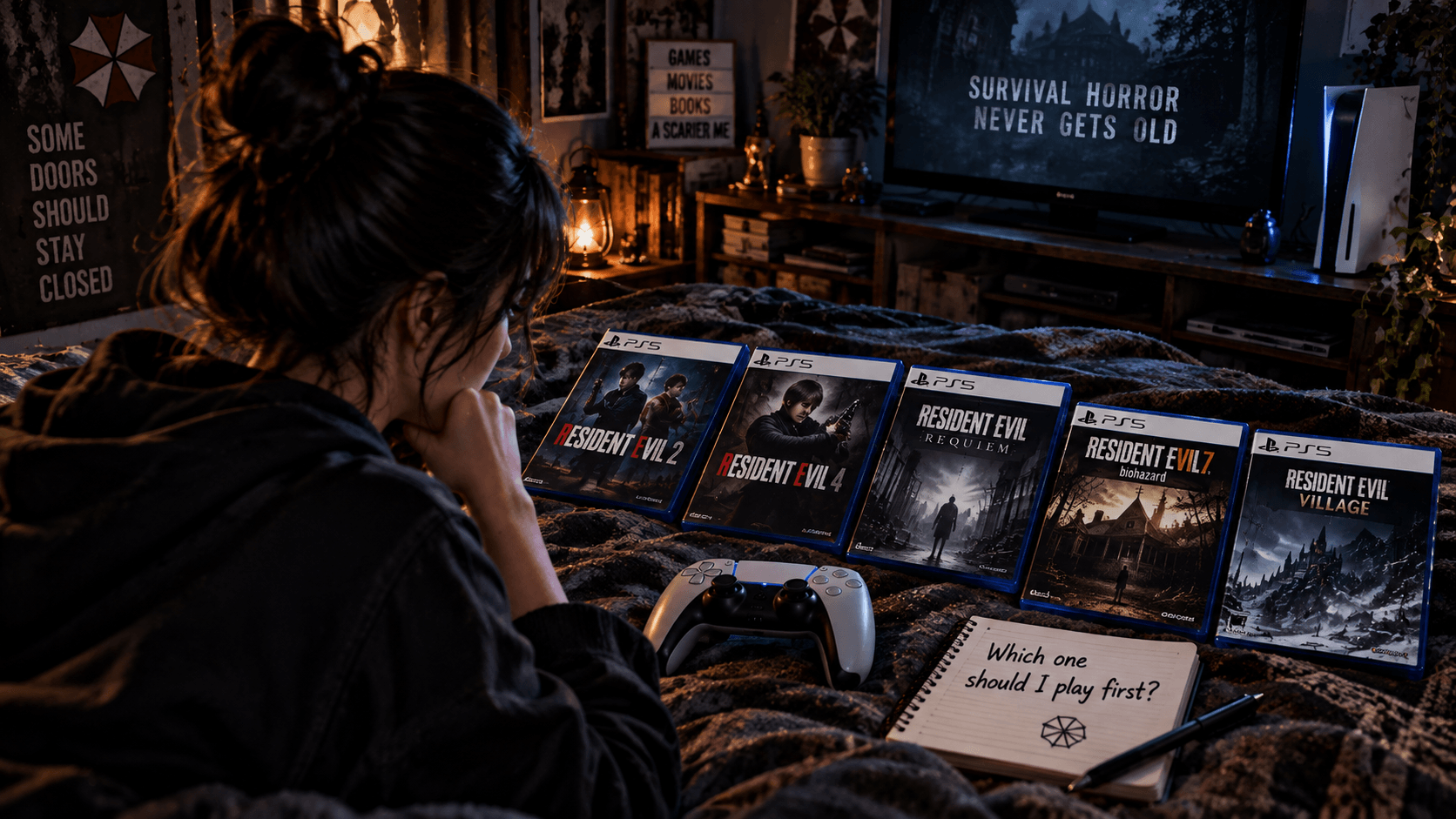
The less fun part comes five minutes later, when you look at the games available on PS5 and find Resident Evil 2, Resident Evil 4, Resident Evil 7 biohazard, Resident Evil Village and Resident Evil Requiem staring back at you.
Remakes. Numbers that do not appear to behave like normal sequel numbers. First-person games. Third-person games. Zombies. Strange villages. Raccoon City. Leon Kennedy appearing decades apart.
So, which Resident Evil game should you play first on PS5?
For most newcomers, we would start with Resident Evil 2 Remake.
It gives you one of the clearest modern introductions to what Resident Evil does so well: exploration, puzzles, limited resources, uncomfortable corridors, zombies that refuse to respect personal boundaries, and enough story context to make later games feel richer.
It is not the only sensible place to begin, though. Resident Evil 4 comes remarkably close, Requiem is far more newcomer-friendly than its place late in the series suggests, and Resident Evil 7 offers an excellent doorway into the franchise’s nastier side.
First, however, we need to remove the biggest worry.
Do You Need to Play Resident Evil in Order?
Generally, no.
You do not need to work through the entire series from the 1990s before somebody allows you into Raccoon City.
Several Resident Evil games tell stories that can be understood perfectly well as a newcomer’s first experience. What matters more is knowing which connections are worth caring about.
Resident Evil 2 and Resident Evil 4 are connected through Leon S. Kennedy. RE2 introduces him much earlier in his life, while RE4 follows a far more experienced Leon. You can start with RE4 without knowing his previous story. Capcom described the remake as a fresh gameplay experience for both longtime fans and newcomers. Capcom’s Resident Evil 4 announcement
Playing RE2 first simply gives Leon’s later appearance more context.
Which Resident Evil Connections Actually Matter?
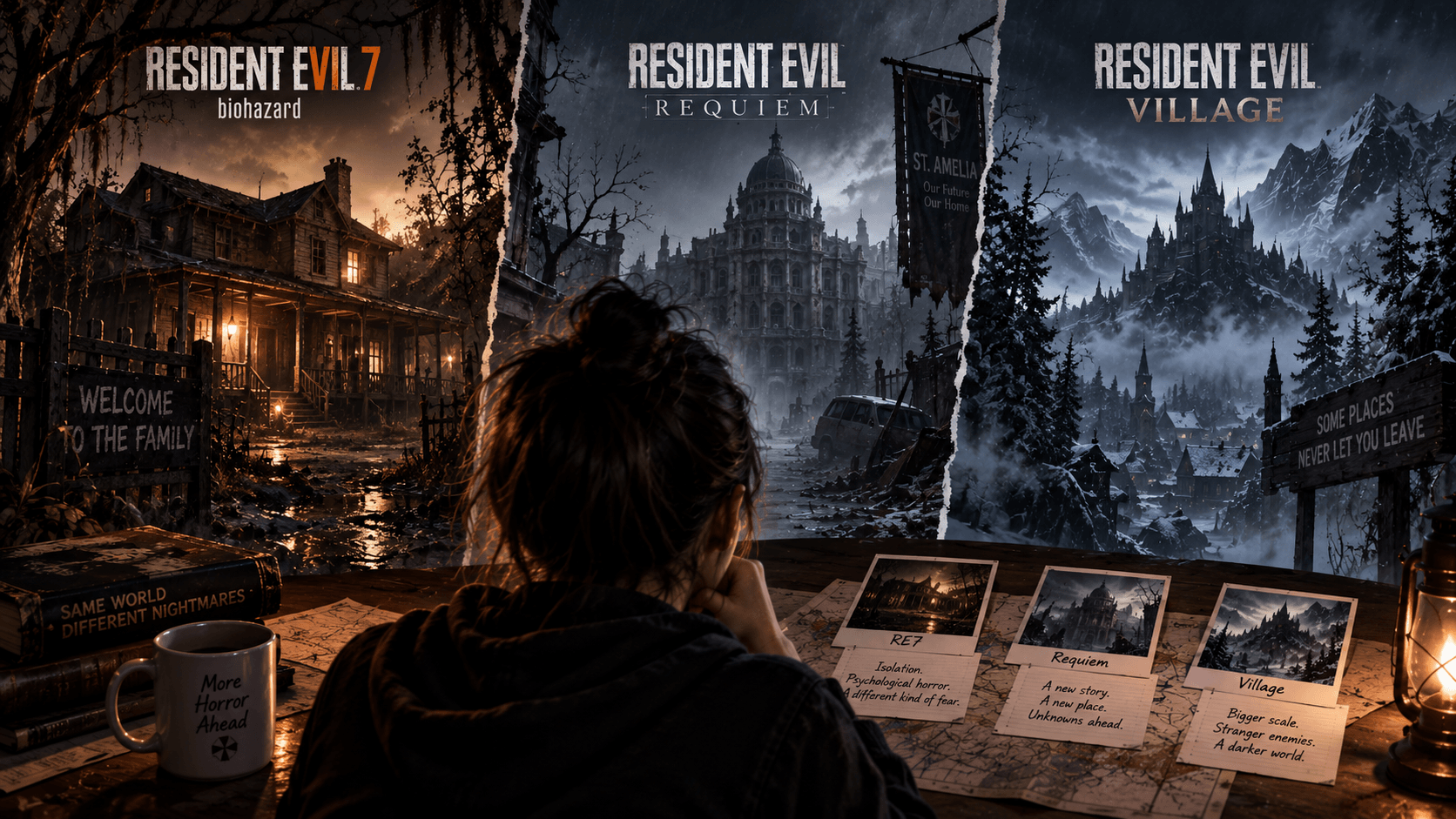
Resident Evil 7 and Resident Evil Village are more tightly linked. RE7 introduces Ethan Winters, while Village continues his story afterward. That is why we would normally play RE7 before Village.
Then there is Resident Evil Requiem. Despite arriving much later in the franchise, it was deliberately designed so newcomers could enter without decades of required homework. Previous knowledge of Leon, Raccoon City and the larger series can make certain moments mean more, but it is not an entry ticket.
So no, you do not need to memorize Resident Evil history before starting.
You just need to pick a doorway that makes sense.
| Our recommendation | Why it works as a first Resident Evil |
|---|---|
| Resident Evil 2 Remake: Start here | The strongest all-round modern introduction to Resident Evil |
| Resident Evil 4 Remake: Closest alternative | Extremely approachable, with considerably more combat and momentum |
| Resident Evil Requiem: Strong modern entry point | The newest PS5 experience and deliberately welcoming to newcomers |
| Resident Evil 7 biohazard: Horror-heavy doorway | Easy to enter narratively, but much more isolated and first-person |
| Resident Evil Village: Better saved for later | Directly continues Ethan Winters’ story from RE7 |
Why We’d Start With Resident Evil 2 Remake
Resident Evil 2 manages something surprisingly difficult.
It feels modern without sanding away the parts of Resident Evil that make the series Resident Evil.
You explore the Raccoon City Police Department rather than simply running through it. Doors stay locked until you understand how spaces connect. Items take up precious inventory slots. Ammunition matters. Sometimes the smartest response to a zombie is not emptying half a magazine into it, but slipping past and hoping it does not become Future You’s problem.
That rhythm teaches a newcomer a lot about the series.
Resident Evil has always been about monsters, of course, but the tension does not come from monsters alone. It comes from making decisions while those monsters are nearby.
Do you use the healing item now? Is that room worth another trip? Do you spend ammunition making this corridor safer, knowing you might desperately want those bullets later?

Why RE2 Makes Such a Useful First Door
RE2 wraps those decisions inside a modern third-person game that does not ask a new player to wrestle with decades-old controls.
It also introduces Leon S. Kennedy and Claire Redfield during the Raccoon City outbreak, giving you useful foundations for several parts of Resident Evil that appear later.
Capcom producer Tsuyoshi Kanda described the RE2 remake as a bridge for introducing newer audiences to the world of Resident Evil. Read Capcom’s Resident Evil 2 developer interview
You are not starting at the literal beginning of the franchise. You are entering at a point where many of its most recognizable ideas are easy to understand.
There is a catch.
RE2 can be stressful.
Resources are not endless, exploration asks you to revisit dangerous spaces, and the game occasionally turns familiar hallways into places you would very much prefer not to visit again. A player accustomed to generous gunfights and constant forward momentum may find that pressure less comfortable than what Resident Evil 4 offers.
We still think that pressure is part of why RE2 works so well as a first Resident Evil.
It shows you the series before it leans too far toward either extreme. You get horror without being dropped immediately into RE7’s intensely intimate first-person nightmare. Combat is there without RE4’s heavier emphasis on fighting. You still meet important characters without needing much previous story knowledge.
For most people stepping into Resident Evil on PS5 for the first time, Resident Evil 2 Remake is the game we would put in their hands.
Affiliate disclosure: As an Amazon Associate I earn from qualifying purchases. Using these affiliate links does not add any extra cost to your purchase.
Resident Evil 4 Remake Is the Closest Alternative
Resident Evil 4 is the game most likely to make us hesitate before handing you RE2.
It is exceptionally easy to imagine a newcomer loving it immediately.
Leon is still played from third person, the presentation feels thoroughly modern, and combat has much more space to breathe. You have more opportunities to fight back, more weapons to work with and a game that frequently wants you moving forward rather than carefully rationing every trip through the same dangerous hallway.
That makes RE4 feel wonderfully energetic.
It also means it shows you a different balance of Resident Evil.
Where RE2 spends more time making you feel vulnerable, RE4 often lets Leon feel capable. He is no longer the inexperienced police officer arriving in Raccoon City. He knows how to handle himself, and the game builds its combat around that.
None of this makes RE4 a poor first game. Quite the opposite. Capcom itself positioned the remake as something newcomers could enjoy too. See Resident Evil 4 for PS5 on Amazon.
The reason we still lean toward RE2 first is that RE2 gives you more of the survival-horror foundation before Resident Evil starts turning up the action.
It also lets you meet Leon closer to the beginning of his story.
Play RE2 first and RE4 later, and the change in him becomes part of the experience. The nervous young police officer and the much more confident agent feel connected rather than simply being two versions of the same famous character.
If somebody placed RE4 in your hands as your first Resident Evil, we would not snatch it away.
We would just place RE2 beside it and say, start with this one first.
Requiem Is Much Easier to Start With Than You Might Expect
The title Resident Evil Requiem creates exactly the kind of anxiety that keeps newcomers hovering over the PlayStation Store instead of playing anything.
It arrives deep into a franchise with decades of history. Leon Kennedy is involved. Raccoon City matters again.
Surely you need homework.
You really do not.
Requiem director Koshi Nakanishi put that worry to rest in a PlayStation Blog interview: the game was designed to welcome complete newcomers who know nothing about the Raccoon City Incident and may never have played Resident Evil before. Grace Ashcroft is part of how the game makes that possible. Read PlayStation Blog’s Resident Evil Requiem director interview
She does not approach danger with Leon’s years of experience behind her. Her side of the game gives newcomers a character through whom the world can feel threatening and unfamiliar rather than assuming everyone arrived carrying an encyclopedia of Umbrella lore.
Leon brings something very different.
His sections lean harder into the capable, action-oriented side of modern Resident Evil, giving Requiem an unusual ability to show a newcomer more than one face of the series inside the same game.
Requiem also allows first-person and third-person play, making it particularly interesting for someone who has not yet discovered which modern Resident Evil viewpoint feels more natural to them.
And unlike the remakes of older entries, this is the newest native PS5 Resident Evil among the games we are comparing here. If Requiem is the game that finally made you curious about the series, there is no sensible reason to treat that curiosity as invalid.
Why We Still Open the RE2 Door First
The little wrinkle is that being easy to enter is not quite the same as arriving with zero context.
Requiem does not require earlier Resident Evil games, but Leon and Raccoon City inevitably carry more history when you have already spent time with them. Certain places, names and returning ideas can land with more weight because you recognise what they represent.
We would never tell a newcomer to postpone Requiem until they have completed a stack of older games. That turns entertainment into coursework.
But if somebody came to us with no preference beyond I want to start Resident Evil, RE2 still gives them the cleaner foundation.
Requiem is impressive partly because it can welcome you without that foundation.
Having the foundation simply lets you notice more of what has been built on top of it.
Resident Evil 7 Is Brilliant, but It Shows You a Different Side of Resident Evil
Resident Evil 7 has one enormous advantage as a starting point. See Resident Evil 7 biohazard Gold Edition for PS5 on Amazon.
Ethan Winters is new too.
You do not begin halfway through his personal story or arrive after several games of character development. Ethan’s nightmare starts here, which makes RE7 unusually easy to enter from a narrative perspective.
Then the camera moves into first person and the walls start closing in.
RE7 feels far more intimate than RE2 or RE4.
Instead of watching your character move through a horrible place from behind their shoulder, you occupy the space directly. Hallways feel narrower. Doors feel closer. Things approaching you have considerably less polite distance between themselves and your face.
Its setting reinforces that feeling.
Rather than giving you the broader Raccoon City disaster or RE4’s larger action sequences, RE7 traps you inside a more isolated horror story and spends a lot of time making that isolation uncomfortable.
That makes it a terrific Resident Evil doorway for someone primarily drawn to horror.
It is also why we would not use it as the general introduction ahead of RE2, RE4 or Requiem.
RE7 deliberately opens onto a more specific corridor of modern Resident Evil: first-person perspective, a new protagonist and a claustrophobic style of horror that feels markedly different from the third-person games around it.
Walk through that door first and you can absolutely fall in love with Resident Evil.
Just do not be surprised when the next door opens onto a much larger, and rather different, part of the house.
That is why RE7 remains an excellent horror doorway without becoming our first recommendation for the wider series.
Save Resident Evil Village Until After RE7
Village is the easiest recommendation here to postpone.
Not because it is a weak Resident Evil game.
Because it is Ethan Winters’ next chapter.
Resident Evil Village takes place after RE7 and continues Ethan’s story, so beginning with Village means deliberately skipping the game that introduces him, his family and the events that put his later journey into context.
Could you still understand Village?
Probably enough to keep moving.
But there is very little reason to enter Ethan’s story halfway through when Resident Evil 7 is readily available and already works so well as a newcomer-friendly entry.
Village also pushes the formula toward grander environments and more action while retaining horror elements, so experiencing RE7 first lets you feel how Ethan’s corner of Resident Evil evolves rather than arriving after that evolution has already happened.
One small PS5 detail is worth keeping straight too.
The standard version of Resident Evil Village is fundamentally a first-person game. A third-person mode exists through the Winters’ Expansion and related expanded content, but it should not be treated as something automatically included in every standard copy.
For a brand-new Resident Evil player, we would simply make life easier:
Play RE7 before Village.
Village will still be waiting when you get there.
Which Resident Evil Should You Actually Start With?
If you have never played Resident Evil before and there is no particular game pulling you harder than the others, start with Resident Evil 2 Remake.
It gives you a modern third-person game without losing the survival-horror tension that defines so much of Resident Evil. You learn to explore instead of simply rushing forward. Ammunition starts to feel precious. You meet Leon and Claire during one of the franchise’s defining disasters. Raccoon City becomes more than a name before later games start asking that name to carry emotional weight on its own.
Most importantly, it gives you somewhere useful to go afterward.
Resident Evil 4 is the closest alternative, especially because its combat is so immediately satisfying and it asks very little of you in terms of previous story knowledge.
Requiem is a completely legitimate place to enter if the newest game is what finally made you curious about Resident Evil. You do not need to earn permission by finishing decades of older releases first.
Resident Evil 7 remains one of the strongest doorways for someone who came primarily for the horror, while Village makes much more sense once Ethan’s story has already begun in RE7.
Another horror series giving you the same franchise-homework feeling? Our guide to whether you need older Silent Hill games before Townfall tackles that question too.
If Resident Evil is turning into a two-person horror night rather than a solo one, our PS5 horror games for couples guide compares couch co-op, shared-controller play, online co-op and different controller confidence levels.
But if you are standing in front of that crowded PS5 shelf and asking us to remove the decision from your hands?
Pick Resident Evil 2 Remake.
Then open the door.