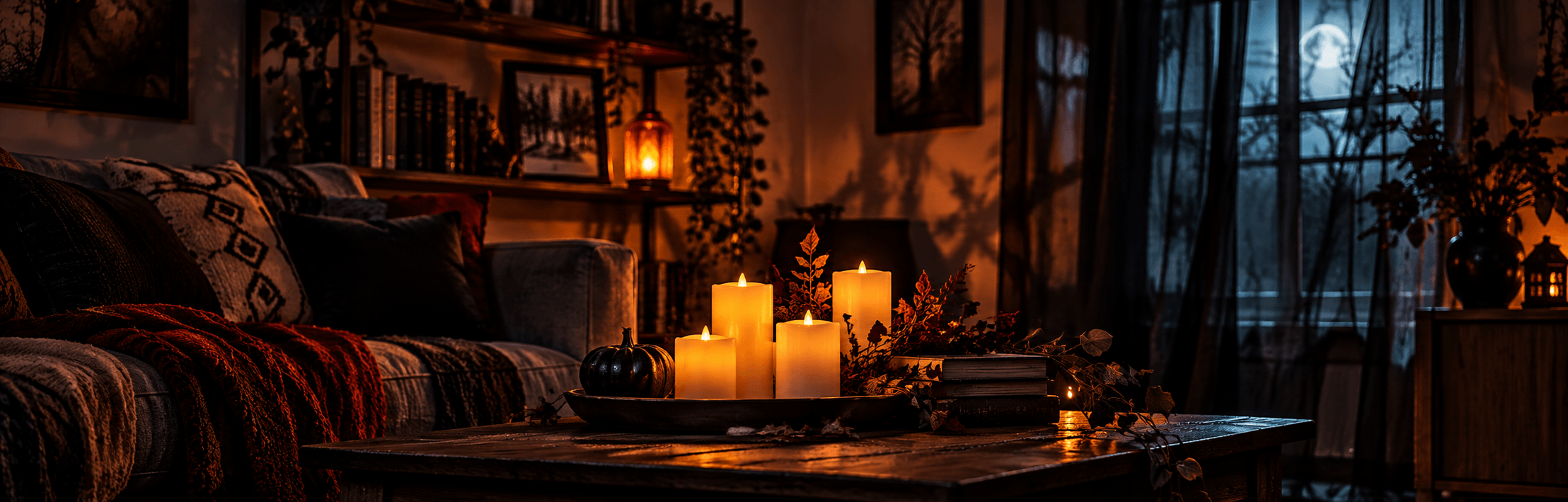
Buying Halloween decorations is easy. Making your living room feel as though somebody really should check what just moved behind that curtain is harder.
Maybe you have already put out candles, skulls and a suspicious number of tiny pumpkins, yet the room still feels exactly like your normal home wearing a Halloween sweater.
Or maybe you have not bought anything yet because every search gives you another enormous pile of ghosts, spiders, skeletons, signs, projectors and things that scream when someone walks past.
Either way, start with the room.
The best scary Halloween decorations are not necessarily the biggest or most dramatic. Usually, you need to work out what is keeping the room feeling normal, then disturb that one thing first.
Before opening another shopping tab, look around and ask what is actually missing.
If you are decorating the yard, porch or balcony instead, our scary outdoor Halloween decorations guide helps you match the scare to the space, weather, setup and storage before you buy.
| If the room still feels… | It may be missing… | Try this first | Buy only if needed |
|---|---|---|---|
| Bright and completely normal | Better lighting | Switch off the overhead light and work with existing lamps | Add atmospheric lighting |
| Too clean and contemporary | Age and texture | Repurpose dark fabric, curtains or throws | Add creepy cloth sparingly |
| Decorated but strangely empty | A suggestion of presence | Partly hide something you already own | Usually nothing |
| Busy but not unsettling | One focal disturbance | Make one familiar object feel slightly wrong | Add one focal piece only if necessary |
| Static or staged | Movement or sound | Use an existing fan, phone, TV or speaker | Usually nothing |
You may discover that one change fixes the whole room. Wonderful. Your wallet may now leave the séance.
Start With the Room, Not the Shopping Cart
Before deciding that you need more decorations, stand in the doorway and look at the room as a whole.
If you have already decorated, ignore how much effort went into each individual object for a moment. Which things are actually changing the atmosphere, and which are simply sitting there?
If you have not started decorating yet, you have an advantage. You can avoid buying five different kinds of Halloween decor only to discover that your ceiling light has made all of them look like props waiting for a party to begin.
A convincingly haunted room rarely needs every possible spooky ingredient. One room might need better lighting and nothing else. Another might already have lovely low light but still look too neat and modern.
Begin with the thing that can change almost everything underneath it.
The light.
Why Scary Halloween Decorations Fail Under Normal Lighting
You can put a beautifully creepy portrait above the fireplace and drape fabric over the shelves, but if the whole room is being blasted evenly by a bright ceiling fixture, every trick is visible at once.
Nothing is lurking. The uncertainty disappears. Even the shadows have lost the courtesy to look suspicious.
Change the Light Before You Buy the Light
First, turn off the main overhead lighting.
Try the lamps you already own. Move one lower if that is practical. Put another toward the edge of the room rather than lighting everything evenly from the middle.
Then look again.
You are not simply trying to make the room dark. You want one warm corner, a darker stretch behind furniture, or an object that disappears slightly until you move closer.
There is some evidence behind the basic idea that illumination changes how a space feels. A study published in Frontiers in Psychology found that changes in colored illumination could affect participants’ moods and impressions. That does not mean a particular Halloween bulb has scientifically proven supernatural powers. It simply supports something decorators already notice: change the light, and the same surroundings can feel different.
If your ordinary lamps suddenly make the room work, keep them.
If You’re Buying One Thing, This Is Where I’d Start
Affiliate disclosure: As an Amazon Associate I earn from qualifying purchases. Using these affiliate links does not add any extra cost to your purchase.
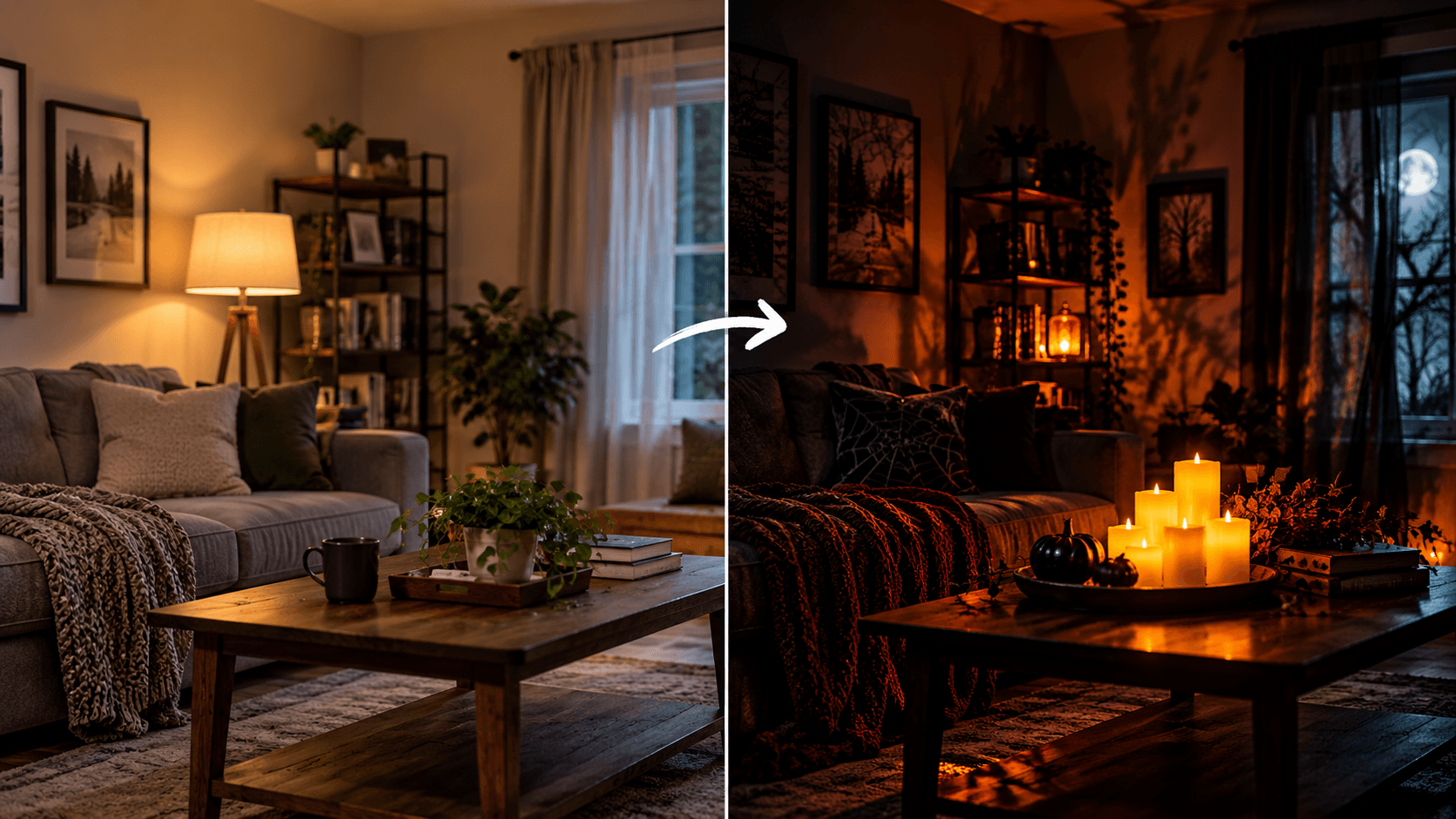
If the room still needs that flickering, old-house feeling, my broadest recommendation is the RY King large flameless real-wax pillar candle set.
The ivory set contains nine mixed-height candles: two 3-inch, two 4-inch, two 5-inch, and one each at 6, 7 and 8 inches.
But please do not line up all nine around the room like they have reported for candle duty.
Start with one mixed-height group on a mantel, cabinet, fireplace, shelf or side table. Three or four candles placed together usually look more deliberate than nine scattered individually. If that cluster gives you the atmosphere you wanted, leave the rest in the box.
That restraint is part of why I prefer this route for an ordinary room. The real-wax exterior can sit naturally among normal furniture instead of immediately announcing itself as a Halloween prop, and the candles do not depend on your room having a particular socket or useful lamp position.
There are tradeoffs. They create localized pools of flickering atmosphere, not an automatic whole-room transformation. Placement matters, and so does how much ordinary lighting you leave switched on.
They also take more storage space than a couple of bulbs. Each candle requires two AA batteries, which are not included, so powering all nine at once would require 18 AA batteries.
You do not need to power all nine at once.
When a Bulb Is the Better Choice
If you already have a suitable E26/E27 fixture in a useful position, the Hompavo flame-effect bulbs on Amazon can create a more noticeable moving-light effect from a very small purchase.
The published specification is 600 lumens, but do not read that as “one bulb will transform your entire room.” The actual effect depends on the room, where the fixture sits and what surrounds the bulb.
A suitable lantern, translucent or frosted enclosure can help diffuse the flickering effect. A heavily opaque shade can hide much of it. The bulb also is not intended for use on a dimmer switch.
So Hompavo can give you more dramatic impact than the RY King candles in the right room, but it relies on that room cooperating.
If you already like smart lighting and want something useful beyond Halloween, the Govee smart RGBWW bulbs on Amazon are the more flexible year-round option.
You gain control over colors, scenes and timing, but you also gain more setup. And restraint matters here too. A dim, dirty amber or muted red may help the room. Five violently saturated colors competing with one another may make your haunting look as though it has started livestreaming.
Once the lighting feels right, look around again. You may already be finished.
One practical note before we start adding fabric: the National Fire Protection Association’s Halloween safety tips (PDF download) advise keeping combustible decorations away from open flames and heat sources, including bulbs and heaters, and keeping exits clear. Flameless candles reduce one obvious flame risk, but fabric still should not be draped against hot fixtures or placed where it obstructs a doorway.
If It Still Looks Too Clean, Ruin It a Little
Sometimes the lighting is lovely and gloomy, but the room underneath it still looks freshly cleaned, symmetrical and deeply confident that nothing unfortunate has ever happened there.
That is where texture helps.
You do not need to cover the walls in fake cobwebs or turn every bookshelf into an abandoned crypt. Pick one or two surfaces that currently look too neat.
Try loosening your existing curtains. Drape a dark throw over part of a chair or cabinet. Use an old piece of neutral or dark fabric across one section of a shelf. Uneven folds help more than perfect decorative symmetry.
The aim is suggestion: dust, neglect, age, something left untouched longer than it should have been.
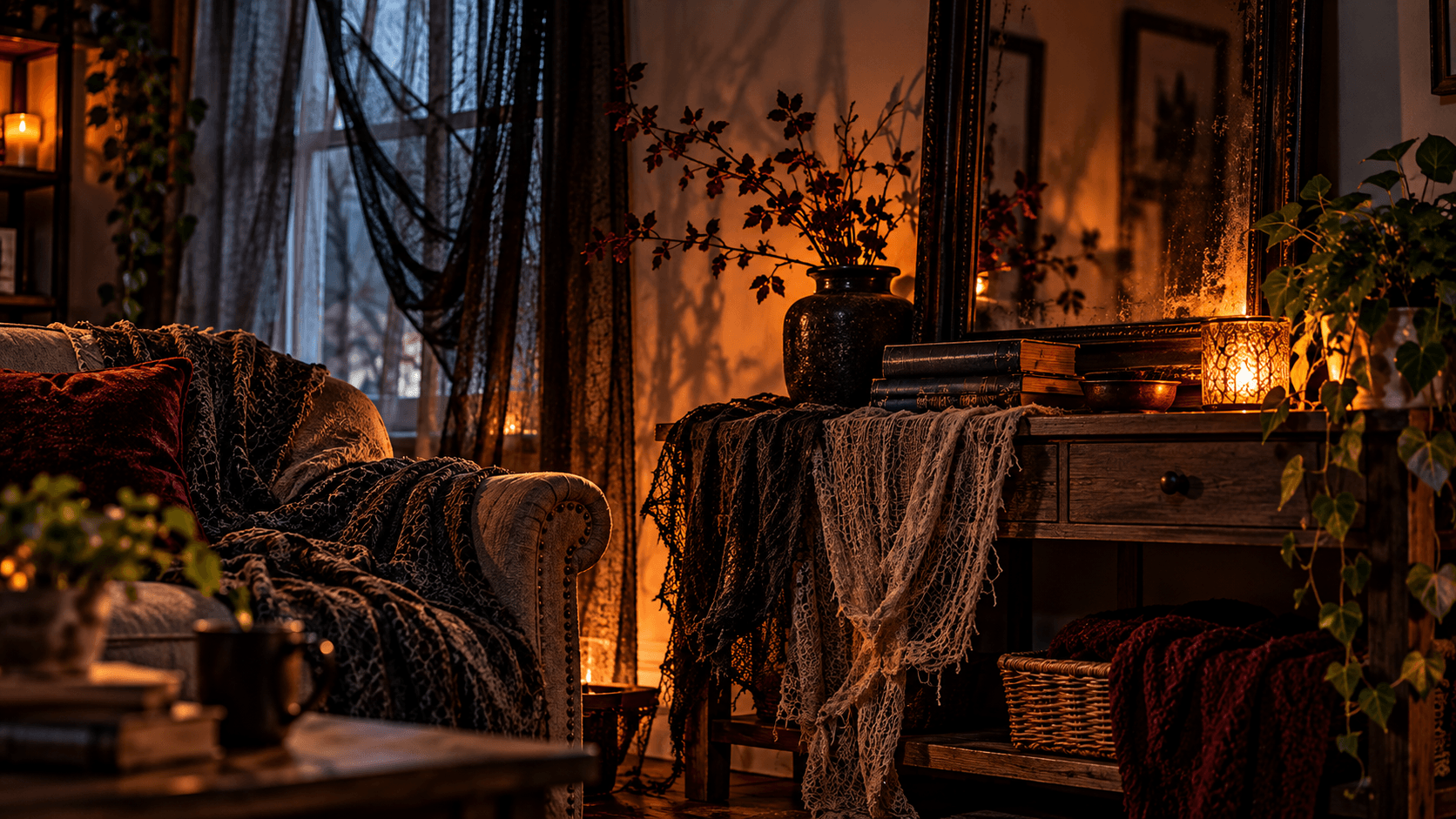
If you cannot create that effect with what you already own, black creepy cloth or gauze can be useful. I would still use it sparingly. One dark stretch hanging from a shelf or partially veiling a mirror can look unsettling. Gauze on every available surface starts drifting toward temporary haunted-attraction territory.
Keep fabric away from bulbs, heaters and other heat-producing fixtures.
If the room now feels older, stranger and less comfortable, that may be all the texture it needs.
Make It Feel Like Something Is There
A room can have wonderful lighting and distressed texture yet still feel oddly empty.
The solution is not necessarily a ghost.
In fact, showing the entire ghost can sometimes make things less interesting because your brain immediately understands what it is looking at.
Instead, leave something incomplete.
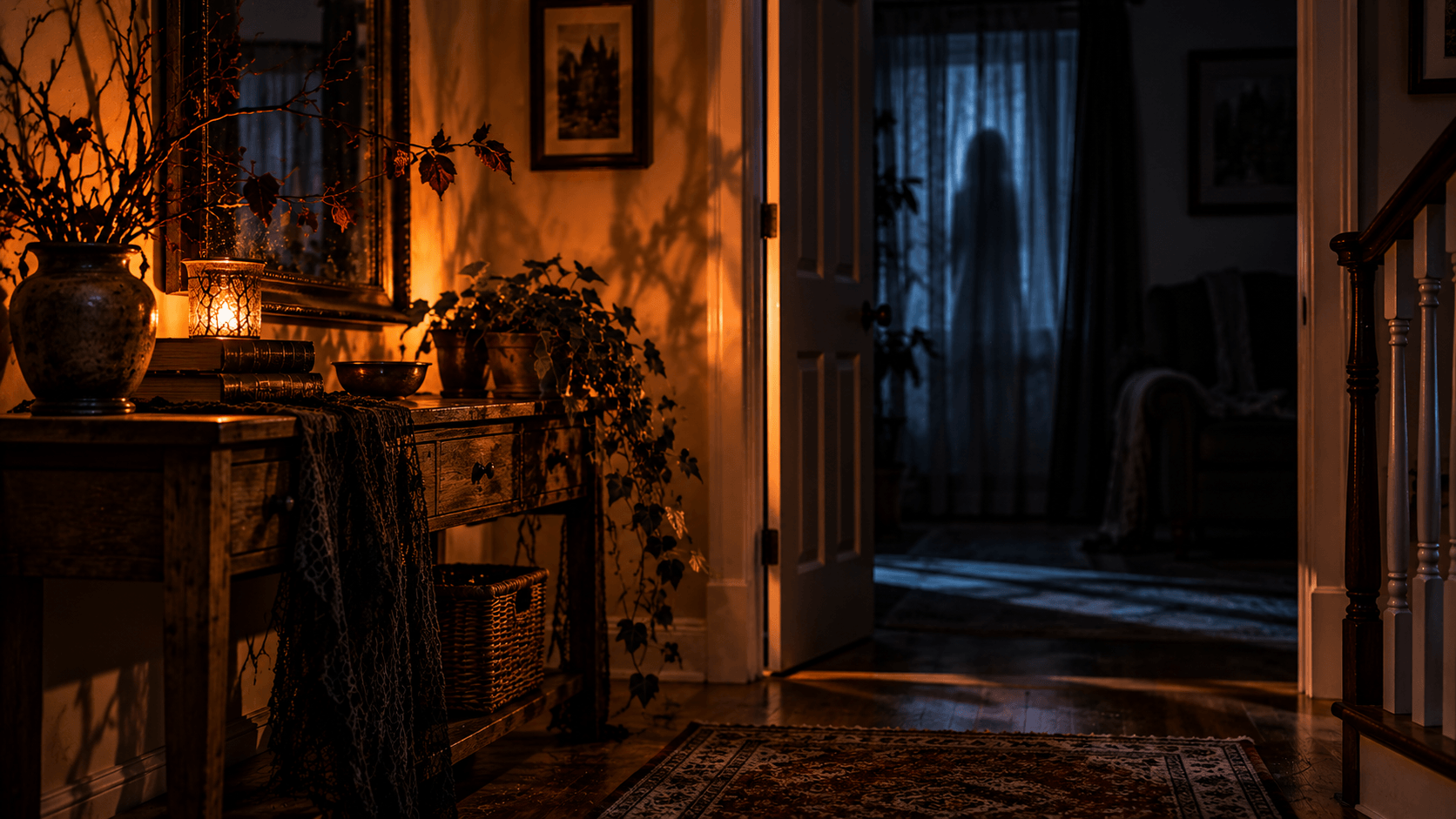
A door left slightly open can create a dark gap that was not there before. Let the edge of an object show from behind a curtain without revealing the whole shape. Hang a dark coat where its outline briefly reads as human before the eye corrects itself.
The unsettling part comes from the viewer not getting the full answer at first glance.
Nothing expensive is required here.
Just keep the room safe to move through. Do not create floor-level surprises, trip hazards or blocked exits for the sake of atmosphere.
If one half-seen corner now earns a second look, leave it alone.
Give the Eye One Thing That Feels Wrong
Now look for the first clearly visible object your eye naturally finds.
If the answer is “everything,” the room may be getting too busy.
A haunted space usually becomes more convincing when one thing acts as the visual disturbance rather than several unrelated decorations competing for attention.
Use something you already own first.
A mirror can feel different when isolated from nearby objects. A framed photograph can become unsettling if it is given its own pool of light. An old clock, doll or stack of books can work because it has been placed somewhere it normally would not be.
A chair facing an empty hallway can feel wrong without being hidden at all. A portrait that is usually part of a gallery wall may feel very different when everything around it has been removed.
Sometimes the wrongness comes entirely from context.
One question hanging in the room is usually more effective than five answers dressed as plastic skeletons.
If you already have that focal point, resist the urge to give it company.
If It Still Feels Too Still, Add Movement or Sound
At this point, the room may look excellent in a photograph but still feel slightly staged when you are standing inside it.
A tiny amount of movement can help.
A fan set low enough to shift a curtain can create movement that is barely noticeable until someone realizes the fabric keeps moving. A television can provide dim changing light if the screen itself is not visible. A phone or Bluetooth speaker can play low background ambience from somewhere outside the viewer’s immediate line of sight.
The key word is low.
If the room suddenly contains constant screams, thunder every six seconds and a soundtrack announcing that something terrifying is about to happen, all the uncertainty disappears.
Now you are running an attraction.
A quiet room with one soft recurring sound can feel stranger because the visitor has to decide whether they actually heard it.
Try the room without the sound or movement again. If nothing is lost, leave it off.
Thinking about a much bigger kind of movement?
If you are considering a full-size motion-triggered prop for a porch or yard, our Halloween animatronics guide helps you decide whether the space, weather, power and storage actually suit one.
Planning a whole Halloween night around the room?
Once the atmosphere is working, our Halloween Movie Night Ideas guide can help you choose the fear level, movie-night mood and setup without turning the evening into another shopping list.
If the room is for a Halloween party and the two of you are still deciding what to wear, our scary couples costumes guide helps you choose a horror pairing that fits both people instead of simply matching the decorations.
The Final Test: What Can You Take Away?
Once you have worked through the room, go back to the doorway where you started.
Do not ask what else you could add.
Ask what you could remove.
Where does your eye go first? Is there one convincing area of low light? Does the room have enough texture to break its everyday neatness? Is there a corner or object that feels slightly wrong?
Then find the decoration that is contributing the least.
If removing it makes the room feel calmer and more believable, it probably never needed to be there.
A room can accumulate Halloween objects surprisingly fast because every individual piece seems harmless. Three candles become six, one skull gains cousins, and suddenly the bookshelf appears to be hosting a convention.
You do not need one purchase for every part of this article.
You do not need to use every candle in a set.
Stop when the room feels wrong enough.
Which Scary Halloween Decorations Should You Actually Buy?
If you have gone through the room and lighting is still the thing holding it back, I would start with the RY King real-wax flameless pillar set.
It is the broadest option because you can place the candles where the room actually needs atmosphere rather than depending on an existing fixture. Start with one mixed-height cluster, leave most of the normal lighting off, and see what happens before putting the rest of the set to work.
Remember the tradeoffs: the effect is localized rather than room-wide, the candles need storage, and batteries are not included. Running all nine would require 18 AA batteries, although there is no reason to use the full set if one cluster already works.
If your room already has a well-positioned compatible E26/E27 fixture, Hompavo is the better higher-impact exception. It can alter more of the surrounding light with less physical clutter, but only when the fixture, shade and room arrangement suit the effect.
Choose Govee instead if Halloween is only one use for the bulbs and you would genuinely use smart, adjustable lighting throughout the year.
And if the lighting is already good?
Keep your money.
Move the curtain. Turn the chair. Empty half the shelf. Let one corner disappear slightly.
The most convincing haunted room is rarely the one that contains the most Halloween decorations.
It is the one where something about an ordinary room has gone just wrong enough that you keep looking at it.