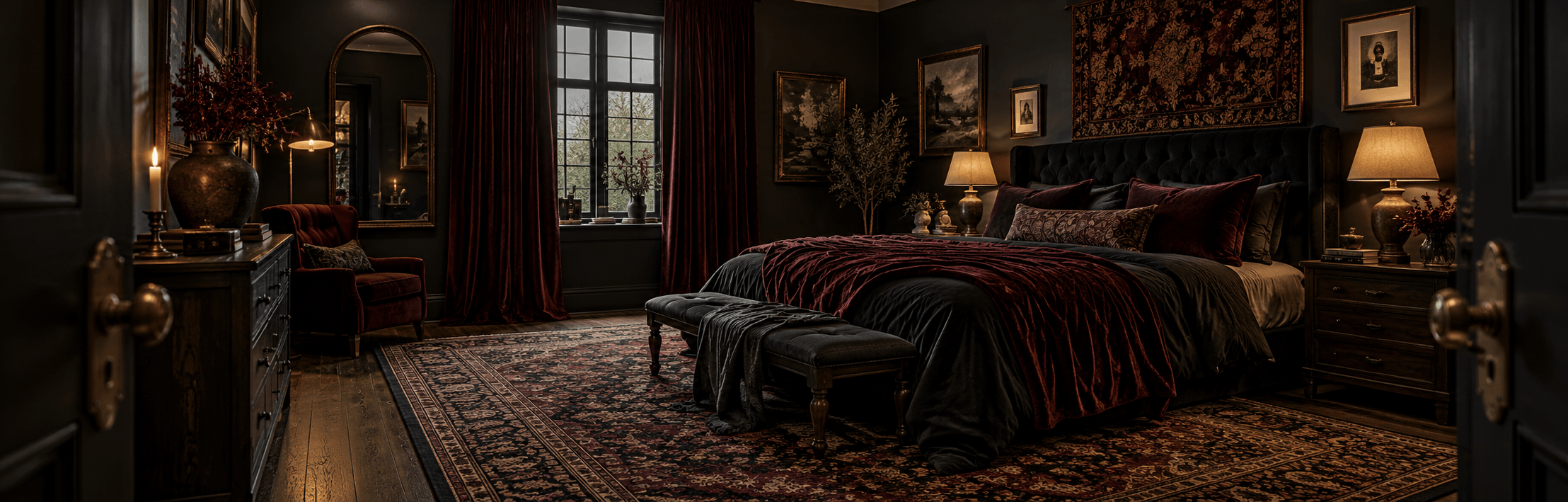
You can have the black bedding, dramatic prints, candles, velvet, bats, antique-looking frames, and that one object you absolutely did not need but bought because it looked delightfully cursed.
And the room can still feel wrong.
That usually doesn’t mean you need more gothic bedroom ideas. More often, something larger is weakening what you’ve already done, several good choices are pulling in different directions, or one part of the room never quite joined the rest.
Those problems leave clues. Once you know what they look like, the next change usually becomes much easier to see.
One thing before we start: gothic does not have one correct look. Victorian gothic, romantic gothic, modern goth, whimsigoth and lighter interpretations can all work. Pale walls aren’t automatically bad, and darker or more ornate furniture isn’t automatically better. What matters is whether the biggest parts of your room support the version of gothic you’re trying to create.
Find the Symptom That Looks Most Like Your Room
Stand at the doorway and ignore the candles, prints and little decorative pieces for a moment.
Look at the walls, bed, curtains, floor and largest furniture.
You may recognize one of these almost immediately:
- The room still looks surprisingly ordinary from the doorway. The walls, curtains or large furniture are probably carrying more visual weight than the gothic details.
- Everything looks good individually, but chaotic together. Several strong colours, patterns, materials or focal points may be competing.
- Laundry, cables, bags or storage keep grabbing your attention. Ordinary visual clutter is breaking the atmosphere.
- The bed seems to float on the floor. The bed zone probably needs a stronger connection to the floor and surrounding furniture.
- The bed looks flat or disappears against the wall. It likely needs more visible texture, height or structure.
- The room looks good during the day but dies at night. Lighting is flattening the atmosphere.
- One wall looks strangely unfinished while the rest of the room feels settled. That wall may need a stronger composition, or it may simply need what you already own rearranged.
Jump to the problem that sounds familiar. You do not need to fix every part of the room at once.
The Big Stuff Is Setting the Wrong Mood
Small decor can only do so much against a large surface or piece of furniture.
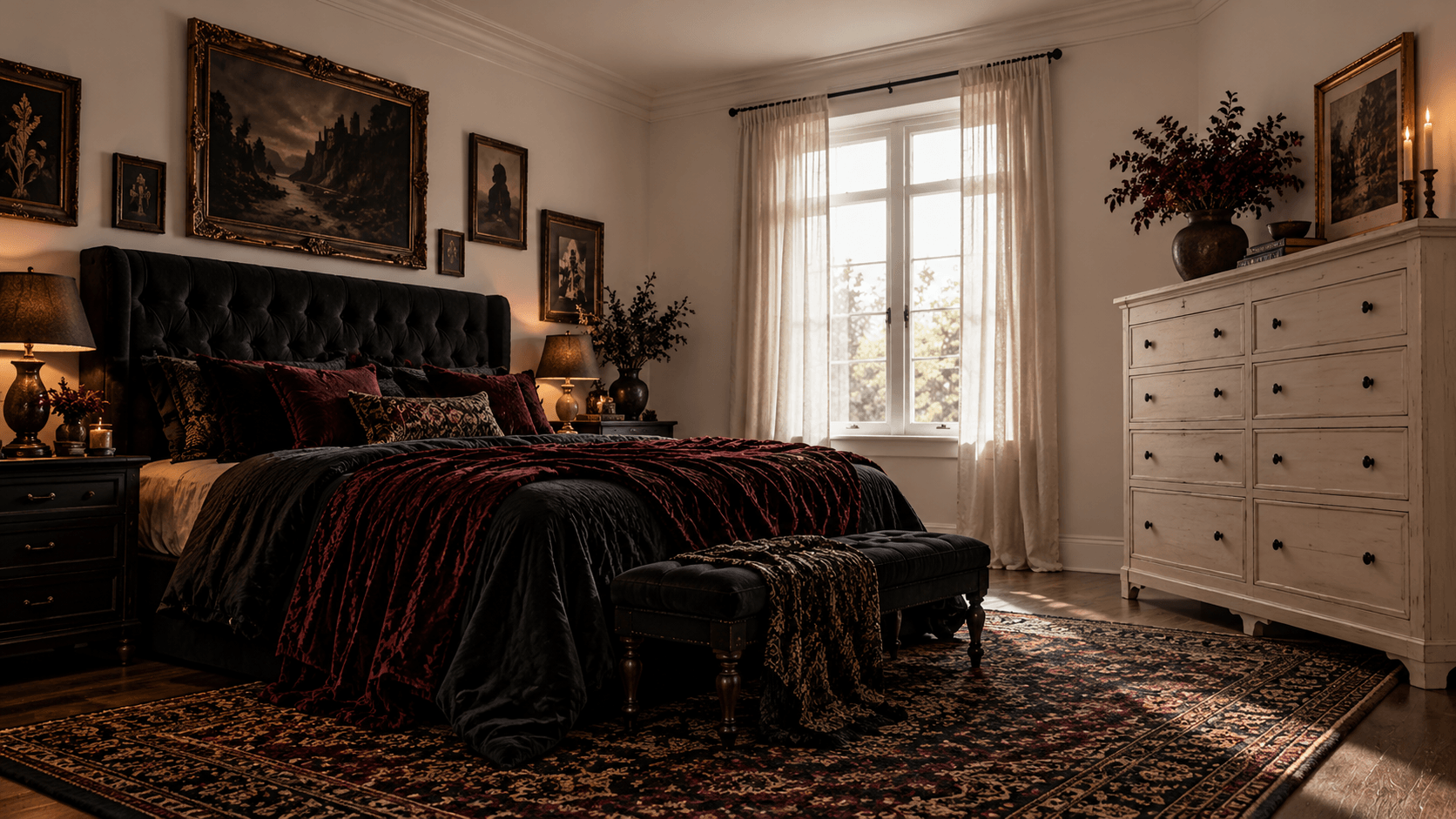
Imagine a black-and-burgundy bed beneath dramatic artwork, surrounded by candles and dark accessories, but sitting against a bright plain wall with short, skinny curtains.
Up close, the gothic details are obvious.
From the doorway, the wall and window still win.
Furniture can do the same thing. A large pale wardrobe, glossy modern dresser or overflowing open shelf may become the strongest element in the room simply because it occupies so much space.
That is why another print or decorative object rarely fixes this particular problem.
Ignore the small pieces for a moment and compare the walls, curtains, bed, floor and biggest furniture. A large element that feels noticeably disconnected from everything around it is usually where the stronger intervention belongs.
That may mean changing a wall or window treatment.
A storage unit may simply need its visible contents concealed.
An incompatible furniture piece might improve after rearranging what surrounds it.
The point isn’t to make every surface darker or more ornate.
It is to stop one large element from drowning out the parts of the room that already work.
Too Many Good Things, No Clear Leader
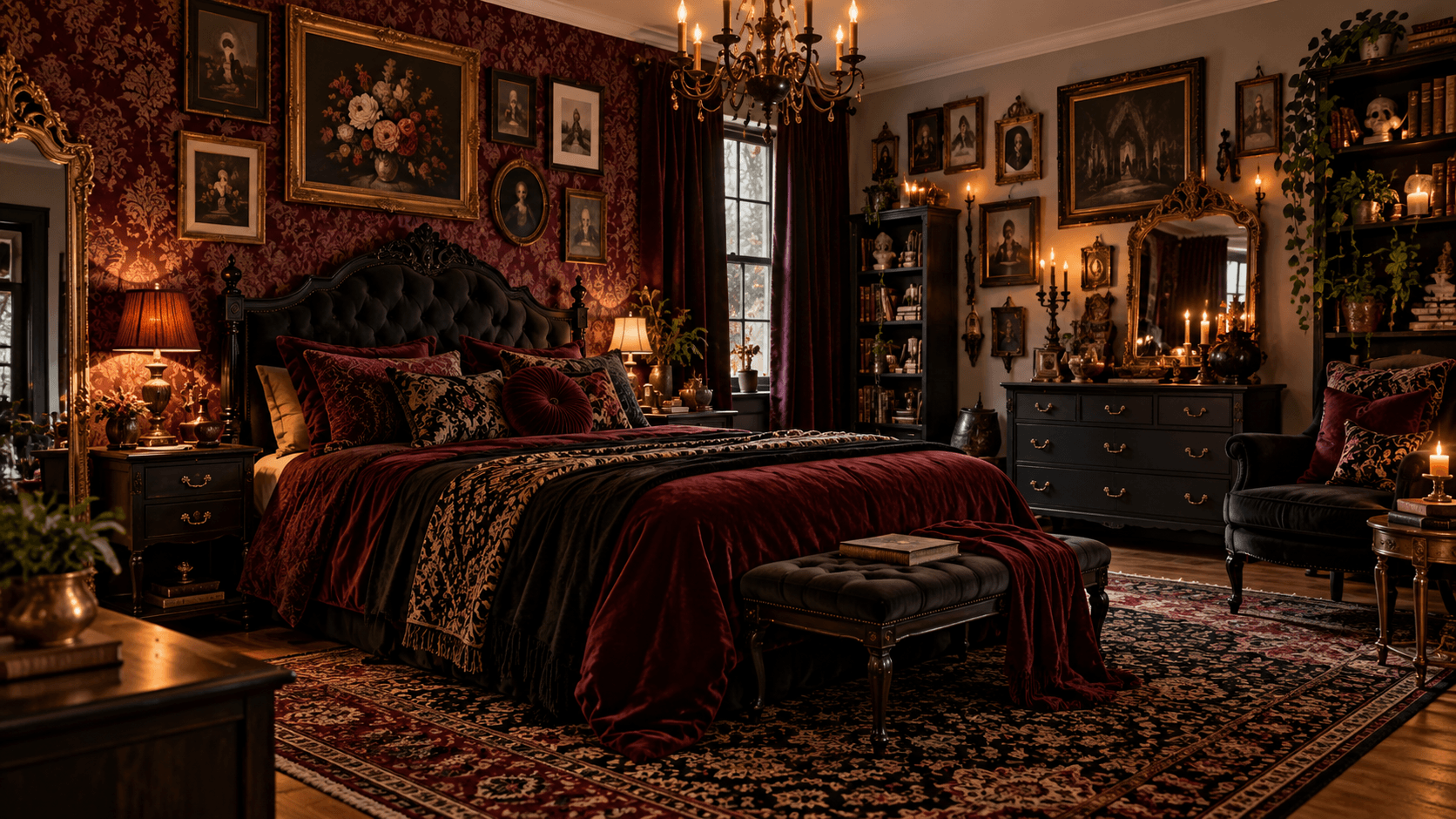
A busy gothic room is not automatically a bad gothic room.
Maximalism can be glorious.
Problems start when every strong element appears equally determined to become the main character.
Picture dramatic wallpaper behind an ornate bed, highly patterned bedding, a detailed rug, a full gallery wall and shelves packed with objects.
Nothing has to be ugly for the room to feel unsettled.
The conflict can also be quieter.
Burgundy velvet bedding, cool purple accents, bright chrome furniture and warm antique brass might all look attractive separately. Together, they can feel as though pieces from different rooms accidentally met at the same party.
Patterns can clash in the same way. Victorian damask beside sharp geometric furniture and several unrelated patterned textiles may leave the room feeling restless even when everything is neatly arranged.
Usually, the room improves when one strong idea leads and the others support it.
A dramatic wallpapered bed wall can handle quieter bedding.
A powerful patterned rug may need less competition nearby.
Repeating one accent colour can connect pieces that currently feel unrelated.
Letting one metal finish appear more often than the others can calm a mixed collection.
One conflicting textile may simply need to move.
Scattered artwork often becomes stronger when several pieces form one deliberate group instead of occupying every available patch of wall.
The fix is not necessarily less personality.
It is less accidental competition.
Ordinary Clutter Is Breaking the Spell
There is a particular kind of disappointment in creating a moody bedroom and then realizing the strongest visual element is a pile of charging cables.
Storage does not come first here.
Removal does.
Old paperwork, shipping boxes, unused clothes, work equipment and random household overflow may not need prettier containers. They may need to leave the bedroom.
For belongings that genuinely belong there, look at the capacity already in the room before adding furniture.
A wardrobe can look full while wasting half its vertical space.
Open shelves may have plenty of capacity but expose every unrelated object inside them.
Seasonal clothing may be occupying useful everyday storage when it could live somewhere less visible.
The order stays simple:
Remove or relocate what doesn’t belong.
Then make existing storage work harder.
After that, use hidden capacity such as the space under the bed where practical.
Only a genuine remaining storage shortage earns another visible piece of furniture.
Small nightly things belong near the bed.
Folded clothes may eventually need a dresser.
Hanging overflow may justify another wardrobe.
Bulky items only start making a storage bench sensible when less visible storage has already failed.
We’ll come back to the surviving storage options later.
Blank Space Is Not Automatically a Problem
A room can feel incomplete without actually needing another object.
Blank wall space can give ornate furniture somewhere to breathe. Open floor around a dark bed can stop the room becoming visually heavy.
The useful clue is imbalance, not emptiness.
A bed sitting alone on a wide stretch of hard floor can seem detached from its nightstands and surrounding furniture.
A richly decorated bedroom with thin, underdressed windows can make those windows look strangely temporary.
A large bed may seem convincing during the day and turn into one flat dark rectangle under harsh overhead lighting at night.
A bare wall can look accidental when the opposite side of the room is visually dense.
Those are specific symptoms, and they point toward specific interventions.
The detached bed may need a rug.
The weak window may need fuller curtains.
The flat-looking bed may need texture or more visible structure behind it.
The dead nighttime atmosphere points toward lighting.
An unresolved wall may benefit from one stronger composition, but only after the things you already own have had a chance to solve it.
Now buying something can become useful.
Before anything gets a checkout button, though, it should survive four checks.
Four Checks Before Anything Earns a Checkout
Will it be strong enough to matter?
A tiny rug beneath a large bed may technically be the right product while changing almost nothing.
The same problem appears with undersized artwork, narrow curtains and headboards mostly buried behind pillows.
Will it physically work here?
Measurements beat optimism.
Will the drawer hit the bed when it opens?
Are the curtains actually wide enough to look full when closed?
Is there enough wall area for the headboard to remain visible behind the pillows?
Does the wallpaper sample come away cleanly?
Will it work properly as the thing it is?
A lamp still needs to provide useful light.
Bedding still needs to be comfortable.
Storage has to be convenient enough that belongings actually get put away.
Good-looking failure is still failure.
Will it create a new problem?
The cure shouldn’t block a walkway, introduce glare, overwhelm the bed or begin another pattern argument.
The strongest option fixes more than it disturbs.
The Bed and Floor Feel Like Separate Rooms
A common symptom is a bed that looks as though it was placed on the floor after everything else was finished.
The bed itself may be fine. The nightstands may be fine. Yet they do not quite read as one zone.
A correctly sized rug can visually pull those pieces together.
Size comes before pattern.
As a useful starting point, bedroom rugs often look more intentional when roughly 18–24 inches extends beyond the sides of the bed. An 8×10 is a common starting size for many queen-bed layouts, while a 9×12 often works as a starting point for king beds.
Those are references, not laws. Bed size, room dimensions and where the rug begins beneath the bed can all change the answer, so measure the layout you actually want.
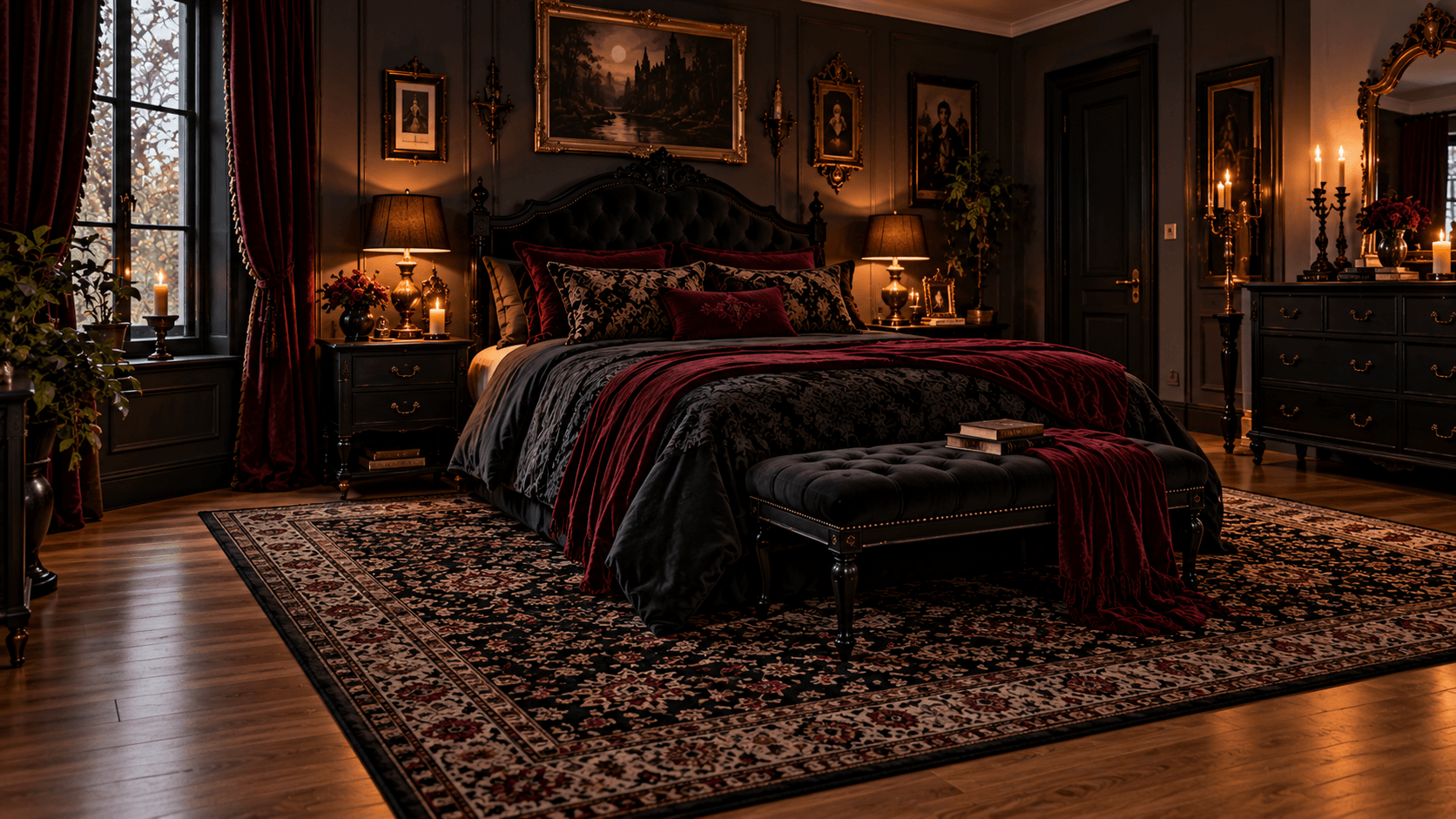
GARVEE Black Vintage Floral/Persian Rug
GARVEE’s black vintage floral rug comes in bedroom-friendly sizes including 8×10, 9×12 and 10×13.
Its dark traditional pattern can support a gothic room without forcing another literal gothic symbol into the space.
Best for: a room that needs stronger connection around the bed without making the rug the loudest decorative feature.
Check the rug placement against your actual bed before buying.
Affiliate disclosure: As an Amazon Associate I earn from qualifying purchases. Using these affiliate links does not add any extra cost to your purchase.
Dalyn Portico PO5 Black
Some bedrooms already contain enough obvious gothic identity.
The wallpaper is dramatic. The bed is ornate. The accessories are doing plenty.
In that room, the rug can be more useful when it simply holds everything together.
Dalyn’s Portico PO5 Black uses black, gray, silver and charcoal tones with a low-profile construction and reaches larger bedroom sizes.
Choose this instead when: the floor needs grounding without another obvious motif.
ODIKA Gothic Bat Medallion Rug
Other rooms are controlled but still feel a little generic.
That is where the floor can carry a stronger gothic signal without forcing more objects onto shelves and walls.
ODIKA’s Gothic Bat Medallion rug goes up to 9×12 and makes the motif part of the room rather than hiding it.
Choose this instead when: the floor itself needs stronger gothic identity and the rest of the room is quiet enough to support it.
Strong wallpaper, highly patterned bedding and a packed gallery probably do not need the bats volunteering for another shift.
The Biggest Surfaces Are Pulling in the Wrong Direction
Sometimes the individual objects are pointing in the right direction, but the walls or windows around them keep telling a different story.
That is why one large surface can matter more than another handful of decorative pieces.
Thin curtains can make the whole window look temporary
The clue is usually proportion.
Panels barely wider than the opening tend to hang flat when closed.
Curtains that stop at an awkward height can make a dramatic bedroom feel unfinished even when the fabric itself is lovely.
Velvet alone does not solve that.
The window needs enough fabric.
As a practical starting point, aim for a combined flat panel width of around 2× the width being covered. That gives the curtains enough fabric to retain some fullness when closed. A Michigan State University Extension curtain guide (pdf) uses the same double-fullness approach as a practical example.
Treat 2× as a starting rule rather than a commandment. Heavy fabrics, different header styles and the amount of fullness you like can shift it. Measure the actual rod or area being covered before ordering.
For a conventional opening, the Royal Tradition Heavyweight Velvet Rod Pocket Panels provide a darker, heavier treatment without forcing the curtains themselves to become themed decor.
Best for: a standard-width window that needs more visual weight and traditional softness.
A very wide window creates a different problem. Several ordinary panels can still look chopped up or fail to produce enough fullness.
The Half Price Drapes Burgundy Signature Extra-Wide Velvet panel is 100 inches wide per panel and comes in several lengths, with a lined construction intended for stronger light blocking.
Choose this instead when: the opening is unusually wide or ordinary panels still look too thin across it.
It is sold per panel, so calculate the combined width you need rather than assuming one extra-wide panel will automatically be enough.
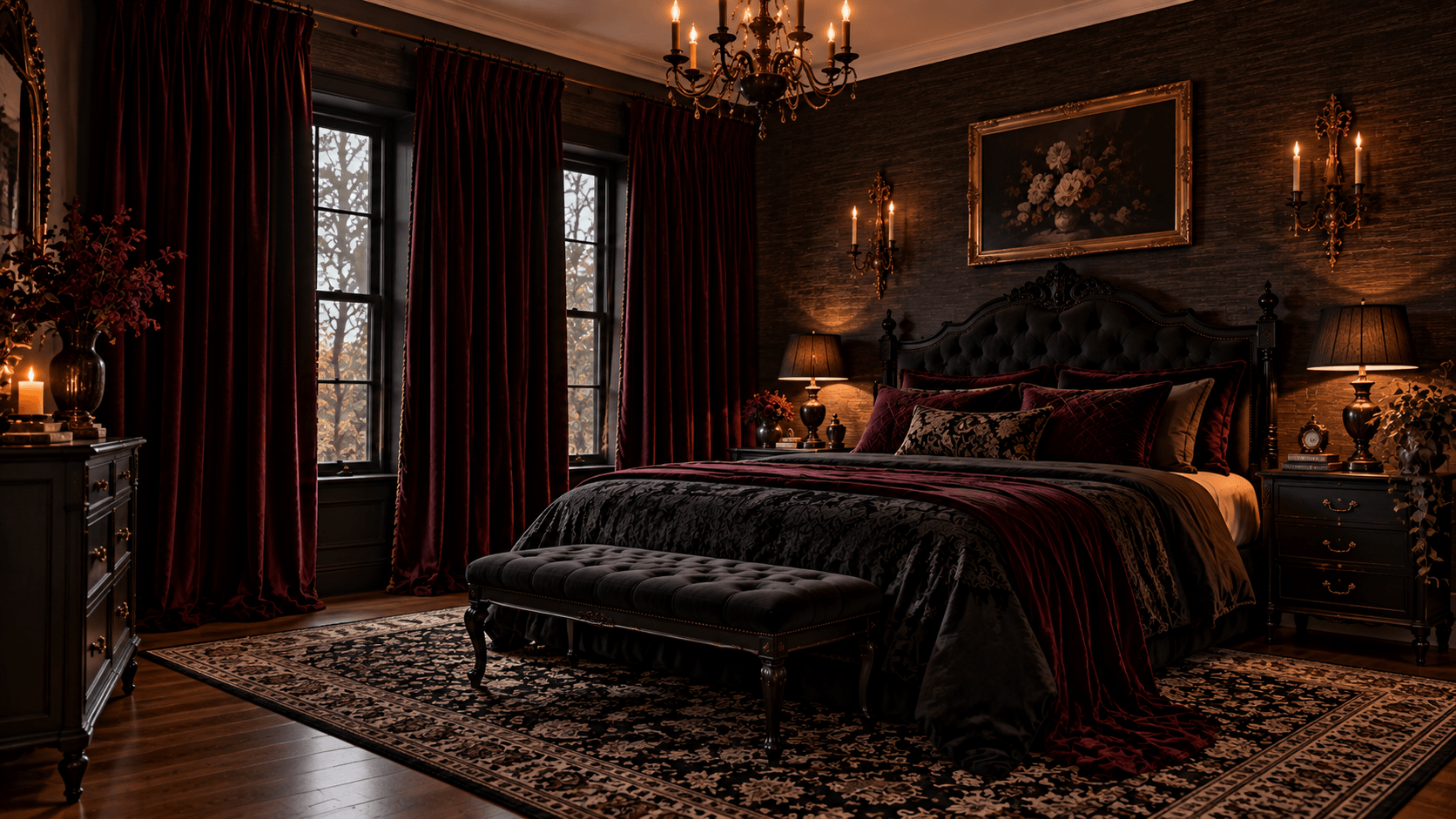
Plain walls can overpower surprisingly elaborate decor
A room full of dark furniture and gothic objects may still feel ordinary when the wall behind everything remains the largest visual surface.
Removable wallpaper can change that relationship without requiring another collection of accessories.
But the wall has to qualify first.
Renters should check what their lease allows before changing the wall. If painting or wallpaper is off-limits, keep the goal and change the intervention: fuller curtains or a large textile can add visual weight without permanently changing the wall, provided the hanging method suits the surface and the item’s weight. “Rental-friendly” should mean permitted and safely removable, not simply adhesive.
Fresh paint needs adequate curing time.
The surface needs to match the manufacturer’s requirements. As a general wall-prep principle, HUD guidance on wall coverings (pdf) recommends a smooth, hard and dry surface before wallpaper goes up.
Most importantly, test a sample before committing to the whole wall.
Leave it on long enough to test adhesion, then remove it and inspect the paint underneath.
NuWallpaper Black Grassweave Peel & Stick Wallpaper works when the wall needs richer surface texture without another representational motif.
Its dark woven-look pattern adds depth while staying quieter than an ornate damask.
A bedroom that lacks Victorian or older ornamental character needs something different.
Tempaper Textured Black Damsel Peel & Stick Damask Wallpaper uses a much more obvious damask treatment, allowing the wall itself to become part of the room’s historical language.
Neither is automatically more gothic or more correct.
The quieter grassweave can be stronger in a room already carrying a lot of pattern. The damask earns its place when the room genuinely needs that ornamental character.
The Bed Is Getting Lost
A bed can be physically large enough and still look weak.
Often the mattress and pillows form one low rectangle against a large wall. The bedding may look good up close, yet the whole bed seems to disappear when you stand back.
That can be fixed in several ways.
Replacing the entire bed should not be the first one.
More texture can give the existing bed more presence
Flat, lightweight bedding sometimes makes a bed look visually thin even when the colours are right.
The Tribeca Living Florence Burgundy Velvet Quilt Set adds richer surface weight without introducing another obvious gothic motif.
Its velvet texture and deep burgundy colour make the bed feel more substantial while leaving stronger patterns elsewhere room to work.
Best for: a bed that needs richness and presence rather than stronger themed imagery.
The Manfei Grey Black Damask Duvet Cover Set pushes in a different direction.
Its dark Victorian-style damask pattern makes the bed itself part of the room’s visual language rather than relying on colour and texture alone.
Choose this instead when: the bed feels generic, not merely too flat.
One practical check before adding more dark or textured fabric: think about how the bedroom is actually used. Pet hair can become much more obvious when it contrasts strongly with the fabric, and claws may be harder on some upholstered surfaces than others. Check the care instructions and your pet’s habits before choosing a textile purely for how good it looks in the room.
Sometimes the problem is behind the mattress
A mattress and pillows with very little structure visible above them can make the whole bed seem unfinished.
That is where a headboard earns consideration.
The FURPOPUP Black Velvet Headboard Only gives the bed a clearer vertical silhouette without requiring a full frame replacement. It can be mounted to the wall or attached to a compatible bed frame.
Best for: a bed that needs a stronger backdrop more than it needs new bedding.
Pay attention to the portion that will actually remain visible above your mattress and pillows. Total product height alone can be misleading.
A headboard cannot rescue the wrong frame
A strongly modern or otherwise mismatched bed frame may remain distracting even after the bedding and headboard improve.
At that point, continuing to decorate around the problem starts costing more than confronting it.
Whole-bed replacement is the heavier intervention, so it belongs after the smaller ones fail.
A textile can create height without becoming a conventional headboard
A large woven piece or tapestry can form a strong backdrop behind the bed.
The useful clue is scale again.
Once the pillows and mattress cover part of it, enough textile still needs to remain visible to make the bed feel more substantial.
The exact same textile may be simple wall decor somewhere else.
Above a visually weak bed, it is doing a different job.
Nighttime Is Flattening the Room
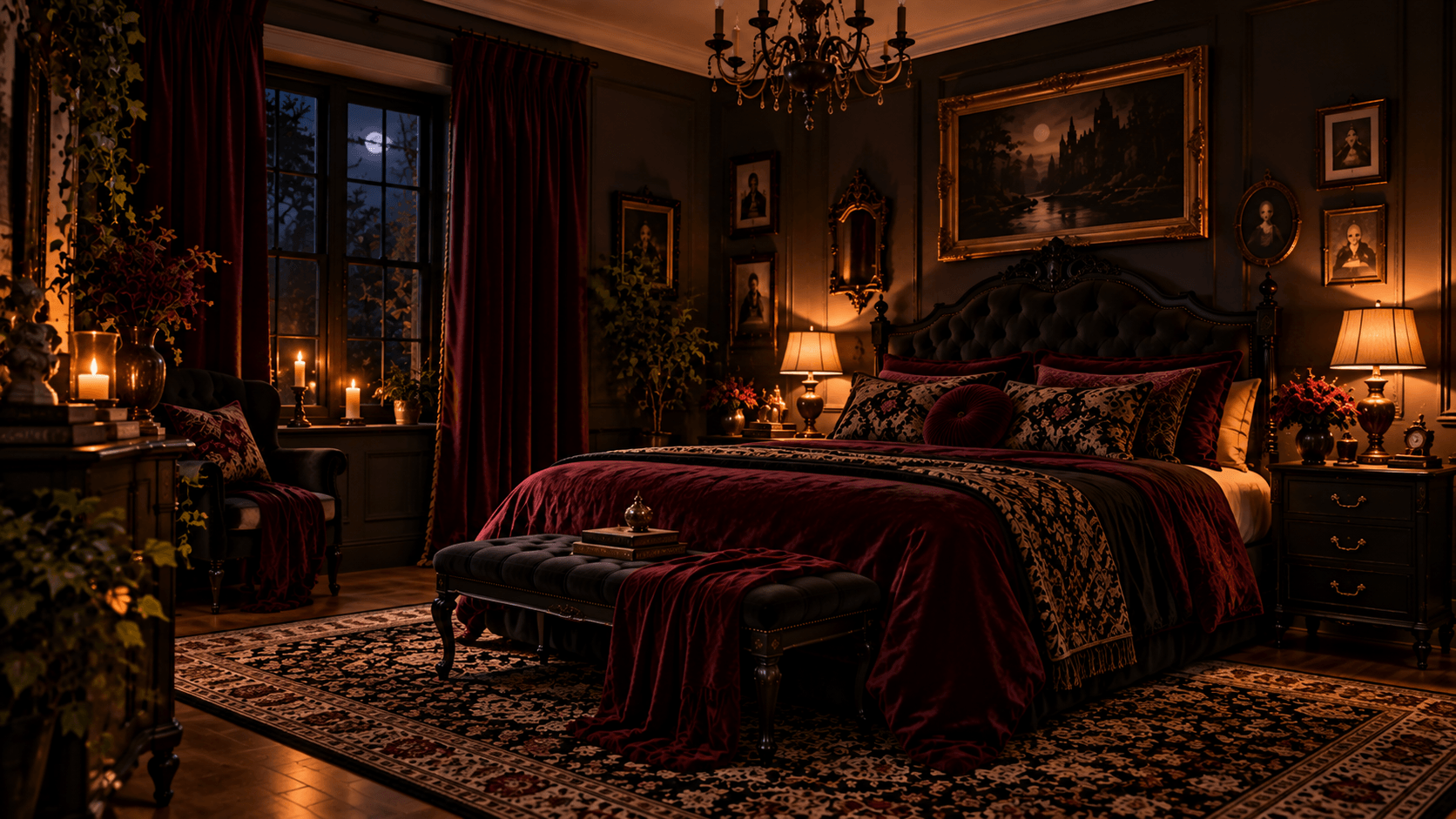
Some gothic bedrooms look wonderful in daylight and strangely ordinary once the sun goes down.
One harsh ceiling fixture can illuminate everything while flattening the shadows, texture and material differences that gave the room atmosphere.
Bedside lighting helps, but different lamps solve different problems.
Brightech Ren Black for a softer evening glow
The Brightech Ren Black is compact, rechargeable and warm at 2700K, with touch dimming and cordless use.
That makes it useful when the room needs a small pool of warm ambient light rather than serious task illumination.
Best for: winding down, atmosphere and flexible placement.
Regency Hill Stephan for more flexible bedside output
The Regency Hill Stephan is a much larger traditional table lamp with two standard bulb sockets, separate pull chains and an included tabletop dimmer.
Its greater output potential makes it more flexible than the little Ren.
Reading comfort will still depend on your bulb choice, lamp height, shade position and where you actually read.
For replaceable bulbs, colour temperature can change the mood almost as much as the lamp itself. Around 2200–2700K is a useful starting range when you want warmer, softer light; choose the brightness based on whether the lamp also needs to handle reading or other tasks. If you use a dimmable or smart bulb, check that it suits the socket and dimming setup rather than assuming every bulb will work properly.
Best for: a bedside area that needs more controllable light rather than atmosphere alone.
Zeckos Vampire Coffin Lamp when the lamp itself should contribute identity
The Zeckos Vampire Coffin Lamp leans deliberately into gothic imagery with its coffin-and-vampire base and bat-patterned shade.
Its strongest contribution is atmosphere plus identity.
That makes sense when useful accent light is already the job.
It makes much less sense as the main answer to demanding task lighting simply because the lamp happens to contain a vampire.
Want the lamp itself to carry more gothic identity? The Zeckos coffin lamp works best when accent light is already the job. See the Coffin Lamp on Amazon →
Building a seasonal haunted-room effect rather than a year-round gothic bedroom? Our Scary Halloween Decorations guide focuses on lighting, texture and atmosphere for that different job.
One Wall Still Feels Unresolved
A blank wall can be completely fine.
The clue is whether it looks restful or accidental.
A bare wall opposite a dense gallery may create useful breathing room.
A bare wall directly above a substantial dresser may look oddly disconnected from the furniture beneath it.
Before buying anything, try the objects you already own.
Several small meaningful pieces can become much stronger when grouped together.
One larger object may make a scattered collection unnecessary.
Only after that should something new compete for the space.
A full-length mirror can solve a real function too
A dressing mirror earns more consideration when it does more than occupy an empty wall.
The OLIXIS 64″ × 21.5″ Arched Full Length Mirror, Black provides full-length reflection with a restrained black frame.
That restraint is useful in a room already carrying strong gothic detail.
Before choosing the position, look at what the mirror will actually reflect.
A beautiful mirror aimed directly at laundry, open shelving or a cluttered doorway can double the visibility of exactly the thing you wanted to quiet.
This model supports floor standing, hanging or leaning, but whichever setup you choose should still follow the product instructions and suit the surface and space around it.
Best for: useful full-body reflection, added depth or light in a room that already has enough stylistic identity elsewhere.
A large textile can soften a visually hard wall
Bedrooms full of frames, furniture edges and dark hard surfaces sometimes benefit from one soft composition rather than another collection of framed prints.
The Pure Country Weavers Tree of Life Umber William Morris Cotton Woven Tapestry measures approximately 77 × 53 inches and uses woven cotton construction.
That scale lets it behave as a substantial wall element rather than another small accent.
Its Arts and Crafts botanical imagery also gives the wall historical character without relying on literal gothic symbols.
Best for: a wall that needs large coverage, texture and mature imagery in one object.
Mounted above the bed to strengthen the bed, it belongs back in the bed section instead.
Same product. Different job.
Personal art should stay personal
This is one place where a generic “best gothic wall art” winner would make the advice worse.
An artist’s work you genuinely love, an old photograph, a thrifted piece, an antique object or something brought home from a trip can give the room identity that another optimized product recommendation cannot manufacture.
Buying fewer, more personally meaningful pieces is often better than efficiently filling every available gap.
Personal identity should not become another merchandise category.
Storage Should Arrive Late
Visible furniture is a fairly expensive way to make a room look quieter.
Use it only when the belongings genuinely need the capacity.
Seasonal clothes and spare bedding are where hidden storage gets another chance.
For suitable beds, the AMJ Extra Length Under Bed Storage Organization Container measures approximately 35.5 × 16.5 × 7 inches.
It uses a zippered lid with rigid internal boards, allowing clothing or bedding to stay enclosed while the container retains its shape beneath the bed.
Measure the lowest usable clearance beneath the bed, including center rails or supports. The inviting gap at the outer edge is not always the space available further underneath.
Using the space under the bed? Measure the lowest clearance first, including center rails or supports. Check Under-Bed Fit on Amazon →
Bedside clutter follows a different rule. Phones, chargers and small nightly items need concealment close enough to the bed that using the storage does not become annoying.
Folded clothing that genuinely exceeds existing capacity may justify a dresser. A wide lower dresser and a tall chest can hold similar amounts while changing the room in very different ways, so wall width and furniture height matter as much as drawer count.
Hanging overflow deserves another wardrobe only after the existing closet has been configured properly. Empty vertical space, poor shelf placement or a badly divided hanging area can make a wardrobe seem full long before its capacity is actually exhausted.
Storage benches come last.
They consume visible floor space, so they work best when they earn that footprint twice: once by hiding bulky belongings and again by providing seating the room genuinely needs.
Otherwise the supposedly quieting solution has simply introduced another piece of furniture to look at.
Action figures taking over the shelf?
A growing collection can create its own space problem. Our Action Figure Collection Display guide helps you work out whether the better move is rearranging, expanding, enclosing or rotating the collection.
Change One Thing, Then Look Again
A bedroom rarely reveals every problem at once.
Fix one meaningful mismatch and the rest of the room may suddenly make much more sense.
Fuller curtains can make the bed feel more deliberate.
A correctly sized rug can make previously disconnected furniture look related.
Removing ordinary clutter can reveal that the room never needed more decoration in the first place.
That is why changing five things at once makes the process harder. You never learn which change actually mattered.
Start with the symptom that most clearly matches what you can see.
A large ordinary element overpowering everything around it needs a substantial response.
Good pieces fighting each other usually need editing rather than another purchase.
A detached bed, weak window, flat nighttime atmosphere or unresolved wall points toward a more specific fix.
And when none of those descriptions really matches your room, give it some time.
You do not have to fill every wall, cover every section of floor or turn every useful object into gothic merchandise.
Sometimes the room isn’t waiting for one final purchase.
Sometimes it is already done.