The elders of Ban Chao, a small village on Thailand’s southern coast, swore that the land remembered every promise. The Salt Mother made sure none went unpaid.
When the evening wind, carrying the bitter sting of brine, drifted in from the mangrove marshes, no one questioned the smell. Before twilight, families would leave red incense burning on their doorsteps.
“Don’t lick your lips, child,” Grandmother whispered, pulling ten-year-old Mali away from the shuttered window.
“Why?” Mali asked, wiping her lips with her sleeve. “It’s just salt.”
“Because salt does not belong to the living alone,” the old woman whispered, her eyes darting toward the floorboards. “Taste it now, and she will taste you in return.”
Long before Ban Chao had a name, the salt flats saved the settlement—though the true cost remained buried.
In those early years, the shoreline was a graveyard. Fish rotted in the nets. The sun baked the mud until it split like dry bone.
Desperate, the first settlers carried bowls of coarse salt to the edge of the marshes. They pressed the white crystals into the black sludge. No prayers were spoken. The salt itself was their wordless offering.
By morning, the wind no longer carried the stink of rot. The nets came back heavy with silver fish. The flats lay smooth, as though unseen palms had swept across them.
The village survived, but that survival had bound it to a silent pact.
The elders began measuring every portion of salt twice, sealing it in jars far from the household food. The warnings survived, though their explanations did not. One was repeated the most: Never let salt rest against bare skin.
The Salt Mother did not demand faith. She demanded balance.
The salt would give. In time, whatever it gave would have to be returned.

When the Salt Comes Due
That night, the wind changed.
Mali sat on the creaking floorboards, watching her father, Kiet, weigh the day’s salt harvest. The air in the storehouse was suffocatingly dry, smelling of turned earth and ancient brine. The iron scale groaned beneath bowls heaped with damp salt.
“Three bowls missing, Kiet,” Grandmother said, stepping out from the shadows. Her skin looked like dried paper. “The flats yielded less today.”
“The tide was high, Mother. It washed some away,” Kiet grunted, wiping sweat from his brow.
“The tide does not steal,” she replied, her voice falling to a dry whisper. “If the harvest is thin, it means the Mother is collecting early.”
Outside, something scraped along the stilts beneath the storehouse—like heavy burlap dragged through mud. Kiet froze. His hand hovered over the wooden salt crate.
“Did you lock the outer gate?” Grandmother asked, her voice trembling.
“I—I thought I did,” Kiet stammered, picking up a rusty lantern.
Thump.
A heavy impact shook the door. Fine white dust puffed through the keyhole and settled on the bare skin above Kiet’s sandal.
He gasped and fell backward as the skin above his sandal shriveled, turning gray and leathery.
“Kiet! Don’t touch the dust!” Grandmother screamed, pulling Mali behind her.
From the other side of the door, a voice rasped. It sounded like dry stones grinding deep beneath stagnant seawater.
“Balance…” The words seeped through the cracks. “Give back what was taken…”
The wooden planks began to split as a thick white crust of salt bloomed across them.
The Woman Who Rose from the Marsh

“Back away!” Grandmother barked, dragging Mali into the corner of the dry storehouse.
Kiet clutched his ankle, groaning as the shriveled gray skin split open, spilling coarse salt instead of blood. Outside, the scraping grew louder, like fingernails dragging across coarse canvas.
“She remembers what we owe,” Grandmother whispered, her dark eyes hollow with terror. “The woman from the marsh.”
Mali trembled. She knew the legend.
Generations after the first offering, during another season of ruin, floodwaters drowned the rice paddies and hunger thinned the village. Then a figure rose from the low-tide marsh.
Salt crusted her hair until it shone like frozen glass. Her skin was cracked and bone-pale. White crystals bloomed wherever she stepped.
She offered no name. Instead, she taught them to carve rectangular scars into the earth—evaporation pans that drew the salt’s hard white bones from the brine. Before she sank back beneath the dark reeds, the villagers understood the only law she demanded.
Balance.
“What did you do, Kiet?” Grandmother demanded, her voice cracking. “What did you take?”
“I only sold one extra bag at the market last week!” Kiet sobbed, clutching his shriveled ankle. “The buyers were desperate!”
“You sold what had been set aside for her,” Grandmother gasped.
A brittle crack echoed through the room as the wooden door bowed inward. A white crust spread through the splintering grain and swallowed the lock.
From the darkness outside, the voice came again, wet and rasping—closer now.
“A bowl of salt… for a bowl of flesh…”
The door hinges snapped.
The Vow That Sustained the Village
The shattered door fell inward with a thud, throwing dust across the floor.
Standing in the doorway was a towering, skeletal figure draped in dripping marsh reeds. Her eyes were milky white, and her split skin revealed packed salt where flesh should have been.
Mali squeezed her eyes shut, but the memory hit her with terrifying clarity: The Vow.
After the marsh woman taught them to harvest the flats, the village made a vow. Every year, before the southwest monsoon, a price would be paid.
Each year, one family surrendered a name in secret—never spoken aloud. An absence. Whoever was named walked into the mist carrying a pouch of salt and never returned.
Mali remembered her uncle Arun, years ago. He had walked into the sea fog while his young son screamed until he bit his tongue. Arun’s pouch had leaked salt into his footprints, leaving a white trail that the tide erased by noon.
In the years since Arun’s offering, no family had surrendered another name. Fear had faded into denial, yet the village kept harvesting the flats and giving nothing back.
Now, the Salt Mother had come to collect the debt herself.
“Kiet.” The Salt Mother’s arm extended with the crunch of grinding salt. One long finger, encrusted with sharp crystals, pointed at Mali’s father. “Your bloodline will repay what you sold.”
“Take me!” Kiet cried, crawling forward on his hands and dragging his ruined ankle. “Don’t touch my daughter!”
“No,” the entity rasped, her milky eyes turning toward Mali. “Young salt… tastes purest.”
The Monsoon the Debt Awoke
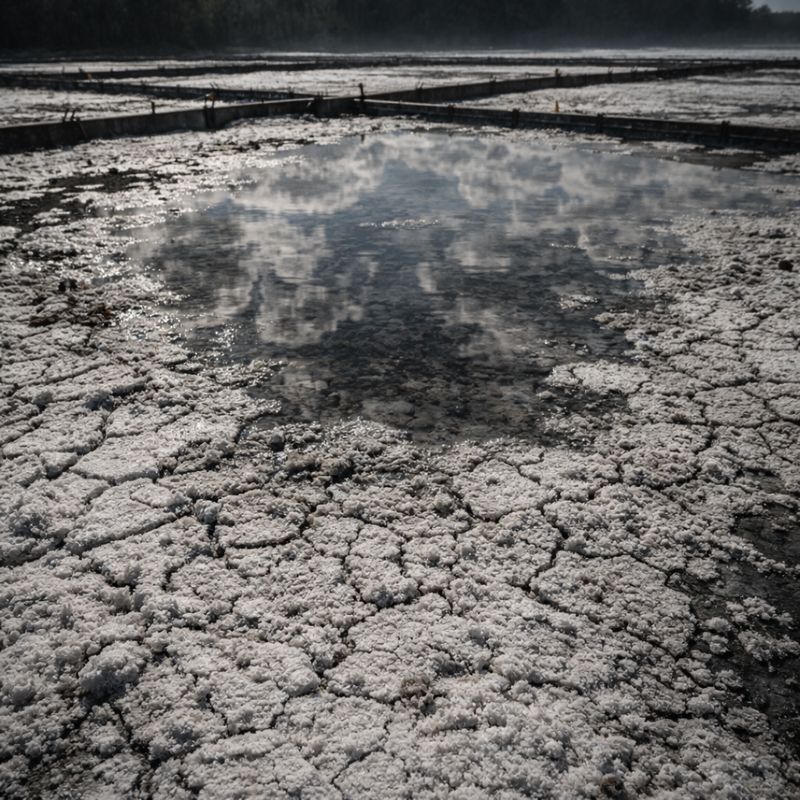
The Salt Mother ignored him. She drifted closer, and the moisture vanished from the room. Mali’s lips split, shedding pale dust instead of blood.
The village’s punishment had begun during the last monsoon, years after Arun became the final offering.
As the season approached, the elders waited for another family to surrender a name. No one refused outright, yet none agreed. Parents hid their sons; daughters sheltered their aged mothers.
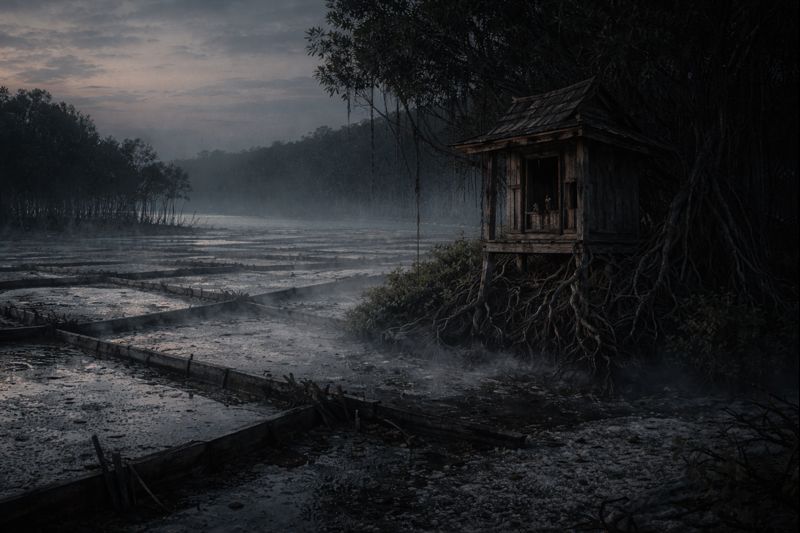
The ancient marsh shrine began to lean, its wooden roof sinking toward the dark mud as the vow remained unpaid.
For years after Arun’s offering, nothing seemed wrong. The monsoon rains remained gentle, and the evaporation pans filled as they always had.
Then, during the most recent monsoon, the curse took root.
Fish spoiled within hours of being caught. Pickled vegetables collapsed into foul, stinking sludge. Cooked rice sweated rancid grease and hardened like gravel. Even the villagers’ tears tasted flat, completely drained of salt.
Panic drove young Sunan to flee. He packed at midnight, slipping toward the highway beyond the mangroves.
But by dawn, they found him kneeling at the edge of the flats. His feet were trapped ankle-deep in crystallized salt. Coarse grains packed his open mouth, and the effort to force them out had split his tongue down the middle.
He was still breathing, yet his eyes never blinked.
After that, no one dared to run. But no one offered a sacrifice, either.
“You broke the vow,” the Salt Mother rasped, her hand hovering inches above Mali’s shivering face. “You fed on my gifts… and starved my altar.”
No Road Out of Ban Chao
Up close, the Salt Mother barely resembled a woman.
Jagged crystals covered her body, each sharp edge glinting like broken glass in the dark. Whenever she moved, her joints cracked like dry timber, releasing thin threads of burning brine.
Around her, the air turned so dry that Mali gasped, each breath scorching her lungs like hot sand.
“Salt Mother, take me!” Grandmother screamed, dropping to her knees and bowing over the salt-crusted floorboards. “I am old! My blood is thin!”
“An old life is an empty coin,” the entity replied, her voice vibrating inside their throats. “A name was promised. You offer what is already spent.”
The Salt Mother took a step toward Mali.
Beyond the shattered doorway, Ban Chao had descended into chaos. The wells brimmed with bitter brine. The dirt paths twisted back on themselves, returning every fleeing villager to the roaring marsh.
“Mali, run!” Kiet roared.
With the last of his strength, Kiet lunged and wrapped his arms around the creature’s crystal-encrusted waist.
The Salt Mother did not move. The moment Kiet touched her, his skin whitened and hardened into salt.
“Father!” Mali shrieked.
“Run!” Kiet’s voice scraped like stone as the crystallization climbed his throat.
Mali threw herself through the rotted shutters and tumbled onto the salt-covered mud beneath the storehouse.
The Name That Was Given
Mali staggered into the darkness, her lungs burning with every salt-laced breath.
Around her, Ban Chao was screaming. Villagers stumbled through the fog, their paths endlessly bending back toward the marsh.
Then, a voice pierced the chaos.
“Stop!”
Mali’s older sister, Nuan, stepped into the center of the village square.
Nuan did not run with the others. She crossed the square slowly, one hand pressed beneath her ribs. She had watched the shrine sink deeper into the mud each year while the village pretended the old vow no longer mattered.
Nuan’s face had gone pale. Her legs trembled as she lowered herself onto the hard-packed earth.
“Take me,” Nuan choked out. Her tears vanished before they reached her jaw.
A sickening hush fell over the square. Mali’s breath caught, while around her, shoulders loosened in shameful relief.
The Salt Mother emerged from the swirling haze and stopped inches away. Her milky gaze settled on Nuan.
Nuan bowed her head. “I give you my name,” she whispered. “I will go willingly.”
“So it will be,” the entity rasped, her voice grinding like stone.
At dawn, Nuan walked toward the edge of the flats carrying a small pouch of salt.
No one walked beside her. Mali watched from the edge of the village. Just before the gray mist swallowed Nuan, another shape stepped from the fog to join her—a woman with salt-white hair.
Then, they disappeared into the marsh.
The moment they disappeared, the curse lifted. The wells ran clear. The twisted paths straightened, and fresh rice cooked soft and sweet again.
But no one ever spoke Nuan’s name again.
The Debt Ban Chao Never Forgot

Years passed, but Ban Chao never forgot what that night had cost.
The marsh shrine was rebuilt from heavy hardwood, its pillars driven deep into the mud.
Every year, before the southwest monsoon, one family surrendered a name in secret. No name was ever withheld again.
Yet, the village was never truly at peace.
Fishermen setting out at dusk swore they saw two figures standing at the edge of the evaporation pans. One was ancient and towering; the other was young, with salt-white crystals woven through her long hair.
Sometimes, when a storm brewed, the younger figure guided a fisherman’s hands toward a loose rope or failing brace. Her face still held a grief no salt had erased.
“Is that the girl who gave her name?” children would whisper when the tide ran low.
“We do not call her back,” the elders would warn, bowing deeply toward the marsh as the bitter wind rolled in from the mangroves.
Ban Chao endured. The pans stayed full, the nets came back heavy, and the flats continued yielding their white harvest.
The salt still gave.
And beyond the fog, beneath the black sludge of the marsh, something kept count.
Related Stories
Some voices wait beneath the sea. Others call from still water where no one should linger after dark.
At Lotus Crossing, travelers say a lantern sometimes glows inside an empty pavilion at night — and if you answer the voice that calls from the riverbank, you may never return to the shore you left.
The Haunted Pavilion of Lotus Crossing: A Chinese Legend
But some presences do not call your name at all. They simply count until your number is reached.
During Ghost Month, one old ritual warned that the dead do not wander without order — and somewhere in the dark, a keeper was said to be recording exactly who would be taken next.
The Number Keeper of Ghost Month: A Haunting Folklore Ritual