The first time I heard about ancestral summoning, I was kneeling on the cold kitchen floor, sorting through my late grandmother’s belongings.
The house was being sold, so I had to clear out every forgotten corner—even those we had deliberately left undisturbed.
Outside, the rain beat a steady, patient rhythm against the glass. The overhead light flickered, gave a nervous hum, then dimmed to a sickly amber glow.
I did not want to touch the dust-covered box tucked deep beneath the pantry shelf.
We had banned incense from the house two winters earlier, after my sister lit a single cone of Nag Champa and something answered.
It did not simply burn; thick black smoke rose from it, winding around her throat like a rope until she collapsed.
When she woke, she could no longer remember her own name, yet she could describe—in agonizing detail—how every relative in our bloodline had died.
We buried her copper incense burners in the backyard that night and swore never to invite the dead inside again.
So when my hand brushed against a small, tarnished holder hidden at the bottom of the box, I froze.
I almost left it there, but I still had a house to empty.
As I lifted the holder to throw it away, something inside the brass basin caught my eye: a fresh mound of gray ash.
I touched the ash. It was still warm.
A second later, the smell hit me—not sweet sandalwood, but the metallic stench of iron and wet earth.
It seeped up through the floorboards, thick and suffocating, as though the house itself had drawn a deep breath—and exhaled.
The Price of Ancestral Summoning
The smoke did not rise. It spilled across the linoleum, curling around my ankles with an icy grip.
My grandmother used to say the rules of summoning were never written down because ink was too permanent for things that changed shape in the dark.
She spoke of it only late at night, when the house fell deathly quiet and every creak sounded like a warning. It was meant to protect our bloodline in desperate times, but every mercy demanded a terrible price.
The ancestors did not want blood or silver.
They wanted space. Space inside the living.
“To call them back,” she would whisper, her milky eyes fixed on the shadows, “you must surrender room for them to sit.”
The price was a slow, agonizing erasure.
The summoned ones would borrow your skin while you slowly loosened from the world around you.
Your name would slip from every tongue as though it had never belonged there. Your face would fade into a gray smudge in old family photographs.
In a crowded room, people would talk straight through you, stepping around your body as though you were nothing more than furniture.
I used to laugh at her stories, dismissing them as ghost tales about relatives no one remembered.
I was wrong.
It was not disappearance. It was removal.
The floorboards groaned beneath my knees.
From the darkness of the basement, four distinct sets of footsteps began marching toward the stairs.
My thumb stung where it had touched the ash. The ritual had not needed a flame—only living skin to complete the link.
The gray dust burrowed beneath my skin, turning the veins in my hand a dull, rotten black.
The Empty Place in the Family Records

I stumbled backward out of the kitchen and into the hallway, panic tightening my chest as the blackened veins beneath my thumbnail throbbed in time with a crushing headache.
My elbow struck the hallway console, sending the heavy family photo album crashing to the floor. The album fell open, and as I reached for it, one photograph caught my eye—and the dread in my chest deepened.
There were gaps everywhere.
In a family portrait from 1998, we stood in a rigid line, yet the far-right side remained awkwardly empty—as though everyone had leaned away from a ghost.
I ran a finger over an old school record. It listed three children. A warm, vivid memory surfaced: four bicycles in the driveway, four voices laughing in the summer heat.
Then I remembered a face.
A boy with my eyes, sitting at our dinner table and passing me the salt.
“What was his name?” I whispered into the silent house.
The Erasure Had Already Begun
I tried to say it aloud.
The first syllable surfaced in my mind, but the moment I opened my mouth, it vanished. My tongue turned heavy and numb.
Where the fourth name should have been, the paper had been worn smooth, rubbed down to its thinnest fibers. It had not been scratched out in anger. It had been methodically erased.
He had taken the smoke, I realized with a sickening jolt. He had summoned them to save us, and the price had erased him.
A floorboard at the top of the basement stairs groaned again. A shadow stretched into the hallway, impossibly long and far too wide to belong to one person.
I looked down at my hands. Then I caught my reflection in the glass of the photo frame. Its edges were already dissolving, my features turning translucent and milky.
I stood in the exact place where someone else had once existed. The room inside me was almost ready.
The Ritual Beneath the Altar
The blackened veins beneath my thumbnail burned like a live ember, making my hand tremble as I pried up a floorboard in the bedroom.
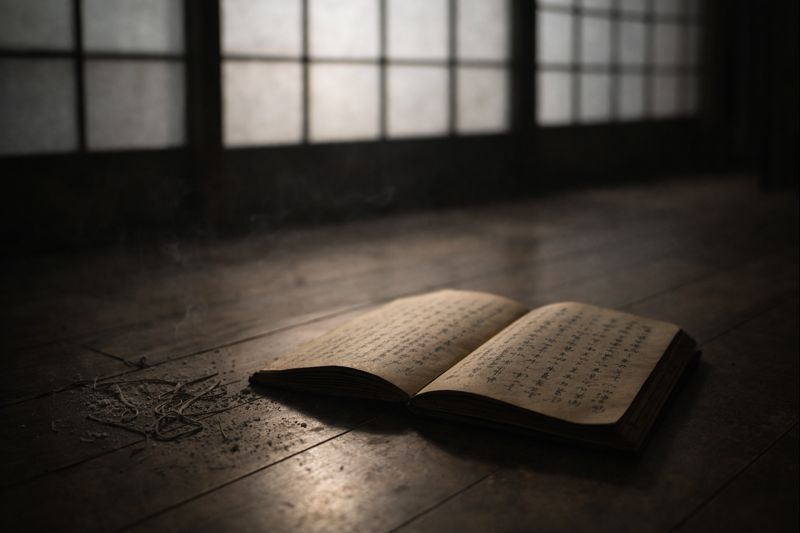
Beneath the forgotten altar, wrapped in yellowed silk, lay my grandmother’s final journal.
Her handwriting was disturbingly steady, each stroke pressed so deeply into the paper that the ink had nearly bled through.
The ancestral summoning ritual was laid out with terrifying simplicity.
It had to be performed at dawn.
Incense had to be lit for every known ancestor, with each family name spoken clearly into the quiet morning air—except one. The final name had to be offered in absolute silence.
Not forgotten, but deliberately left unspoken.
When the smoke rises, she had written, it must ascend straight to heaven. If it bends toward you, the debt has been claimed. Protection will enter the house, but something of you will not leave it.
A cold draft swept through the room, though every window remained latched shut.
The journal’s pages began turning on their own, snapping violently past one another before slamming to a stop at the final entry.
A single line had been written there in fresh, glistening red ink:
The bend has already chosen the reader.
I dropped the book.
My shadow on the bedroom wall did not move with me. It remained rooted to the wall, leaning sharply toward the doorway and stretching unnaturally toward the basement stairs.
Down below, the basement door creaked open.
Slowly and methodically, a voice began calling out my family’s missing names—four dead relatives whispering through a single mouth.
With every name the layered voice spoke, another piece of my memory vanished forever.
The Debt Had Chosen Me
The voice called another name—my father’s—and the warm memory of his laughter dissolved, leaving behind a cold, greasy emptiness.
Panic surged through my chest, but my limbs felt weighted down, as though the air had thickened into honey. I scrambled back toward the kitchen, desperate to stop the burning beneath my thumb, but the smoke rising from my skin was no longer gray.
It was oily black, bending sharply sideways and streaming down the dark throat of the hallway toward the basement.
The debt had chosen me.
With every step, the house seemed to shrink around me, the hallway warping and compressing like a collapsing lung.
I stumbled into the bathroom and threw myself against the sink, wrenching the tap open to wash the ash away. Ice-cold water flooded over my hands, but the ash remained embedded beneath my skin, glowing faintly like a dying ember.
I lifted my head and looked into the mirror. A strangled gasp escaped me.
My reflection was fading. My eyes had blurred into smudges, and my jawline bled into the tiles behind me.
In the glass, four figures draped in shadow stood directly behind my hollow silhouette. They were not specters or ghouls. They were my bloodline, waiting patiently to step into the skin I was vacating.
I tried to call for help—to shout my own name, to hold on to who I was—but my tongue lay against the roof of my mouth, heavy as lead.
The name was gone.
Down the hall, the front door swung open. A woman stepped into the house carrying groceries. Her gaze swept past the bathroom as though I were not there.
“Is anyone home?” my mother called out, her voice cheerful and completely empty of recognition.
The Dead Stepped Into My Place
“Mom!” I tried to scream, but all that escaped my throat was a dry, breathless wheeze.
She passed the bathroom without turning her head, stepping over my shadow on the floorboards as though it were nothing more than a stain on the wood.
I reached for her sleeve, but my fingers passed through the fabric, sending a sickening numbness crackling through my hand.
This was no passage into some hidden room beyond the living. I was slipping out of the world.
From the dark hallway behind her, the four figures advanced in silence.
They did not glide. They walked with heavy, deliberate steps, filling the narrow corridor. The air around them reeked of rot, old copper, and wet soil.
As they passed my mother, she shivered and pulled her coat tighter, unaware that four generations of our dead now stood in her living room.
Then the figure at the front turned toward me.
It had no face—only a smooth, blank void where its features should have been—yet I felt it staring directly at me.
It raised its right hand.
The same glowing black ash stained its thumb. It reached forward and pressed its thumb against my forehead.
An agonizing surge of heat tore through my skull.
My mind flooded with memories that were not mine: the smell of burning wood in 1942, the icy bite of a river in a long-forgotten winter, the agony of dying alone in a dark room.
My own life—my childhood, my favorite songs, the sound of my sister’s laughter—was being forced out to make room.
I fell to my knees and watched my hands turn fully translucent against the floorboards as the dead began moving into my home.
The Erased Brother Returned
The four specters lunged, their hollow mouths opening in shrieks I could not hear, though the floorboards rattled beneath them.
Then he stepped out of the shadows.
He was older now, but there was no mistaking the sharp jawline or the eyes that mirrored my own. The boy from my memory—the fourth child missing from the 1998 photograph—stood between me and the dead.
He carried nothing in his hands, yet a rush of summer wind swept through the corridor, carrying the scent of crushed leaves and cutting through the reek of copper and rot.
The specters lashed out, dark tendrils of smoke whipping toward his chest as they tried to tear through him and reach me.
He did not flinch. He slammed his palm against the floorboards, sending a shockwave of blinding white light down the hallway.
The blast struck them head-on. The specter at the front shrieked as its smoky form split apart and thrashed against the light.
My brother advanced, driving them back step by step.
They fought against him, clawing at the walls as their presence coated the wallpaper in white frost. He did not yield—a protector forged from the very silence our family had built around him.
With a desperate heave, he raised both hands and sent a wall of blazing white fire down the corridor, driving all four figures across the threshold and sending them tumbling down the dark basement stairs.
The basement door slammed shut with a deafening crack. The brass latch clicked into place and glowed red-hot for a single second before the door sealed shut.
Silence collapsed over the house. The specters had been driven back, confined behind the door for now.
I looked up, gasping for air, as my brother turned to face me.
The Name No One Could Remember

He stood in the hallway as pale dawn light bled through the curtains, his form shimmering like heat above asphalt.
I scrambled to my feet and reached for him.
“Wait… please,” I choked out, my voice trembling. “What is your name?”
He did not answer. He could not.
The ritual had stripped his name from human memory long ago, erasing it until even the ink on his birth certificate had vanished.
He was the brother who had sacrificed everything—his childhood, his place at our dinner table, his very right to be remembered—to anchor our bloodline against the dark.
His eyes met mine, filled with quiet, devastating tenderness.
He offered a small, tired smile—the kind a big brother gives a frightened child—and raised two fingers to his forehead in a faint, parting salute.
Then, as the sun broke over the horizon, he stepped backward into the shadows.
No door opened. No sound marked his departure.
He dissolved into the quiet warmth of the morning.
Down the hall, the kitchen door swung open.
My mother emerged holding a steaming mug of coffee, oblivious to the battle that had just saved her life.
She saw me kneeling on the floor and called my name, concern tightening her face. Then she looked toward the empty hallway.
“Did you feel that cold draft?” she asked softly, shaking her head. “It felt like someone was standing right there.”
I stared at the empty space where he had stood, an aching sorrow pressing against my chest.
He would never have a grave. No one else would ever remember that he had lived. But as I watched my mother sip her coffee, alive and unharmed, I knew the truth.
He was still here—silent, forgotten, and watching over us.
Related Stories
Some rituals do not call the dead for answers.
In another home, a third incense stick burned where only two should stand, and the smoke began to drift toward names that had long slipped from memory.
The Third Incense Stick: A Forbidden Summoning Ritual
Some forgotten spirits do not wait inside a family altar.
Elsewhere, a man once tried borrowing fortune from a grave that no one visited anymore — believing the dead could lend luck without asking for more in return.