Everyone in Rustline Alley knew Ironworks Apartments before they knew its debt.
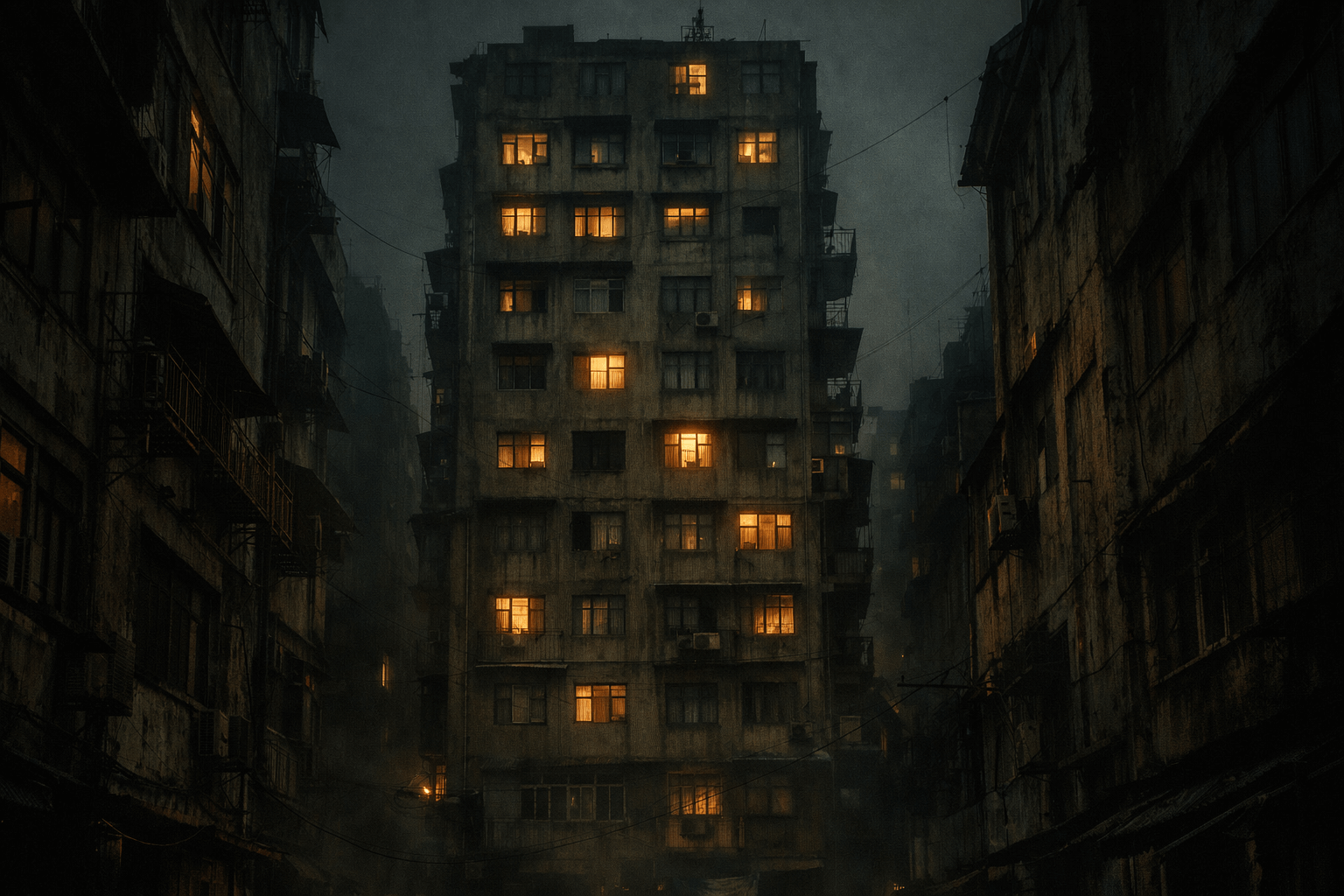
Ten stories tall and narrow, it stood wedged between grease-choked food stalls and shuttered shops, its soot-stained windows stacked like exposed ribs.
Sunlight never reached the lower floors. Even after a downpour, stifling heat clung to the narrow corridors.
Past midnight, the stairwells stayed unnaturally warm, as if the concrete were hoarding a fever it refused to release.
The debt, however, was older than the concrete.
More than a century before the foundation was poured, a destitute laborer lived on that same patch of earth in a rotting timber shanty.
A series of blighted harvests had cost him his tools, his livestock, and nearly everything else he owned. Still, the loan shark’s interest multiplied faster than mercy.
On a moonless night, the collectors came.
They chained the door from the outside and sloshed kerosene along the wooden walls. Neighbors later spoke of his desperate screams, growing weaker as thick, oily smoke swallowed them whole.
No rites were performed. No one guided what remained into the quiet dark.
The shanty burned to ash, but the soil remembered.
Decades later, Ironworks Apartments rose from those same scorched bones, its walls quietly absorbing the unpaid balance.
The Scorched Debt

Mr. Lin inherited the building from his uncle.
As a boy, he had watched soot drift from an upper window long after a small fire was declared contained. As the building’s owner, he blamed the old wiring—until the tenants began dying.
He repainted the blistered walls. He replaced charred doors. Nothing worked.
The heat was absolute. Unnatural.
Ironworks Apartments radiated a stifling, feverish warmth that mocked the surrounding alley.
Air conditioners rattled uselessly on the sills, blowing lukewarm dust before sputtering out, their compressors burning out within weeks. Cold water ran tepid from the taps.
Some nights, Lin stood alone in the central stairwell, pressing a palm against the iron railing.
Even at dawn, the metal felt hot enough to scald, coating his palm in greasy perspiration.
He would yank his hand back and wipe it frantically on his trousers, sickened by how quickly the moisture returned—and how strongly it smelled of lard.
He told the remaining families it was poor insulation and trapped air.
He slashed the rent to a fraction of the market price, but low rent could purchase only so much patience.
Anyone who could scrape together enough money fled within a month, choosing debt over the smothering heat.
Only those with nowhere left to run stayed behind, trapped in the slow boil.
Fire That Learned the Building
If the suffocating heat was a burden, the fires were a death sentence.
They did not behave like tragic accidents born of frayed wires or forgotten stoves. They materialized out of nothing, fueled by an unseen malice.
A stairwell burst into roaring flames while torrential rain flooded the alley outside. On the seventh floor, heat buckled a heavy steel door inward while the adjacent unit remained untouched, its wallpaper unmarked by the blaze.
Escaping was rarely an option.
Desperate survivors spoke of deadbolts locking by themselves, their metal scorching to the touch, and air that suddenly tasted thick and slick with old kerosene.
Beneath the plaster, within the concrete walls, a soft, dry crackle echoed constantly—the sound of timber splintering in an inferno where no wood existed.
The fifth floor bore the worst of the fire’s branding.
Soot smeared across the corridors, settling into the faint, unmistakable shape of charred fingerprints dragging along the plaster.
Maintenance scrubbed the walls raw with bleach and painted over the black streaks. Within days, the marks bled back through—narrower this time, packed closer together, like dozens of hands frantically clawing toward the exit.
When the Fires Began to Climb
Desperate for a solution, Mr. Lin exhausted his savings on increasingly dangerous remedies. He hired Taoist priests with brass bells and yellow talismans to seal doorframes and trace protective symbols along the scorching stairwells.
It was a catastrophic failure.
One night, a heavy paper charm blackened and folded inward on itself without a spark of flame. Another ritual ended in horror when a locked stairwell suddenly flared into an inferno, killing a young assistant before anyone could force the warped door open.
The priests packed their ritual tools and fled before dawn, leaving behind no answers—only terrified warnings that the building was beyond cleansing.
After that, the fires changed.
They began to climb.
Rather than spreading outward, each new fire ignited one floor higher than the last, as if a deliberate presence were ascending through the building’s spine.
Mr. Lin abandoned his apartment and locked himself inside the ground-floor office, leaving every corridor light burning.
Once, at three in the morning, the fire alarms wailed before choking off mid-scream. He forced himself outside into the oppressive night.
The alley was empty. There was no smoke, no frantic tenants, and no unnatural glow in the windows.
He stood there in the suffocating dark until sweat soaked his collar, listening to the dry, phantom crackle echoing through the mortar.
The building no longer felt like a property he owned. It felt like a ledger, and the final payment was overdue.
The Debt the Monk Would Not Seal
The fifth expert Mr. Lin pleaded with arrived without an entourage.
He was an old Buddhist monk from a remote mountain temple who refused payment, asking only to spend a single night inside the sweltering building.
He sat cross-legged on the third-floor landing—where the building’s first modern deaths had occurred—and simply listened.
By dawn, the monk’s faded gray robes carried the distinct, bitter stench of kerosene.
“It remembers,” the monk said, his voice as dry as ash.
Mr. Lin swallowed hard, his skin slick with heat. “What does it want?”
The monk did not answer right away.
He asked for old records—land transfers, forgotten deeds, and the registry compiled after the fire a century ago.
Running a withered finger down the brittle paper, he stopped at the loan shark’s surname. His descendants still prospered, owning vast shipping warehouses near the river.
Trucks bearing the family company’s name rumbled past Rustline Alley every morning.
“The fire began with their greed,” the monk said quietly, meeting Lin’s eyes. “They burned a poor man alive for a handful of silver. But for a hundred years, this ground has been collecting interest from whoever happens to stand closest.”
Mr. Lin’s throat tightened as cold dread pierced through the stifling heat. “How do I stop it? How do I make it leave?”
The monk set the paper down and looked toward the scorching, pitch-black stairwell.
“A debt like this ends only when it is paid by the bloodline that incurred it,” the monk said.
“Your talismans, your prayers, your paint—they are only delays. The flame is ascending, Mr. Lin. And when it reaches the roof, it will settle the balance with this entire block.”
The Debt Found Its Bloodline
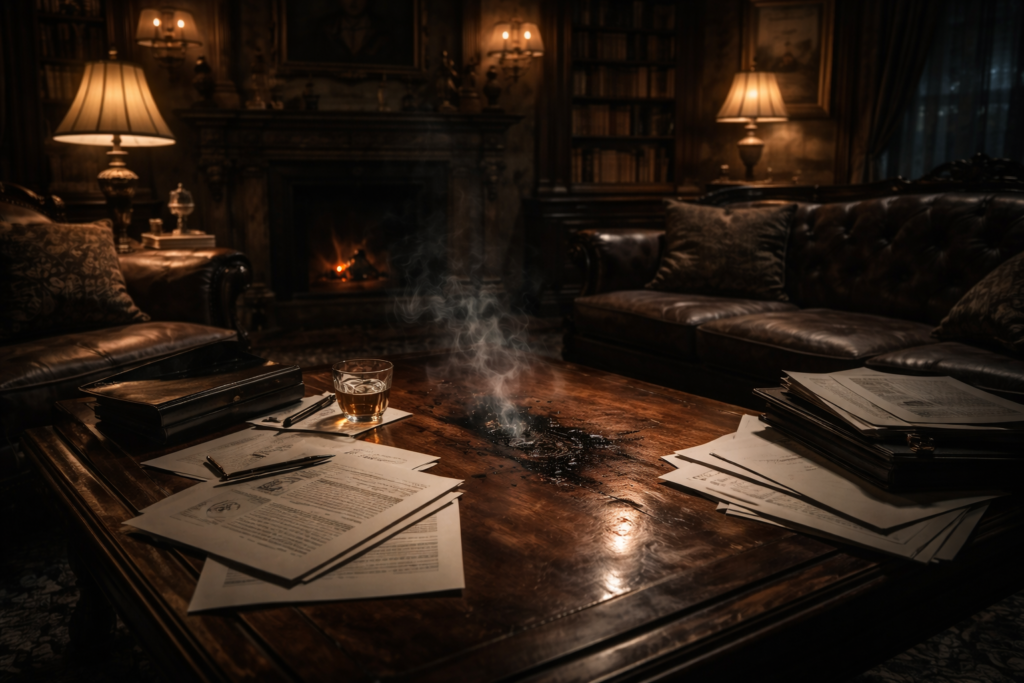
Driven by desperation, Mr. Lin spent weeks pulling every favor, leaning on corrupt officials, and exhausting his remaining contacts to track down the loan shark’s bloodline.
He finally secured a meeting with the current patriarch of the riverfront shipping empire, who listened to Lin’s frantic warning with cold, aristocratic amusement.
The patriarch dismissed him as a madman.
Then the ledger found them.
It started within hours.
Their corporate accounts froze mid-transfer, locked by untraceable digital errors. Major buyers inexplicably withdrew from signed multimillion-dollar contracts without warning.
At midnight, every fire alarm in their hillside mansion erupted at once, then died mid-wail, leaving the family trapped in suffocating silence.
The disturbances quickly turned physical.
Kitchen stoves across their estates roared into towering, unnatural blue flames before snapping shut on their own.
Polished brass door handles throughout their properties grew hot enough to blister skin, then turned icy seconds before anyone could douse them with water.
Nothing spread. Nothing was consumed.
It was not an attack—it was a formal notice.
The debt, long diverted onto innocent tenants, had finally traced its way back to the bloodline that owed it—and demanded payment in full.
The Scorched Heir
The family had no idea that the monk had altered the game.
Without telling Mr. Lin, the old monk had severed the spirit’s anchor to the concrete, allowing it to pursue the guilty bloodline—while binding it with a strict seal that forbade it from taking another life.
Back in Rustline Alley, the relief was immediate. For the first time in years, the midnight warmth began to thin.
The iron railings cooled to the touch. The air finally lost its suffocating stench of old oil.
Meanwhile, the loan shark’s family panicked behind locked doors. They poured millions into charitable donations and hired high-priced lawyers to salvage their collapsing contracts, but the haunting persisted.
Nothing eased. The invisible vice only tightened around them.
When the monk finally returned, he demanded a single act of retribution: one descendant of the loan shark had to stand alone in the Ironworks stairwell.
The chosen heir arrived at dusk, pale and trembling.
His relatives gripped his arms and forced him forward, more concerned with saving themselves than comforting him.
His lips moved in a silent prayer, but no sound escaped his throat.
The monk stepped back and began to chant, his voice low and rhythmic.
Suddenly, the heat returned with violent force. It closed around him instantly, as if something beneath his flesh had ignited.
He gasped, choking on air that had turned to thick ash.
Before their eyes, a dark mark surfaced across his pristine white shirt, spreading into the unmistakable outline of a scorched hand pressed flat against his chest.
His terrified scream tore through the stairwell, echoing off the concrete like a century-old debt finally being settled.
The Final Payment
The scorching heat vanished as quickly as it had arrived.
The young heir collapsed onto the concrete, gasping for breath, the scorched handprint seared permanently into his flesh.
The monk approached the trembling descendant and struck his wooden fish once.
With a final, echoing chant, he guided the lingering spirit toward the quiet dark, severing its tie to the earth at last.
The spirit was gone, but justice was not finished.
The curse claimed no life, leaving behind only a lifetime of agonizing penance.
Every night, as the sun dipped below the horizon, the mark on the heir’s chest would flare to life, burning like fresh coals.
He would spend the rest of his days enduring the heat of the fire his family had started, a living vessel for a debt that could be paid only through pain until his final breath.
In Rustline Alley, the transformation was absolute.
For the first time in a century, the stairwell felt like ordinary, lifeless stone. In the weeks that followed, tenants returned, their doors swinging open without resistance.
Mr. Lin stood alone on the third-floor landing and pressed his palm against the iron railing.
It was cool to the touch. He kept his hand there longer than necessary, waiting for a phantom warmth that never came. Yet, true relief eluded him.
He was left with the lingering burden of what it had taken to cleanse the ground beneath his feet.
Outside, as paper offerings curled to ash in the alley’s evening breeze, the air remained still. Ironworks Apartments was finally quiet—standing upon soil whose debt had, at last, been paid in full.
Related Story
Some debts burn through buildings and refuse to disappear. Others wait quietly behind new walls and polished glass.
Inside a newly renovated apartment, a mirror remained mounted where the previous owners had left it — and sometimes, when the lights were dim, the reflection did not move with the room around it.