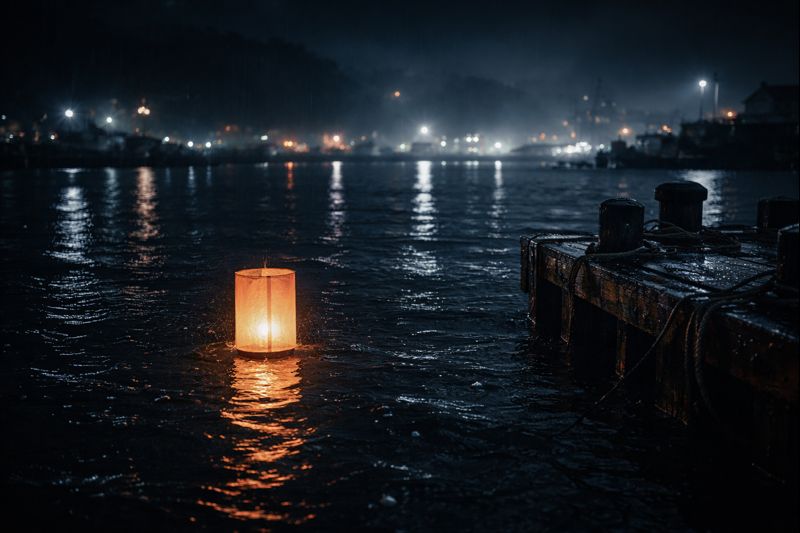
Rain crept over Keelung Harbor before dusk, slicking the wooden planks until they shone like dark glass.
Diesel fumes tangled with the sweet, heavy scent of temple incense drifting from the inland streets. Fishing crews hurried to secure their lines, engines cutting out one by one until the boats became motionless silhouettes along the quay.
During Ghost Month, no one lingered by the harbour at dusk. The gates between worlds were open, and the tide carried more than water.
Except for me.
My phone vibrated against my palm, displaying my mother’s last message: The doctor says soon. I had typed three replies and erased them all.
I told myself I was waiting for the storm to pass, but the truth was simpler: I wasn’t ready to return to that quiet house, where every room seemed to be waiting for the end.
An old warning from my grandmother returned to me, unchanged from childhood: Never answer a call from the dark. Never follow a light that moves against the wind.
Beyond the rusted warehouses, the harbor PA crackled to life, static grating against the silence:
“The final vessel will dock at Pier Three. Waiting passengers, please remain behind the yellow line.”
The announcement died in a pop of feedback.
I stepped toward the edge of the pier. The harbour water below churned black as spilled ink, as though it were waiting for something to break the surface.
The Stilled Tide
The time on my phone screen flickered: 18:59. It changed to 19:00, flickered once, then slipped back to 18:59.
Then the world froze.
It wasn’t merely quiet. It had been stilled. The distant hum of city traffic vanished.
The choppy harbour water flattened into a seamless black plane. Above me, heavy raindrops hung motionless in the air, then dissolved into nothing before touching the harbour.
The air turned ice-cold, thick with the stench of stale brine and old mud.
Out on the dead water, a soft amber glow kindled within the fog.
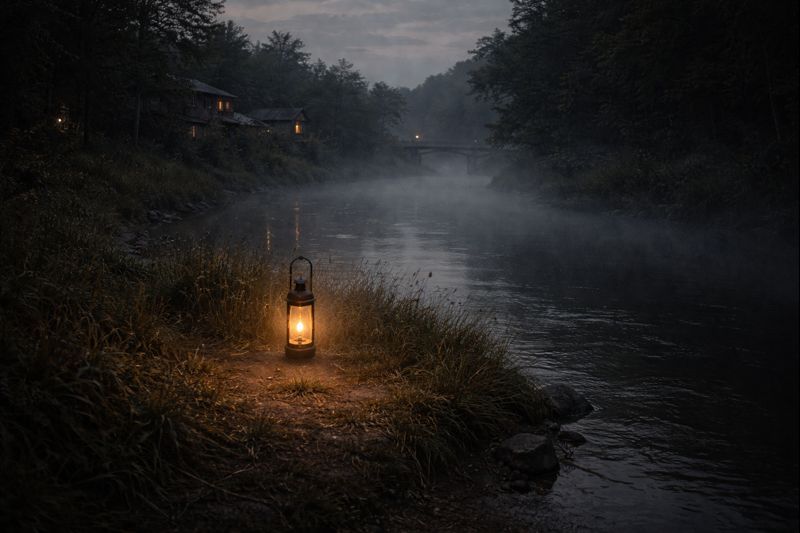
A single paper lantern—the kind released for the dead—shone through the fog.
There was no breeze, and the tide was drawing out to sea, yet the lantern moved steadily toward the shore without leaving a single ripple.
Right toward Pier Three.
My breath hitched. Beneath the glowing paper shade was no candle flame, only the pale, wet shape of a hand pressed against it from below, towing the lantern towards me from beneath the water.
The Girl on the Water
The lantern glided against the tide without disturbing the black surface, as if the harbour itself refused to touch it. The pier lights above me flickered and died one by one, leaving the dock beneath long, suffocating stretches of shadow.
My phone jolted violently in my hand. The screen remained locked at 18:59.
The paper lantern nudged the moss-covered concrete of Pier Three. A slow ripple spread across the glass-like water. Then came a wet, heavy thud. A second followed.
Someone was approaching across the harbour—not rising from its depths, but walking over its surface as though the water had hardened beneath each step.
A young girl stood on the water beside the pier. Her soaked white dress hung heavy against her, dripping dark, brackish water. She kept her head bowed, long black hair veiling her face like a shroud.
The air grew heavy with the sharp smell of iron and rot.
“Are you lost?” The words left my mouth before I could heed my grandmother’s warning.
“Not lost,” she murmured. Her voice was hollow and dry, like dead leaves scraping across pavement, as if those two words had worn it thin over decades.
She lifted her face just enough for the lantern to gleam in her milky, pupilless eyes.
“Waiting.”
The Echoing Word
“Waiting for who?” I whispered, my limbs locked by the freezing air.
“They said soon.”
The word struck me like a blow. Soon. The exact word from my mother’s message. My chest tightened until I couldn’t draw a breath.
The girl tilted her head with a sharp, unnatural jerk, studying me through the tangled curtain of her hair.
“You have something to say,” she rasped, stepping closer without a sound. “Why don’t you say it? Come on. Don’t hold back.”
Behind her, the water folded inward, sinking into a deep, silent vortex.
Never answer a call from the dark. My grandmother’s voice screamed in my memory. If I repeated the word aloud—if I acknowledged her call—I knew I would surrender whatever still anchored me to the shore.
The pier lights flickered back to life for a split second, casting long, twisted shadows across the dock before dying again.
I clamped my jaw shut and forced myself to step back.
The glow inside the paper lantern flared wildly beside her feet. Beneath it, the wet, pale hand hammered against the paper from below, straining to tear its way through.
The Missing Reflection
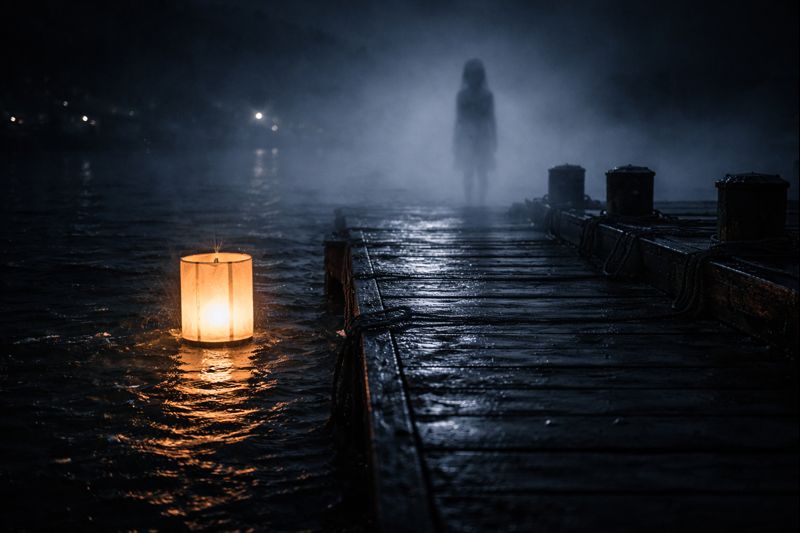
Her bare, waterlogged feet stepped onto the wooden planks without a sound, leaving no wet footprints behind.
“Forget about me,” I said, struggling to keep my voice steady. “You look like you need help. Tell me what happened. Maybe I can help.”
The paper lantern flared, spilling a sickly orange light across the pier. The dock seemed to lengthen before me, stretching endlessly over the black water.
The girl’s lips parted in a faint, eerie smile.
“You want to help me?”
I swallowed. “If I can.”
“Then take something from the water for me.”
A chill crawled across the back of my neck. I glanced at the black surface beside her, where the lantern drifted without a ripple.
“From the water?”
“Don’t worry,” she whispered. “You won’t feel the cold.”
Her smile widened.
“In fact, you won’t feel the water at all.”
“How do you know?”
“Because I stopped feeling it.”
The stench of stale brine, rust, and rotting seaweed thickened until the back of my throat burned.
I looked down. In the slick puddles gathering between the planks, the lantern glowed clearly. So did my own pale reflection.
She did not.
Where her body should have appeared, the puddle held only the empty, starving sea.
Before I could leap back, her dripping fingers clamped around my wrist. The cold didn’t bite. It seeped into me, heavy, patient, and absolute, numbing my flesh to the bone. To my horror, my arm jerked toward her, dragging my shoulder with it.
“Walk with me,” she whispered, her head tilting further than a human neck should allow. “Then I won’t be alone.”
The Weight of an Answer
The urge to answer pressed against the back of my teeth, heavy as lead and desperate to be spoken. My body leaned towards her, and one foot slid closer to the pier’s edge before I realised I was moving.
The toe of my shoe reached the edge of the pier. One more step forward and I would plunge into the black water churning below like tar.
“Don’t you want to help me?” she whispered, bringing her face closer to mine. “Come. It’s only the lantern. Take it from the water for me.”
The lantern floated just beyond the edge of the pier, its heat somehow reaching my face with the stench of old wax and burning hair.
She wanted my answer. The moment I agreed, there would be nothing left to keep me on the pier.
In the suffocating dark, I pictured my mother alone in a sterile hospital room, staring at her phone and waiting for the reply I had been too frightened to send. If I entered the water tonight, she would wait for a reply that would never come.
I clamped my jaw, planted both feet against the planks, and wrenched my arm free. I managed to stagger back only a single step.
Her grip tightened once, crushing the bones of my wrist, and then released.
Not out of mercy. Not in defeat. She released me because she knew the sea had endless patience.
The Snap of Time
The world narrowed until nothing remained but the violent thrumming of my pulse. Then the harbour snapped back into motion.
Rain slammed onto the wooden planks. Diesel engines groaned to life in the distance. The harbour PA crackled back on with a clipped fragment of the earlier announcement:
“…will dock at Pier Three. Waiting passengers, please remain behind the yellow line.”
The static died. It did not repeat.
The girl was gone. The paper lantern was gone.
Below me, the harbour was no longer a sheet of dark glass. Restless black swells churned against the moss-covered pilings.
I stumbled away from the edge and fled down the pier into the rain.
When I reached the amber streetlights beyond the quay, I collapsed against a concrete wall. I shoved back my rain-soaked sleeve. The skin beneath was dry, yet crusted with a bitter layer of white sea salt where no water had touched me.
My wrist, where her dead fingers had held me, still carried the sickening scent of rot and stagnant brine.
I pulled out my phone with trembling hands. The screen read 19:47. The last time I looked, it was 18:59.
Forty-eight minutes had vanished in the blink of an eye.
What Waits in the Dark
My mother died that night before I could reach the hospital. I never got to say goodbye or answer her final message.
Years have passed, but Keelung never forgets.
Now, whenever Ghost Month returns, I make sure I am miles away from Keelung Harbor before dusk settles over the water. I never stand near the piers, and I never look out at the dark horizon after the temple lanterns are lit.
Yet, safety is an illusion.
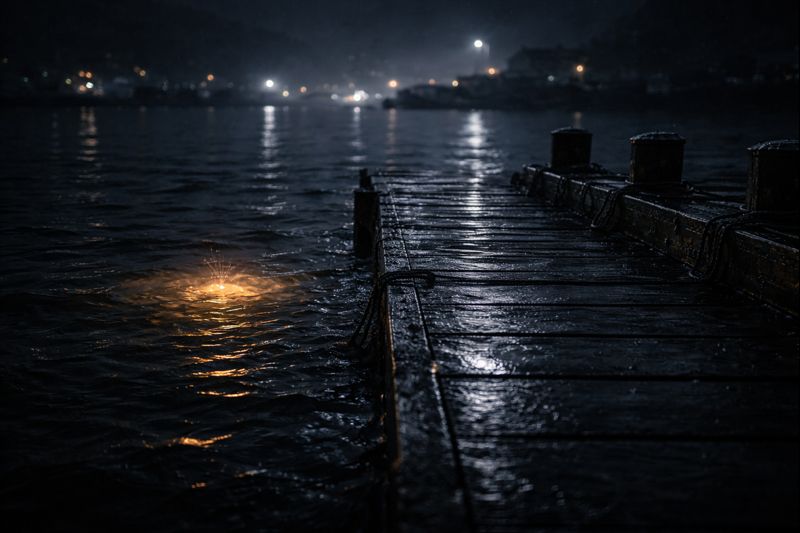
Sometimes, on windless nights, my phone vibrates in my pocket. When I pull it out, there are no notifications. The digital clock flickers, glitches, and freezes at 18:59.
A suffocating silence settles over the city as every sound fades—and the girl appears.
Sometimes she stands beyond the nearest window, her soaked white dress hanging motionless as black water pools beneath her bare feet. Other times, I see her in the reflection of my phone screen, waiting behind my shoulder with that same faint smile.
No matter how far I travel from Keelung Harbor, the girl always finds me. She is still waiting for me to answer—and walk with her into the dark water.
Related Stories
Not every lantern follows the tide.
In Willow Bend, a lantern appeared at the river bend each evening—waiting for someone willing to carry it.
The Waiting Lantern at River Bend: A Restless Ghost Story
Some spirits wait in the water.
But others listen from the dark.
Not every haunting begins with footsteps or shadows. Sometimes it begins when something learns your name.