In the misty highland villages beneath Mount Yushan, locals still warn of whispers heard in the forest after sunset.
The warning does not concern the entire ridge or any modern trekking routes.
It belongs solely to the old spine: a choked, forgotten trail on the northern face, worn into the mountain long before painted markers or wooden signposts—before anyone dared give names to its dark interior.
Locals choose their words carefully when mentioning it. They leave out names, landmarks and anything that might help an outsider find the trail. Once the warning is given, no one lingers on the subject.
When curious outsiders ask why, the villagers lower their voices to harsh whispers. Their eyes leave the fire and settle on the towering shadow of the tree line outside.
When I first heard the warning as a naïve university freshman, I dismissed it as superstition—another grim local tale meant to keep careless student hikers off treacherous ground after dusk.
Now, looking back with terrible clarity, I understand that those words were never merely a campus ghost story. They were instructions for survival, and I had been too foolish to listen.
Shortly after graduating, I helped organize a volunteer survey expedition to Mount Yushan’s northern face. Our task seemed straightforward: map the decaying footpaths before planned resort developments erased them completely.
I told myself we were preserving a piece of history before roads, hotels and viewing platforms buried it.
But repetition has a way of making even the oldest warnings seem harmless.
After enough days spent with measuring tapes, numbered stakes and GPS readings, the forest began to feel ordinary.
I carried that confidence beneath the suffocating canopy on a quiet evening thick with fog. By nightfall, I would understand why the villagers never named what waited along the old spine.
The Silence Beyond the Trees
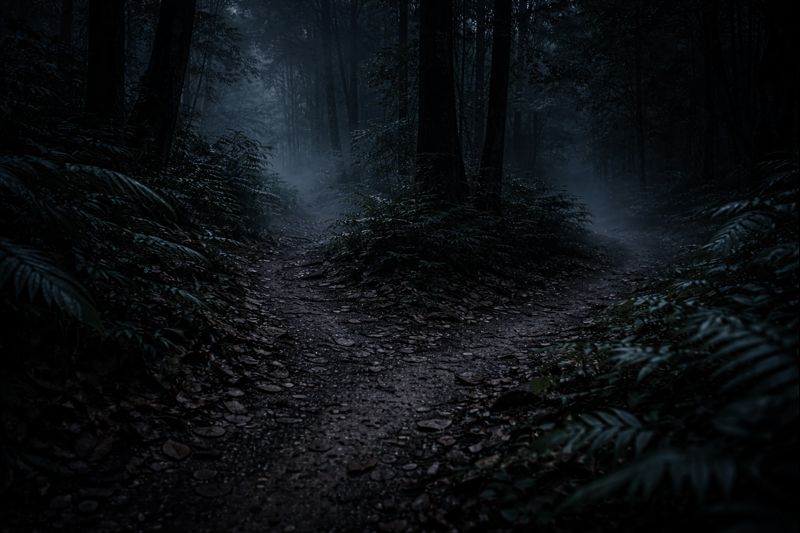
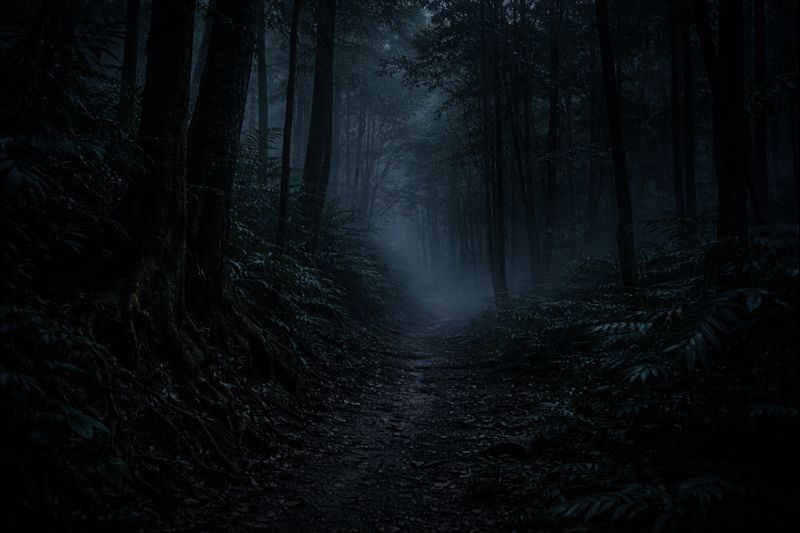
The old spine looked ordinary at first—a damp, narrow ribbon of broken slate winding between moss-slick trunks. I had walked enough trails like it to stop watching every step.
Daniel, my closest friend from university, bumped his shoulder against mine as I hesitated at the tree line.
“Still afraid of those freshman bedtime stories?” he asked with a grin, tightening one strap of his pack.
We went in anyway.
Within twenty metres, the canopy thickened as though the branches had drawn together above us. Sunlight reached the trail only in thin, cold needles, while pressure gathered behind my eardrums.
I checked the handheld GPS. The screen flickered, and the satellite count fell to zero, though it had shown a full signal at the trailhead.
Around us, the forest seemed to draw inward.
The usual sounds of the mountain forest—the chatter of cicadas, the flutter of birds among the branches—faded one by one. Soon, only the hum of our equipment remained, harsh and intrusive in the silence.
The deeper we went, the less the old spine felt abandoned.
The Trail That Answers Back
I heard it first. A shard of slate cracked behind us. Then another. Each sound came a heartbeat after my own footfall.
When I stopped and turned, the path behind us was empty. The footsteps stopped at the same instant.
Daniel’s grin vanished. He laughed once—too sharp, too quick. “You hear that too, right?”
Then the whispering began.
At first, there were no words—only a breathy murmur threading through the leaves. I told myself it was wind. Then the air went still, and every branch stopped moving.
The whispering did not stop.
We turned back. The single path behind us had become three—identical, equally worn, each vanishing into the fog.
“This—this wasn’t here.” Daniel backed into me.
Then a voice spoke my name—clear, familiar, close enough that warm breath touched the back of my neck. Instinct pulled a reply into my throat, but the warning returned—not its words, only the fear on the villagers’ faces. I clenched my teeth and said nothing.
Behind me, Daniel answered before I could stop him. “Who’s there?”
The forest answered at once. Silence dropped over us, dense and absolute. The trunks creaked without wind, like enormous bodies leaning closer to listen.
That was when we ran.
Those Who Answered

We did not choose a direction. We ran wherever the undergrowth opened, our boots skidding over wet roots and loose soil.
Branches whipped our shoulders and hooked into our clothes, dragging us sideways whenever we found a clear line ahead. Above us, the last scraps of sky vanished as the canopy knitted shut.
I risked one look behind us.
A silhouette stood on one of the three paths behind us. It was almost human, but far too tall, with arms hanging below its knees.
Its elbows and knees folded the wrong way, then twitched straight again. Whenever a sliver of light caught its head, grey mist shifted where its face should have been, never holding one shape long enough to recognise.
It did not run. It moved along one of the false paths with unhurried steps, yet the distance between us narrowed.
As it came closer, it began whispering names from the mist where its mouth should have been.
Not my name. Not Daniel’s. And never the same name twice.
Each name came in a different breathless voice, broken by the gasps of someone still running somewhere inside the forest.
The Path of Least Resistance
One after another, narrow paths opened through the undergrowth beside us. Each was smooth and rootless, sloping gently downhill while the ground beneath our feet grew steeper. Every one curved toward the tall figure keeping pace beyond the trees.
The ache in my legs made them look like mercy.
Behind me, Daniel’s footfalls lost their rhythm. His breathing came in raw, uneven pulls.
“Do you hear it calling?” he asked. His voice had lost its usual edge.
I heard it. The whisper had softened into something almost kind, promising rest if we stepped onto one of the paths. I clenched my jaw, fixed my eyes ahead and ran on.
“Maybe… maybe it’s just someone from the crew,” Daniel muttered, his pace slowing to a crawl. “Maybe we should check—”
He stopped talking.
I ran on, listening for the next scrape of his boots.
One step. Two. Three.
Nothing followed. His ragged breathing had vanished with his footfalls, leaving an emptiness behind me that seemed to widen with every stride. I waited for him to curse, to call my name, to make any sound at all.
He never did.
Only a long breath moved through the canopy. The branches overhead shivered once, though the air remained still.
I did not turn around.
What the Forest Leaves Behind
I stumbled onto the gravel service road long after midnight, legs shaking, clothes clinging cold against my skin. I kept expecting Daniel to burst from the trees behind me, laughing, swearing, insisting the whole thing had been some cruel joke.
The tree line behind me remained dead still.
By the time the rest of our survey crew reached the trailhead, we had counted everyone twice.
Daniel was gone.
At first light, search teams combed the northern ridge with dogs, drones and powerful torches.
They found nothing. No broken branches. No heel marks cut into the mud. No dropped gear. Nothing that showed where Daniel had left the trail—or that he had ever been there.
What I never told them was that, before the organised search began, I had returned to the northern face alone.
The three false paths were gone. In their place lay a single trail choked with fern and hanging moss, one I had never seen before.
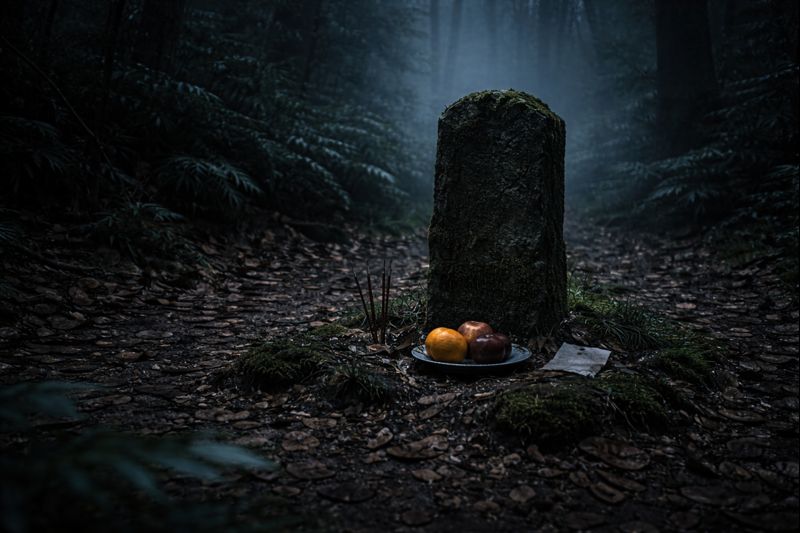
Against every instinct, I followed it. The trail ended in a clearing barely wider than a room. At its centre stood a single stone marker, green with moss.
No name had been carved into the stone. At its base rested simple offerings: smouldering incense, dried fruit, a bowl of rice and a cup of tea.
Steam still curled from the tea.
I did not step closer. I left the clearing and said nothing about what I had found.
Hours later, the search teams reached the same place. Local elders ordered the rescue leaders to leave the marker untouched. No one argued.
Some markers are not raised to remember the missing. They are left to appease whatever still walks the old spine.
What Still Waits
I no longer set foot on mountain trails after sunset.
I avoid paths that soften beneath my boots, and I turn away whenever the brush opens too neatly ahead of me.
Sometimes, in the hour before dawn, I wake with my shirt damp and Daniel’s name already formed behind my teeth. The need to call for him swells until my chest hurts, but I bite the inside of my cheek and let the name die in my mouth.
Daniel answered when the woods called. The forest heard him.
Whatever passed between them did not end on the mountain.
Even now, miles from Mount Yushan, I sometimes feel watched from the trees beside a park or an empty road. Traffic noise thins. The leaves go still. Before long, I can hear nothing but my own breathing.
Perhaps the thing that kept pace beyond the trees never lost interest after I escaped. Perhaps it memorised the sound of my steps and has been waiting for one careless word.
Some forests do not chase you. They do not need to.
They simply listen—and wait for you to answer.
Related Stories
Some voices take your name the moment you answer them. Others erase it slowly until no one remembers it existed.
In one remote village, a quiet river carried more than water. Each year, another name disappeared from memory — until even the people who lived there began to fade from the world.
The Name-Eating River That Slowly Erased Our Village
But sometimes the voices are patient. They wait across still water, calling for someone to cross.
At Lotus Crossing, travelers say a lantern sometimes glows inside an empty pavilion at night — and if you answer the voice that calls from the riverbank, you may never return to the shore you left.