

People in my town avoid the Haunted Pavilion of Lotus Crossing, especially after dusk. Even so, I walked toward the old river road one humid evening, telling myself I only wanted to see it once more before the vines swallowed it whole.
The pavilion once welcomed travelers. After the highway opened, everyone left. Shops shuttered. Lamps broke. Stone steps cracked under creeping roots. Elders said the pavilion remembered names—especially the ones families stopped speaking.
I used to laugh at that.
I do not laugh now.

The Path to the Haunted Pavilion
The tiles looked ordinary at first. Cicadas screamed from the trees. Sweat slid down my back.
Then the air cooled too quickly.
The insects stopped mid-cry.
A soft dragging sound followed—bare feet across stone.

I told myself it was wind. Still, my shoulders tightened. I noticed paper money laid beside the path. The notes were clean and dry, though no festival marked the calendar. Ash clung to them, faint but fresh.
My grandmother once slapped my wrist for stepping over offerings.
“Walk around,” she had said. “And never let your shadow fall on them.”
I stepped around the paper, careful not to breathe too deeply.
The dragging sound came closer.
For a moment, I nearly turned back.
Instead, I kept walking.
The Pavilion Without Shadows
Fog gathered low over the river.
When it thinned, the Haunted Pavilion stood ahead.
Red pillars leaned inward as if listening. The roof sagged. Moonlight poured across the clearing, yet none of it held to the structure. The beams drank it and returned nothing.
No shadow stretched from the eaves.
That unsettled me more than the silence.
I climbed the steps. The air turned sharp and cold. My breath showed white in the dark. Behind me, the river lost its reflection. Water moved, but it refused to mirror the sky.
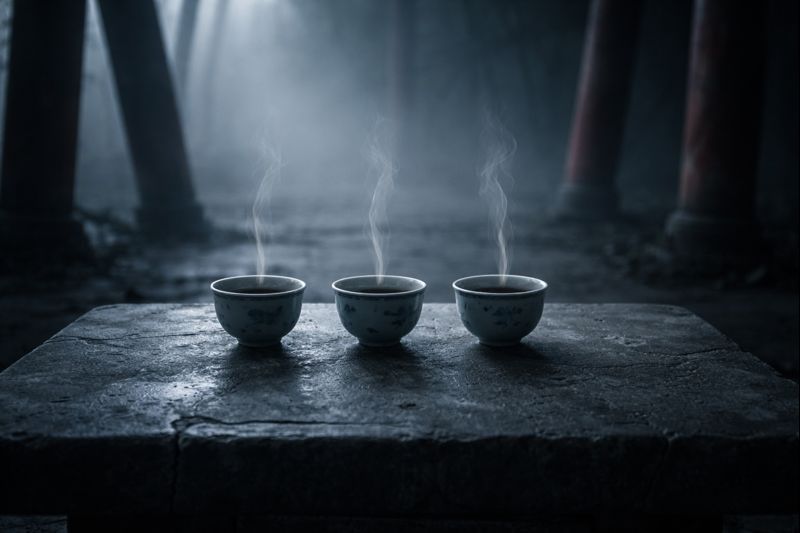
Inside, a stone table waited.
Three cups of tea rested upon it. Steam rose in thin threads.
No kettle.
No host.
My throat tightened. I bowed once out of habit.
“I don’t mean to disturb anyone.”
The steam stiffened mid-air.
Hungry Guests at the Haunted Pavilion
Whispers filled the pavilion.
Whispers slid along the beams.
They overlapped, brushing my ears like dry leaves. Words pressed against each other until they almost formed sentences. I caught fragments—dates, courtesy names, half-remembered titles.
My grandfather’s courtesy name drifted through the air.
No one had spoken it in years.
My chest tightened. I had forgotten the final tone of it.
A woman stepped into the fogged light. Her feet hovered a finger’s width above the floor. Her face held a softness that might once have been kind.
“Sit,” she said.
A chair scraped toward me on its own.
I took one step back. My heel caught the edge of the stone.
“I can leave offerings,” I said. My voice shook despite myself. “But I won’t stay.”
Her smile pulled wider, stretching past comfort.
“Those who sit,” she murmured, “finish the tea.”
The cups trembled. Steam thickened. Names rose from it—layer upon layer—until the air felt crowded with the dead.
One cup turned toward me.
On its surface, my own name began to form.
Names in the Tea
The pavilion groaned softly.
I stared at the cup. My name rippled there, uncertain, as if testing the sound of itself. The letters blurred and reformed.
The woman watched without blinking.
“You remember some,” she said. “Not all.”
The whispers grew louder. Pillars creaked. Tiles cracked beneath unseen weight. The dragging steps circled the pavilion, closer with every breath.
I thought of the family altar we stopped tending after my grandmother passed. The incense bowl that gathered dust. The stories I never asked to hear twice.
Balance is never free.
My hands shook. I did not carry prepared paper. I had nothing to offer but what I still held in memory.
I forced myself to speak.
I said my grandfather’s courtesy name aloud.

The cup hissed.
I spoke my grandmother’s childhood nickname—the one she hated when neighbors used it. The steam thinned slightly.
I reached for more and found gaps.
One ancestor’s name would not come.
The cup bearing my name steadied.
The Rule of Balance at Lotus Crossing
The river shifted behind me.
Water tapped against stone in a slow, patient rhythm. Offerings feed, my grandmother once said. Names endure.
“I don’t have all of them,” I whispered.
The woman tilted her head.
“Then you stay.”
The chair pressed against my knees.
My mind searched desperately. Faces came before names—weddings, funerals, old photographs curled at the edges. I spoke what I could. I admitted what I had forgotten.
“I will remember,” I said. “I will speak them again.”
Silence spread through the pavilion.
The cup with my name cracked down the center.
Steam poured out and rushed toward the river. The dragging steps faltered. The pillars eased.
The woman’s smile faded.
“Go,” she said softly. “Do not return alone.”
I backed away, bowing twice. I did not turn until my feet touched the dirt path.
What Remains of the Haunted Pavilion
People still avoid Lotus Crossing. During festivals, they leave offerings beside the path. Some bow. Some whisper.
I began tending the family altar again.
Each month, I speak the names I know. I ask my parents for the ones I do not. I write them down so they will not thin like steam.
Sometimes, at dawn, I pass near the river. The Haunted Pavilion still leans toward the water. It still keeps its light.
Last week, I paused and listened.
From within the beams, a voice repeated a name I could not recognize.
It sounded almost like mine.