Having worked with corpses for years, Zhao Min knew to ignore silence. In mortuaries, silence was rare and comforting, but she had grown dependent on it, trusting it as proof she could improve the dead for the living, and quietly disliking any moment that suggested she could not.
This made her efficient, and, since being efficient was praised more, she became a technician who measured success by how quickly faces could be improved, how neatly damage could be concealed, and how softly visible signs of death could be made.
So, when the accident case arrived at the prep room, she expected difficult, but not unusual, work. Difficult did not mean strange in her mind, and she preferred it that way. Strange belonged to the older staff’s stories. It was only when she drew back the sheet that she realised whatever lay before her was not damage waiting to be corrected. It felt like the final arrangements.
Intake
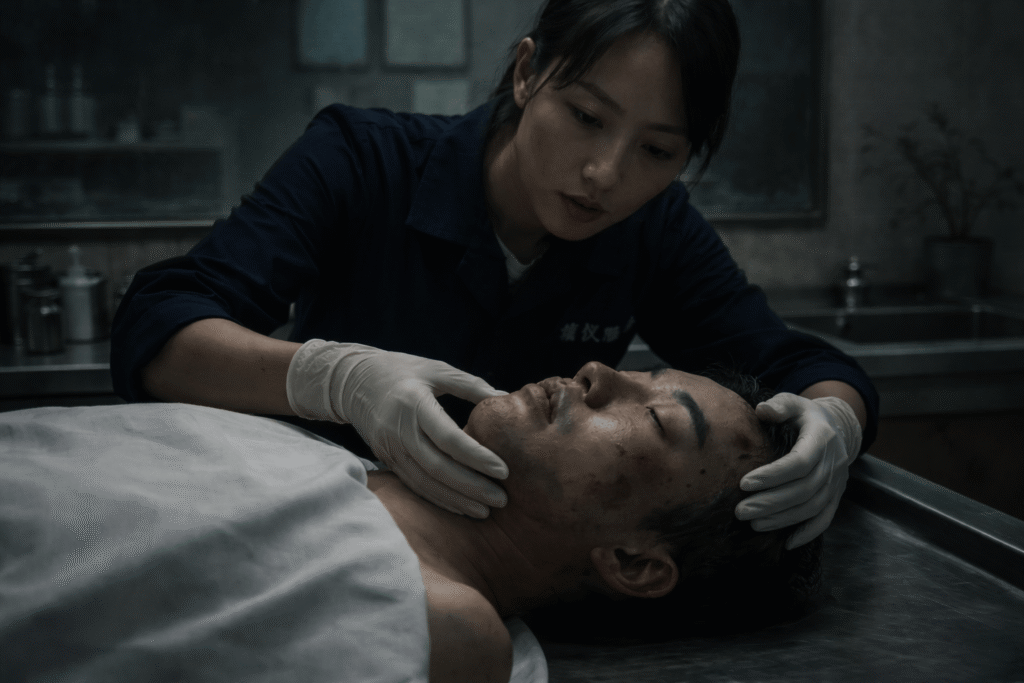
The body belonged to a man in his thirties. His documents were plain and unremarkable, as official records often are. However, the moment Zhao Min studied the face, she felt an unfamiliar hesitation.
The jawbone was not shattered, nor was the cheekbone collapsed. Instead, everything had shifted, worse than disorder, as though a single force had struck the face, pushing the structure sideways.
One eye sat lower than the other, not sunken, but displaced. The mouth had been subtly offset, not by tearing but by settling. Even the tension in the skin followed a pattern that suggested a conclusion, as if the body had already finished something she had not been present to witness.
She did not like the feeling that placed something outside her control in the room. So she prepared.
Behind her, the corridor remained empty. The refrigeration units hummed steadily. A trolley wheel clicked faintly somewhere down the hall.
The room should have felt routine. Instead, it felt as though it were waiting to see what she would do.
The Warning
“You’re looking at it the wrong way.”
Mr. Lau appeared in the doorway. Zhao Min tensed up. She hadn’t heard him approach and disliked being observed.
“The alignment is off. I can restore it.”
Mr. Lau entered the room. He had the quiet patience of someone who had spent years in places where haste made things harder. He stopped beside the table. He did not examine the instruments or ask how long the work would take. Instead, he looked at her face.
“No,” he said. “You can alter it, but that is not the same as restoring it.”
Zhao Min breathed out. “You want me to leave him like this?”
“I want you to respect the direction the body has already taken.”
She turned. Her annoyance was clear. “Families don’t come here to be shown impact geometry. They come here to say goodbye.”
Mr. Lau’s gaze remained steady. “Saying goodbye is not the same as denying.”
Final State
He rested one hand on the table. His voice was quieter and more difficult to dismiss; the room seemed to lean in.
“Some faces can be recognised, others cannot, without forcing them away from their final state.”
“Final state,” Zhao Min repeated dismissively.
“Dead do not resist correction,” Mr Lau continued. “Most do not. But when a form keeps returning to the same position, you should ask whether you are working against damage… or someone who is still holding it there.”
No one spoke, and the silence felt intense. For a brief moment, Zhao Min had the uncomfortable impression that the silence was not empty, but occupied — as though something near the table was listening for how it would be handled.
Zhao Min looked back at the face and said, “I’ll handle it.”
Mr Lau studied her and added, “Do not force symmetry where the dead have refused it. That is not restoration. That is disrespect.”
His footsteps faded, but the word lingered.
The Weight of Other Stories
Zhao Min arranged her tools in her preferred order. This eased her discomfort and gave her something solid to hold onto when a case refused to feel ordinary.
While she checked the materials and prepared the table light, she was irritated by a memory of another story. It was a story she had barely listened to earlier in the week, when two attendants had spoken quietly about a construction worker named Liang Jun.
At the time, she had dismissed it as typical chatter. However, her mind kept circling back to the story, especially the part about how some things do not stay where they are buried once they have been disturbed.
She was annoyed that she remembered it at all.
The Thought That Should Not Stay
This was a preparation room with a steel table and a documented road accident. There was also a body whose injuries followed physical laws that she could see and touch. But her mind refused to ignore the connection between that story and the face before her.
Something had been moved.
And something had not accepted where it had been left.
Something that was meant to remain in its final state had been forced elsewhere.
Closing her jaw in irritation, she was now frustrated not only with the case but also with herself. She bent over the body again, determined to prove to herself that the room contained nothing more than the ordinary stubbornness of broken structure.
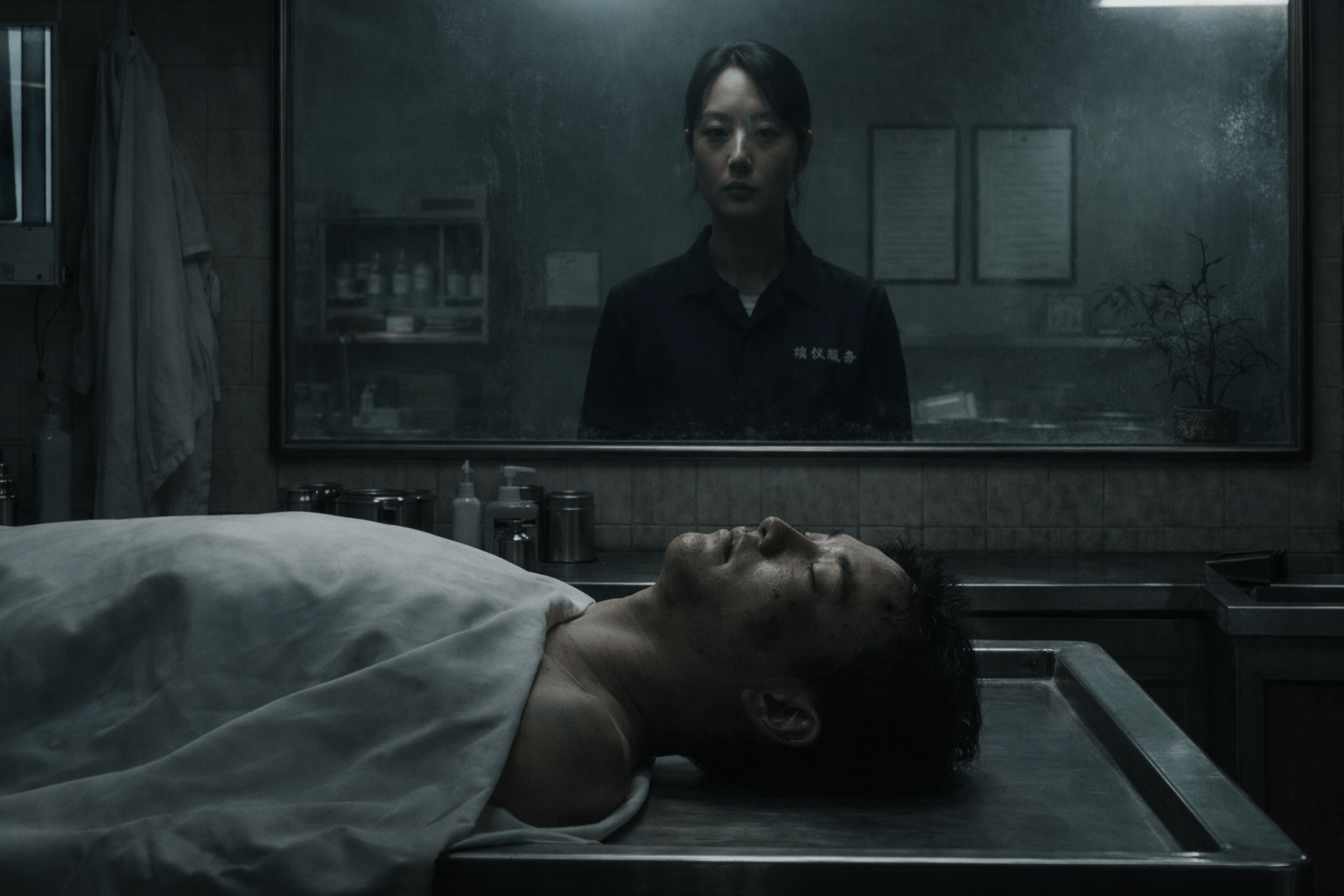
At that exact moment, the overhead light above the mirror on the far wall flickered once and steadied. In that brief dimming, her reflection appeared to stand fractionally differently from where she knew she was.
When the light returned to normal, the mismatch disappeared.
She told herself she had imagined it.
Then she began.
First Disrespect
At first, her touch was clinical but not reverent. There’s a kind of care that exists only for appearances and never for the thing being handled. Zhao Min had practised that kind of care for so long that she no longer heard the contempt hidden inside her efficiency.
“Who leaves a face like this?” she murmured, speaking aloud to assert authority. Irritation came more easily to her than unease.
She slipped one hand beneath the chin and lifted the head without properly supporting the neck — an old, bad habit. The instant the weight shifted into her palm, she felt an answering movement that made her pause. It was not the expected drag of gravity across the damaged structure, but something more deliberate.
A cold sensation passed over the back of her wrist.
She frowned and adjusted her grip.
The First Unease
When she looked in the mirror, her hands in the reflection seemed strangely delayed. But by the time she focused on the image directly, everything matched again.
“You’re tired,” she muttered.
Then, more impatiently than cautiously, she tilted her head further. As her neck shifted, a faint sound, like the smallest possible exhale, came from somewhere very close — close enough that she could not tell whether it had come from the body or from her.
She froze.
The room returned at once to its normal silence.
Her pulse, however, did not.
The First Correction
Zhao Min started moving again, focusing on the jaw to make the face recognisable again. She also wanted reassurance from practical work after feeling unsettled.
She placed her thumbs along the displaced angle and applied pressure, guiding the structure back towards the centred position. The movement was reassuring because the bone responded, the asymmetry softened, and the face appeared more acceptable.
Holding it there, she glanced at the mirror for confirmation.
Her reflection looked back, but not correctly.
The hands in the mirror were not pressing the jaw in the same place as hers. They were lower, closer to the throat.
Zhao Min looked away from the mirror in irritation, then back with a hard, angry focus.
The reflection matched exactly.
Her own hands, posture, and face were pale beneath the light.
The embarrassment of that moment turned to annoyance.
The Return to Its Place

She released the jaw.
The face moved back slowly and tenderly, not collapsing or slipping, but with a deliberate steadiness that suggested correction, not failure. It was as though something unseen had waited for her hands to leave before resuming control.
The movement was quiet, precise and unhurried.
This made it far more disturbing than any sudden jerk or violent resistance could have been, because it was certain, not confused or unstable.
It was not undoing her work, but rejecting it — as though the face belonged to a decision that had already been made and was still being held in place by something that had not let go.
The jaw shifted sideways, the cheekbone followed suit, and the entire structure settled once more into that same displaced alignment, as if it belonged there and had no intention of being anywhere else — not because it could not move, but because it refused to yield.
Zhao Min stared, her breath shallow, her chest tightening as a small, cold pressure gathered beneath her sternum and spread slowly as the realisation pressed inwards.
Then she whispered, “No,” as though the word itself might interrupt what she had just witnessed and force reality to return to something she could manage.
It did not.
Resistance
Her second attempt was less patient because ignoring someone’s authority can quickly lead to aggression. Zhao Min had never handled being ignored well, least of all by something incapable of choice.
She worked the jaw again, this time applying firmer pressure and holding it in place for longer. She studied the lines on the face, willing them into submission with her concentration and her hands. When she finally released her grip, the jaw remained aligned for three full seconds — long enough for a sense of relief to wash over her.
Then the cheek gave way, drawing inwards subtly as if something beneath the skin had begun to inhale.
Zhao Min’s stomach tightened.
The jaw followed, gliding sideways in a motion so smooth that it seemed not mechanical, but obedient; as if answering to another set of hands, another memory that she had no right to interrupt.
The skin along the man’s neck rippled.
Not visibly at first, but in the way that fabric might shift when breath expands beneath it.
The Body That Breathes Back
Zhao Min stepped back so suddenly that she hit the trolley with her hip, making a clattering noise. The silence was broken by the sharp sound, which echoed for longer than expected.
The neck became still.
The room returned to silence.
She stood motionless, staring at the face, her thoughts racing as she tried to explain the noise. She needed an explanation to remain in control.
But none of them was right.
Because none of them accounted for intention — and intention implied presence.
On the far wall, the mirror caught her eye.
This time, her reflection was watching the body before she was.
Zhao Min’s breath faltered as she turned to face the glass.
The reflected Zhao Min did not move immediately.
It turned one heartbeat later.
Escalation
She could have stopped at that moment. If she had, the story might have remained her own private shame rather than becoming a pattern. However, Zhao Min was not one to retreat.
Frustration flooded through her. She adjusted the overhead lamp, tightened her gloves and returned to the table.
“If you can settle one way,” she said under her breath, “you can settle another.”
She began with the cheekbone, applying sustained pressure and support until the contour that had been forced in rose towards symmetry. Then she secured what she had repositioned and moved to the jaw, drawing it back into alignment and holding it there long after any technician would have considered it safe to do so. Her wrists trembled with exertion. Despite the cold room, sweat gathered at the base of her neck.
As she leaned closer, something near the mouth moved.
Zhao Min refused to stop.
The Face That Endures
She corrected where she thought tension and structure needed managing. With every correction, the face became more coherent and more wrong.
When she stepped back, the face remained intact. The jaw was centred, the cheekbone no longer sank, and the eye line looked cleaner, more balanced and more acceptable.
Yet the expression that settled across that forced arrangement did not resemble peace, neutrality or even emptiness, but something far more unsettling. It was as if whatever had occupied that face at impact had not left, but been pressed deeper and held beneath the surface.
Behind her, the mirror reflected the table. For one instant, however, the face in the mirror remained in its original position while the face on the table stayed corrected; the two versions existed in an impossible contradiction.
Then both matched again.
Zhao Min did not realise she was crying until she felt a cold tear pass down the side of her nose beneath the mask.
The First Incident
She left later than planned, walking out into a night time world of rain and yellow streetlamps. The city was obscured by water, causing headlights to stretch into long, trembling ribbons across the road. Although she kept telling herself that what had happened in the preparation room was due to exhaustion, tension and poorly managed nerves, her body no longer moved with its usual confidence.
At the first junction, while waiting to cross, she became aware of a specific ache in her jaw that could not be ignored because it did not resemble the general soreness of stress or the diffuse fatigue of clenching; instead, it felt as though pressure had been carefully placed along one angle of bone and was being held there by something deliberate.
When the signal changed, she stepped forward.
A car cut through the turn too close to the curb, sending a rush of wet air and reflected light across her.
Instinct took over before she could think, and she jerked violently to one side.
Pain burst through her face with such precise familiarity that she stopped in the middle of the crossing, one hand flying up to her cheek as her breath caught in her throat. The sensation tracked from her jaw to her cheekbone to the muscles near her eye, moving in the same direction that she had spent the night trying to correct. It was as though the movement she had just made had not caused something new, but had briefly completed something that was already happening inside her.
A horn sounded.
Someone shouted.
She stumbled onto the opposite pavement.
The Reflection That Should Not Be There
She looked at a darkened shop window to steady herself, seeking an ordinary reflection that would confirm her hidden feelings.
But what she saw made her knees weaken.
Her face appeared normal, features aligned, and symmetry intact, but then another shape appeared behind her in the reflection. It was close, sharing her outline, its lower half obscured by darkness and upper portion leaning forward at an unnatural angle. The head was bent sharply to one side, recognisable as memory, not imagination.
The same angle, displacement and final position.
A bus passed, its headlights sweeping across the surface in a brief brightness. When the light cleared, the second shape had disappeared, leaving only her own reflection, an expressionless face that had not yet caught up with what she had seen.
Zhao Min took a step back, her shoes slipping on the wet pavement as she fought to regain her balance.
No one reacted.
No one had seen anything.
This unsettled her more than the reflection itself.
The Pattern
After that, the change did not come in the form of a dramatic haunting that could have been confronted all at once. Rather, it came in the form of a tight net of incidents that were so exact in their repetition that each ordinary explanation only made the next occurrence more unbearable. This was because ordinary explanations rely on randomness, whereas these events began to feel arranged.
The following morning, she turned too quickly while opening a storage cabinet and hit the same cheekbone on the edge. It wasn’t hard enough to cause an obvious bruise at first, but it left a deep, throbbing ache under the skin. When she pressed her fingers there, she could feel a tenderness that was more like pressure from within than impact.
Later, while speaking to a co-worker, her jaw seized mid-sentence, dragging the words sideways in her mouth so abruptly that the other woman stopped and asked if she was feeling well. Zhao Min forced a smile that felt too tight to be convincing and dismissed it as a lack of sleep, even though she could feel the pull guiding her mouth towards the same off-centre line she had spent so much effort forcing the dead man’s face away from.
The Shape She Is Becoming
By evening, she had begun to hold her neck differently, as if a subtle imbalance were teaching her posture a new obedience. She would catch herself tilting unconsciously, angling her chin slightly too far to one side, while her shoulders compensated for an invisible weight. This pressure seemed imaginary until she tried to straighten up and discovered how much effort resistance required.
This sensation intensified on the second night, when she woke from a light sleep with the unmistakable feeling that someone had leaned very close to her ear. In that moment before she was fully awake, she heard a breath beside her face. It was so close that it felt intentional.
She turned on the lamp.
The room was empty.
However, the pillow beside her had a shallow depression angled towards her.
From that moment onward, coincidence no longer felt like a possibility because coincidence does not repeat itself.
This was not random.
This was imitation.
This was an instruction.
This was something unfinished, insisting on being carried forward through her.
And, beneath the fear that was beginning to take hold, Zhao Min understood that it was worse than being followed.
The body had not merely resisted her correction.
It had determined the direction in which she was now being guided.
The Alignment
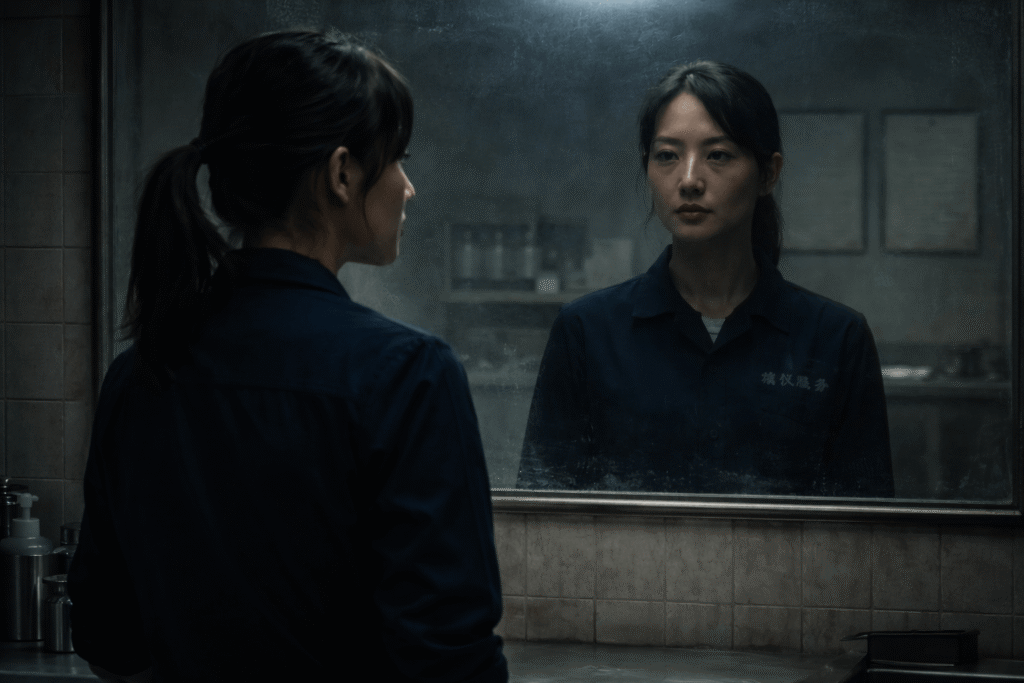
By the third day, she approached the mirror with dread and necessity. Every ache demanded proof; every glance revealed something she could not bear to confirm. Yet she found herself drawn back to the mirror again and again.
At first, nothing obvious changed, and her face remained recognisably her own. However, Zhao Min knew the structure of her features too well to be reassured by appearances. She began to notice the smallest inconsistencies. For example, her mouth seemed to settle a fraction lower on one side when she relaxed. Or her left eye carried a subtle strain.
One evening, she stood in front of the bathroom mirror for nearly ten minutes, waiting for something to confirm that what she felt was real.
The Reflection Moves First

She moved again.
Her reflection did not follow immediately.
Instead, it remained in its previous position.
It was as though the version of herself inside the glass had already transformed.
Only after that delay did it align with her current posture.
Zhao Min felt the blood drain from her face.
She raised one trembling hand to her cheek.
The reflection’s hand also lifted, but not to the same place.
It pressed along her jaw with the familiarity of someone correcting a position they already knew.
It was calm and disturbingly precise.
Then, with the smoothness of something correcting a minor misalignment, the hand in the reflection slid upwards and matched hers perfectly.
Zhao Min stumbled backwards.
The mirror showed only her.
Wide-eyed.
Pale.
Breathing too quickly.
Yet, in the centre of the glass, where her face had just been, the fogging of a breath remained for one impossible heartbeat.
The Accident
Even before the accident, it didn’t feel random. Zhao Min recognised the pressure that always preceded incidents: a narrowing of possibilities that seemed to guide her body towards a single outcome. Every choice she thought she was making had already been narrowed down to one inevitable direction.
It was raining that night, coating the roads in a thin, reflective layer and turning headlights into trembling bands of light. Depth was deceptive. After one final attempt to correct her posture in the staff bathroom, she left work unsettled. For a brief moment, she felt her jaw shift with a softness that shouldn’t be possible before it settled back into place.
She knew she should have taken a taxi.
She recognised the thought as reasonable.
However, when fear becomes too specific, it often disguises itself as control. She convinced herself that walking to the bus stop would steady her and disrupt whatever pattern had begun to take hold.
At the crossing near the main road, she hesitated when the lights changed. A sensation held her in place, feeling less like instinct and more like memory – an awareness that carried the certainty of an impact on her right, the angle of the force, the twist of her neck, and the alignment of the bone she had seen once before.
The Completion of the Line
She looked both ways. The nearest lane appeared clear, so she stepped forward. However, the car came from farther down than she had judged; its speed had been masked by the rain and reflections until it was too close for her to react. Zhao Min did not feel surprised; instead, she felt recognition, as though the event unfolding in front of her had already been rehearsed.
Her body moved before her thoughts could intervene, turning in the same direction as before and offering the same side — the same line of jaw and cheekbone — to the oncoming force. This was not a reaction, but a continuation of something already in progress — something that had been waiting for her to arrive at this exact moment.
The impact did not arrive as a single moment, but as a sequence of sensations unfolding with terrible clarity: the sideways wrench of her head; the deep, crushing pressure against bone; and the overwhelming certainty that nothing about this collision was new.
As she fell, the rain-slicked street rose towards her like a sheet of darkened glass.
Just before the world collapsed into darkness, she saw not the driver’s face in the windshield, but another face layered over it. It was calm in its ruin, its structure already complete. It was waiting for her.
Reflection
When consciousness returned, it was slow and deliberate, allowing pain to arrive before thought. Zhao Min understood she was lying in a hospital room, aware of the silence, not the machines, the faint antiseptic smell or the stiff bandages. The silence had returned in the mortuary: watchful, patient and present.
Across the room, a mirror was mounted at an angle. She knew she would not be able to make that choice. Turning her head sent a grinding pain through her jaw and neck, yet beneath that pain, there was a quiet relief of pressure. Whatever had been guiding and correcting her for days had finished its work.
Her breath shortened and her fingers tightened against the sheet.
Initially, she was not shocked by the distortion, but by the recognition that there was no hesitation or gradual realisation. Her face had the same structure as the one she had handled: the jaw was displaced to the same side; the cheekbone was driven inwards with the same terrible precision; and the eye was lowered in that same final line that made the entire expression feel concluded.
She stared, unable to cry because crying belongs to uncertainty, and uncertainty had already ended.
Then the mirror changed.
Not her face.
The depth behind it.
The Presence Behind
A second figure appeared behind her reflection. It didn’t step forward; it simply became visible, as though it had always been there.
It stood close.
Too close.
Close enough that she could feel the intention of it — not as a force, but as a presence that had endured something and had not yet released it — and had no intention of doing so.
Its head was bent at the same fatal angle that she now carried.
But its mouth was different – not neutral or empty, but holding the faintest tension; the restrained strain of someone who had endured unbearable force without release, expression or permission to turn away.
Zhao Min tried to move.
Pain held her in place.
In the mirror, the figure behind her lifted one hand and placed it along the line of her jaw. The touch was almost gentle, almost approving; it was exactly where she had once forced the dead man’s face into position.
The touch did not register on her skin.
It registered beneath it, as though something within the body recognised the hand before she did.
A deep, inward pressure responded, subtle yet unmistakable, and Zhao Min watched in frozen horror as her reflection’s mouth shifted one final fraction, settling into the precise alignment she had once tried to deny.
Then the figure leaned closer until its damaged cheek almost touched hers in the glass. The mirror fogged faintly between them, bearing the unmistakable trace of another breath.
The Truth of the Exchange

She understood then.
She had thought disrespect had brought about the punishment.
It had not.
Disrespect had branded her.
By turning away from the truth of the dead man’s end, she had offered her own face as a replacement — not to correct it, but to carry him forward.
Not imitation.
An exchange.
Not absence.
Continuation.
Her lips trembled and, through the pain, her voice broke into a thin whisper.
“I did not restore you.”
In the mirror, the ruined eye held hers.
“You restored me,” she finished, though the words felt less like understanding and more like something being answered.
The figure did not disappear.
It only became harder to distinguish.
Until there was no clear boundary left.
Until Zhao Min could no longer tell where her face ended and the dead man’s final state began.
Final Realization
When the nurses entered, adjusted her bedding, checked her chart and spoke to her, none of them reacted to the presence in the mirror. Each time Zhao Min’s breathing became shallow, the glass behind them misted over. She realised then that the horror would not end with the accident because accidents only explain the visible part of a pattern. The true ending existed elsewhere: in repetition and transmission.
If she healed at all, she would heal into the shape she had been given. If she returned to work, she would stand before other broken faces knowing that some damage is not damage at all, but a conclusion. And if she ever felt the urge to undo what death had decided, she would act, knowing that some endings cannot be changed. The dead, when denied their final state, do not always seek revenge in ways the living would recognise. They seek something quieter and more precise.
The Ending That Continues
They seek continuity — not to exist again, but to remain.
They guide.
They repeat.
They wait for recognition.
When the room quietened again and evening gathered against the hospital window, Zhao Min kept her eyes averted from the mirror, clinging to the illusion that her refusal might shield her.
But certainty has its own gravity.
Eventually, her gaze returned.
The second figure was no longer separate.
Its outline had thinned into hers, merging so completely that distinguishing them had become an effort she could no longer sustain.
Yet one detail remained.
A hand.
It was still resting along her jaw in the reflection, steady and patient, as though ensuring that she would never forget the exact position that she had once tried to change, nor the cost of forcing something away from the truth that it had already chosen.
And in that stillness, Zhao Min finally understood what Mr Lau had meant.
Some faces are not unfinished.
Some faces are endings.
Anyone who tries to correct them may be corrected in return — and made to carry what they refused to end.
Related Story
A construction worker disturbed something buried beneath a foundation.
From that moment on, the weight on his back was no longer his alone.