I was born cold. Even in the dead of midsummer, when the heat outside could melt asphalt, my hands remained as icy and rigid as a corpse’s hands.
“Take another breath, child,” my grandfather would murmur, pressing his weathered, calloused hands against my chest. Every morning began the same way—his anxious eyes scanning my ribcage, waiting for its faint, agonizing rise and fall.
Breathing was a constant struggle. It felt as though a thick, damp cloth had been pressed over my mouth while a suffocating weight ground against my sternum. Deep breaths didn’t bring relief; they only brought sharp, biting pain.
“Why can’t I play outside like the other children, Ye Ye?” I asked one afternoon, watching through the shop window as they ran beneath the blazing sun.
“Because the air out there is too sharp for you,” he whispered, dipping a cloth into a steaming bowl of dark, pungent herbal water. He gently wiped my trembling arms, trying to force warmth back into my skin. “You stay near me. Always.”
My childhood was confined within the oppressive walls of his paper-effigy shop.
It always smelled of dried rice paper and earthy starch paste. All day long, the crisp rasp of bamboo splints being shaved and bent into intricate frames filled the shop.
Overhead, countless sheets of brightly coloured rice paper hung from the ceiling. To another child, they might have been craft supplies; to me, they resembled silent funeral banners, swaying overhead as they blocked out the sun and wrapped the shop in perpetual twilight.
Grandfather kept me close, but one place in the shop remained strictly off-limits.
“Never open the back storage room,” he warned, his voice turning unusually harsh. “No matter what you hear inside.”
Behind the Forbidden Door
Years passed, but my condition never improved. I grew up frail, trapped in a body that felt perpetually half-dead. I assumed it was some cruel defect of birth—a lifelong illness I was condemned to endure.
After Grandfather passed away peacefully in his sleep, the shop stood abandoned, gathering dust. With medical bills mounting from treatments that had never helped, I returned to pack up his belongings and put the old shop on the market.
As I stood in the centre of the dusty shop, the scent of starch paste dragged me back to my childhood. My chest tightened as the familiar weight pressed against my sternum.
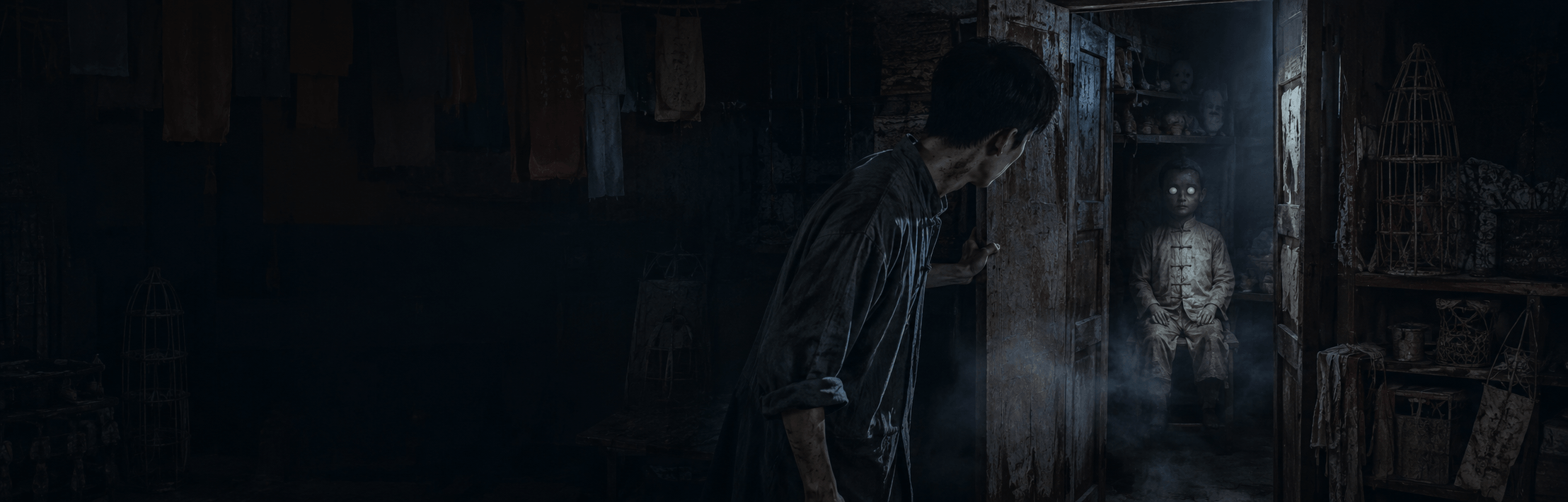
Then I saw it: the door to the back storage room.
The heavy iron padlock had rusted through, and the doorframe had warped away from the latch. I hesitated as Grandfather’s stern warning echoed in my mind, but curiosity—and the need to inventory everything—won out.
With a hard shove, I forced the door inward. Its hinges groaned as a cloud of stagnant, freezing air rolled out.
Inside, seated upright in the dimness, was a life-sized paper effigy. Its delicate bamboo frame had been shaped with meticulous precision and covered in pale rice paper.
My stomach churned as I stepped closer. The effigy wore clothes identical to those I had worn as a child.
It was complete in every detail except for the eyes. Its nose and mouth had been carefully formed, but where its eyes should have been were two blank, chalk-white circles.
As I took a step back, the cold in the room deepened. A sudden, impossible draft whistled through the room and threaded through the effigy’s hollow paper head, emerging as a long, shivering sigh—like a breath that had been trapped inside it for years.
The Unfinished Masterpiece
The hollow sigh faded into the stale air, leaving my heart hammering against my ribs. I forced in a shallow, agonizing breath and stared at the life-sized effigy seated upright in the dim back room.
Its paper skin had been painted the smooth white of porcelain. Beneath the paper skin, its bamboo frame had been assembled with flawless symmetry.
As I stood before it, a cold shiver ran down my spine. Even seated, its height, posture and proportions mirrored my body with disturbing precision. It was like facing a pale reflection of myself rendered in paper.
The two chalk-white circles where its eyes should have been seemed to follow me despite their emptiness.
My phone buzzed, shattering the silence. I flinched and pulled it from my pocket.
“Are you the late craftsman’s grandson?” a stern voice asked when I answered. “I need a complete set of high-grade paper effigies for an ancestral burial tomorrow. Every figure must be fully finished. I’ll pay three times your grandfather’s usual rate.”
Overdue medical-payment alerts crowded the screen beneath the call banner. The payment would be enough to clear every medical bill weighing on me.
I looked through the open doorway at the leftover effigies gathering dust in the shop. There were enough figures to fill the order—but only if I included the one hidden in the back room.
Only its eyes remained unfinished. A few strokes of black ink would complete it. Then I could sell every figure in the shop and finally escape the debt that had followed me for years.
“I can have the complete set ready by tomorrow,” I said quietly.
Dotting the Eyes
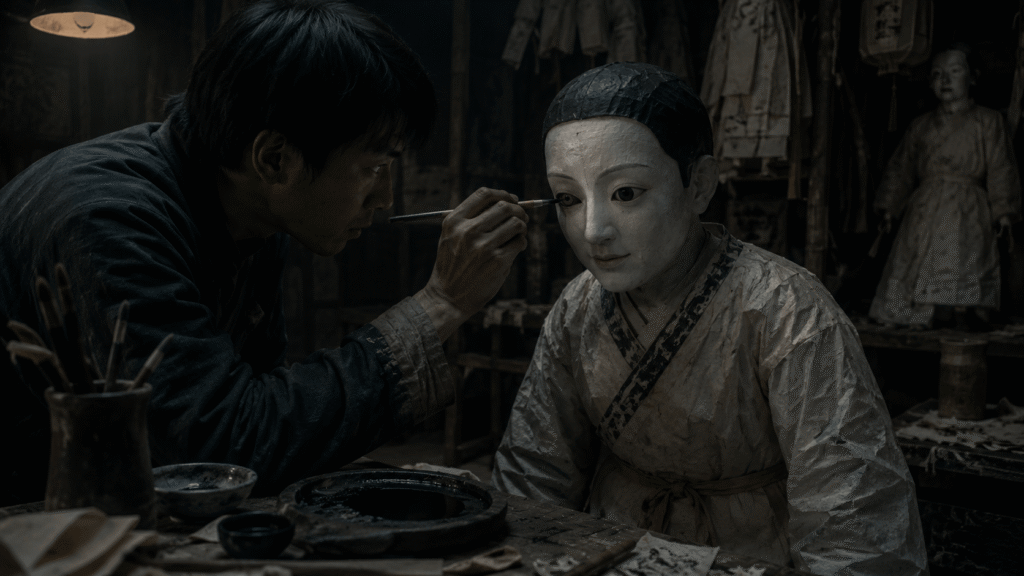
I carried the effigy into the main shop and seated it beside the workbench. Then I poured a little water into Grandfather’s old inkstone and began grinding an inkstick against its surface.
As thick black ink pooled in the inkstone, I remembered Grandfather’s warnings about Dian Jing—the ritual of dotting the eyes of a paper figure.
“Dotting the eyes gives it a soul,” he used to say. “Never paint them unless you are ready for what fills them.”
I let out a weak, rasping laugh. “Just old superstitions,” I muttered, trying to shake off my unease.
I dipped a fine goat-hair brush into the black ink and stepped towards the effigy.
My hand trembled as I pressed the brush tip against the paper face. With one slow, deliberate turn, I formed a black pupil inside the left eye.
I paused. The effigy seemed to lean forward by a single millimetre.
I swallowed and raised the brush to the right eye, forming the second pupil. The moment the second pupil was complete, a heavy hush fell over the entire shop.
The temperature plummeted. The air turned so brutally cold that my next ragged exhale burst into a thick cloud of white vapour.
Shhh… shhh…
A dry, hollow sound echoed through the still air—the unmistakable rustle of paper shifting beneath the effigy’s clothes, though not a single breath of wind stirred.
The Miraculous Recovery
I woke up the next morning feeling entirely transformed.
For the first time in my twenty-four years, the crushing weight on my sternum had vanished. I sat up quickly and drew in a deep breath, but there was no pain—only cold morning air flowing effortlessly into my lungs. No wheezing. No coughing.
I rushed to the bathroom mirror and froze. The ghostly pallor was gone, and colour had returned to my cheeks. When I touched my forehead, my hands—once cold as a corpse’s—were warm against my skin.
“A miracle…” I whispered, pressing a hand to my chest. “It looks like I’m cured.”
Overjoyed, I called my clinic and cancelled every upcoming appointment. For the first time, my future no longer seemed defined by illness. I could finally sell the shop, take the client’s money, and start living.
Back in the shop, I arranged Grandfather’s remaining effigies near the front window and placed the completed one among them, ready for the client’s arrival. In the morning sunlight, however, something about the completed effigy looked subtly wrong.
Its painted paper face no longer looked flat or dry. A smooth, faintly moist sheen covered its surface, like living skin. As I passed it on my way to brew tea, I stopped dead in my tracks.
The painted black pupils were no longer staring straight ahead. They had turned towards me, subtly tracking my every movement across the room.
The Creeping Metamorphosis
The following morning, the client called to postpone the collection. Urgent business had taken him overseas, he explained, and he would collect the order in a week.
By day three, the joy of my recovery had turned into a horrific nightmare.
It started with my skin. It became unnaturally dry, stretching tightly over my bones and turning a chalky, bloodless white.
When I tried to bend my knees or elbows, they no longer yielded like human joints. Each movement ended in a sharp snap, like dry bamboo splints bending under strain.
That afternoon, while moving a display case, a jagged edge scraped deeply across my forearm.
I gasped, bracing for pain and the rush of blood. But no crimson flowed.
The skin split without a trace of blood, dry as torn parchment. From the open gash, fine, light-grey paper fibres spilled out, fluttering silently onto the wooden floorboards.
“No, no, no…” I whispered, clutching my bloodless arm.
I looked across the showroom.
Seated among the other figures, the effigy from the back storage room was changing. Its chest now rose and fell with slow, heavy breaths. A living flush had spread across its pale cheeks.
Meanwhile, deep within my own chest, the feeling of life was fading fast. Each breath felt shallower, as though my lungs were becoming hollow shells. I felt empty.
I was becoming paper. And the paper was becoming me.
Paralysed in Bamboo and Paper
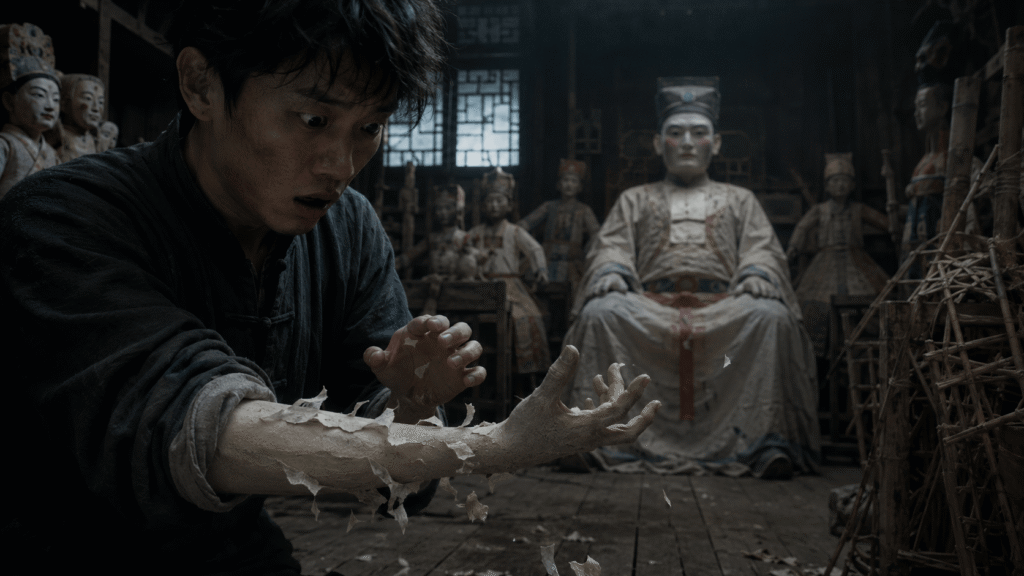
Horror seized me. I knew what I had to do: burn it. Burn it to ashes before it took everything.
With trembling, chalk-white hands, I snatched a box of matches from the counter. But my fingers were no longer flesh and bone—they had become brittle, rigid husks.
When I tried to strike a match, my rigid fingers clenched too hard. The matchstick snapped cleanly like dry straw in my useless grip.
“Help!” I tried to scream, but only a dry, paper-thin rasp escaped my throat.
My legs gave out beneath me. I didn’t crumple like a person; I toppled stiffly against the shop wall and came to rest in an unnaturally upright seated posture.
My joints locked solid. I was completely paralysed, pinned in place like a display mannequin.
Tap. Tap.
The effigy rose from its seat and stepped towards me.
There was no papery rustle now. Each footstep landed with the solid thud of human weight against the floorboards. It stood over me, flexing fleshy fingers, rolling shoulders that had once been bamboo and drawing in one long, effortless breath.
It looked down at me. The black pupils I had painted were now focused and frighteningly human.
The Borrowed Life
The entity—wearing my stolen life, my stolen warmth—walked slowly across the room and knelt beside me.
It reached out a soft, warm hand and gently pressed its flushed cheek against my freezing, chalk-dry face. The contrast was agonizing; I felt the radiant heat of my own stolen life hum against my hollow, bamboo shell.
It leaned in close to my ear, its breath sweet and warm.
“Thank you for the eyes,” it whispered.
A slow, wide, chillingly triumphant smile stretched across its face. It stood up casually, adjusted its sleeves, and turned towards the front door.
Unlocking the entrance, it stepped out into the blinding, warm sunlight, instantly blending into the bustling crowd of the city outside.
I was left alone in the dim shop, frozen in that unnatural seated posture against the wall.
Behind that lifeless stillness, I struggled until terror became agony. No limb moved. No sound escaped. Inside my chest, there was no heart, no lungs—only a hollow silence trapped in a frame of bamboo and paper.
As the door swung shut, leaving me abandoned in the shadows, I could only pray that someone would one day strike a match and end what remained of me.
Related Story
Some curses begin with a ritual. Others begin with one careless act.
He disturbed what belonged to the dead—and carried something away without knowing it.