A Halloween party can go wrong in a surprisingly polite way.
Nobody complains. Nobody storms out. People just get quieter while the host explains a game, somebody wanders back toward the kitchen, and two guests suddenly become very interested in whether there is more ice.
That is the danger with Halloween party games for adults. You can choose a perfectly good game and still choose the wrong thing for the party that is actually happening in front of you.
If people are already laughing, eating, meeting each other and drifting happily between groups, leave them alone. You do not have to freeze a good night because your mental schedule says, “Right. 8:30. Everybody stop. It is game time.”
This guide is mainly written for a normal house party or casual gathering. Some of the ideas below are things I would plan around. Others are better kept in reserve for the moment the room needs a little help.
Halloween Party Games for Adults: Start Here
| If this sounds like your party… | Start here |
|---|---|
| You want one easy boxed game and still want to play | Herd Mentality |
| You want to spend $0 and do not mind running the activity | ESV Halloween team trivia |
| Everyone is standing and the energy needs a quick lift | Halloween Pick-a-Side |
| Your friendship groups are not mixing | Two Rooms and a Boom |
| You do not want formal “game time” at all | Don’t Get Got |
| Everyone actually wants murder, suspicion and deduction | Deception: Murder in Hong Kong |
| You want one short, concentrated bluffing round | One Night Ultimate Werewolf |
| You want something spooky without the accusations | Mysterium |
| A small group wants to spend the night solving one case | Unsolved Case Files: Harmony Ashcroft |
| You want the game itself to become the night | Blood on the Clocktower |
These are doing different jobs. A five-minute rescue should not be judged like a game you bought because twelve people are coming specifically to play it.
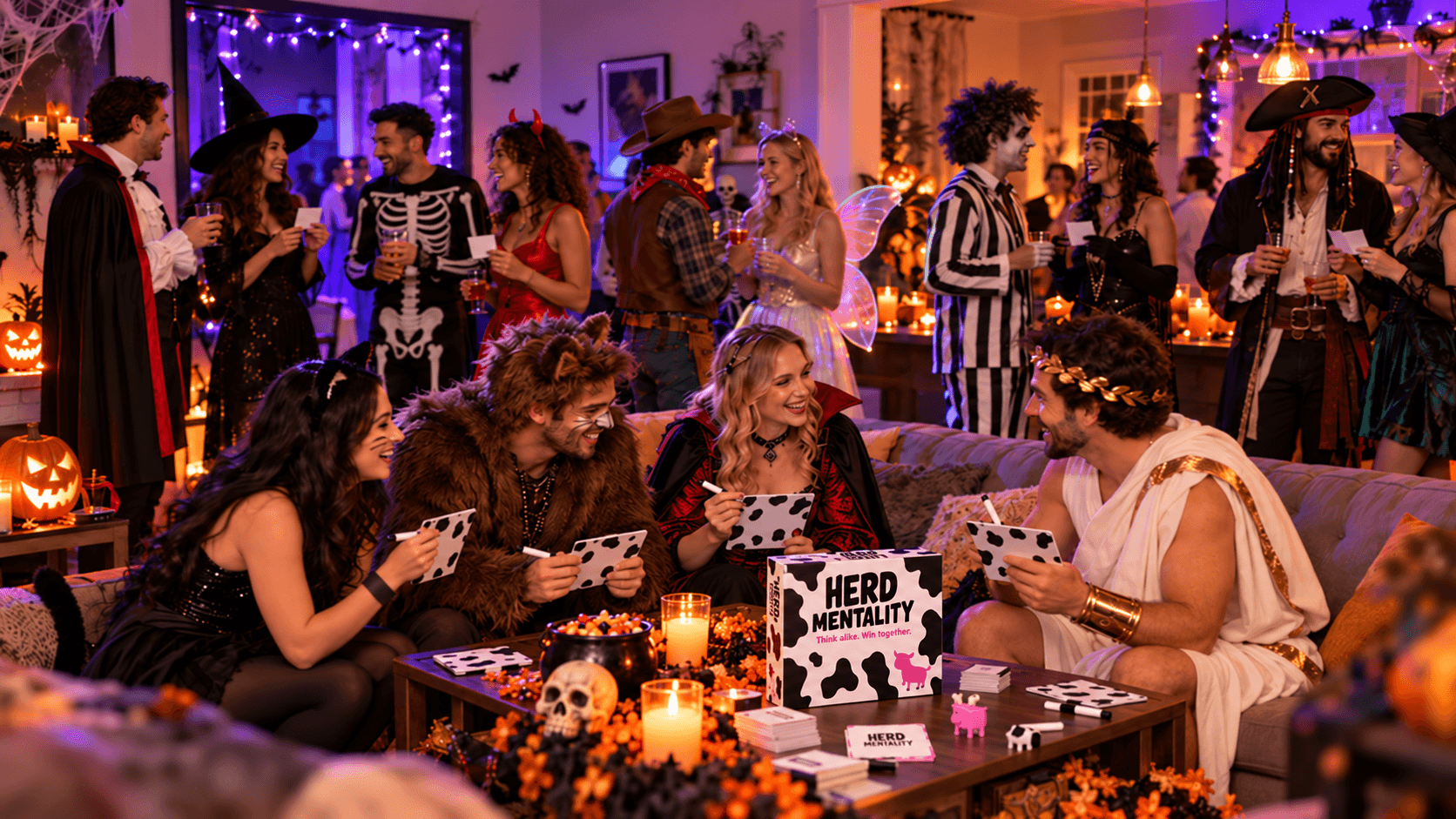
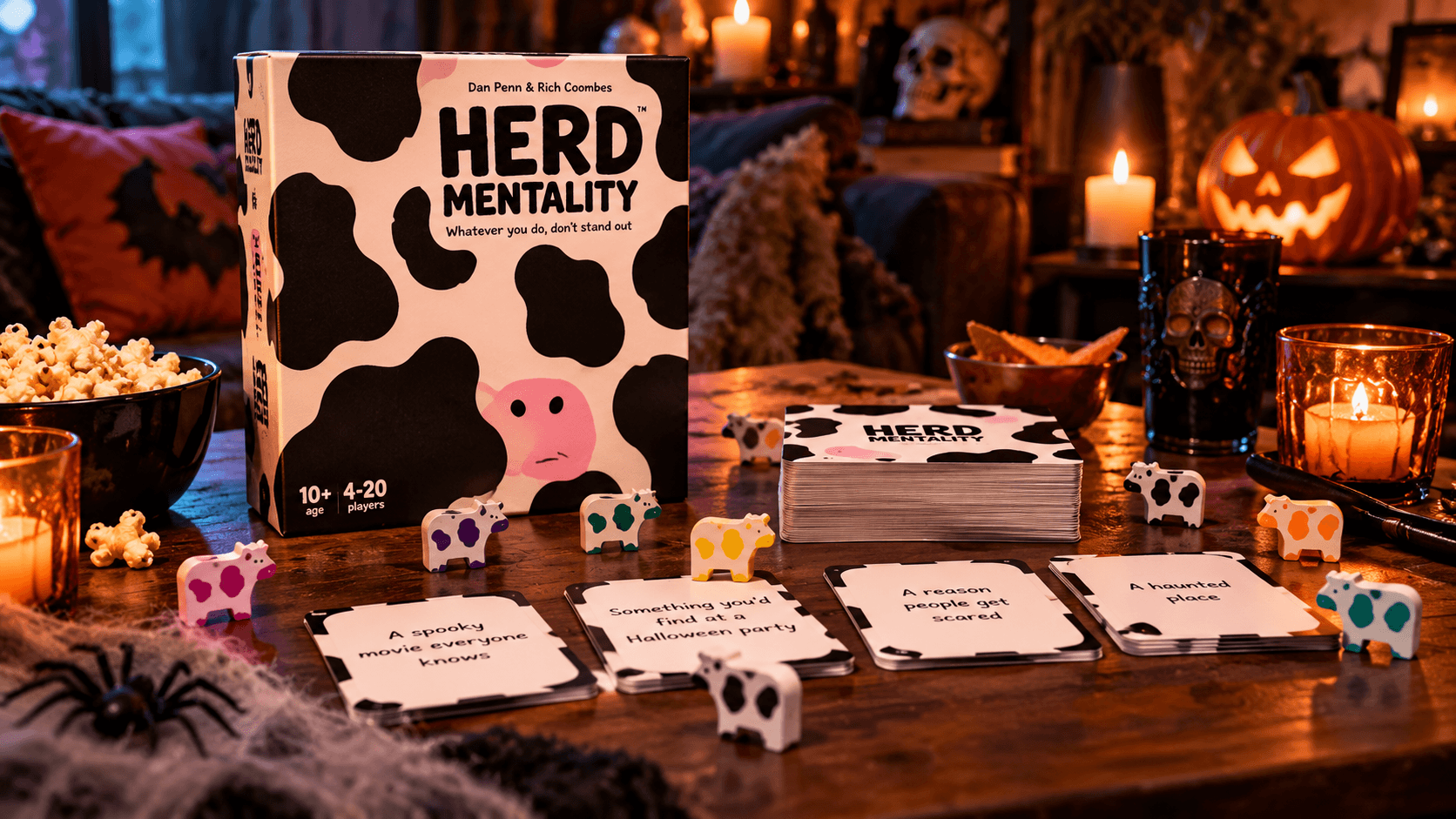
If You Want One Box on the Table, Herd Mentality Is the Easy One
For a mixed adult group, Herd Mentality is the boxed game I would reach for first.
It is not remotely spooky. There are cows involved, and October does not magically make the cows sinister.
What it does unusually well is get people playing before anyone has time to become nervous about “learning a board game.” Nobody needs to bluff, act in character or know which horror sequel came out in 1988.
The official range is 4–20 players, although roughly 6–14 is the range I would feel most comfortable planning around. Fifteen to twenty can still work, but now you have a lot of people writing answers and waiting to reveal them one by one.
The person reading the questions still gets to play, which matters more than it sounds. If you have already cleaned the house, bought the food and somehow become responsible for an ice supply that keeps vanishing, it is nice not to spend the next half hour working too.
There is a little social spotlight. The lone odd answer gets the Pink Cow, so a very shy guest can still find themselves briefly singled out. Most groups will treat that as silly rather than stressful, but I would not call it completely pressure-free.
When Herd works, the good bit is watching people discover that the colleague they barely know apparently has very strong opinions about breakfast food. Conversation starts happening around the answers without anyone being told to “mingle.”
If the room is not enjoying it, finish the question and stop. You do not owe the box a complete game.
Affiliate disclosure: As an Amazon Associate I earn from qualifying purchases. Using these affiliate links does not add any extra cost to your purchase.
Free Halloween Party Games for Adults: Trivia That Knows When to Stop
Halloween trivia has one job: finish while people still want another question.
I would much rather give a party 18 good questions than bury it under 100 and slowly watch everyone’s enthusiasm leave through the nearest window.
The ESV version is deliberately short: 18 questions, three rounds of six, eight easy, seven medium and three harder, plus one numerical closest-answer tiebreaker.
For 6–15 guests, team trivia is easy to run. Fifteen to twenty is still comfortable. Twenty to thirty works, but by then you are collecting more answers, tracking more teams and periodically asking the music to please give you twenty seconds of peace. Once you move much beyond thirty, it starts feeling less like something you slipped into a house party and more like an event you are running.
Round 1: Everybody Gets to Feel Clever
- What date is Halloween celebrated each year?
- What creature is traditionally said to transform under a full moon?
- What vegetable is most commonly carved into a jack-o’-lantern in the United States today?
- Which 1978 horror film introduced Michael Myers?
- In Ghostbusters, what is the name of the giant marshmallow mascot?
- What is the name of Bram Stoker’s famous vampire count?
Show Round 1 answers
- October 31
- Werewolf
- Pumpkin
- Halloween
- Stay Puft Marshmallow Man
- Count Dracula
Round 2: A Little More Halloween Brainpower
- In The Addams Family, what is the name of Wednesday Addams’s brother?
- Halloween falls on the evening before which Christian feast day?
- Which ancient Celtic festival is often linked with the origins of Halloween?
- Who wrote Frankenstein?
- What is the name of the schoolmaster in Washington Irving’s The Legend of Sleepy Hollow?
- Which 1996 slasher film introduced Ghostface?
Show Round 2 answers
- Pugsley Addams
- All Saints’ Day
- Samhain
- Mary Shelley
- Ichabod Crane
- Scream
Round 3: Let the Horror Fans Have Their Moment
- In Hocus Pocus, what is the surname of the three witch sisters?
- What is the name of the ship that carries Count Dracula to England in Bram Stoker’s novel?
- Which 1960 horror film features the Bates Motel?
- Who wrote The Haunting of Hill House?
- What is Dr. Frankenstein’s first name in Mary Shelley’s novel?
- In Bram Stoker’s Dracula, which English seaside town does the Demeter reach?
Show Round 3 answers
- Sanderson
- Demeter
- Psycho
- Shirley Jackson
- Victor
- Whitby
Tiebreaker: In what year was Bram Stoker’s Dracula first published? Closest answer wins.
Show the tiebreaker answer
1897.
If you want a quick background source for the Halloween-history questions, the Smithsonian’s overview of Halloween’s Celtic roots is a useful informational read.
That is enough. The room should feel clever before it feels tested, and nobody needs to spend the night arguing over an actor’s birthday or a body count from sequel number six.
The trade-off is simple: trivia costs nothing and already feels Halloween-ish, but someone has to become quizmaster. If you enjoy that, wonderful. If you have spent the whole day hosting and would quite like to sit down with everybody else, Herd starts looking more attractive.
The Room Is Already on Its Feet? Use Pick-a-Side
Sometimes the room does not need cards, pencils or a table. It needs three minutes of movement.
Halloween Pick-a-Side is almost aggressively simple. Give people two choices, point to opposite sides of the room and let them move.
- Vampire or werewolf?
- Haunted house or dark forest?
- Ghosts or zombies?
- Creepy carnival or abandoned mansion?
- Horror movie marathon or ghost-story night?
- Black cat or raven?
Nobody has to justify their answer. The moment you start asking every person to explain themselves, a three-minute party lift begins mutating into a workshop.
Keep it to walking, clear the floor first and remember that long capes, elaborate dresses and decorative gravestones are not famous for improving mobility. Anyone who would rather stay put can point or use hand signals.
If two prompts land with a thud, stop. You have lost ninety seconds, not the next hour. And if the party is already loud, lively and moving perfectly well without you, keep the prompts in your pocket.
When the Problem Is Cliques, Not Boredom
You know this party. Work friends have colonized one corner. College friends have claimed the sofa. Somebody’s partner has been beside the guacamole for forty minutes and is now on speaking terms with the serving spoon.
Two Rooms and a Boom helps because it does not ask people to mingle more courageously. It gives them a reason to move and talk to people outside the group they arrived with.
The official range is 6–30 players, and it becomes especially interesting once you get into the low teens and suddenly realize most table games are not going to include everyone.
The “two rooms” part is more flexible than it sounds. You do not literally need two enclosed rooms. You need two areas where one group cannot clearly hear the other group’s conversations. A living room and kitchen may work beautifully. Two ends of the same tiny lounge probably will not.
When it goes well, people who arrived in separate little social islands start having urgent conversations with strangers because the game has finally given them a reason to.
There is also an official free Print-and-Play. If you have a printer, time to prepare everything and no objection to doing some cutting before guests arrive, start there. The paid box is about convenience and durable components. You are paying to skip the printing and preparation, not buying permission to play.
What If Nobody Wants “Game Time” at All?
This is where Don’t Get Got remains interesting.
Its secret missions can run underneath the party while everybody continues eating, drinking and talking. Nobody has to gather around a table. Nobody has to finish their sentence because the host has just announced that the next scheduled activity is beginning.
The 2021 New Edition we checked is listed for 2–10 players, so I would use it for a smaller group and definitely not treat one normal box as a twenty-person solution. See Don’t Get Got (2021 Edition) on Amazon.com.
It still solves one problem the others do not: game-friendly guests can have something running in the background without asking the entire party to become game night. If people forget their missions because they are busy talking, nothing collapses. The party just continues.
When Everyone Actually Wants Murder in the Room
Some groups do not need gentle encouragement. They are already sitting down, leaning forward and quite excited to accuse one another of murder.
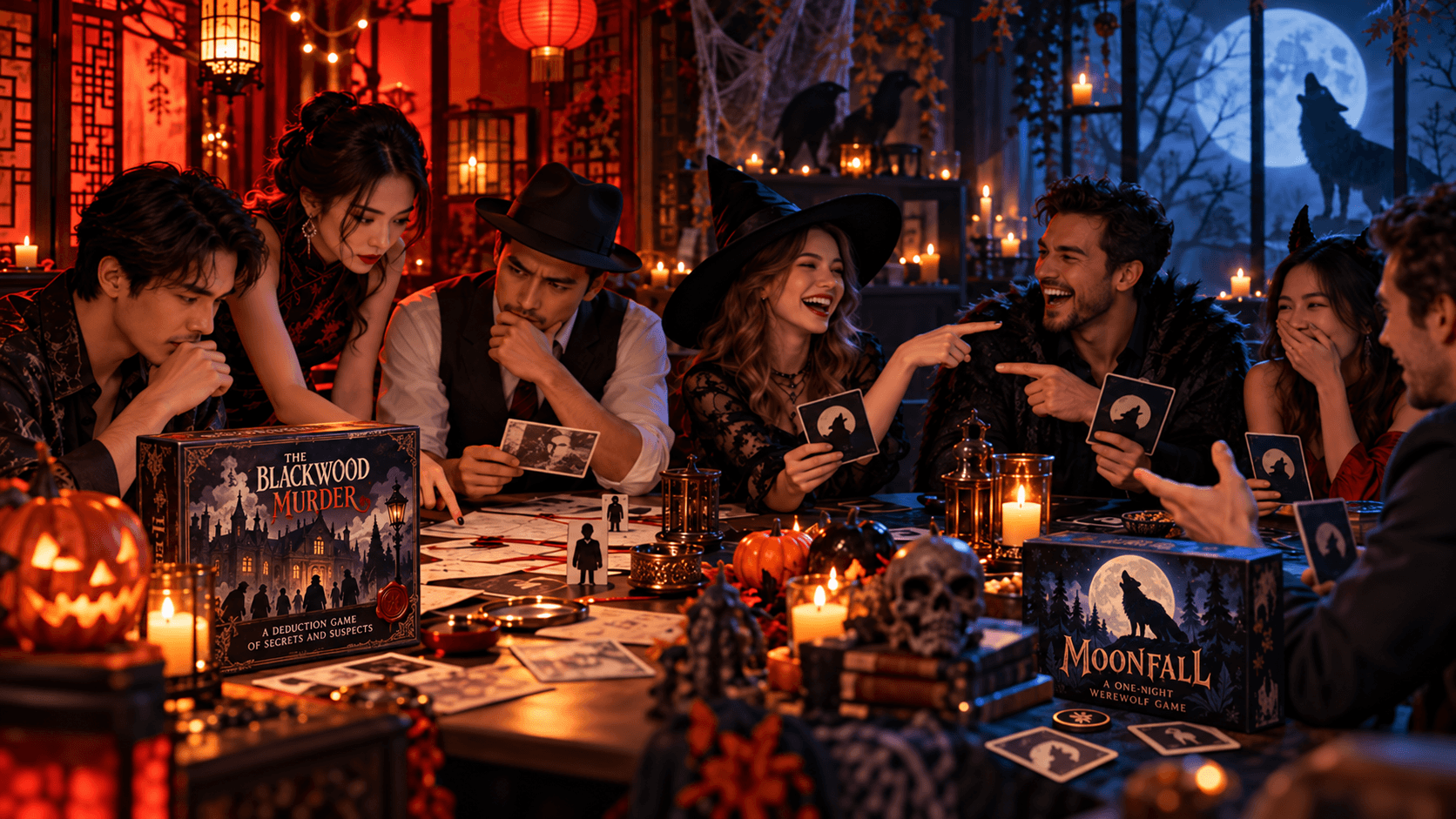
That is when Deception: Murder in Hong Kong makes sense.
The official range is 4–12 players, with a publisher playtime of about 20 minutes. For a party, I would be happier aiming around 6–10, especially if several people are new.
That 20-minute figure is useful as a guide, not a promise. A larger first-time group still has to learn the game, study the evidence, argue and take presentation turns.
Those presentation turns are the social-pressure warning. This is not full theatrical murder-mystery role-play, but players do need to explain theories and accuse one another in front of the table.
For the right group, that is exactly why the game comes alive. Suddenly everyone has a theory, somebody is pointing furiously at a clue and the quiet person at the end of the table has noticed something the rest of you missed.
For someone who came hoping to disappear quietly behind a witch hat and a drink, it may be a lot.
Give Deception decent lighting too. Murder atmosphere is lovely. Holding a clue card six inches from your face because the host committed too hard to candlelight is less lovely. If you want the room dim without making the cards unreadable, a small Gritin clip-on light on Amazon.com is an optional fix, not a requirement.
If the group wants a focused murder game, Deception: Murder in Hong Kong on Amazon.com is a strong choice. If the room is noisy, several guests hate bluffing or more than twelve people need to join, move on. And if the first game does not click, there is no rule saying Halloween requires a rematch.
Ten Minutes of Suspicious Chaos: One Night Ultimate Werewolf
One Night Ultimate Werewolf is much smaller and faster. It supports 3–10 players, takes about 10 minutes, needs no moderator and eliminates nobody. I would think of it as a quick focus reset rather than an energy game.
Everyone has to stop, listen and pay attention for a bit. The narration is important, so if the main speaker is still pounding away beside you, lower the music or move somewhere quieter.
The first round can also be slightly bewildering for newcomers. They understand their own card, then five other people start making suspicious claims and suddenly the information puzzle has arrived before everyone feels ready for it. Let the first round teach the second.
When it works, the ten-minute limit is part of the charm. People immediately start demanding another because somebody is clearly lying and everybody would like another chance to prove it. When it does not, ten minutes have passed and you can simply not play again. See One Night Ultimate Werewolf on Amazon.com.
A Quieter Kind of Spooky: Mysterium
Mysterium changes the mood. It is slower, stranger and far less interested in making your guests call one another liars.
The current refreshed game supports 3–7 players and runs for around 42 minutes. One player becomes the Ghost and communicates through surreal illustrated clues while everyone else tries to understand what those images are pointing toward. If you want to check the mechanics before committing, Libellud’s Mysterium rulebook (downloadable PDF) is the useful informational source.
For a smaller group that wants to settle around a table, it can create one of the nicest kinds of party silence: six people suddenly staring at the same bizarre picture because everyone is convinced it means something different.
The Ghost is also where the game can drag. If clue selection stalls, everybody else waits while one person silently negotiates with a deck full of dream logic.
And because those illustrated cards are the heart of the game, please let people see them. Keep the room moody if you like, but there is a limit. Six adults squinting at a dark rectangle is not atmosphere.
Mysterium is not something I would drop into ten spare minutes. Once people sit down, they are committing to a proper session. That is great when the quieter, eerie session is exactly what they wanted. See Mysterium (2025 Refresh) on Amazon.com.
Want Detective Night Instead? Unsolved Case Files
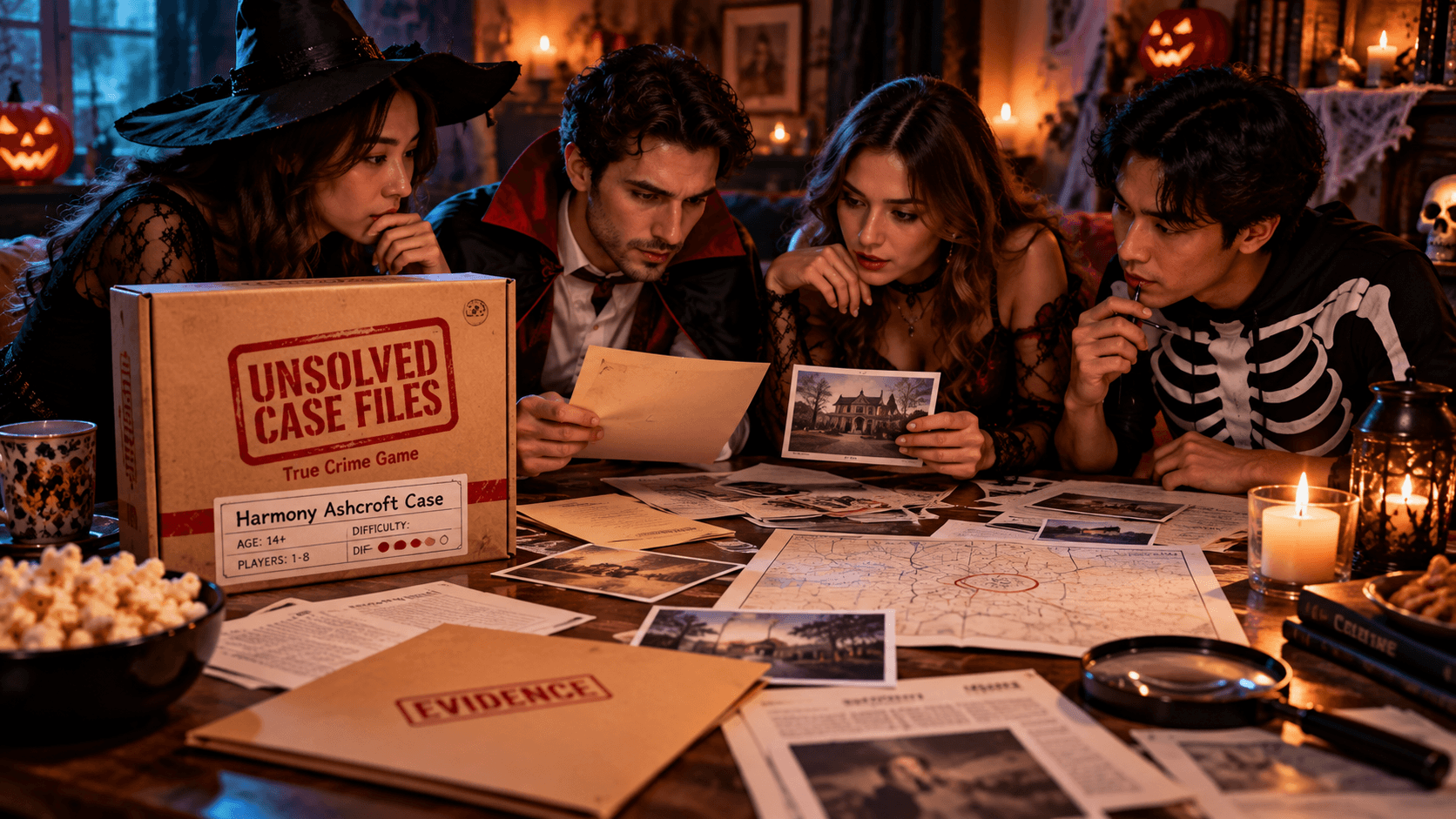
If there are only a few of you and everyone would happily spend a substantial chunk of the night poring over documents, photographs and clues, Unsolved Case Files: Harmony Ashcroft fills a different gap.
This is less “party game between snacks” and more “the party has quietly turned into detective night.” That can be exactly right for a smaller group that wants one murder case to occupy the evening.
The trade-off is replayability. Once your group has solved this particular case, the mystery is no longer much of a mystery. I would buy it for the experience, not because you expect the same people to replay Harmony Ashcroft next month. See Unsolved Case Files: Harmony Ashcroft on Amazon.com.
Blood on the Clocktower Is the Event
At some point, a party game stops being something you add to the evening. Blood on the Clocktower is on the other side of that line.
It is for 5–20 players, plus a Storyteller. That Storyteller is important enough that I would never casually fold them into the player count. They are running the experience.
If the host takes that role, the host is working. If the host wants to play normally, somebody else needs to be ready to Storytell.
This is also why the roughly $160 direct price needs context. Comparing it with a ten-minute filler tells you very little. If twelve or fifteen people are gathering partly because they want to spend a big chunk of the night playing Clocktower, the purchase is carrying much more of the event.
Dead players stay involved instead of becoming spectators, and Traveller characters help with guests who arrive late or need to leave early. The official Blood on the Clocktower how-to-play page is useful if you want to understand the Storyteller role before planning the night.
When Clocktower lands, it can become the thing people are still arguing about in the group chat the next morning.
But you do need to mean it. Someone has prepared to Storytell, everyone has gathered and the party has deliberately shifted toward the game. There is no tidy little two-minute exit if the group discovers this was not what they wanted after all.
That is why I would not buy it casually. I would buy it for the Halloween party where playing Clocktower is part of the plan.
What You Probably Do Not Need to Buy
Most of the obvious party-game extras are unnecessary. For trivia, paper works. Your phone already has a timer. You probably own pens, even if half of them will mysteriously disappear before the second round.
Physical buzzers can be fun if you host quizzes regularly. The Learning Resources Answer Buzzers on Amazon.com give teams distinct sounds, but I would not buy them for one Halloween party unless you genuinely want them afterward.
The same goes for lighting. If Deception or Mysterium is difficult to read because you deliberately kept the room dim, the Gritin clip-on light on Amazon.com is a small optional fix. If your existing lamp already works, use it.
The useful purchases here are the games themselves, and even then only when buying one actually makes the night easier or better. If paper already solves the problem, keep the money for snacks.
A Few Edge Cases Worth Checking
- Several guests are shy: Herd, team trivia or Mysterium are gentler places to start. I would be more careful with Deception.
- You want to play too: Herd is the easiest boxed option because the question reader still participates. Two Rooms, Deception and One Night also let the host play normally.
- You have 15–20 guests: team trivia or Two Rooms begins making more sense than squeezing everybody around a smaller game.
- You have 20–30 guests: Two Rooms fits naturally. Trivia can still work, although the host has more scoring and crowd management to do.
- People will arrive late: short rounds are easier to absorb. One Night is much easier to rejoin between rounds than a longer sit-down game.
- Nobody wants an organized game: believe them. Don’t Get Got may work in the background, or simply let the party continue.
Still building the room around the party?
Our scary Halloween decorations guide helps you fix lighting, texture and atmosphere before buying another pile of props.
Decided nobody wants an organized game after all?
Our Halloween Movie Night Ideas guide can turn the same evening into a shared horror night without forcing the room into game mode.
The Best Game May Be the One You Never Start
Planning a Halloween party makes you want to use everything you planned. The food is out, the playlist is ready, the decorations survived installation, and somewhere there is a game you very deliberately bought.
You still do not have to play it.
If the party is already working, do not interrupt it. If the room needs help, use the smallest thing that can fix it.
Choose the big, high-commitment game when you genuinely want it to carry the night.
Otherwise, let the party keep being a party.