Every library has rules, but ours had one rule no one dared say aloud: If you see a door that wasn’t there yesterday, do not open it.
I broke that rule on a rainy Tuesday.
The library lay in a dead silence, the air thick with the smells of old paper and damp wool. I was hunched over my history notes when Arthur, the elderly head librarian, shuffled past my desk. His face was unusually pale.
“Packing up soon, Leo?” Arthur whispered, his voice trembling slightly. “The light is dying. You shouldn’t be here after dark.”
“Just five more minutes,” I replied, not looking up. “I need to finish this chapter.”
“Don’t linger,” he warned, his eyes darting toward the back aisles. “The floor plan… it shifts when it’s hungry.”
I brushed off his superstition.
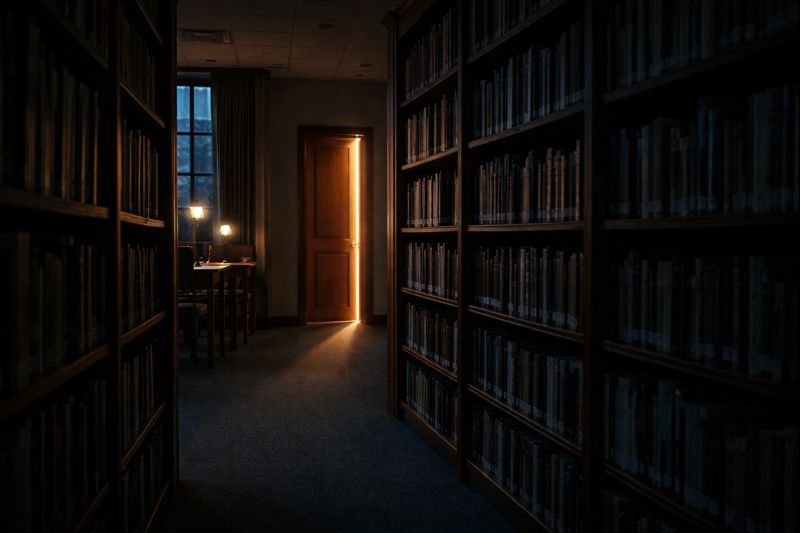
But five minutes later, walking down the history aisle, I stopped cold. Fitted precisely between two tall bookcases was a narrow door of dark oak. I had walked this aisle every day for three years. It had never been there before.
A rusted metal plate was fixed to it at eye level: QUIET ROOM.
The brass handle gleamed in the dim light, and even before touching it, I could feel warmth radiating from it. My heart hammered against my ribs. Beneath the panic, a quiet certainty told me to run. Instead, I raised my hand.
“Leo, don’t!” a panicked voice whispered beside my ear.
I whipped around. The aisle was empty. Behind me, the door gave a faint wooden groan, and I realised the voice had come through it.
Transfixed, I gripped the warm brass handle and opened the door.
Inside the Quiet Room
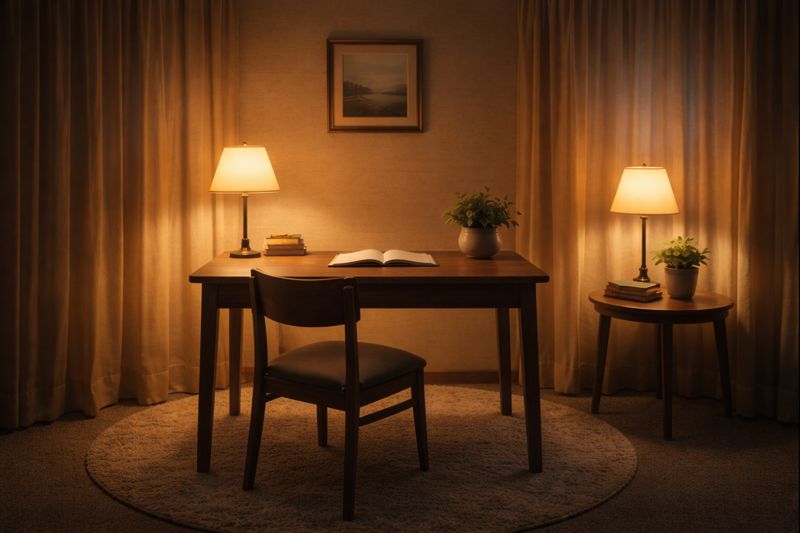
The moment I stepped inside, the door slammed shut behind me with the heavy finality of a vault door.
The air was frigid and suffocatingly dry, carrying the smells of copper and ancient dust. The space stretched far beyond the library’s outer walls, narrowing into an impossible corridor of bare floorboards beneath dim glass bulbs that hung overhead without cords.
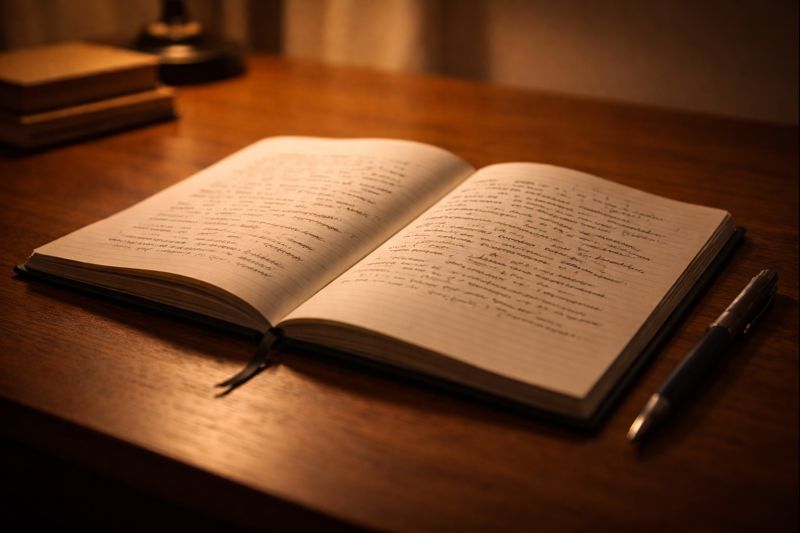
A short distance ahead stood a single wooden desk. On it lay an open leather-bound notebook and a dark fountain pen.
“Is… is someone there?” I called, but the vast space swallowed my voice.
No answer. Only a low, rhythmic rasp, like something breathing beneath the floorboards.
Despite every instinct telling me to stay back, I approached the desk. As I reached for the notebook, the pen snapped upright, balancing on its nib.
I recoiled from the desk.
“Sit.” A whisper sounded not in the room, but directly inside my skull. It scraped through my thoughts, impossibly close.
“Sit down, Leo.”
My body obeyed before I could resist. I sank into the wooden chair. The pen toppled and rolled across the desk, stopping against my knuckles.
The pen dragged itself across the open page, leaving thick, jagged letters in fresh black ink:
WRITE WHAT YOU WON’T SAY. OR WE WILL EXTRACT IT.
The skin at the back of my neck prickled as cold, invisible fingers settled lightly against my throat.
Feed the Ink
The fountain pen jerked into my hand, and my fingers closed around it against my will. Black ink dripped from the nib onto the page, spreading in glossy stains.
“I don’t want to do this.” I tried to release the pen. My fingers refused to open. An unseen force held them clenched around the pen.
“Write.” The command pressed deeper into my thoughts. “Feed the ink, Leo. Give us a secret, or we’ll take something else.”
My breathing shortened. Unable to release the pen, I began with the truths that hurt least. I wrote that I was terrified of failing school. That I pretended everything was fine while my parents screamed at each other downstairs. That I felt lonely every day.
With every sentence, something cold seemed to drain through my hand and into the ink. My chest hollowed, and my thoughts grew unnaturally light.
“There,” I whispered, tears stinging my eyes. “I did it. Let me go.”
The page flipped over with a sharp snap.
Fresh ink spread across the blank page, forming jagged words:
A WEAK OFFERING. BUT ACCEPTABLE.
The invisible fingers vanished from my throat. I jerked backward and toppled from the chair.
“Leo…” A voice came from the darkness farther down the impossible corridor. It wore my father’s voice, stretched and muffled as though he were speaking underwater. “Why didn’t you tell me, Leo?”
I scrambled to my feet and backed toward the sealed door. “Stay away from me!”
The Hollow Price
I lunged at the dark oak door and burst back into the library’s history aisle.
I slammed it shut and sagged against a bookcase, fighting for breath. A few fluorescent tubes hummed overhead, and the familiar smells of old paper and damp wool filled the aisle again.
I looked back. The gap had vanished. The two bookcases now stood flush together, their shelves packed with old encyclopedias.
“Leo?”
I flinched so hard my shoulder struck the shelf. Arthur stood at the end of the aisle, his flashlight beam trembling across the floor.
“Arthur!” I pressed a hand to my chest. “The room… the door was right there. It made me write things.”
Arthur stared at me, his eyes wide with sorrow. “You opened it, didn’t you? What did you give it?”
“Just… secrets.” I rubbed my temples as an ache pulsed around a blank place in the back of my mind. “I told it about my family. About my dad.”
Arthur’s flashlight flickered. He stepped closer and lowered his voice. “Leo… what is your father’s name?”
I froze, my mouth opening without a sound.
My father’s face refused to form in my mind. His name was gone too.
The memory of writing about him remained, but the man himself had vanished. The Quiet Room had kept more than a secret.
Arthur looked stricken. “It doesn’t just collect truths, Leo,” he whispered. “It keeps them.”
The Hunger for Quiet
I swore I wouldn’t go back, but the blank place in my mind never stopped aching. A week later, the dark oak door appeared between two bookcases in the fiction section.
This time, I crossed the threshold without hesitation and headed straight for the desk.
“Welcome back, Leo.” The voice pressed into my thoughts, intimate and pleased.
I fed it every shame I had buried, every grief I had refused to name, and every guilt I had carried alone. With every confession, the memory behind it blurred, and a rush of sickening relief swept through me. I left the room lighter, unable to remember what had made me hurt.
That night, I slept without dreams. By daylight, the relief had already begun to sour.
Soon, I began noticing the same emptiness in others. Maya, a girl from my history class, emerged from the back aisle with glassy eyes and a fixed smile. Her textbooks slipped from her arms, but she never looked down.
“Maya?” I touched her shoulder. “Are you all right?”
She turned towards me slowly. “I feel so quiet, Leo. So empty. It’s wonderful.” Her voice held no emotion.
I looked towards the front desk. Arthur sat staring at the wall, his mouth slack and a thread of saliva shining at the corner of his lip.
The Quiet Room had never wanted only our secrets. It was stripping away the memories and feelings attached to every confession, leaving less of us each time.
Worst of all, we wanted to go back.
The Quiet Spreads

The door stopped hiding.
By the third week after I first opened it, the door no longer appeared in only one place. Dark oak doors stood beside the science shelves, near the water fountain, and beside the front exit. Queues formed outside each one.
I watched as classmates, teachers, and neighbours entered them one by one. They entered tense and reluctant. They emerged calm, their faces vacant and their eyes unfocused.
I confronted Maya near the front desk. “We have to stop. It’s taking everything that makes us who we are.”
She tilted her head. The corners of her mouth kept lifting until the expression no longer looked human. “Why fight it? Memories only hurt us, Leo. Without them, there is only peace.”
“You don’t even remember your mother’s name, do you?” I demanded.
Maya’s smile vanished. She blinked once. “Who?”
I bolted towards the library’s main doors, but the handles would not turn. A sudden silence settled behind me. I turned.
Everyone in the library had gone still. Dozens of hollowed patrons stood among the aisles, their vacant eyes fixed on me.
Their mouths opened together, and the voice from the Quiet Room spoke through every throat at once:
“It’s time for your final entry, Leo.”
The Final Entry

The main doors remained sealed. The hollowed patrons closed in, driving me backwards through the aisle until my shoulders struck one of the dark oak doors.
“Write, Leo.” The same whisper emerged from dozens of throats. “Give us the rest.”
I wrenched the door open and stumbled through. It slammed shut behind me.
The impossible corridor had fallen dark, except for a single glass bulb glowing above the desk. The notebook lay open beneath the light. Black ink writhed across its pages like a nest of worms.
My body carried me to the chair and forced me down. The fountain pen drove itself into my fist, its barrel biting into my palm until blood ran down my wrist.
“Stop. Please.”
“Write your name, Leo.” The command filled my thoughts. “Give us what remains, and you’ll finally be at peace.”
I fought the pressure guiding my hand and forced the pen across the page. Instead of my name, I wrote the only words that still felt true:
I CHOOSE TO REMEMBER YOU.
A piercing sound tore through the corridor as the notebook’s pages ripped themselves apart. Black ink burst from the pages and struck my face. Something tore free inside me—the final piece the room had demanded.
The room buckled. Darkness swallowed me.
I woke sprawled across the cold floor of the history aisle. The fluorescent lights burned overhead. The patrons were gone. So was Arthur. No dark oak door remained between the shelves.
I left the library and walked home through the rain. With every step, the truth became harder to ignore.
My name would not come to me. Neither would fear, grief, or love. Only a vast, freezing emptiness remained.
The Quiet Room didn’t destroy me. It kept me.
Related Stories
Some places listen quietly, waiting for someone to speak. Others remain frozen in the moment they were last needed.
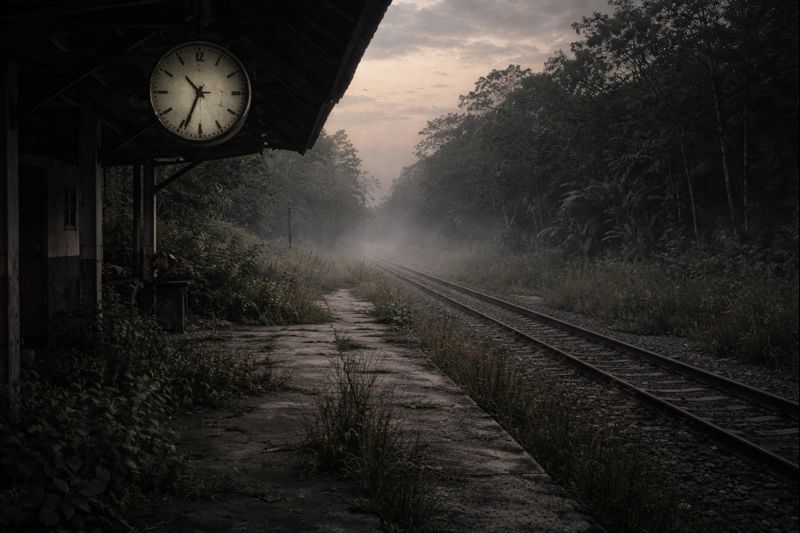
At an abandoned station far from the city, travelers say the platform lights sometimes glow late at night — and the clock above the tracks still shows the same time it did on the night the last train arrived.
The Forgotten Train Station Where Time Refused to Move
But some places do not simply wait. They change when no one is watching.
In a small apartment where nothing unusual had ever happened before, the walls and furniture seemed subtly different each morning — as if the space itself had been rearranging the room while its occupant slept.