I took the apartment because it was cheap, quiet, and three blocks from the nearest station.
The leasing agent laughed when he mentioned the rumors, dismissing the past tenants’ claims that the place was “haunted” the way people dismiss cracks and mildew as character.
His laughter stopped before it reached his eyes, but I didn’t care. I just needed a place that didn’t ask questions.
After the breakup, sleep came in brief, punishing scraps.
I didn’t want a home. I wanted four walls that would stay where I left them.
Faded beige paint. Slow elevators that smelled of machine oil. A lobby noticeboard crowded with names no one had bothered to remove, pinned beneath rusting staples.
No gleaming smart locks. No security cameras blinking above the stairwell doors.
If the building had a bad reputation, good. It kept the rent low and the neighbours behind their doors.
I unpacked two cardboard boxes, dragged a thin mattress onto the scuffed hardwood, and turned off the overhead bulb.
That night, the building gave me nothing but silence.
No footsteps through the ceiling. No pipes knocking inside the walls. Only the hollow calm of knowing no one else was there.
It was exactly what I had asked for.
The First Week
The first week passed without anything I could prove. Still, each morning, something in the apartment felt slightly wrong.
The shoe rack seemed pressed more tightly against the wall. The hallway looked narrower, as though the plaster had drawn inward overnight.
Whenever I turned my head, the corners lagged at the edge of my vision, bending for a second before settling back into place.
The rest of the building seemed to sleep through the night. I didn’t.
When sleep refused to come, I paced the floorboards. Twenty-eight steps to the window. Pause. Twenty-eight steps back to the door.
I used to count like that during our arguments, fixing on the rhythm until her words blurred. Now I used it against the silence she had left behind.
On the third night, my footsteps began echoing a beat longer than they should have, as though the room were stretching to hold them. Then, somewhere behind the lath and plaster, something clicked once.
A single dry snap, sharp and deliberate. I told myself it was the pipes settling.
By the fifth night, the sound wasn’t in the walls anymore. It was in the air.
A faint, low hum—like a wire drawn too tight and vibrating in the wind—that stopped the moment I held my breath to listen.
My mind was playing tricks. It had to be. Loneliness makes a quiet room loud.
Still, on Sunday morning, I took out the tape measure I’d used during move-in and measured the hallway again. It was three inches shorter than it had been seven days earlier.
The Apartment That Refused to Stay Still
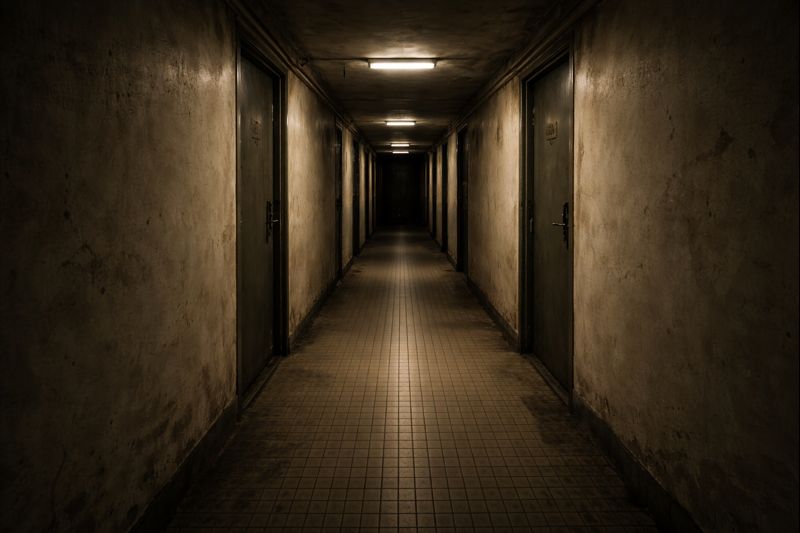
By the second week, avoiding the apartment became routine.
I stayed out past midnight, killing time in bright, noisy diners to delay returning to that quiet hallway.
When I came home on the tenth night, exhausted, I froze at the threshold.
The brass door plate read 12A. It was supposed to be 12B.
Yet the comma-shaped gouge beside the lock—carved by my keys on move-in night—was still there. The door was mine.
I returned to the lobby. The tenant directory listed my name beside 12B, followed by the tenants of 12C and 12D. There was no 12A on the fire-escape plan mounted beside the directory.
My breath came in thin, shallow pulls.
Inside, the ceiling light reached halfway down the entry before an unnatural shadow swallowed it.
The bed had been dragged against the opposite wall. Fresh grooves scored the hardwood from its original position, glistening as though they had just been made.
I laughed breathlessly. It came back warped and distant, like a recording played in an empty church.
The next morning, I fixed a bright red strip of masking tape across the joint where the doorframe met the plaster, low enough to reach the baseboard.
A crude seal that would tear if the frame shifted away from the wall.
That night, sleep failed completely. I paced.
Twenty-eight steps. Pause. Twenty-eight steps back.
On the twentieth step, my foot landed on something soft. Cold.
I looked down.
The red tape had torn along the joint, its edges feathered as though stretched past their limit.
Beside my shoe, protruding through a newly split seam in the baseboard, were three pale, human fingers.
The fingers did not curl or pull back, but their skin was slick with sweat, and the nails tapped softly against the grain in time with my pulse.
The Shift
At dawn, the tape was gone.
A faint, raised seam ran down the wall—yellowed with age, as if the plaster had been surgically opened and hastily resealed decades ago.
Midnight arrived with a cadence of sharp clicks—like deadbolts testing themselves in sequence. The floorboards shuddered. Behind the plaster, something shifted with the wet, grinding sound of bone settling into a joint.
Early in the third week, after my twenty-eighth step, an impossibly narrow door appeared beside the kitchen cabinet.
It had no handle. Its dark wood was etched with hairline grooves. The air around it was hot and moist, carrying the smell of old copper and unwashed skin.
I didn’t touch it.
I stood there, counting under my breath until numbers lost meaning.
Later that week, at midnight, the clicking returned—right against my ear. The plaster groaned as the walls eased apart, and the handleless door swung inward.
Beyond it stretched an impossible corridor lined with identical doors, their brass plates climbing toward numbers higher than a three-story building could contain.
The air hit me like a dead man’s exhalation—stale, suffocating, and thick with the scent of long-closed rooms.
The clock on my phone froze at 12:00. A crack split the glass with a soft snap.
Despite myself, I took one hesitant step forward. The corridor felt horrifyingly less empty than my own room.
At the far end of the corridor, a door eased open into pitch darkness.
No one stood there. But two wet, pale hands appeared high on either side of the frame and gripped the wood. Then came the soft shuffle of bare feet across linoleum.
I scrambled backward.
The door beside my kitchen slammed shut, cutting off the heat and sealing me inside an apartment that now measured only fourteen steps from door to window.
The Haunted Apartment Rewrites Itself
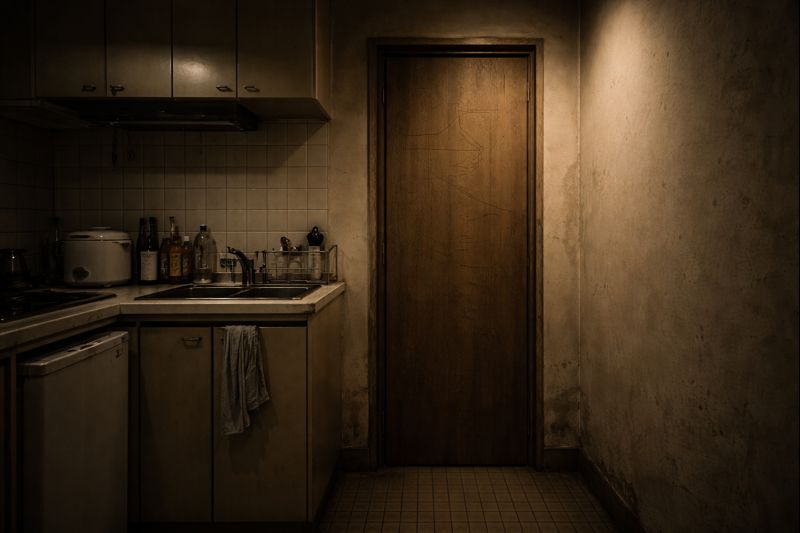
After that, the apartment began to rewrite itself. The kitchen and bedroom traded places overnight.
The bathroom mirror lagged behind my movements. My reflection remained facing me for a full second after I turned away.
Once, I opened the front door to leave, only to face that endless, dark corridor instead of the building hallway.
At the far end, past dozens of identical doors, stood another doorway with the same comma-shaped gouge beside its lock.
My door.
Three days later, I found a notebook wedged behind the sink’s cold-water pipe.
The script began neat, then deteriorated into frantic, microscopic letters pressed so deeply into the pulp that rust-dark stains bled through the paper. Several pages had been torn out mid-sentence.
On the final intact page, a single name had been gouged into the paper. My name.
A date at the top of the page placed the entry decades before my birth. Yet beneath it, my name had been pressed through sheet after sheet, the oldest impressions yellowed with age.
Suddenly, the plaster behind the mirror began to churn.
A sharp crack echoed through the apartment as the living room walls lurched inward, stealing another foot of space.
My furniture groaned between the advancing walls. Beneath the paint, dozens of wet hands pushed outward from inside the walls, their raw, nailless fingertips stretching the surface like rubber.
Then, my phone buzzed in my pocket.
A message from an unknown number. Four words:
“Stop counting the steps.”
Above me, the ceiling bulb shattered, plunging the shrinking room into pitch-black darkness.
In the darkness, bare feet shuffled closer from inside my closet.
The Twenty-Ninth Step
At midnight, the clicking began early—then cut off instantly, leaving a silence so absolute my ears throbbed with pressure.
An oak door now stood freestanding in the center of the living room, rooted into the floorboards.
My name was gouged into its surface.
The letters sloped with the awkward leftward tilt I had as a child, before I forced myself to change my handwriting. White plaster dust filled the grooves, some bright and fresh, some dulled to gray with age. Where the cuts ran deepest, the wood radiated a feverish heat.
I tried to scream, but my throat clamped shut.
A bitter, metallic taste flooded my mouth, like copper wire laid under my tongue. I forced air past my lips, but only a dry rasp escaped.
Around me, the walls leaned inward. Not rushing—just a steady, suffocating tilt that pinched the room into an hourglass shape. The plaster cracked with a sound like snapping ribs.
The door didn’t move. It waited.
Then the brass knob turned from the inside.
Slowly, the panel swung inward, revealing no light—only a narrow void that breathed ozone and wet earth.
A figure dressed in my clothes emerged from the pitch-black threshold, its head bent at an impossible angle.
It stepped into my shrinking room on bare, bloodless feet.
When it lifted its face, its features were a smooth, blank expanse of skin, broken only by a single jagged slit where its mouth should have been.
The slit parted, and out came my lost voice, clear and perfectly mocking:
“Step twenty-nine.”
What the Apartment Took
Before dawn, the figure and the oak door were gone. I shoved everything into my duffel—shirts, tangled cords, my toothbrush.
The sharp clicking answered every scrape of a drawer, quickening with impatience.
I bolted for the exit, threw the front door open, and stopped dead.
No elevator. No familiar hallway. Only the impossible corridor stretching into darkness. At the far end, another door stood waiting, its brass plate gleaming: 12A. Or was it 12B?
The digits blurred in my head, slippery as oil. I couldn’t even remember which number had been mine.
Behind me, the room groaned. The oak door bearing my name had returned. It swung wide, spilling thick, hot darkness across the floorboards.
Bare, bloodless feet slapped against the wood as the figure stepped into the light.
I backed into the front doorway, trapped between two impossible spaces. My lungs burned as the frame tightened around my shoulders, threatening to crush my ribs.
Desperate, I looked back at the figure advancing toward me.
“I’ll come back!” I choked out, the promise tumbling past my lips before I could stop it. “I swear—I’ll come back!”
The word “back” echoed down the infinite corridor, multiplying into dozens of hollow voices.
Instantly, the clicking snapped off.
The corridor collapsed inward with a rush of stale air, folding like origami until the familiar hallway snapped back into place. Behind me, the apartment settled, silent and satisfied. It had taken my promise.
I sprinted to the stairwell and took the steps four at a time, bursting into the cool pre-dawn air. Three blocks later, I reached the station without once looking back.
I had made it out. But at the ticket machine, my hand brushed something cold in my coat pocket as I reached for my wallet.
A brass key. Stamped 12A.
The Promise Comes Due
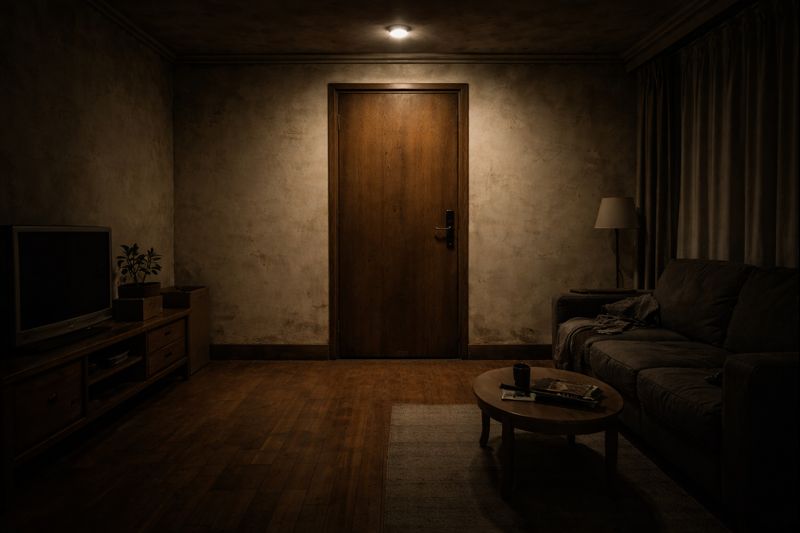
Now I live somewhere else. Somewhere normal, with walls that stay still. Yet every Sunday at midnight, I return to Apartment 12A.
Those are the terms: I must cross the threshold and physically walk all twenty-eight steps through the shrinking room.
Only once did I try to break the promise. I stayed in my new apartment, locked the deadbolts, and turned off my phone.
Midnight arrived.
Every lock in the apartment clicked in sequence. The walls groaned and drew inward like a lung emptying.
The floorboards beneath my bed grew scorching hot, and my stolen voice rasped my name from inside the bathroom mirror.
Pale, wet fingers pushed through the plaster ceiling, dripping sweat onto my face.
The apartment doesn’t care where I sleep. It owns the space I occupy.
I barely survived that night.
At 2:00 a.m., bleeding and sobbing, I raced back to 12A and forced myself through all twenty-eight steps. Only then did the walls ease back.
Breaking the promise again is no longer an option.
Each Sunday night, I take the train, walk the three blocks from the station, and let the brass key turn in the lock.
Inside, the apartment stretches just far enough to give me twenty-eight steps. Each week, the ceiling sinks a little lower.
People think I live alone in the city, but I don’t. I am only the tenant of something that feeds on space and time.
I know that one night it will stop stretching before I reach twenty-eight, leaving no room to turn back.
Tonight, as the clock strikes midnight, I take my first step forward and silently form my name. Each week, it feels a little less like mine.
Related Story
Some apartments shift while you sleep. Others change slowly, one floor at a time.
In an aging apartment block, residents began noticing something impossible: every year, the stairwell seemed to lose another level — as if the building itself were quietly erasing the floors, and the people who once lived there.