The mirror arrived in our apartment building on a Tuesday morning, wrapped in thick cloth and carried by two silent movers.
Elias and I had both skipped classes—his in history, mine in physics—to unpack our new apartment.
We watched from the lobby as the building’s landlord directed the men. He was a collector of oddities who had filled the corridors with chipped brass and heavy, forgotten timber.
To him, the mirror was just another rare antique to give the place character.
No one feared it then.
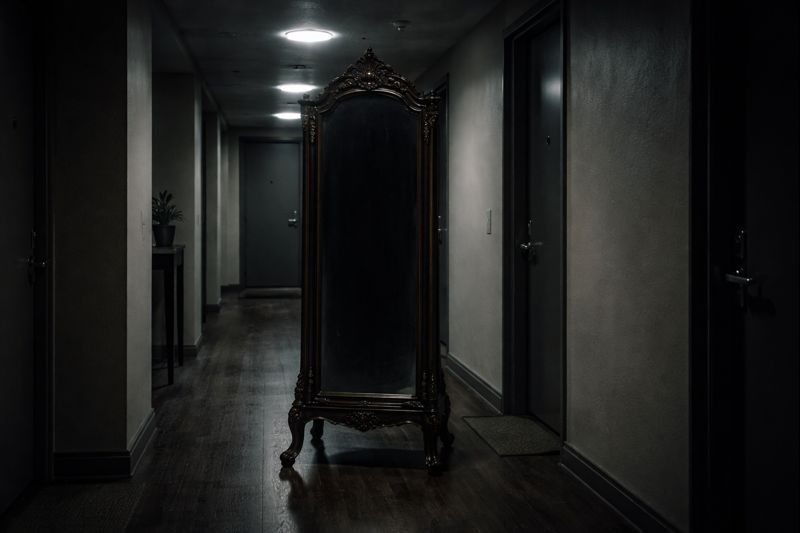
It stood taller than a person, framed in dark, dense wood carved with looping patterns that seemed to wriggle if you stared too long.
When I brushed my fingers along the edge, the wood was unnaturally cold.
As a physics student, I understood light: reflection, refraction, angles. But when Elias stepped in front of the glass, the laws of optics dissolved.
The reflection didn’t match. In the glass, Elias wasn’t holding a cardboard box.
He stood motionless, staring past the real Elias and directly at me with hollow, dark eyes.
I grabbed his arm to pull him away, but my reflection didn’t move either—it remained suspended in the silvered glass, wearing a wide, impossibly jagged grin.
Then came the sound: a quiet, frantic tapping from inside the surface.
Suddenly, my real arm lifted toward the mirror as though gravity had shifted into the glass.
The lobby light flickered, dimming as the space around us began to warp, stretching toward the frame like metal pulled to a magnet.
We tried to run, but our feet hit smooth, cold glass.
Only then did we understand.
The mirror hadn’t come to decorate the building. The building was being pulled into the mirror—and we were already on the wrong side of the glass.
The Mirror in Apartment 3B
Then, as suddenly as it had begun, the distortion stopped.
The lobby snapped back into place, leaving Elias and me staring at our ordinary reflections as though nothing had happened.
Neither of us spoke as we carried the last of our boxes past the mirror and into Apartment 3B.
Inside, the air was heavy with the sharp tang of fresh paint and plaster dust, yet a lingering undertone—like damp earth and stagnant water—clung to the floorboards.
It felt less like a new beginning and more like stepping into a room that had been waiting for us specifically.
The layout was simple, but wrong.
The living room had a high, narrow window, though no light seemed to reach the far corners. Shadows pooled beneath our cardboard boxes in odd, impossible directions, defying the overhead bulb.
When Elias set his duffel bag on the floor, the thud sounded muffled, swallowed instantly by the quiet walls.
Elias stopped beside the far wall. “Was that here when we signed?” he asked, his voice tight.
“I don’t remember seeing it. Why?”
He pointed to a framed, full-length mirror mounted between our bedrooms.
It was an exact twin of the grand antique downstairs—same dark, looping wood, same unnatural cold radiating from the glass.
“The landlord said this unit was empty,” Elias whispered. “So why is that here?”
I stepped closer, trying to shake the sudden knot in my chest.
I looked at our reflection.
Elias was staring at the glass, but in the reflection, his image was looking past me, toward the front door.
Then came a soft scrape against the hallway floor outside. It sounded like dense wood being dragged slowly up the stairs, inching closer to our door.
We turned to look at the entrance, but in the mirror, the door was already open.
The Delay Was Spreading
The real door remained firmly shut. Then Elias shifted beside me, and his reflection followed a terrifying fraction of a second too late.
We stood frozen between the bedrooms, watching the delayed image settle back into place.
“It’s catching up,” Elias whispered, his face pale against the harsh overhead lights. “Or it’s practicing.”
I tried to rationalize it—a trick of the glass’s curvature, refraction, uneven lighting—but science offered no comfort.
The mirror didn’t just delay our movements; it began to retain them.
When Elias pulled his hand back to his side, his reflection’s hand stayed suspended in the air for an extra second, fingers twitching before snapping back into position.
Over the next week, the building began to warp around the twin mirrors.
The quiet excitement of the newly renovated apartments curdled into an unnatural silence.
Tenants stopped speaking in the corridors. When they walked past the lobby mirror, they kept their eyes glued to the floor, terrified of catching their own eyes in the glass.
Because the delay was spreading.
By Friday, it wasn’t just the lobby.
In our apartment upstairs, the bathroom mirror lagged when I brushed my teeth.
The reflective finish on our kettle hesitated before showing my face. Every shiny surface in the building was becoming a window to the same slow, patient observer.
Late one night, I woke to the sound of quiet, rhythmic tapping on our bedroom window.
I sat up and looked toward the dark glass. Rain wasn’t falling outside.
In the reflection, Elias and I were still asleep in our beds. But standing over us was my own reflection, glass-side out, tapping its knuckles against the pane, waiting for me to turn around.
The Collapses Began
The sickness spread faster than the lag.
Within days, tenants stopped using the lobby stairs, crowding into the smooth metal elevators just to avoid passing the glass.
People complained of a heavy, suffocating pressure behind their eyes, persistent nausea, and the horrifying sensation of being watched from inside their own medicine cabinets.
A man on the third floor draped black bedsheets over every reflective surface in his flat.
Yet, step across the street into the local bakery, and light behaved normally again. The anomaly was strictly contained within our walls, radiating outward from the twin antique mirrors.
Then the collapses began.
Mrs. Gable from Apartment 2A was the first.
She was checking her mail when she caught her own gaze in the lobby mirror. She collapsed onto the polished tile without a sound.
When the paramedics arrived, they found her breathing normally, heart steady, but entirely unresponsive—her eyes wide, blank, and staring straight ahead.
A week later, the young guy from 4B went down the exact same way.
Each time someone fell into the stupor, the mirror grew hungrier.
The delay between real life and the reflection stretched from a fraction of a second to several horrifying seconds.
Elias and I stood at the edge of the lobby one evening, watching Mrs. Gable’s reflection through the glass. Her real body had been taken to the hospital days ago.
But in the mirror, she was still standing by the mailboxes.
Slowly, her reflection turned its head toward us.
It raised a pale, trembling finger to its lips, letting out a soft, frantic shush that rattled the glass in its dark wooden frame.
The Mirror Was Learning
After Mrs. Gable’s reflection shushed us, we fled upstairs.
By midnight, Elias’s bedroom wall had become a map of terror. He pinned up our building’s blueprints, marking each collapse with red ink.
The clusters were clear: every single victim had stood directly in the lobby mirror’s line of sight.
“It isn’t lagging anymore,” Elias whispered one midnight, his eyes sunken and bloodshot. “It’s digesting.”
We stood before the grand antique, forcing our bodies into absolute stillness. In the glass, our reflections held still too.
Then, two full seconds later, my reflection subtly shifted its weight—a tiny, unnatural correction, like an actor remembering their posture.
It wasn’t just delaying us. It was imitating us.
When the mail carrier collapsed the following morning, his real body twitched violently on the lobby tile before going still.
But in the mirror, his reflection didn’t fall. It remained standing upright, staring out at us with a hollow, satisfied grin.
Desperate for answers, Elias lost his temper. He grabbed a heavy brass lamp and smashed a smaller decorative mirror on the second floor.
The glass shattered into a hundred harmless pieces, but the air instantly turned frigid.
A low, vibrating hum rattled our teeth. Breaking the glass didn’t destroy the entity—it just tore open another seam.
That night, the lobby mirror’s delay stretched to nearly five horrifying seconds.
Moving vans began arriving at dawn as the tenants who had already reached the street fled, abandoning their leases.
But for those of us still trapped upstairs, escape wasn’t so simple.
The stairwell doors were jammed shut, and the elevator only ever opened on one floor: the lobby.
Right in front of the glass, where our reflections were now waiting for us, standing completely still—even when we weren’t there.
What the Mirror Took
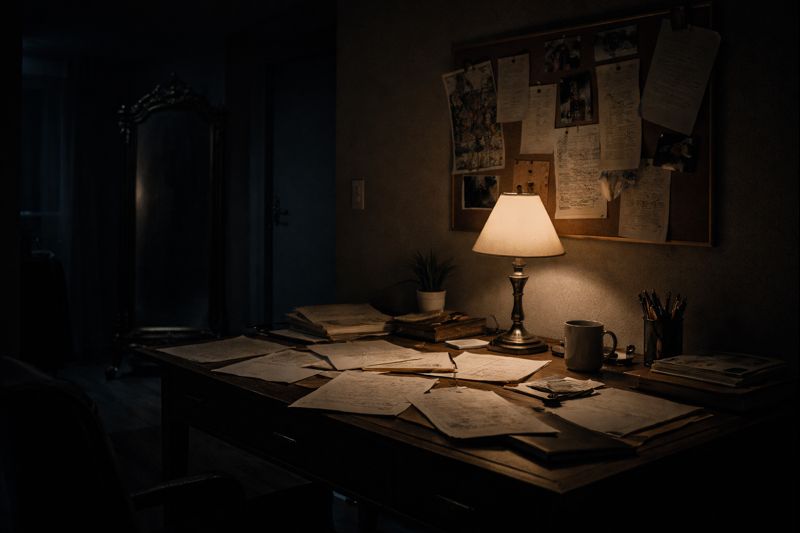
Elias stopped sleeping entirely.
His desk was littered with printed property records, local archives, and yellowed news clippings dating back to 1892.
The history of the mirror was a trail of sudden, unexplained grief.
Its original owner, a wealthy Victorian industrialist, had purchased the piece shortly after his family mysteriously vanished.
Within six months, he was found dead inside a locked study, seated in a high-backed chair directly facing the glass.
No marks on his body. No poisons in his blood. Just his lifeless corpse staring into the frame.
“The police thought it was heart failure,” Elias said, his voice barely a rasp as he traced the ink of an old obituary. “But look at the coroner’s note. He wrote that the body felt ‘hollowed out.'”
Physics couldn’t explain conservation of mass when a soul went missing.
That night, I found Elias in the darkened lobby, standing bare-chested in front of the grand mirror. He was inches from the glass.
In the reflection, his image wasn’t looking back—it was turned away, whispering secrets to the shadowy figures of Mrs. Gable and the mail carrier trapped inside.
“Elias, we’re getting out tonight,” I snapped, grabbing his cold shoulder. “We’ll break through the stairwell doors if we have to.”
He didn’t flinch.
In the glass, his reflection slowly turned its head, locked eyes with me, and spread its mouth into a terrible, knowing grin—even while the real Elias remained staring blankly ahead.
“I can’t leave now,” Elias whispered, his voice breaking. “It’s too late for me. It already took a piece of my soul. Look.”
He raised one trembling hand. His fingertips had darkened to a bruised black, and thin veins of shadow crawled beneath his skin toward his wrist.
Breaking the Haunted Mirror
“Then what do we do?” I asked, my knuckles white around the iron crowbar.
“Destroy it,” Elias said softly. “It’s the source of everything.”
“But you said it already took a piece of you! What happens to you if we break it?”
Elias let out a bitter, lifeless laugh. “Do we really have a choice?”
“When?” My voice trembled. “When is the right moment?”
“When it takes all of me. That’s when it’ll be fully inside the glass.”
“Are you insane? You’re talking about sacrificing yourself!”
“It’s already happening,” he whispered, staring blankly ahead. “Better me than the whole building.”
Outside, the storm battered the glass doors as the emergency lights flickered, casting long, writhing shadows.
The mirror’s surface hummed, bulging outward like water stretched to its breaking point under impossible pressure.
Elias stepped directly into its pale, sickly light. In the frame, his reflection didn’t mimic him. It stood rigid, hands clasped tightly behind its back, before slowly turning its head to lock eyes directly with me.
The air pressure in the lobby plummeted, seizing the oxygen right from my lungs.
“Now,” Elias whispered.
The sound didn’t come from his throat—it echoed from deep inside the glass.
I didn’t hesitate. I swung the crowbar with everything I had left.
The impact produced no crash of breaking glass—only a dull, sickening crunch.
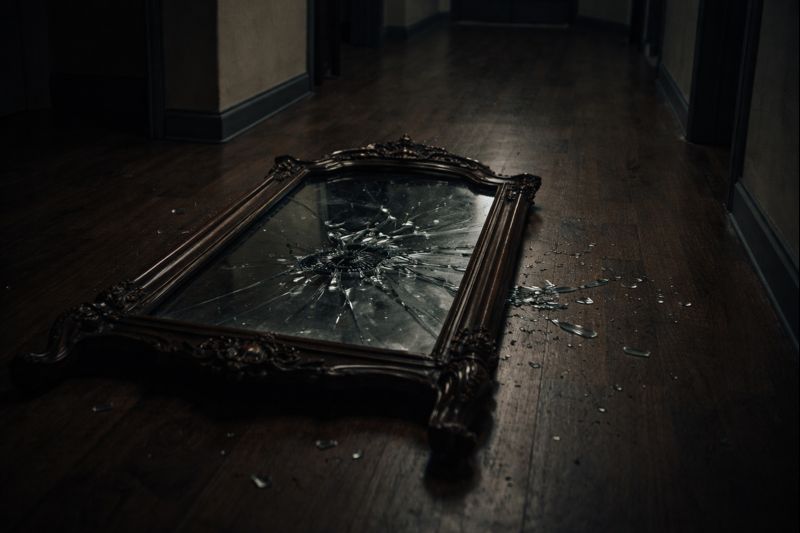
The mirror imploded, folding violently inward into a dark, suffocating vortex. Its dark wooden frame snapped along its carved loops like brittle bone, exhaling a freezing gust of stale, rot-scented air that knocked me off my feet.
A shockwave blew out every light overhead, plunging us into absolute, heavy silence.
When I scrambled up, Elias was crumpled on the cold tile, hollowed out and still.
The Door Was Only Sealed
The paramedics called it an unexplained coma, a sudden loss of higher brain function with no physical cause.
Over the following week, Mrs. Gable, the mail carrier, and the others all woke up in their hospital beds—confused, exhausted, but alive. The mirror’s hold on them was broken.
The landlord cleared away the splintered timber, patched the crumbling drywall, and painted over the scar left in the lobby.
Life returned to the building. Voices and footsteps echoed through the corridors again, lively and ordinary.
New tenants moved in, unaware of what had been buried beneath the paint.
Our apartment is peaceful now. Light behaves according to the laws of physics. Shadows fall where they belong, and reflections move precisely when they should.
Except Elias never came back.
I visit him at the care facility every Sunday, sitting beside his quiet, breathing form.
His chest rises and falls, but his eyes are fixed on the far wall, wide and unblinking. I bring his old history books and read them aloud, holding his limp, cold hand, praying for a sign—a twitch, a flicker, anything.
He gave everything to shatter that glass, yet I am haunted by the awful truth of what we did. We didn’t destroy the mirror’s world; we only sealed the door.
Every night, before washing my face, I stand motionless before the bathroom mirror. In the darkness, my hands remain at my sides as I search the quiet depths of the glass.
Fear no longer keeps me there. Grief does.
And each night, I wait, desperately hoping Elias’s reflection will one day step out from behind my own.
Related Stories
Some reflections show what should no longer be there. Others belong to debts that never finished burning.
In a crowded alley block, a fire once climbed through ten stories of concrete and smoke — but long after the flames died, something inside the building continued to remember what had been owed.
The Debt That Burned in the Ten-Story Alley Block
But some buildings do not simply remember. They change, quietly, one floor at a time.
Residents of an aging apartment block began noticing something impossible: every year, the stairwell seemed to lose another level — as if the building itself were slowly erasing the people who once lived there.