You have survived the workweek. Everyone is finally home. And somehow the house still ends up split between phones, laptops, games and separate rooms.
You do not need to announce a forced “family bonding night.” You just need a case worth arguing about.
That is where a good murder mystery game earns its place. The box gives everyone something external to focus on, so the conversation starts by itself: competing theories, somebody guarding the witness statement like classified material, and Dad becoming suspiciously confident that the neighbour did it.
That split-house feeling is not just in your head. The American Psychological Association’s 2026 Work in America survey found more workers reporting tension and stress during the workday, while Pew Research Center found nearly all U.S. teens use the internet daily, including four in ten who are online almost constantly. Research on shared family leisure and adolescents also points to communication as an important part of time together. So yes, there really is a lot competing for everyone’s attention before family night even starts.
So this guide is not trying to find the most elaborate box. I looked for cases that give families a reason to sit around the same table and stay interested long enough for the night to become its own thing.
Affiliate disclosure: As an Amazon Associate I earn from qualifying purchases. Using these affiliate links does not add any extra cost to your purchase.
Quick Guide: Which Case Fits Your Night?
| Game | What stands out | Age guidance | Players | Approx. time | Digital involvement |
|---|---|---|---|---|---|
| Murder of a Millionaire | Best overall family case night | 14+ | 1–10 | ~2 hours | Online police inbox |
| Murder at the Movie Theater | Easier first full case | 14+ | 1–10 | ~2 hours | Online police database |
| Harmony Ashcroft | Document-heavy realistic cold case | 14+ | 1+; larger groups can split into teams | Often 2–3 hours | Online answer checks and hints |
| The New Haven Case | Deep collaborative investigation | 14+ | 1–6 | 90–180 min | Websites, calls, chats and other digital clues |
| Murder in Miami | Experienced-family challenge | 14+ | 1–10 | ~3 hours | Online police database |
| Death at the Dive Bar | Fuller case in a compact session | 14+ | 1–5 | 45–60 min | Online player resources |
| Luna Knight Quick Play | Gentlest introduction to the format | 14+ | 1–4 | ~1 hour | Online answer checking |
| The Salem Slicer | Darker true-crime experience | 17+ | 1–6 | 90–120 min | Some online content |
Tier 1: The Three I Would Start With
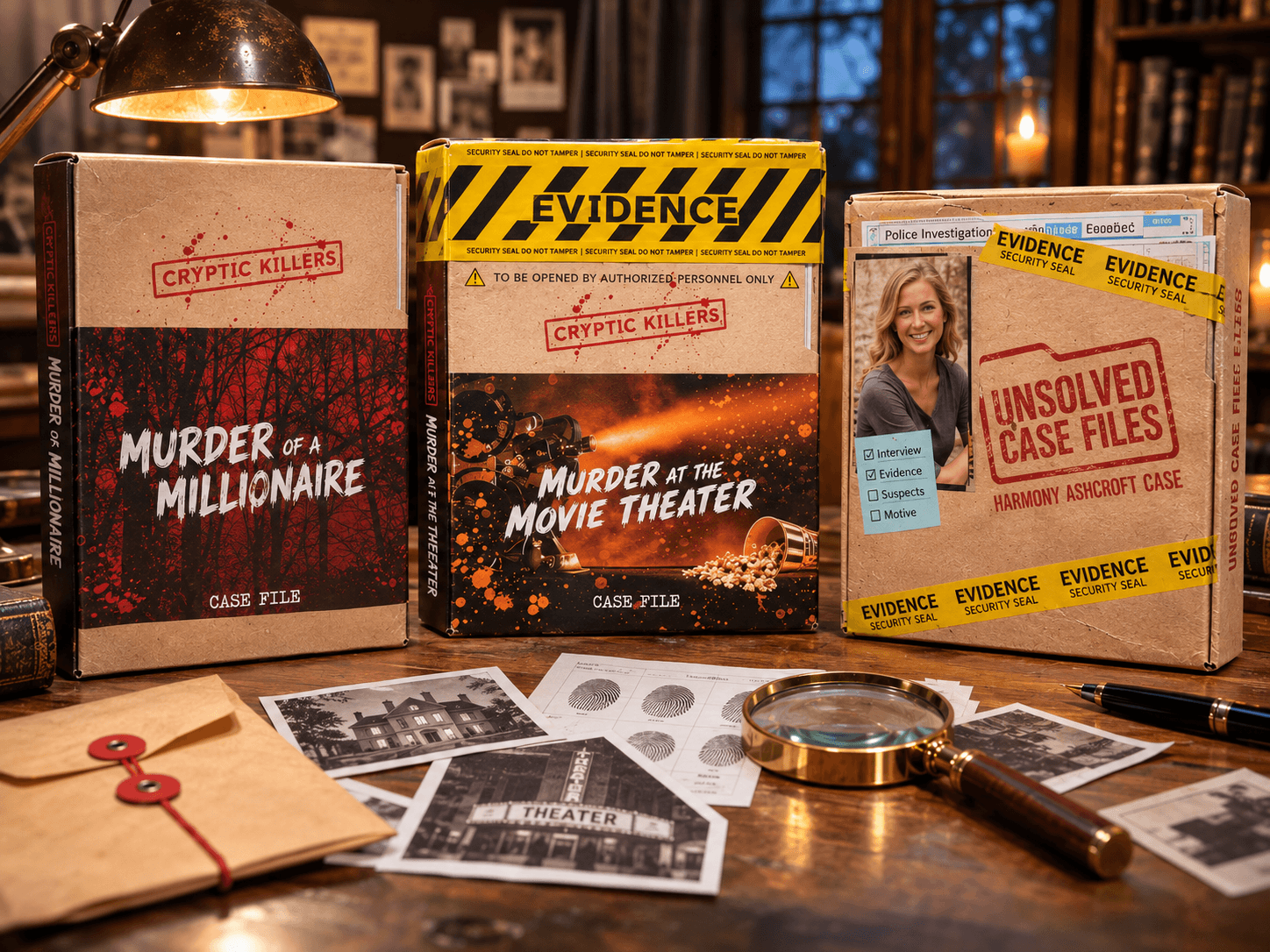
1. Cryptic Killers: Murder of a Millionaire — Best Overall
If I were choosing one box for a family that wants a proper case night without jumping straight into the deep end, this is the one I would put on the table.
You get 29 pieces of physical evidence, roughly two hours of play, an online police inbox and an official difficulty rating of 3.5/5. That is just enough friction to make theories matter without turning the evening into three hours of everyone silently staring at the same clue.
It narrowly beats Murder at the Movie Theater for the top spot because both are approachable, similarly sized experiences, but Millionaire gives the group a little more to chew on. The difference is not enormous. It is simply the better default when you want the first case to feel satisfying rather than deliberately easy.
2. Cryptic Killers: Murder at the Movie Theater — Best Easier First Full Case
This is the softer landing.
The format is very similar to Millionaire: physical evidence, online investigation, up to 10 players and around two hours. The important difference is the official difficulty rating. Movie Theater sits at 3/5 instead of 3.5/5.
That makes it useful when the family is curious about case-file games but nobody wants the first night to become a test of endurance. You still get a complete investigation, just with a slightly gentler path through it.
I would choose this over the winner when ease matters more than squeezing out a little extra challenge.
3. Unsolved Case Files: Harmony Ashcroft — Best for a Realistic Cold-Case Feel
Harmony Ashcroft feels less like opening a puzzle game and more like somebody dropped a case file on the table and told you to find what the original investigation missed.
There are more than 50 documents and photographs, and the case is broken into three objectives. That structure gives the group useful checkpoints without turning the investigation into a sequence of tiny puzzles.
The trade-off is reading. There is a lot of paper to absorb, compare and pass around. A family that loves poring over statements and noticing contradictions may prefer this to the Cryptic Killers format. A group that wants faster visual clues may find it heavier.
Unsolved Case Files does not set a fixed maximum group size. Its own guidance says larger groups, roughly beyond six to eight, can split into teams. For an ordinary household, the bigger question is not “Are there too many people?” so much as “Can everyone stay involved while the documents move around?”
Tier 2: Better When You Already Know What Kind of Night You Want
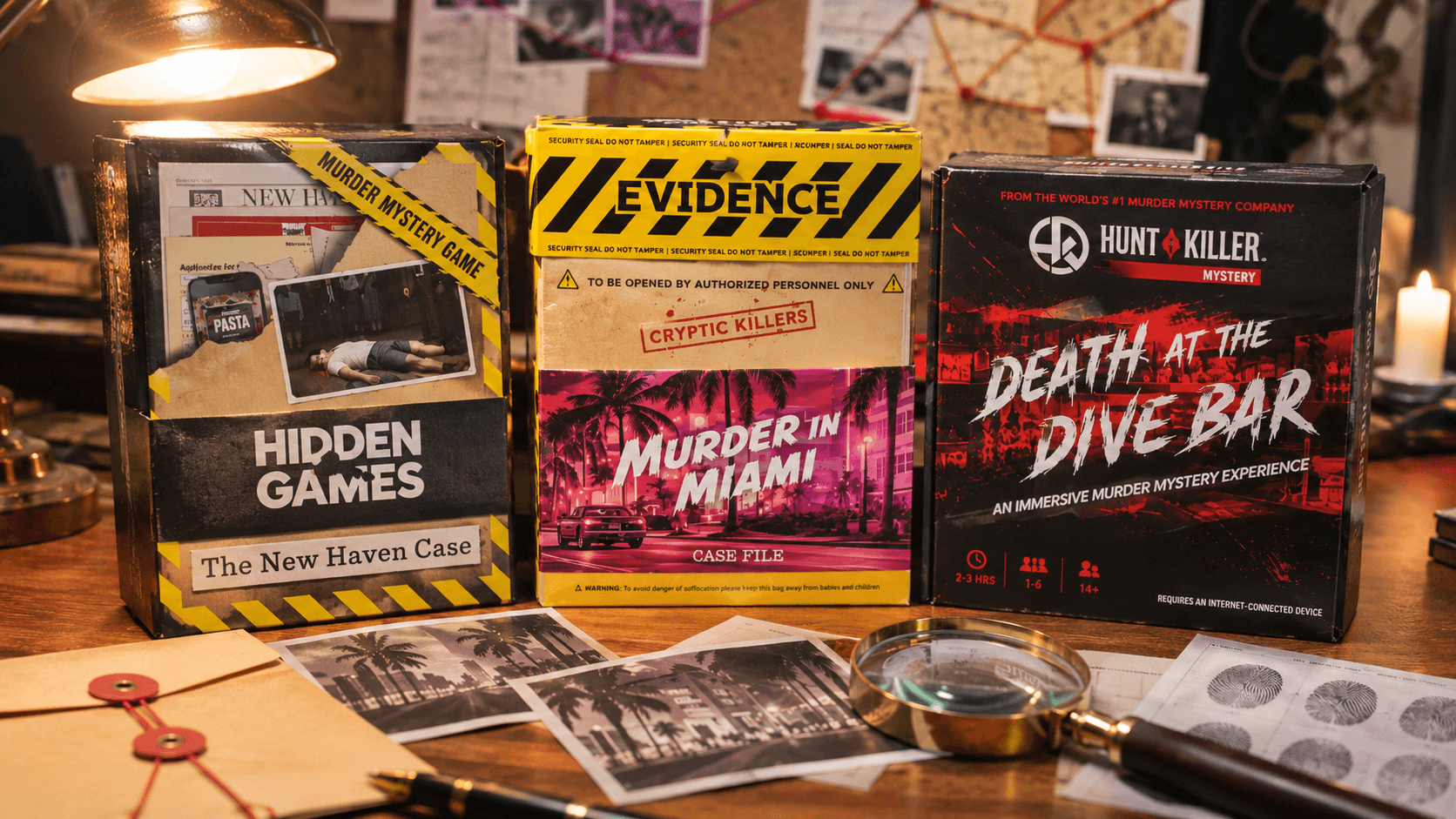
4. Hidden Games: The New Haven Case — Best Deep Collaborative Investigation
This one asks more of the table, but it also gives the table more to do.
The New Haven Case mixes physical evidence with calls, secret websites, profiles, chats and interviews. The official range is 1–6 players, with roughly 90–180 minutes of play.
The appeal is the feeling of investigating rather than simply solving a stack of paper puzzles. People can chase different leads, compare what they found and pull the threads back together.
That extra digital layer is also the reason I would not make it the universal first pick. It is still mostly a table experience, but it is less “phones away for the evening” than the box might initially suggest.
5. Cryptic Killers: Murder in Miami — Best When the Family Wants a Harder Case
Murder in Miami is the one I would save until the table has already proved it enjoys this kind of thing.
It is rated 4.5/5 for difficulty, runs around three hours and comes with 36 pieces of evidence. That is a real jump from Millionaire, not just a different story wrapped around the same challenge.
There is a useful distinction here: harder can mean more satisfying deduction, but it can also mean more chances for the group to get stuck in a confusing timeline or spend too long inside the online portal. Some player experiences mention that kind of friction.
So I like Miami as the “we want more” box, not the “let us see whether we even like these games” box.
6. Hunt A Killer: Death at the Dive Bar — Best Fuller Case in a Compact Session
Short does not always mean “starter version.” That is the reason Death at the Dive Bar survived the shortlist.
It is designed for 1–5 players and about 45–60 minutes, with an official difficulty of 2/5. Yet it still feels like a complete little case rather than a sample packet whose main job is to sell you the bigger game.
That makes it useful for the evening when everyone wants the detective-night feeling but nobody wants to donate the entire night to it.
I would choose it over Luna when you want more substance in roughly the same broad time window. I would not choose it because it is the cheapest route. The reason to buy it is the compact case, not value-per-minute arithmetic.
Tier 3: Useful for a More Specific Kind of Family
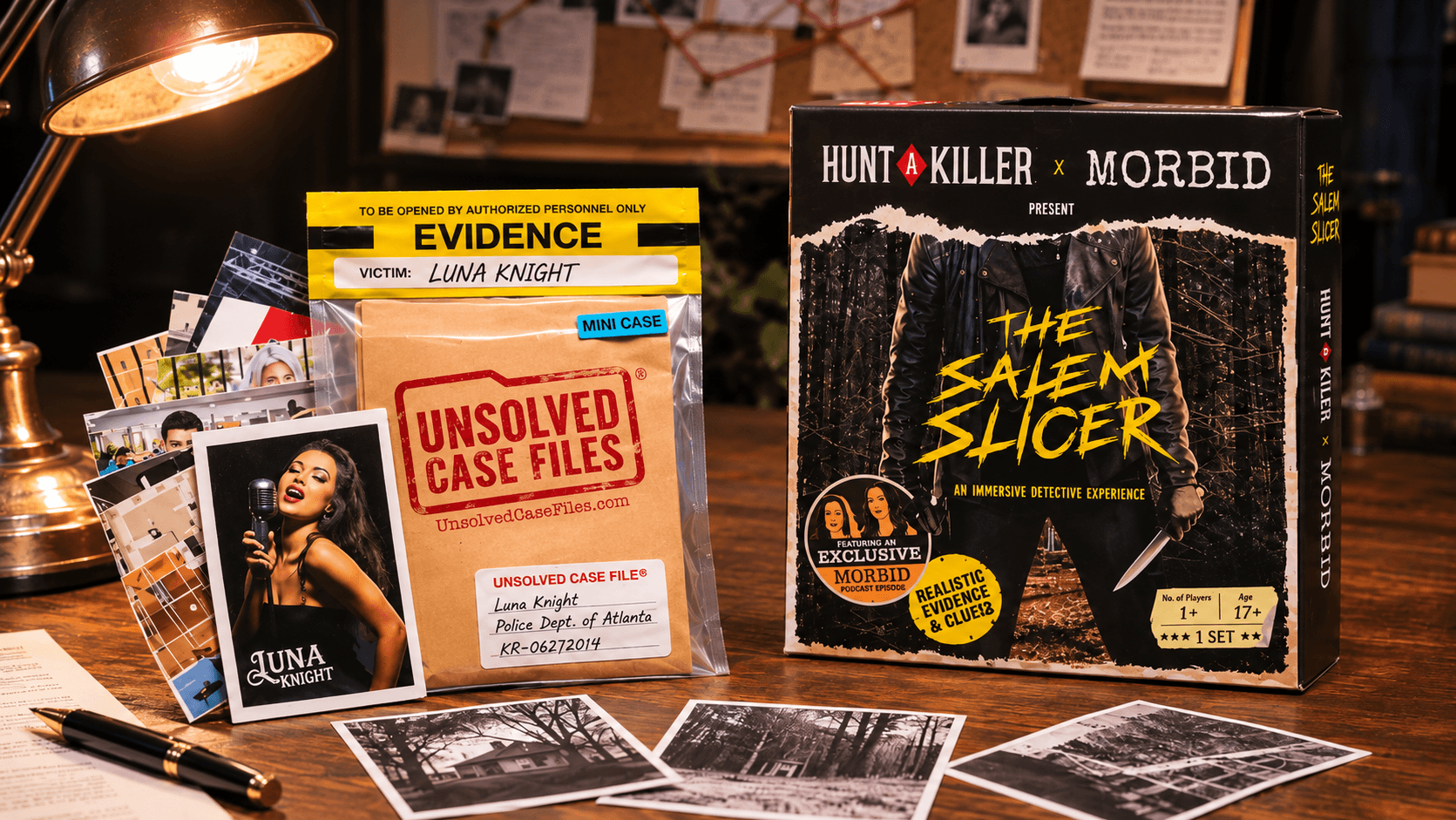
7. Unsolved Case Files: Luna Knight Quick Play — Best Simple Test Run
Luna Knight makes sense when the real question is not “Which full case is best?” but “Will we even enjoy sitting around a table doing this?”
It is a Quick Play / Mini Case for 1–4 players, around an hour, with 29 documents and photos plus online answer checking. The point is simplicity. You get the case-file rhythm without making the first attempt a long commitment.
Luna isn’t really the bargain option here. Its advantage is giving your family an easier, lower-commitment way to find out whether this kind of case night actually clicks.
Luna is the low-pressure test run. You still get the evidence-reading and deduction loop, just without asking the table to commit to a longer investigation. See Luna Knight Quick Play on Amazon →
8. Hunt A Killer × Morbid: The Salem Slicer — Best for a Darker True-Crime Night
The Salem Slicer is easy to solve compared with some of the games above. That does not make it the gentlest choice.
The official guidance is 17+, for 1–6 players, with roughly 90–120 minutes of play. Hunt A Killer describes the mechanics as easy but the subject matter as heavy. The case revolves around a serial killer and includes deliberately grisly evidence.
That is why this sits here rather than beside the beginner-friendly cases. The issue is not whether your family can understand the puzzles. It is whether everyone at the table actually wants that darker true-crime tone.
Salem is here for a different reason. The case is mechanically easier, but the material is much darker, making it a better fit for a family or older group that enjoys grim true-crime stories more than difficult puzzles. See The Salem Slicer on Amazon →

Pairings That Actually Make Sense
I would not turn this into a shopping basket just because two boxes can technically be bought together. A second case only earns its place when it gives the family a useful next step.
- Murder at the Movie Theater → Murder of a Millionaire: start with the easier 3/5 case, then move to the slightly harder 3.5/5 case.
- Death at the Dive Bar → Murder of a Millionaire: begin with a compact complete case, then move into a fuller two-hour investigation.
- Murder of a Millionaire → Murder in Miami: a clean progression from moderate challenge to a much harder 4.5/5 case.
- Harmony Ashcroft → The New Haven Case: move from document-heavy deduction into a more interactive investigation with calls, websites and digital clues.
- Luna Knight → a full case later: use Luna as the test run. If the table wants more, then choose something like Millionaire or Harmony Ashcroft.
For a Bigger Family Gathering
The player number on the box is useful guidance, not a law of physics.
Cryptic Killers officially supports up to 10 players on the cases here, which makes those boxes the easiest fit when more relatives have gathered around the table. Unsolved Case Files does not set a fixed maximum and says larger groups can split into teams.
The practical question is whether everyone can see enough evidence and have something to contribute. One person can take the timeline, another can compare statements, somebody else can handle maps or digital clues. That kind of natural division works better than forcing everybody to read the same sheet over one another’s shoulders.
If two teams want to race, give them the same case. Different cases introduce different difficulty levels, clue structures and solving times, which makes the competition mostly theatre.
Planning for a room full of guests instead of one family table?
Our Halloween Party Games for Adults guide compares games by what the room actually needs, including a focused cold-case option when a small group wants detective night.
What to Know Before You Buy
Most of These Are One-Time Experiences
Once the family knows who did it, the central mystery is gone. Think of these more like an escape-room night in a box than a board game you expect the same group to replay every month.
Mostly Off-Screen Does Not Mean Screen-Free
The table, papers and discussion do most of the work, but several cases use websites, answer portals, police inboxes or digital evidence. The New Haven Case leans furthest into that mix.
Age Guidance Is Only Part of the Decision
Most of the list is officially 14+. That does not mean a younger teenager can never participate, especially with parents at the table. It does mean the box is telling you something about reading level, subject matter or both. The Salem Slicer is the clearest exception because its official 17+ guidance reflects much darker content.
Harder Is Not Automatically Better
A family laughing over three competing theories is having a better case night than a family staring at a 5/5 puzzle in complete silence because nobody knows what to do next.
So Which One Would I Put on the Table First?
Murder of a Millionaire remains the default recommendation.
It gives you enough challenge to make the investigation feel worthwhile, without asking the family to begin with the hardest or longest case in the room.
If you want the gentler first step, choose Murder at the Movie Theater. If your table loves realistic documents and slow cross-checking, Harmony Ashcroft is the more interesting route.
The useful part is not that everybody suddenly becomes “good at family time.” It is that for an hour or two, the phones stop being the most interesting thing in the room because somebody has just found a contradiction in the witness statement.