The move from Yuanshan’s old town house to the sleek high-rise in Feiyue City was supposed to be a fresh start.
But in the rush of packed boxes and new beginnings, the Chen family left the ancestral tablet behind in the village storeroom.
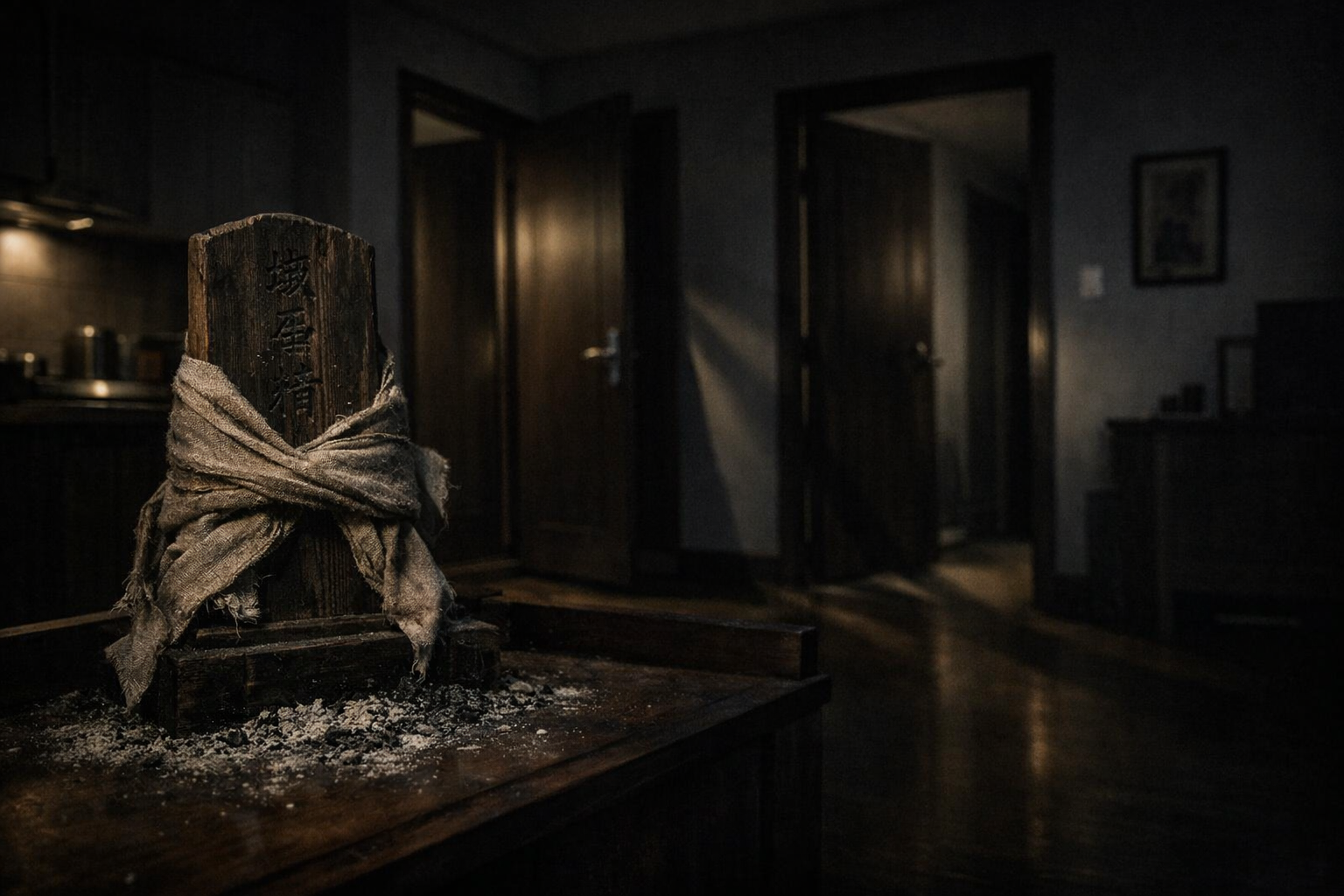
High on a dusty shelf, wrapped in faded cloth, it sat forgotten—no farewell words whispered, no final stick of incense burned. They told themselves it was temporary.
The first few days in the apartment were quiet. Then, the silence began to shift.
The apartment didn’t feel haunted—it felt occupied.
It started with traces of warmth.
Chen Fei would sit in the armchair, only to find the cushion faintly heated, as though someone had just stood up.
Beside the window, the heavy wooden rocking chair often moved gently in the still air, creaking beneath an invisible weight.
Then came the kitchen utensils.
Fei woke up at dawn to find a pair of wooden chopsticks resting neatly on his bedside table.
The next night, two porcelain rice bowls appeared on the floor of his daughters’ bedroom, arranged as if waiting for a meal.
He confronted his wife, mind racing.
There were only four of them in the house. Neither girl had brought the chopsticks into their parents’ room. Neither remembered seeing the bowls.
“It’s just stress,” his wife insisted, her voice tight, though her eyes darted nervously toward the shadows in the hallway. “New house, frayed nerves. We’re just misplacing things.”
Fei nodded, desperate to believe her.
But as he looked at the empty rocking chair moving in the corner, a cold truth settled in his chest: whatever they had neglected in Yuanshan had not allowed itself to be forgotten.
The Wrong Offering
A few nights after the bowls incident, the youngest daughter woke up sobbing.
Between frightened hiccups, she claimed a shadowy figure had been standing beside the shoe cabinet, softly whispering her name over and over.
Her mother hushed her too quickly. “Don’t say that,” she whispered, her eyes darting nervously toward the bare, empty altar space in the living room.
Panicked, Chen Fei assumed he had somehow offended the Di Ji Zhu—the household spirit guarding the new apartment.
Still failing to connect the disturbances to the ancestral tablet they had left in Yuanshan, he hurried to make amends.
He bought fresh flowers, ripe oranges, and lit three sticks of incense at the vacant altar. He bowed low, murmuring desperate apologies while burning stacks of joss paper to appease the home’s original keeper.
It didn’t work. In fact, it made things worse.
The spirit seemed angered by the wrong offering.
The next night, the air in the apartment turned suffocatingly cold, thick with the sharp scent of stale, ancient dust.
In the dead of night, the sound of heavy, bare footsteps echoed down the tiled hallway, dragging slowly from the front door toward the bedrooms.
When Fei went to the kitchen at dawn, every single cabinet door stood wide open.
Inside, the freshly bought fruit had rotted beneath thick black mold, while the flowers had crumbled into dry ash.
The faint, raspy whispering was no longer confined to the entryway. It now came from beneath Fei and his wife’s bed, repeating the family’s names in a voice dry as dead leaves.
The Breaking Point
The corruption began to bleed into their bodies and the apartment itself.
It started with scratches as thin as paper cuts across their arms and calves—shallow and painless, as though drawn with a blunt needle while they slept.
Every morning, dead mice lay neatly aligned along the kitchen wall. Motionless cockroaches formed a rigid border along the baseboards, their feelers pointed toward the family.
Dampness crept across the walls, tracing seams and cracks like spreading veins, filling the air with the stench of rotten wood and cold ash.
The breaking point came during dinner.
As the four of them sat in trembling silence, a heavy BANG echoed through the flat. The bathroom door slammed shut. Then came the bedroom doors—BANG, BANG—their locks turning from the inside with sickening clicks. One by one, every interior door sealed itself.
Panic exploded.
The children screamed as the family bolted for the exit. Chen Fei threw himself against the front door, but the lock would not turn, as though it had been welded shut.
Behind them, shadows gathered along the apartment walls.
Desperate, Fei threw his full weight against the door until the locking mechanism snapped with a sharp CRACK.
They sprinted down the hallway into the night, leaving everything behind, and huddled together in a nearby budget hotel room, too terrified to close their eyes.
At dawn, exhausted and desperate, Fei gathered his sobbing family.
“We’re going to the temple,” he declared, his voice trembling. He believed the temple deity’s sacred presence would purge whatever evil was tormenting them.
He still did not realize: no holy temple could protect a family from the wrath of the ancestors they had abandoned without farewell.
The Forgotten Tablet
After returning from the temple, a heavy, false sense of relief settled over the apartment.
But that night, the nightmare came.
Chen Fei dreamed of total darkness. At its centre stood their ancestral tablet, upright and stark.
Three crimson incense sticks burned before it, but the smoke did not rise—it pooled around the base like dark, suffocating water.
Fei snapped awake in the dark, gasping, unable to pull air into his lungs.
As his chest heaved, the truth struck him with cold, merciless force: the tablet. They had left their ancestral tablet in Yuanshan.
He didn’t wait for sunrise.
Leaving his family at the apartment, he drove back to the village alone as dawn broke.
The old storeroom door groaned against his weight, refusing to move until the rusted latch finally snapped. Inside, high on the dusty shelf, the wrapped tablet sat undisturbed.
But as Fei drew closer, his heart stopped.
Fresh ash covered the shelf beneath it, warm to the touch, with faint red embers still glowing underneath.
He stood frozen in the cold silence, staring at the sacred wood. A terrifying, cowardly thought surfaced: What if I just leave it here? What if I walk away?
Then, overwhelming shame surged through him, breaking his paralysis. He reached out to reclaim what his family had abandoned.
As his fingers gripped the carved wood, a chill shot up his arms.
When he lifted the ancestral tablet, it no longer felt like carved wood. It weighed more than memory allowed—heavy as stone, cold as ice, and pulsing with a terrible rage.
The Ancestral Tablet Returned
Back in the city, Chen Fei carefully unwrapped the tablet and placed it at the centre of the living-room altar.
He lit three sticks of incense, watching the smoke swirl upward. He bowed, deeply relieved, believing the nightmare was finally over.
He was wrong.
That afternoon, the thin scratches on his arms deepened, beading with blood.
His youngest daughter screamed whenever anyone tried to bring her near the living room, retreating to the furthest corner of the apartment.
His wife stood paralyzed in the kitchen doorway, staring at the altar as if the piece of wood might turn its face toward her. That night, she switched on every single light in the house, no longer bothering to pretend it was for the children’s sake.
In the bathroom, Fei washed his hands again and again beneath scalding water, but the sensation of hot ash remained against his skin.
He waited two terrifying days before seeking help.
The first temple’s caretaker flatly refused to set foot in the apartment. He listened to Fei’s story, turned pale, and gave him directions to an old exorcist—yet refused to write the man’s name on paper.
The old exorcist arrived after dark. Stern and weathered, he refused to sit down and remained rigid in the entryway.
Before the ritual could begin, Fei’s resolve collapsed, and the full truth spilled out of him. “I left it in the storeroom…” he whispered, his voice thinning into a pitiful crack. “We forgot them.”
The exorcist didn’t answer right away.
He slowly turned toward the altar’s glowing red lamps, his eyes widening with cold horror.
What the Ancestral Tablet Held

The exorcist exhaled slowly, his face grim. “Let me check. Pray it’s not what I think it is.”
He stepped carefully over the threshold, drawing a ring of grey ash around the ancestral tablet and placing yellow talismans at measured intervals.
Then, the tablet responded.
The ash circle split with a soft, sickening crack. A line of dark moisture seeped through the break, tracing a straight path toward the family.
A violent surge of air slammed into the exorcist, knocking him back several steps.
Fei’s wife flinched, but instinct took over—she seized both daughters and backed into the hallway.
The exorcist regained his footing, his voice remarkably level despite the terror in the room. “This is not your ancestor.”
Chen Fei gasped, his blood running cold. “What… what do you mean?”
“When you abandoned the tablet in the dark, your ancestors’ spirits departed,” the exorcist explained, his eyes fixed on the vibrating piece of wood.
“An empty vessel in the dark never stays empty. A malevolent entity—a hungry, wild spirit—found it. It fed on the traces your family left behind, followed your bloodline to Feiyue City, and waited. You didn’t bring your ancestors home, Mr. Chen. You brought home the thing that took their place.”
Fei stumbled back, horror choking him. “How do we fix this? How do we get rid of it?”
The exorcist reached into his robes and withdrew a heavy brass bell and a sealed jar of black ritual ink. “We can’t just throw it out now—it’s tethered to you. We need to seal it.”
No Seal Lasts Forever

The ritual was a quiet, suffocating war.
As the exorcist chanted, the room temperature plummeted, and the air grew heavy with the stench of copper and rot.
Invisible forces slammed against the walls until, with one final, agonizing shriek from the tablet, the entity was forced back inside.
The exorcist wrapped the ancestral tablet tightly in black silk, packed grey ash around it, and sealed the cloth with blood-red script.
He moved it to a forgotten storage facility on the outskirts of the city—a windowless vault for unclaimed ritual objects, where cursed things were sealed away and slowly erased from human memory.
Before leaving, the exorcist handed four red cloth charms to the family.
“Keep these on you at all times,” he instructed, his face drawn and pale.
“No seal lasts forever. If these charms ever turn black, it means the entity has broken free. Run immediately. They will protect you for only a few hours—use that time to find me.”
“Can’t you just destroy it once and for all?” Chen Fei begged, his voice trembling.
The exorcist shook his head gravely. “I can’t. Nobody can.”
“During the ritual, I realized it was never merely a hungry spirit. It feeds on human malice—hatred, envy, greed and cruelty. As long as those emotions exist, it cannot truly be destroyed.”
“It can only be contained. That is why I hid it where no family altar, living bloodline, or regular human presence can feed it.”
He looked at the traumatized family one last time. “You gave it a doorway once, Mr. Chen. Pray it never finds another.”
Related Stories
Some names are forgotten when families fail to bring them home. Others are washed away long before anyone notices they are gone.
In one remote village, a slow-moving river carried more than water. Each year, another name quietly disappeared from memory — until even the villagers themselves began to fade from the world.
The Name-Eating River That Slowly Erased Our Village
Some objects are sealed away. Others leave the damage behind in the rooms that held them.
Before the tablet was found in storage, another place had already learned what happens when something unfinished refuses to stay buried. In one operating room, the dead did not seek revenge—they sought correction.