Wei Jun first heard the Night Route rules beneath a flickering warehouse light, while somewhere in the darkness, a reversing forklift beeped like a failing heartbeat.
It was close to midnight at the logistics yard. Rainwater streamed from the parked trailers beneath the orange glow of the sodium lamps. The air was thick with diesel fumes, rotting cardboard, and the bitter smell of burnt instant coffee.
Drivers finishing their shifts stood beneath the loading bays, smoking quietly as rain rattled against the metal roofs above them.
“Overnight run?” one of them asked.
Wei Jun nodded as he scribbled his name across the manifest.
Medical supplies. Two cities. Double pay.
It was too much money to refuse.
Uncle Teo, the oldest driver on the roster, stepped into the light. His eyes were cloudy with age, but they fixed sharply on Wei Jun.
“Then listen to me, boy,” he said. “And remember the Night Route rules.”
Wei Jun glanced up from the manifest, wondering if he had heard correctly. “The… what? Since when do overnight runs come with rules?”
“You’re still new here,” Uncle Teo said. He stepped closer, his expression hardening. “This route is special. After midnight, the road belongs to something else. No matter what you see, you keep driving—unless the rules tell you otherwise.”
Wei Jun gave a quiet laugh. “Uncle, I’ve driven overnight plenty of times. A road doesn’t suddenly change because the clock strikes twelve.”
“That may be true for the other routes,” Uncle Teo said. “But this one is different.”
Rules for the Road After Midnight
Before Wei Jun could answer, the old man seized his forearm. His fingers closed with surprising strength.
“Between midnight and three,” Uncle Teo said, “you never stop for anyone waving you down. Even if they step into the middle of the road, you drive around them.”
Wei Jun’s smile weakened slightly. “Who would even be standing in the middle of the road at this hour?”
“Those who belong there,” Uncle Teo replied. “And if the cabin suddenly turns cold, keep your eyes ahead. Don’t look at the passenger seat.”
“Why? Someone might be sitting there?”
Uncle Teo ignored the question and continued.
“If the radio static clears and you hear a voice too clearly, switch it off. Don’t listen to what it says, and don’t answer—even if it knows your name.”
Wei Jun decided it was nothing more than an old driver’s superstition and tried to pull his arm free, but Uncle Teo held on.
“After two in the morning, watch the GPS. If it recalculates without you missing a turn, ignore it. Stay on the highway, no matter where it tells you to go.”
“All right,” Wei Jun said. “I understand. Now please let go—I’m already running late.”
“I’m not finished.”
Uncle Teo leaned closer. Wei Jun smelled stale tobacco and black coffee on his breath.
“If you pass the same landmark twice, don’t accelerate. Keep the truck at the same speed and wait until the road changes by itself.”
Wei Jun frowned. “How could I pass the same place twice without turning around?”
“You’ll know when it happens.”
The old man’s grip tightened.
“If every traffic light ahead turns green at once, slow down. They want you moving fast.”
“Who are ‘they’?”
Again, Uncle Teo gave no answer.
The Last Rule
“The last rule is the one that matters most. Watch your headlights. As long as they touch the asphalt, keep driving. But if the light stops falling on the road—if it shines forward and there is nothing there—stop the truck immediately.”
Wei Jun stared at him.
“On the highway?”
“Immediately,” Uncle Teo repeated. “Don’t move again until you can see the road.”
For several seconds, neither man spoke.
Then Wei Jun laughed and finally shook his arm free.
“You old-timers spend too many nights alone,” Wei Jun said as he climbed into the truck and shut the door before Uncle Teo could reply.
The engine started with a low mechanical growl.
Dashboard lights flickered awake around him, illuminating the manifest, the half-empty coffee cup in the holder, and the vacant passenger seat.
As the dashboard clock turned to 12:00, Wei Jun shifted the truck into gear and pulled away from the warehouse.
In his side mirror, Uncle Teo remained beneath the flickering light, watching as he drove out into the rain.
The Woman on the Road Shoulder
The highway bled into the darkness, swallowed by long stretches of industrial wasteland.
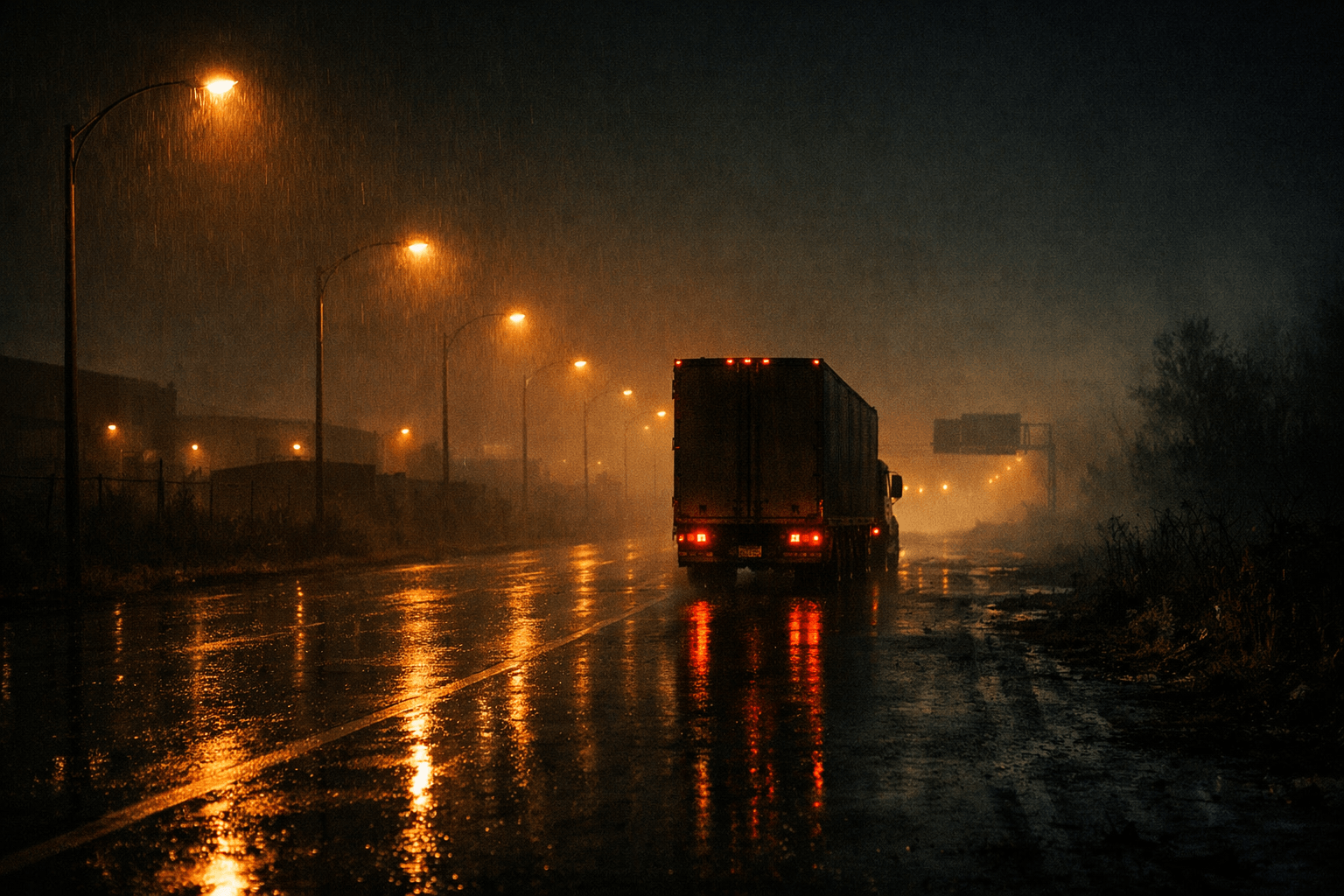
Rain had polished the asphalt into a black mirror while the wipers beat steadily across the windshield.
By 12:30 a.m., Wei Jun had settled into the hypnotic hum of the engine, and the logistics yard had become a fading memory.
Then his headlights caught her.
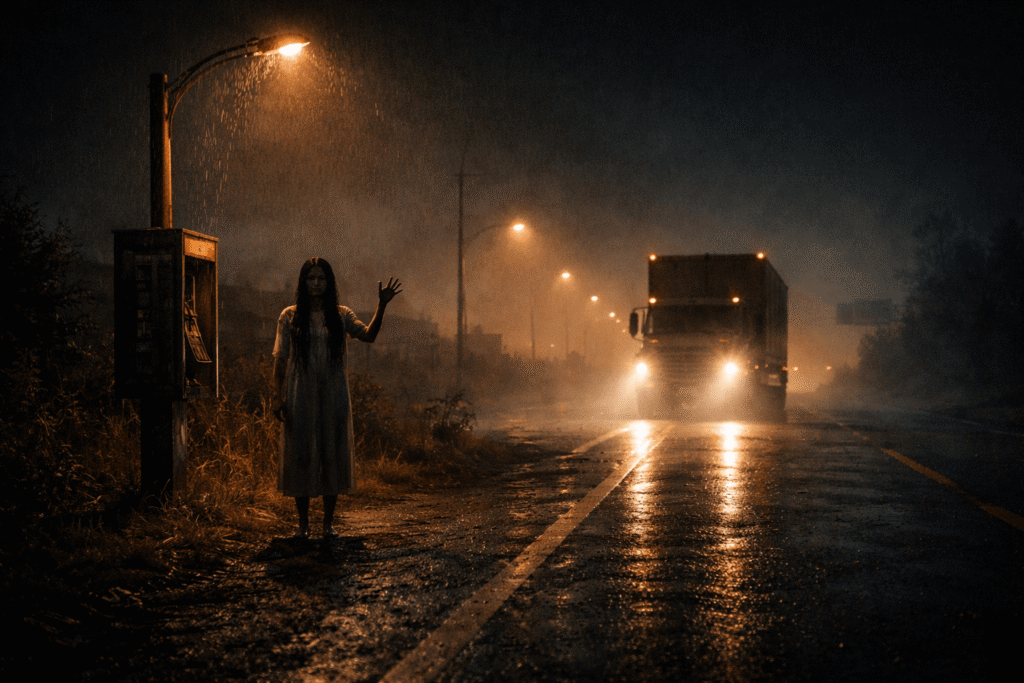
She stood on the narrow shoulder beside an emergency phone box. Her pale clothes clung to her body, shifting in the wind. Strands of matted hair covered her face.
As the truck approached, her arm rose with agonizing slowness, like someone who had been trying to signal for help for an eternity.
Rule one: Never stop for anyone between midnight and three.
Wei Jun’s knuckles whitened around the wheel. He stared straight ahead and drove past.
In the side mirror, her silhouette did not shrink the way it should have. She seemed to remain fixed in the darkness, anchoring the distance while the truck sped away.
“It can’t really be that sinister…” Wei Jun muttered. Uncle Teo had only just warned him about people standing along the road.
Wei Jun swallowed hard and forced himself to blame it on tiredness.
Twenty minutes later, after passing a service exit and navigating two sweeping bends, his headlights cut through the gloom again.
His breath caught in his throat.
It was her again. She stood beneath a crooked road sign, her arm lifting in the same slow, patient motion.
It was impossible. No one on foot could have reached this place before him.
Wei Jun pressed the accelerator, his heart hammering against his ribs. As the truck roared past, he risked a glance at the side mirror.
This time, her hand turned towards him, fingers curling into a stiff, welcoming wave.
Do Not Look Beside You
The cold didn’t drift in; it dropped like a guillotine.
It wasn’t the familiar, artificial chill of the A/C, but a frost that slipped beneath Wei Jun’s jacket and settled against his spine. His breath bloomed into a white cloud in the dim glow of the dashboard.
Instinctively, his hand darted toward the climate controls, only for his fingers to freeze in mid-air.
The plastic knob was gone.
It had snapped off two weeks ago; the system was completely dead. Yet, the temperature inside the cab was plummeting by the second.
The vinyl of the steering wheel grew slick and icy under his palms, his knuckles stiffening into rigid claws.
If the cabin turns cold, don’t look at the passenger seat.
Uncle Teo’s warning echoed in his ears, suddenly stripped of all superstition. It was a lifeline.
Wei Jun glued his eyes to the dark highway ahead, staring so hard his vision blurred. But the peripheral view was a cruel thing.
In the edge of his sight, the shadows on the passenger side began to warp.
The worn fabric of the empty seat groaned. The springs gave a slow creak, compressing under an invisible weight.
Then came the sound. The wet drip… drip… drip… of rainwater soaking into the upholstery.
A terrible smell filled the cramped cabin—the stench of river mud, decay, and drenched, rotting fabric.
Something was sitting right next to him now.
Wei Jun clamped his jaw shut to keep his teeth from chattering, his muscles screaming with the urge to turn his head.
He just kept driving, staring blindly at the dark highway ahead.
The Radio Remembers
The radio snapped awake with a violent pop that made Wei Jun jump.
A wall of harsh static filled the freezing cabin, scraping against his raw nerves. He reached out to punch the power button, but before his fingers could touch the plastic, the static vanished.
The silence that followed was absolute.
Then, a woman’s voice spoke through the speakers. It didn’t sound like a broadcast but like she was right behind him.
“Do you remember?”
Wei Jun slammed his palm against the dashboard, violently hitting the off button.
The digital display died.
The cabin plunged back into the heavy drone of the engine. He let out a ragged breath, his chest heaving and hands shaking so violently he could barely keep the truck centered in the lane.
If the radio voice sounds too clear, shut it off.
He followed the rule.
Then, the dead speaker in the passenger door whispered.
“Why did you leave me alone?”
It was wet, breathless, and laced with a terrifying familiarity.
Wei Jun’s heart seized.
He refused to look left, but in his peripheral vision, the dark shape in the passenger seat leaned closer. The smell of river mud and stagnant water grew overpowering, choking the air right out of his lungs.
Ahead, the highway stretched out like an endless black ribbon, devoid of cars, lights, or escape. He forced his eyes wide and pressed his foot harder against the accelerator.
The Road Without an Exit
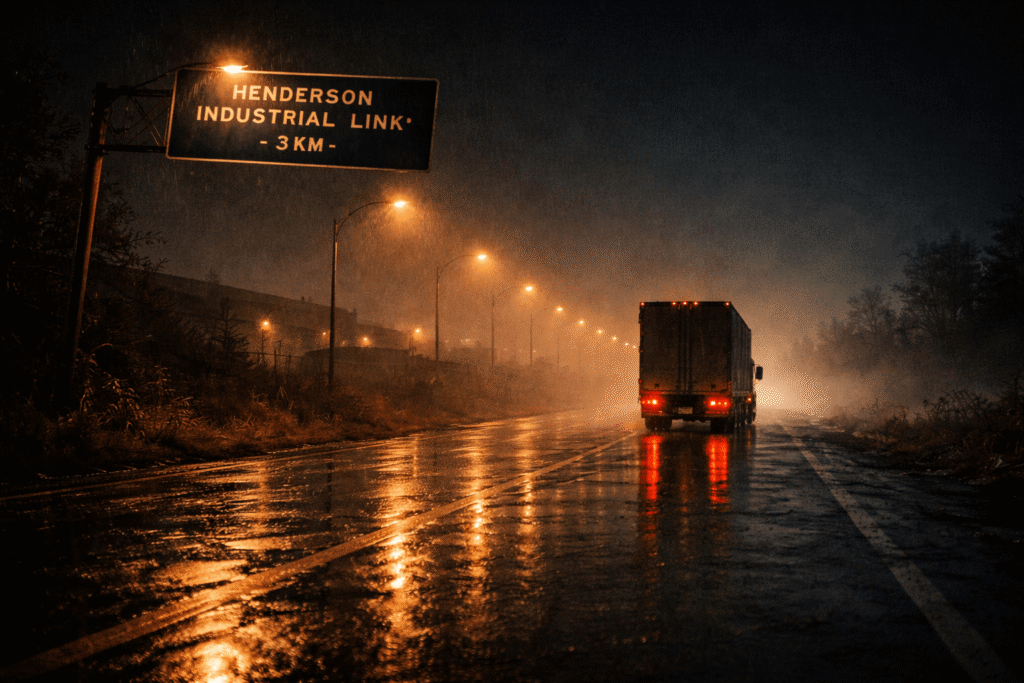
The sign loomed out of the dark: HENDERSON INDUSTRIAL LINK — 3 KM. The number three was marred by a rust-colored scratch, and the metal pole leaned slightly to the left, like a broken spine.
Wei Jun only noticed because of the dead moth trapped behind the reflective laminate.
Ten minutes later, his high beams hit it again.
Every detail matched. The realization stripped the moisture from his mouth and tightened a fist around his throat.
If you see the same road sign twice, don’t accelerate.
Uncle Teo’s warning flashed in his mind, but panic is a terrible navigator.
Fear slammed his foot down on the pedal. The heavy diesel engine roared, and the truck surged forward into the blackness.
He thought he could outrun it, but he was wrong.
The road wasn’t stretching ahead anymore; it was folding in on itself, a sickening loop of asphalt.
Adrenaline spiked. Wei Jun yanked the wheel, tearing down an unmarked exit ramp to break the cycle.
The truck rocked violently, tires screaming as he threw it into a sharp, desperate turn.
He floored the accelerator, scanning the horizon for a toll booth, a different landmark, anything.
The headlights swept over a sign emerging from the dark.
Wei Jun’s heart seized.
HENDERSON INDUSTRIAL LINK — 3 KM.
He drove across the median, but every curve, every straightaway, every desperate detour bled right back onto the same empty stretch of highway.
The Highway Chase
The headlights cut through the gloom, and there she was—standing in the middle of the lane.
Wei Jun shrieked, yanking the wheel. The massive truck groaned, swerving violently as he narrowly missed her.
He checked the side mirror, his chest heaving, but the asphalt behind him was empty.
But then, a shape detached itself from the shadows along the guardrail.
The woman stepped into the light, and she began to run.
At first, the motion looked human.
Then the cold reality hit him.
The truck was already moving at highway speed. Eighty miles an hour.
She wasn’t dropping behind. She was running right alongside the metal barrier, her feet barely brushing the gravel. Her wet, pale clothing clung to her frame, and her long hair streamed in the wind, yet her torso remained strangely, terrifyingly upright.
She wasn’t running so much as gliding, a broken doll pulled along by invisible strings.
And she was gaining on him.
“Get away!” Wei Jun screamed, flooring the accelerator.
The diesel engine roared in protest, the needle creeping past ninety-five, the cabin vibrating violently.
It didn’t matter. The distance between them shrank by the second.
Through the driver’s side window, the sound of her bare feet slapping the asphalt grew deafening over the roar of the engine—a wet, rapid slap-slap-slap-slap.
Slowly, her head turned toward him.
The matted hair parted, revealing a face gray and bloated from water, her eyes milky and wide.
Her arm lifted again, pressing a palm flat against the glass of his window.
The Road Remembered
The palm print on the glass vanished.
Wei Jun let out a ragged sob, thinking he had finally outrun her. Then, a rattling breath drawn right beside his ear shattered the illusion.
“Are you looking for me?”
The woman sat in the passenger seat. Her head was lowered, drenched hair obscuring her face, her hands resting quietly in her lap.
Wei Jun didn’t turn his head. He knew with absolute certainty that looking at her would be the last thing he ever did.
“You hit me last winter,” she said, her voice a hollow whisper. “Then you drove away.”
“No… please…” Wei Jun choked out, tears blurring his vision.
“Did you know I was still breathing?” The air grew so cold it burned his skin. “If you had stopped, if you had called for help, I would have lived. But you left me in the ditch to die.”
“I’m sorry! I’m so sorry!” he screamed, his voice cracking with useless remorse.
“I have waited on this road for so long,” she whispered.
“Until I finally found you.” Her head shifted with a wet crack, but Wei Jun refused to look.
Ahead, the highway abruptly ended at a familiar city intersection. The traffic light burned a mocking, solid red.
If every light turns green, slow down, the rule had said.
But this one was red, and Wei Jun realized he had no control. His legs were paralyzed, pinned down by an invisible weight. The truck accelerated toward the junction.
From the left, a car entered the intersection. The twin beams of its headlights blinded him, flooding the cab.
The last thing Wei Jun heard before the metal crumpled was her satisfied whisper: “We’re home.”
The Night Route Records
The crash made the papers for a single day before dissolving into the noise of newer tragedies.
A cargo truck had blown a red light at Westbridge Road and Alder at 2:13 a.m., crushing a ride-hailing sedan. The driver of the sedan miraculously survived with only cracked ribs.
In their reports, traffic investigators noted a strange piece of history: last winter, a hit-and-run victim had died in the ditch less than two hundred meters from that exact intersection.
The driver of the truck back then had never been found. Until now.
Doctors couldn’t explain how Wei Jun had escaped the twisted cabin with only minor bruises. They also couldn’t explain why his eyes remained rolled back, trapped in an unbreakable coma.
Back at the logistics yard, the supervisor stood before the shivering night shift workers, his face grim under the warehouse light.
“Wei Jun won’t be coming back,” he said flatly. “Ran a red light at Westbridge. He’s in a coma.”
The men dispersed in uneasy silence.
Retreating to his cramped office, the supervisor let out a heavy sigh. “Another one,” he muttered.
He picked up an ink stamp, slammed the word LEFT across Wei Jun’s employee photo, and slipped it into a faded manila folder labeled The Night Route.
Beneath Wei Jun’s file lay an older photograph.
It was a picture of Uncle Teo, his eyes milky and fixed on the camera. Across the old man’s chest was a faded red stamp: DECEASED—dated three years earlier.
Related Stories
Some drivers say certain late-night intersections remember every accident that happened there.
One ride-hailing driver discovered that the system sometimes sends passengers to Westbridge Road & Alder—even when no one requested the ride.
And sometimes the rating it gives you afterward isn’t possible.
If Your Ride-Hailing Rating Goes Above Five
Some who never leave the road are not lost.
They are moved somewhere that knows how to take them in—where everything is counted and nothing is allowed to leave unfinished.