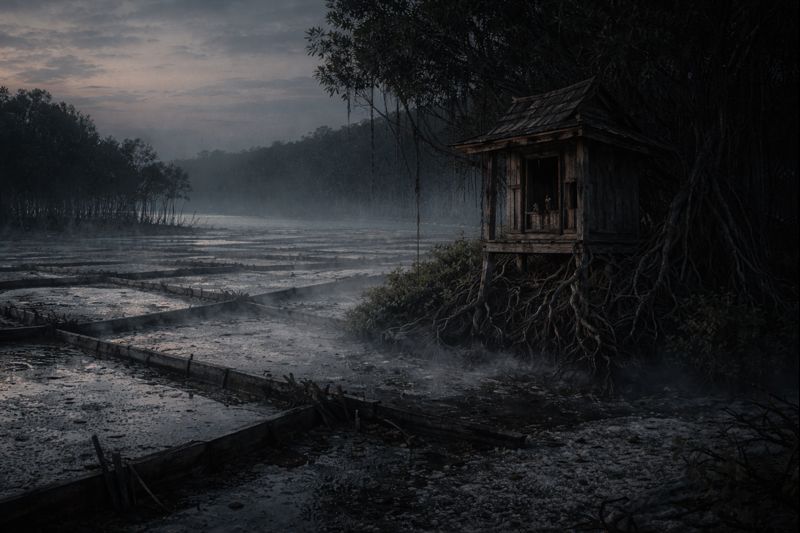
We live in a small village wedged against the water, where life revolves entirely around the river. It feeds us, carries our nets, and washes our dead.
Mapmakers call it the Astra River, but the villagers whisper another name: the Name-Eating River.
As a child, I thought the name belonged to a dark bedtime story meant to keep us from drowning.
I was wrong.
The river coils through our valley with the patience of something waiting to be fed.
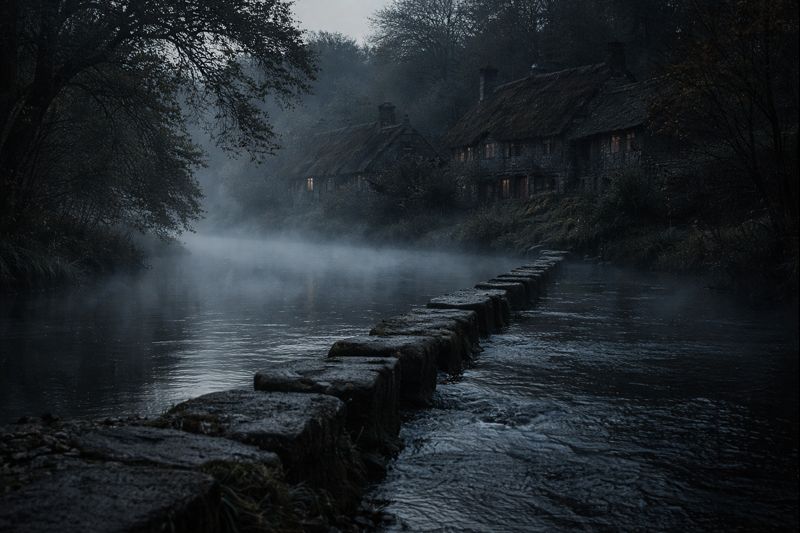
Every morning, a thick, suffocating mist clings to its glassy surface. No one steps onto the crossing stones without paying the toll.
One by one, villagers kneel at the muddy bank, press their lips to the freezing water, and whisper their true names into the dark current.
Most reach the opposite bank shaken but unchanged. Lately, however, the river has begun taking more than sound.
Old Thomas crossed on Tuesday. He bent over the water, gave it his name, and stepped onto the slippery stones.
Halfway across, he froze.
He pressed a trembling hand to his throat, his mouth opening and closing in silence.
When he reached the far bank, he stared in horror at his own work-worn hands. He couldn’t remember who they belonged to.
By afternoon, he didn’t recognize his own wife.
The river doesn’t swallow bodies. It hollows them out, leaving something behind that still walks, works, and eats—but no longer knows why.
Yesterday, my mother could no longer remember her middle name.
Today, I knelt at the edge. Cold mist wrapped around my ankles as I lowered my mouth towards the current and whispered my name.
Something beneath the surface whispered back—and it sounded hungrier than yesterday.
When the River’s Greeting Became Law
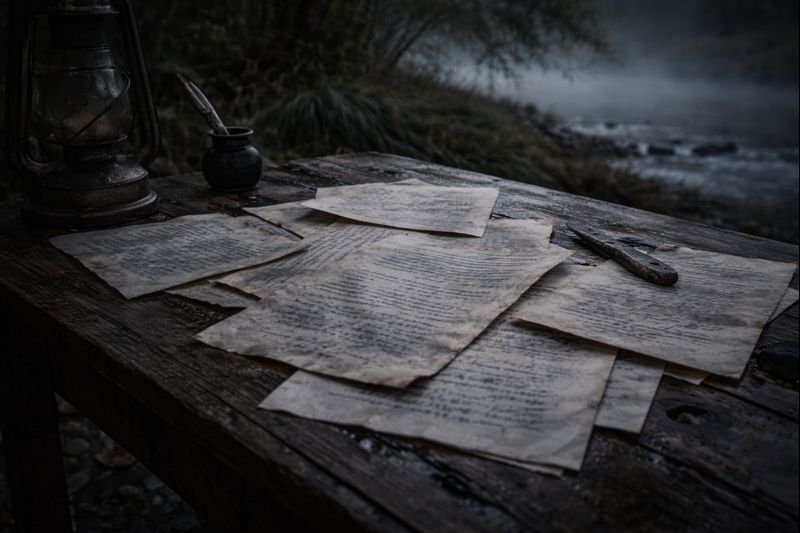
As I listened to the voice beneath the surface, I remembered what my grandmother had told me about the earliest names offered to the river.
Long before the Astra River appeared on any map, violent surges drowned neighbouring settlements while our banks remained untouched.
The elders believed the water recognised us. Whispering your name was once an offering of respect—a greeting freely given, not a toll demanded.
Then the water grew greedy, and what had begun as a greeting hardened into law.
Always whisper.
Never speak your name while the river can still hear you.
And never cross after dark.
When the children asked why, the elders looked towards the river and pretended not to hear.
When the Names Began to Break
Then the river began breaking down the names it took, and at first, the damage was easy to dismiss.
Handwriting warped until signatures no longer resembled the names given at birth.
Our neighbour greeted a friend of twenty years, then fell silent when asked to introduce himself, his fingers scraping desperately across his lips as though his own name had become trapped beneath them.
Soon, laughter became rare, replaced by long silences as people reached for familiar memories and found nothing waiting for them.
When I returned home from the river, I tried to write my own name on a scrap of paper.
Halfway through, my fingers locked around the pen. The ink thickened beneath the pen, black and tar-like, refusing to follow the final strokes.
The second half of who I was simply refused to be written.
It was gone.
We don’t talk about what we’re losing anymore because the river has always listened closely when we speak of what it has taken.
We simply cross faster now, heads lowered and hands pressed to our throats. Whenever we give the river our names, voices stir beneath the mud—thousands of them, each still trying to remember whom it once belonged to.
The Day the River Took More Than Names
My cousin Mara crossed late one afternoon. The light was still strong, but she hovered at the muddy bank, paralysed.
When she finally knelt to pay her toll, her whisper sounded wrong—drawn out and wet, like air leaking from a drowning lung.
She stood up slowly, her fingers pressed flat against her windpipe. “Did I… always say it that way?”
By evening, her hands had forgotten how to write her own name.
She held a pen above a blank sheet of paper, frowning at her trembling fingers, before letting out a soft, hollow laugh. The page remained empty.
Then the river began devouring her piece by piece.
First went the small things: the baker’s name, the turn by the well. Then she looked at her own brother, blinked, and called him “you.”
By Friday, every face had become a featureless mask to her.
Finally, she turned to me—her lifelong shadow—and waited politely for a stranger to tell her who I was.
I ran to the elders, desperate and shouting for an answer.
What the River Was Putting Back
They didn’t comfort me. They didn’t even look up.
Their eyes were glassy, fixed on the floor as though they were trying to remember the names of their own children.
“If we stop feeding it our names,” the head elder rasped, his voice a dry rustle of dead leaves, “the river will stop taking only the names… and start taking the flesh.”
He slowly pulled back his sleeve.
Beneath his skin, the veins were neither red nor blue. They were thick, black, and fluid, writhing beneath the flesh like miniature currents.
The river hadn’t just taken his name—it was filling him from the inside, patiently replacing his blood with dark, stagnant water.
No one asks what the river will choose next. The answer is already inside us. This is no longer a village—only cattle waiting to drown from within.
Join Us

That night, I couldn’t sleep. The silence in the village wasn’t peaceful—it was heavy and suffocating, like being buried beneath wet silt.
From my window, I watched Mara walking towards the bank. She moved with a jerky, unnatural rhythm, like a puppet tugged by unseen strings. I scrambled out into the damp cold and ran after her, calling her name.
She didn’t turn. She couldn’t. “Mara” was only a dead sound to her now.
She stood at the edge of the Astra River, grey mist curling around her knees. But she didn’t kneel. She didn’t whisper. She had nothing left to give.
I reached for her arm, but the moment my skin touched hers, I recoiled. She was freezing—hard and slick as river stone. Beneath her skin, black currents writhed through her neck and crept towards her face.
Then her mouth opened.
It didn’t sound like Mara. It sounded like a thousand wet, gargling throats whispering in unison—a chorus made from every name the water had ever swallowed.
“Join us,” the river rasped through her lips.
Her eyes rolled back until they were entirely black, as though filled with stagnant water. Slowly, agonisingly, she stepped forward—not onto the crossing stones, but straight into the pitch-black depth. She didn’t splash. She sank at once, like an anchor dropped into a well.
A single ripple spread outward and slapped cold against my bare feet.
As I stumbled backwards, weeping, a dark liquid began to seep from beneath my fingernails. A slow black drip. The river was no longer waiting at the bank. It was awake inside me now, and it was demanding its next meal.
When the River Came Ashore
I clawed at my hands, smearing the black ooze across my skin, but it would not come away. It sank back into my pores and pulsed in time with my racing heart.
I am… I am…
Panic choked me.
I tried to speak my own name—to anchor myself to the earth beneath my feet—but my tongue felt thick and heavy as clay.
The first syllable dissolved in my throat before it could reach the cold air.
Mara’s face appeared beneath the black water. She wasn’t drowning. She floated just below the glassy surface, her pale face stretched into a terrible, serene smile.
Her lips moved, and the voices of the lost travelled through the water—my grandmother’s cracked voice, old Thomas’s gruff timbre, and the thin cries of a hundred forgotten children.
They chanted the names they had surrendered over and over, their voices swelling into a deafening, wet roar.
The black fluid beneath my fingernails surged towards the river, jerking my arms towards the deep. The river wasn’t merely taking my identity now; it was using the water inside my veins to reel me in.
“No,” I choked, spraying flecks of black water across the mud.
I turned and ran back towards the dark huts of the village. But as I stumbled down the dirt path, I saw them.
Every front door stood wide open.
Dozens of figures shuffled out into the fog—my neighbours, my friends, the elders.
They moved in perfect, synchronised silence, their arms hanging limp as black tears trailed down their expressionless faces.
None of them were whispering anymore. They didn’t need to.
The Astra River had stopped waiting at the shore. It was marching into the village through the veins of its victims, coming to collect what remained of us.
The Hunger Inside Me
I raced into my cottage, slammed the wooden door, and shoved the iron bolt into place.
My chest heaved, each breath burning like swallowed ash.
Outside, a hundred bare feet dragged through the mud in perfect unison.
Scrape. Drag. Scrape.
They weren’t knocking. They were leaning their waterlogged bodies against the wood, their combined weight bowing the thick oak inward.
I collapsed against the table, desperately searching for anything to anchor my mind.
Who am I?
I grabbed a rusted paring knife and held it over my forearm. If the river lived in my blood, I would bleed it out.
I dragged the blade across my flesh.
No red spilled.
Only thick, pitch-black water seeped from the wound, smelling of rotting reeds and stagnant mud. It didn’t drip down my wrist—it curled upwards, crept towards the knife, and swallowed the steel beneath a crust of black ice.
Pain didn’t come. Only a deep, numbing cold that crept straight into my bones.
“Open,” a voice gargled from the other side of the door. It wasn’t a single neighbour. It was all of them, speaking through one waterlogged throat. “The river does not like to wait.”
The door hinges shrieked as the wood began to split.
Dark water surged beneath the threshold, pooled around my feet, and tightened around my ankles like liquid chains.
My memories were liquefying. My mother’s face melted into a smear of grey. The memory of my childhood home collapsed into wet mud.
The last untouched piece of who I was dissolved into the dark tide.
The door splintered and finally gave way. Fear was gone. Only emptiness remained.
And hunger.
The Ritual Is Over
Black water burst through the shattered doorway, carrying the hollowed villagers into the room. There was nowhere left to run.
I didn’t run. I couldn’t.
The dark water inside my veins surged towards the incoming tide and bound me to the chorus.
I sank to my knees as cold, waterlogged hands closed around me—not to tear me apart, but to pull me into their mass.
As the river forced itself down my throat, the last fragment of my human mind dissolved. The person I had once been vanished into the black water.
Together, we became a single crawling mass of stolen flesh and black water, dragging ourselves back towards the riverbank.
We spilled into the icy current and sank into the lightless mud, where thousands of forgotten faces stared from the silt, their open mouths releasing endless streams of bubbles.
Now the village stands empty.
The huts rot in the perpetual fog, doors swinging on rusted hinges. The fields lie dead, untended, waiting.
Mapmakers will still print Astra River across their maps. Travellers will still stumble upon our silent banks and mistake the stillness for peace.
At the water’s edge, the crossing stones will seem harmless beneath the cold mist.
We wait just beneath the glassy surface, staring up through the grey mist with pitch-black eyes. We hear their footsteps on the mud.
And the moment they step into the current, we reach up from the dark to take everything.
Related Stories
Some names fade slowly from memory. Others are taken the moment you answer them.
Deep in a mountain forest, there is a rule locals refuse to break: if something calls your name after dark, you must never reply — because the voice may not belong to the living.
Forest Whispers: The Rule You’re Not Meant to Answer
But some names disappear for a quieter reason. They are simply never brought home.
In one family shrine, an empty space waited where an ancestral tablet should have been — and without it, the name it carried slowly slipped out of the world.